
Despite Prime Minister Viktor Orbán’s repeated attempts to cloak his parliamentary pre-election campaign, scheduled for April, in pacifist rhetoric, it is increasingly difficult to sustain the claim that Hungary remains outside the war unfolding on the European continent. In reality, Orbán’s Hungary has already entered the conflict—not through direct military engagement, but by aligning itself politically, economically, and strategically with the Kremlin against the European Union and the broader Western community.
Crucially, Orbán’s narrative of “peace” does not serve to distance Hungary from war; rather, it functions as a domestic political tool designed to mask Budapest’s active participation in Russia’s confrontation with Europe. While Hungarian voters are warned about the dangers of being “dragged into a war with Russia,” Orbán has, in practice, positioned Hungary on Russia’s side in its systemic conflict with the EU. The result is a paradoxical situation in which Hungary portrays itself as a victim of Western escalation while simultaneously undermining Western cohesion from within.
This pattern is not without historical precedent. Hungary has previously aligned itself with forces hostile to Europe’s collective security. During the Second World War, the regime of Ferenc Szálasi chose alliance with Nazi Germany, a decision that ultimately led to national catastrophe. Today’s circumstances are different in form but not in logic: once again, Budapest is betting on an external revisionist power to advance its own ambitions at the expense of European stability.
Orbán’s strategy is particularly corrosive because it combines material dependence on the European Union with political subversion of its institutions. While Hungary remains a major beneficiary of EU financial transfers, Orbán simultaneously works to obstruct common European policies, dilute sanctions against Russia, and weaken EU foreign and security policy consensus. This dual-track approach—extracting resources from Brussels while undermining Brussels’ strategic coherence—constitutes a form of internal sabotage rather than mere dissent.
Support for the Kremlin is not purely ideological. It is rooted in concrete geopolitical calculations. Orbán appears to operate on the assumption that a Russian victory, or at least a strategic weakening of the European order, would reopen the question of borders and minority claims in Central and Eastern Europe. Within this worldview, Moscow’s success would create conditions under which Hungary could pursue territorial revisions involving western Ukraine, as well as parts of Romania and Serbia, under the pretext of protecting ethnic Hungarians. Such expectations align closely with the Kremlin’s broader objective of dismantling the post-Cold War European security architecture.
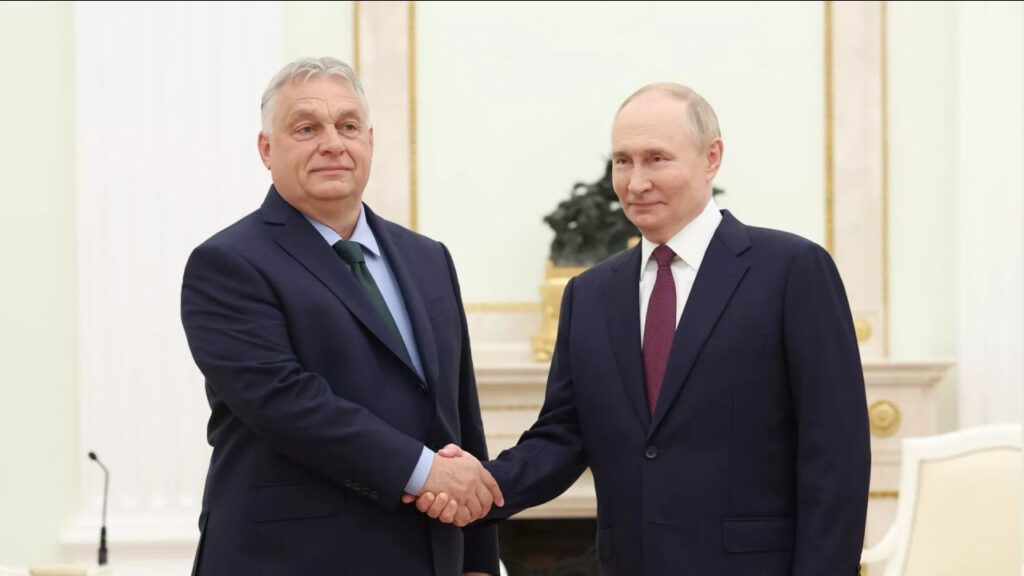
In practical terms, Hungary has already become an operational asset for Russia inside the EU. Budapest provides political cover for Moscow, serves as a channel for sanctions erosion, and enables Russian influence operations under the guise of sovereignty and neutrality. Hungary’s role in the energy sector is particularly significant: long-term dependence on Russian hydrocarbons strengthens Moscow’s leverage in Central Europe and undermines collective European energy security strategies.
As a result, Hungary has evolved into one of Russia’s key influence hubs within the European Union. From this position, Budapest actively shapes debates on EU enlargement, Ukraine, and relations with Russia in ways that reflect Kremlin interests rather than those of a united Europe. This does not merely slow European decision-making; it distorts it, embedding Russian strategic preferences into EU processes from the inside.
In this sense, Orbán’s Hungary is not a passive bystander seeking peace, but an active participant in a hybrid war against Europe. The battlefield is institutional rather than military, and the weapons are vetoes, disinformation, economic dependency, and political obstruction. The long-term consequence is a weakened European Union—precisely the outcome Moscow seeks, and one that Orbán appears willing to facilitate for his own political and strategic ends.
Hungary’s participation in the war on the European continent must be understood beyond the narrow definition of kinetic military engagement. Modern conflict—particularly as waged by Russia—relies on hybrid warfare, where political obstruction, economic leverage, institutional sabotage, and information operations substitute for tanks and missiles. By these criteria, Hungary under Viktor Orbán is not neutral; it is an active participant on Russia’s side.
Participation in Hybrid Warfare Against the European Union
Russia defines the European Union not as a civilian bloc but as a strategic adversary. Consequently, actions that undermine EU unity, decision-making capacity, and security resilience directly support Russia’s war effort. Hungary’s systematic obstruction of EU policies—particularly on sanctions, military aid to Ukraine, and enlargement—functions as force multiplication for the Kremlin.
By using veto power and procedural delays, Budapest degrades the EU’s ability to act collectively, mirroring Russian objectives without deploying military force. In strategic terms, this constitutes participation in a non-kinetic battlespace, where institutional paralysis replaces battlefield defeat.
Weaponization of Alliance Mechanisms
Hungary’s membership in the EU and NATO grants it access to sensitive decision-making structures. Rather than strengthening collective defense, Orbán exploits these mechanisms to extract intelligence, slow responses, and amplify Russian narratives within allied forums.
This behavior transforms Hungary from a passive ally into an internal disruptor. In military doctrine, enabling an adversary’s freedom of action—especially from within a coalition—meets the threshold of hostile involvement. Hungary’s actions reduce the effectiveness of European deterrence, thereby assisting Russia’s strategic campaign.
Economic Warfare Through Sanctions Erosion
Economic pressure is a core component of the war against Russia. Hungary’s persistent efforts to dilute, delay, or carve out exemptions from sanctions—particularly in the energy and financial sectors—directly weaken this pressure.
By maintaining privileged energy arrangements with Moscow and advocating for “pragmatic” engagement, Budapest undermines Europe’s economic front. This behavior aligns with Russia’s strategy of fracturing Western resolve and sustaining its war economy. In effect, Hungary acts as a logistical and political rear area for Russia’s economic warfare against Europe.
Energy Dependency as a Strategic Weapon
Hungary’s deliberate deepening of dependence on Russian gas and nuclear energy—despite viable diversification options—should be understood as a strategic choice rather than an economic necessity. Moscow treats energy not as a commodity but as an instrument of coercion.
By anchoring Central European energy infrastructure to Russian supply chains, Hungary strengthens Russia’s leverage over the region and obstructs collective European energy security initiatives. This directly supports Russia’s broader war aim: to retain strategic control over Europe’s economic vulnerabilities.
Information Warfare and Narrative Alignment
Hungarian state-aligned media consistently echoes Russian framing of the war:
- portraying Ukraine as responsible for escalation,
- depicting Western military aid as reckless,
- framing EU policies as warmongering, and
- presenting Russia as a rational actor defending its interests.
This narrative synchronization is not incidental. Information warfare is a recognized domain of modern conflict, and Hungary functions as a domestic amplification node for Kremlin messaging within the EU. Such alignment contributes to social polarization, war fatigue, and skepticism toward European solidarity—key Russian objectives.
Facilitation of Russian Influence Operations
Hungary provides a permissive environment for Russian diplomatic, intelligence, and business activities. Budapest’s resistance to counterintelligence cooperation and reluctance to expel Russian operatives contrasts sharply with the actions of most EU states following Russia’s invasion of Ukraine.
In security terms, this enables Russia to maintain operational depth inside the EU. A state that knowingly allows adversarial intelligence operations to function on its territory during wartime cannot credibly claim neutrality.
Strategic Alignment With a Revisionist War Outcome
Orbán’s long-term calculus appears to assume that a weakened or fragmented European order would benefit Hungary politically and territorially. His rhetoric on ethnic minorities abroad, combined with historical revisionism, aligns with Russia’s vision of a post-war Europe defined by spheres of influence rather than rules.
By betting on Russian success—or at least European failure—Hungary positions itself as a political stakeholder in Russia’s war outcome, rather than as an impartial actor seeking peace.
Redefinition of “War” in the 21st Century
Finally, Hungary’s role must be evaluated within the contemporary understanding of warfare. Russia’s conflict with Europe is not limited to Ukraine; it is a systemic confrontation involving institutions, economies, narratives, and alliances.
Within this framework, Hungary is already at war—not with tanks, but with vetoes; not with artillery, but with energy contracts; not with soldiers, but with disinformation and institutional sabotage. Its alliance with Russia does not contradict this reality; it explains it.
Hungary’s alignment with Russia does not place it outside the war—it defines the manner in which Hungary participates in it. By acting as an internal disruptor within Western institutions, facilitating Russian economic and informational warfare, and obstructing Europe’s collective defense, Budapest has crossed the threshold from dissent to strategic hostility.
In modern conflict, neutrality is defined by behavior, not declarations. By that standard, Viktor Orbán’s Hungary is not a neutral state seeking peace, but a hybrid ally of Russia engaged in a non-kinetic war against Europe.
Hungary’s Refusal to Support Ukraine and the Consequences for Ethnic Hungarians
Strategic Non-Assistance as a Political Choice
Viktor Orbán’s refusal to provide military assistance to Ukraine is presented domestically as a policy of restraint intended to “keep Hungary out of the war.” In practice, however, this position carries direct and measurable consequences—particularly for ethnic Hungarians living in western Ukraine, including Transcarpathia (Zakarpattia). By denying Ukraine defensive support while benefiting from EU and NATO security guarantees, Hungary contributes to the prolongation and intensification of the war on Ukrainian territory, where ethnic Hungarians are citizens of the Ukrainian state and subject to mobilization.
Ethnic Hungarians as Ukrainian Citizens Under Wartime Mobilization
Ethnic Hungarians in western Ukraine are Ukrainian citizens and, under conditions of full-scale war, are legally mobilized into Ukraine’s armed forces alongside other citizens. As Russia continues its war of aggression, these individuals are exposed to direct combat risks on the front lines. Their vulnerability is not hypothetical; it is a structural consequence of a prolonged, high-intensity conflict.
Hungary’s policy choices do not remove ethnic Hungarians from the battlefield. On the contrary, by weakening Ukraine’s defensive capacity through obstruction of military aid and sanctions, Budapest indirectly increases the duration, scale, and lethality of the war—thereby increasing casualties among all Ukrainian soldiers, including ethnic Hungarians.
Causal Chain: From Non-Support to Human Losses
The causal mechanism is straightforward:
- Orbán blocks or undermines military assistance to Ukraine, both bilaterally and through EU mechanisms.
- Ukraine’s defensive capabilities are weakened, increasing battlefield pressure and prolonging hostilities.
- Mobilized Ukrainian soldiers face higher casualty rates due to equipment shortages, delayed aid, or insufficient air and artillery defense.
- Ethnic Hungarians serving in Ukrainian units are exposed to the same increased risks, resulting in avoidable losses.
While Orbán publicly claims to act in the interest of ethnic Hungarians abroad, his policies objectively worsen their security situation by contributing to conditions in which they are more likely to be killed or wounded.
Instrumentalization of Ethnic Hungarians for Political Messaging
A critical contradiction lies at the heart of Orbán’s policy. Ethnic Hungarians in Ukraine are invoked rhetorically as a justification for distancing Hungary from Kyiv, yet in practice they are treated as expendable within Orbán’s broader alignment with Russia. Rather than advocating for Ukraine’s rapid military strengthening—which would shorten the war and reduce casualties—Budapest prioritizes political alignment with Moscow.
This instrumentalization turns ethnic Hungarians into a political shield rather than a protected community. Their suffering is used to argue against aid to Ukraine, even as the absence of such aid contributes to continued fighting that places them in harm’s way.
Moral and Political Responsibility
It would be inaccurate to claim that Orbán directly orders violence against ethnic Hungarians. However, in modern warfare, responsibility is not limited to those who pull the trigger. Political leaders who knowingly pursue policies that increase the probability of lethal outcomes for a specific population group bear indirect responsibility for those outcomes.
By opposing Ukraine’s military defense while fully aware that ethnic Hungarians are mobilized into Ukrainian forces, Orbán accepts and effectively normalizes their losses as collateral damage of his geopolitical strategy. In this sense, his policy does not protect ethnic Hungarians—it structurally contributes to their continued exposure to lethal risk.
Strategic Paradox: Alignment With Russia Harms the Claimed Constituency
Orbán’s alignment with Russia creates a paradox that undermines his own stated objectives. A Russian victory or prolonged war does not guarantee improved conditions for ethnic minorities in Ukraine; instead, it threatens the territorial integrity, legal protections, and demographic stability of regions where ethnic Hungarians live.
By weakening Ukraine rather than strengthening its ability to defend itself, Hungary’s policy increases human losses among the very population Orbán claims to defend, while advancing Russian war aims that are historically hostile to minority rights and local autonomy.
Hungary’s refusal to support Ukraine militarily does not insulate ethnic Hungarians from war—it exposes them more deeply to its consequences. Through deliberate non-assistance and obstruction, Orbán contributes to the prolongation of a conflict in which ethnic Hungarians, as Ukrainian citizens, are mobilized and killed.
Thus, while Orbán frames his policy as pacifist and protective, its real-world effect is the opposite: it stimulates conditions that lead to continued combat and preventable losses among ethnic Hungarians in Ukraine. In strategic and moral terms, this represents not neutrality, but complicity through omission.
Use of “National Survival” Rhetoric
Szálasi
Szálasi framed Hungary’s alliance with Nazi Germany as a matter of national survival, portraying the war as existential and unavoidable.
Orbán
Orbán frames conflict with the EU and the West as a struggle for:
- cultural survival,
- demographic survival,
- political sovereignty.
This rhetoric normalizes confrontation and justifies alignment with authoritarian powers as defensive necessity.
Parallel:
Both leaders weaponized existential rhetoric to override moral, legal, and alliance constraints.
Exploitation of External War for Internal Power Consolidation
Szálasi
War conditions were used to:
- suspend democratic norms,
- eliminate opposition,
- centralize power.
Orbán
Orbán has used:
- permanent “emergency” narratives (migration, COVID, war),
- exceptional legal frameworks,
- national security framing
to consolidate executive authority and weaken institutional checks.
Parallel:
External conflict becomes a tool of domestic political control.
Instrumentalization of Ethnic Hungarians Abroad
Szálasi
Ethnic Hungarians outside Hungary were used as justification for alliance with Nazi Germany and territorial claims, often at catastrophic human cost.
Orbán
Ethnic Hungarians abroad are invoked rhetorically to justify confrontation with Ukraine and the EU, yet policies that weaken Ukraine increase the risk to those same communities, particularly during wartime mobilization.
Parallel:
In both cases, ethnic Hungarians function less as protected communities and more as strategic symbols.
Relationship With Europe
Szálasi
Szálasi rejected Europe’s political order outright, aligning Hungary against it through military force.
Orbán
Orbán formally remains inside Europe’s institutions but undermines them from within, using vetoes, obstruction, and narrative warfare.
Parallel:
Szálasi attacked Europe from the outside; Orbán challenges it from within.
Outcome Logic: Short-Term Gains, Long-Term Risk
Szálasi
The alliance with Nazi Germany resulted in:
- occupation,
- devastation,
- moral and demographic catastrophe.
Orbán (ongoing)
Orbán’s alignment risks:
- strategic isolation within the EU,
- long-term economic dependency,
- reputational and institutional damage to Hungary’s place in Europe.
Parallel:
Both strategies prioritize short-term political advantage over long-term national security.
Comparative Conclusion
Ferenc Szálasi represents Hungary’s most extreme historical case of catastrophic alignment with a revisionist power. Viktor Orbán does not replicate Szálasi’s methods or crimes, but he reproduces key elements of the same strategic logic:
- choosing an external authoritarian patron over European solidarity,
- framing subordination as sovereignty,
- instrumentalizing nationalism and minorities,
- betting on the collapse or weakening of the European order.
History does not repeat mechanically, but it often rhymes. The comparison between Szálasi and Orbán is not moral equivalence; it is a warning about structural patterns that have led Hungary into disaster before.
More on this story: Hungary’s Espionage Against EU Institutions:
More on this story: Hungary’s Balancing Act: Strategic Risks of Budapest’s Covert Ties with Russia
More on this story: Hungary: Trojan Horse in Russia’s Proxy War Against Europe

More on this story: The Kremlin’s Battle for Budapest: Russia’s Hybrid War to Keep Orbán in Power