

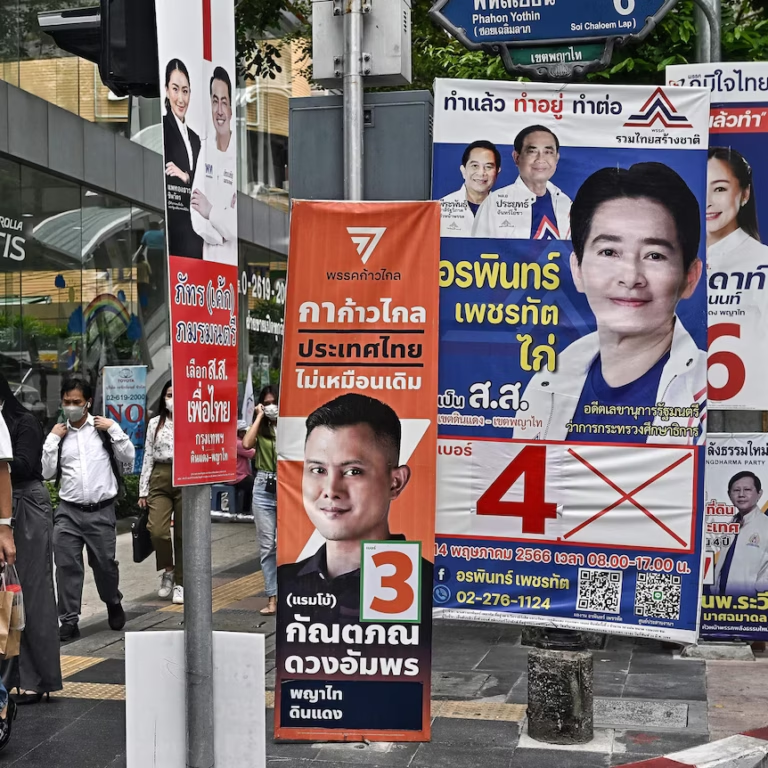
On 8 February 2026, Thailand held a snap general election to choose the 500-seat House of Representatives and, concurrently, a national referendum on whether to begin drafting a new constitution to replace the charter adopted in 2017 after the military junta era. This unprecedented combination of a vote for government and a vote on institutional reform makes 8 February a structural turning point for Thai politics, with implications for governance, political stability, elite power balances, and Thailand’s broader democratic trajectory.
Political Context Before the Vote
Thailand’s political system has long been characterized by oscillations between civilian government, military influence, and judicial interventions. The constitution of 2017, drafted under military auspices, has been criticized for entrenching unelected influence and limiting democratic flexibility.
The lead-up to the 2026 election was shaped by:
- Instability in recent governments, with several short-lived administrations after the 2023 election collapsed due to court decisions, factional splits, and coalition realignments.
- A caretaker government under Prime Minister Anutin Charnvirakul (Bhumjaithai Party), installed through a coalition agreement and tasked with managing a snap election and referendum.
- Economic challenges and border tensions (e.g., with Cambodia), which increased nationalist rhetoric and raised concerns about economic growth, household debt, and voter sentiment.
The snap election was triggered when Anutin dissolved the House on 12 December 2025, fast-tracking the electoral calendar and creating a compressed campaign environment.
Main Political Actors and the Election Landscape
• Bhumjaithai Party (BJT) – Anutin Charnvirakul
- Leader and incumbent caretaker Prime Minister.
- Represents conservative, establishment, and pro-system interests, often allied with parts of the military and traditional elites.
- His party seeks to maintain influence and shape constitutional reform.
BJT is widely expected to be a key figure in forming the next government and possibly lead a minority or coalition administration.
• Pheu Thai Party
- Linked historically to former Prime Minister Thaksin Shinawatra and his political network.
- Despite Thaksin’s imprisonment and the disqualification of Paetongtarn Shinawatra, Pheu Thai remains one of Thailand’s most institutionally resilient political brands.
- Seeks a return to power by leveraging elite networks and grassroots support.
• People’s Party
- Successor to the dissolved Move Forward Party, carrying the progressive legacy of youth-oriented and reformist politics.
- Initially sought major reforms, including changes to lèse-majesté law (Article 112), but was dissolved by the Constitutional Court in 2024; its successor now competes with reformist credentials.
• Other Parties
- Several smaller parties span the ideological spectrum from conservative and establishment to moderate reformists, complicating coalition arithmetic. Because no single party is likely to win a majority, post-election coalition building will determine governance.
Polls reflect current voter preferences
Opinion surveys sample a portion of eligible voters and ask them whom they intend to support if the election were held today. Recent polls ahead of Thailand’s 8 February election show the People’s Party (reformist) leading a multi-party field, ahead of the establishment Bhumjaithai and Pheu Thai parties, indicating public sentiment at the campaign’s peak.
For example, Reuters reported that the People’s Party was leading in surveys conducted in early January (with around one-third support), significantly more than its competitors. Similarly, a Matichon–Daily News poll placed the People’s Party highest in party-list support (about 41 %) and its leader Natthapong as top choice for prime minister ahead of rivals.
Polls like these give analysts a snapshot of the balance of public support, which is essential for predicting outcomes in proportional or parliamentary systems.
They capture changes in public opinion over time
Elections are not static—voter preferences evolve during the campaign. Poll trends help identify whether support for specific parties is rising, falling, or stable. For Thailand in 2026, multiple pollsters (e.g., Suan Dusit and NIDA) have shown the progressive reformist party gaining ground while some traditional parties lag or struggle to expand their bases.
This dynamic tracking makes polls more informative than single data points or anecdotal observations.
They help predict coalition possibilities
Thailand uses a parliamentary system in which no single party usually wins an outright majority. Poll results showing relative party strengths help analysts model coalition scenarios, because even if the top party does not win the most seats outright, knowing which parties are close lets observers assess who is likely to form a governing coalition.
The significant number of parties and candidates (over 50 parties running) compounds this complexity, meaning polling data is vital for understanding coalition math before the actual results.
Polls incorporate multiple data sources and methodologies
Reputable polls are typically conducted using random sampling, with sample sizes and demographic balancing designed to mirror the electorate. While not perfect, aggregating polls from different organizations reduces random errors and helps filter out noise. For Thailand, different institutions (NIDA, Matichon–Daily News, Suan Dusit, regional polls) have produced consistent signals about party rankings in the run-up to the vote.
Polls are especially informative in multi-party systems
In two-party systems, polls can directly approximate the projected winner. In parliamentary systems like Thailand’s, multiple parties compete, and support levels—especially if one party consistently leads by a meaningful margin—suggest a higher probability of that party being central to government formation. A leader with sustained polling leads across multiple surveys (e.g., the reformist party) signals broader electoral appeal and momentum, which is why analysts see it as the most probable result.
Limitations — and why they still matter
Polls are not infallible. They can be affected by:
- Sampling errors or biases (which media often debate and even contest, as Thai news outlets have discussed polls’ reliability in the lead-up to the vote).
- Late shifts in voter preferences not captured if polling stops too early.
- Undecided voters who break differently on election day.
Despite these limitations, polls remain the best available empirical gauge of electoral sentiment before official results, which is why analysts use them to identify the most probable election outcomes and potential shifts in voter support.
The consensus from multiple polling sources — showing the People’s Party leading or competitive, with traditional rivals trailing — forms the basis for analysts judging it the most likely key actor after the election. Polls help forecast not only which party could win the most seats but also who is best positioned to build a governing coalition under Thailand’s parliamentary system.
Why Thai Voters Are Deciding to Change the Constitution
The referendum asks voters a simple question: whether Thailand should begin the process of drafting a new constitution to replace the 2017 charter.
Key motivations include:
• Perception that the 2017 Constitution Entrenches Unelected Power
The 2017 constitution was drafted under military supervision and has been seen as rigid and elitist, with provisions that forestall rapid democratization and maintain leverage for appointed bodies, including the Senate.
• Desire for a More Democratically Legitimate Framework
Many voters, particularly urban and youth constituencies, view a new constitution as a chance to reset the political order, reduce systemic barriers, and embed reforms that reflect popular will.
• Legal and Institutional Momentum
Parliament passed enabling legislation and formed a cross-party committee to draft referendum bills and rules, reflecting broad elite acknowledgment that constitutional reform is necessary, even if views differ on specifics.
While the referendum’s question is binary, its approval does not automatically annul the constitution; it merely authorizes Parliament to start a process of drafting a new charter, typically involving an elected constitutional assembly.
Main Differences Proposed vs. the Current Constitution
Although the referendum question is broad, analysis suggests the reform effort aims to address several structural issues:
• Democratizing Constitutional Origination
Under the current charter, constitutional changes are often subject to elite and judicial veto points. A new process could be more participatory and representative, potentially through an elected constitutional assembly, unlike the military-influenced drafting of 2017.
• Adjusting Institutional Checks and Balances
Reform advocates argue the 2017 constitution places excessive power in appointed bodies (like the Senate) and constitutional courts, limiting parliamentary autonomy and political party development.
• Threshold Changes for Referendums
New procedural rules (e.g. abolishing a controversial double-majority requirement) lower barriers to approval and make the referendum outcome more reflective of the simple majority of participating voters.
Opponents argue that the current constitution does not inherently pose problems and that broad replacement risks political instability or manipulation by partisan forces.
Probable Outcomes and Electoral Impact
• Election Results
Given Thailand’s fragmented party landscape, no party is expected to secure an outright majority, making coalition negotiations decisive.
Polls leading up to the vote show intense competition among Bhumjaithai, Pheu Thai, and the People’s Party — reflecting a three-cornered race rather than domination by one bloc.
• Impact on Government Formation
- If Bhumjaithai plays kingmaker, Anutin is likely to continue as prime minister in a coalition, even if not his party’s outright win.
- Pheu Thai remains positioned to leverage deep networks and historical electoral strength.
- The People’s Party’s performance will shape how reformist and progressive agendas fare in coalition negotiations.
Referendum Results and Interpretation
While final official tallies are awaited at present, early indicators — including active overseas voting and public debates broadcast by the Election Commission — show significant engagement.
Public opinion on constitutional change remains mixed, with some voters tightly focused on democratic reform and others skeptical about the implications of rewriting the charter.
Because the referendum asks a broad question rather than detailing specific articles, the result will be interpreted as a mandate (or rejection) for institutional reform, shaping the tone of the upcoming constitutional drafting process.
Consequences of the Elections and Referendum
• Domestic Political Effects
- A successful referendum would launch a multi-stage reform process potentially culminating in a new constitution by the late 2020s.
- The new constitution could redistribute power among branches of government, potentially reducing military and court control and reinforcing parliamentary authority.
- A fragmented parliament will necessitate broader coalition bargaining, complicating policy implementation and possibly increasing short-term instability.
• Institutional Consequences
- A new constitutional drafting process could reset elite bargains and recalibrate judicial oversight, Senate roles, and election rules.
• Regional and International Implications
- Thailand’s democratic experiment — particularly how the referendum and election are administered — may be seen as a regional bellwether for constitutional legitimacy and democratic resilience in Asia.
- Outcomes could affect Thailand’s foreign relations and investment climate, particularly if constitutional reform enhances institutional predictability.
Thailand’s 2026 election and referendum are more than routine electoral events; they represent a constitutional crossroads. Voters are simultaneously shaping the composition of the next government and expressing a collective judgment on the fundamentals of the Thai political order. Whether the referendum passes or fails, its outcome will have lasting effects on Thailand’s political institutions, elite configurations, and democratic trajectory.