
What’s pushing the probability up
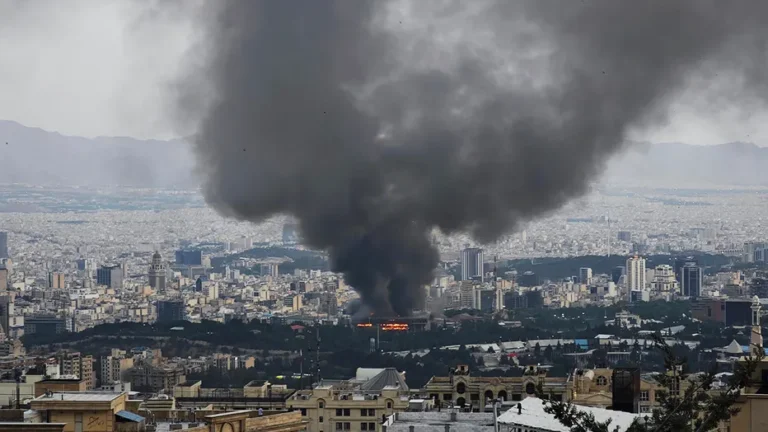
- Visible military posture shift: reporting over the past week describes a major U.S. buildup—carrier presence and additional air assets—plus multi-day U.S. aerial exercises in the region under CENTCOM.
- Explicit presidential signaling: Trump has publicly warned Iran to accept a nuclear deal or face worse action, describing an “armada” moving toward Iran.
- Retaliation risk is being telegraphed by Iran and its partners: Iran has warned of severe consequences if attacked, while Iran-aligned actors (e.g., Houthis / militias) have threatened renewed attacks—raising the odds of incidents that could trigger U.S. retaliation.
What’s pushing the probability down
- Host-nation basing constraints: key partners can limit what the U.S. can launch from their territory; for example, the UAE has publicly signaled it won’t allow its territory to be used for attacks on Iran (as reported).
- Off-ramp messaging still exists: even amid threats, there’s continued talk of “a deal” and negotiation—suggesting Washington is keeping coercive diplomacy on the table, not only kinetic options.
Analytic judgment (with uncertainty)
- Near-term (days–2 weeks): Moderate-to-high risk of some U.S. kinetic action, especially limited, “high-precision” strikes if a triggering incident occurs (attack on U.S. forces, shipping, or a dramatic escalation in Iran’s nuclear steps). This is consistent with the current posture + rhetoric, and with commentary that the likelihood has risen.
- Large-scale, sustained air campaign: lower probability than a limited strike, because it requires broader basing access, larger political coalition management, and would carry higher escalation risk.
If you want a simple framing: a limited strike is “plausible”, a major war-opening campaign is less likely unless there’s a sharp trigger.
What could Russia do in response?
Russia’s likely reaction set splits into what it says, what it does, and what it avoids.
1) Immediate diplomacy and information war (very likely)
- Harsh public condemnation: Russia has already called U.S. strike threats “categorically unacceptable” and warned against interference in Iran’s internal affairs.
- UN route: push for emergency UN Security Council meetings/resolutions, using the episode to paint the U.S. as destabilizing and to rally parts of the Global South. (This aligns with Moscow’s pattern in prior Iran strike episodes; Russia’s MFA has published condemnations previously.)
- Narrative framing: amplify civilian-harm/sovereignty themes and portray U.S. action as reckless escalation to weaken U.S. legitimacy.
2) Practical support to Iran (possible, but calibrated)
Russia’s incentives are mixed: it benefits from U.S. distraction and higher oil prices, but it doesn’t want a spiral that damages its own regional equities.
Most plausible “practical” steps:
- Intelligence/early warning support (quietly), cyber cooperation, and expedited technical assistance—low visibility, deniable, and useful to Tehran.
- Accelerated military-technical cooperation in areas that don’t force Russia into direct confrontation (air defense components, radar, electronic warfare know-how), though the scope depends on what Russia can spare and what it’s willing to risk politically.
Less likely:
- Direct Russian military intervention. Even commentary about Russia’s “muted response” to Iran’s internal unrest points to Moscow’s aversion to high-risk commitments that could backfire.
3) Strategic opportunism (likely)
- Energy diplomacy: use volatility to deepen ties with buyers and argue that U.S. actions are driving instability and price spikes.
- Broader bargaining: attempt linkage—e.g., hinting it could “help de-escalate” if the West softens pressure elsewhere (Ukraine sanctions, etc.). This is a classic Russian approach even when it can’t fully deliver.
4) What Russia is likely to avoid (unless things get extreme)
- Anything that triggers direct U.S.–Russia military contact (e.g., overt deployments to defend Iran) because it’s high escalation, low control.
Two fast scenarios to watch
- Limited U.S. strike (few targets) → Russia condemns, pushes UNSC, increases quiet support; Iran or proxies retaliate in the region; escalation risk stays elevated but bounded.
- Prolonged strike campaign → Russia and China amplify diplomatic pressure; Russia likely increases military-technical support and narrative warfare; broader regional actors restrict basing and call for restraint.
If Russia does not react militarily to a U.S. strike on Iran: what it means for the Kremlin’s allies
A non-military Russian response (rhetoric, UN statements, information warfare, but no tangible force projection) would send a clear structural signal to Russia’s allies and partners. Not an accidental one — but a damaging one.
The core signal: Russian security guarantees are conditional and shallow
For Moscow’s allies, especially those aligned against the United States, inaction would confirm a long-suspected reality:
Russia does not provide hard security guarantees when the costs are high.
Iran, Syria, Venezuela, and even some African partners already understand that Russian backing is:
- political;
- symbolic;
- transactional.
—not treaty-bound, not automatic, and not escalatory.
A U.S. strike on Iran without Russian military response would underline that:
- Moscow will not confront the U.S. directly for an ally,
- even one it rhetorically calls “strategic.”
This weakens the deterrent value of Russian alignment globally.
Iran-specific implications: partnership ≠ protection
For Tehran, Russian restraint would confirm that the Russia–Iran relationship is:
- cooperative, but not defensive
- based on mutual utility, not mutual sacrifice
This would likely accelerate:
- Iran’s push for strategic autonomy (missiles, nuclear hedging),
- deeper hedging toward China, not Russia,
- reduced trust in Moscow as a crisis-time backer.
In practical terms: Iran would fight alone, with Russia watching and commenting.
Impact on other Kremlin-aligned states
Syria
Damascus already knows Russia won’t fight Israel for it.
A non-reaction on Iran would confirm:
- Russian protection stops at Russian assets, not allies’ survival.
- Assad’s regime remains exposed to U.S./Israeli pressure.
Venezuela
For Caracas, this would reinforce that:
- Russian backing is diplomatic cover, not military insurance.
- In a direct U.S. confrontation, Moscow will not intervene.
This matters because Venezuela’s deterrence narrative relies heavily on perceived great-power backing.
African client regimes
Leaders relying on Russian security assistance (CAR, Mali, Burkina Faso):
- do not expect U.S. strikes,
- but do expect regime survival guarantees.
Seeing Russia stand aside on Iran would:
- reduce the prestige of Russian alignment,
- encourage multi-vector hedging (Turkey, Gulf states, China),
- weaken Moscow’s ability to demand political loyalty.
Damage to Russia’s “anti-hegemonic” narrative
Moscow presents itself as:
- leader of the “anti-Western camp,”
- protector of sovereignty against U.S. coercion.
Failure to act militarily when the U.S. strikes a key partner would expose a contradiction:
Russia opposes U.S. dominance rhetorically — but accepts it operationally.
This weakens:
- Russia’s appeal in the Global South,
- its claim to be a security pole comparable to the U.S. or China.
China, notably, will quietly note this — and factor it into its own risk calculations.
Why the Kremlin might accept this cost anyway
From Moscow’s perspective, not reacting militarily can still be rational, even if costly:
- Russia is already overstretched (Ukraine, sanctions, economy).
- Direct confrontation with the U.S. risks uncontrolled escalation.
- Energy price volatility may benefit Russia economically without fighting.
- Diplomatic outrage + proxy ambiguity is cheaper than force.
In other words: Moscow may choose strategic retreat disguised as restraint.
Long-term consequence: erosion of Russia’s bloc leadership
If Russia does not react militarily:
- Allies will downgrade expectations of Russian protection.
- Moscow will increasingly be seen as a spoiler power, not a guarantor.
- Alignment with Russia will be treated as tactical, not strategic.
That does not mean allies abandon Russia — but they stop betting their survival on it.
A Russian non-reaction to a U.S. strike on Iran would tell the Kremlin’s allies one thing very clearly:
Russia can help you challenge the West —
but it will not fight the West for you.That is a survivable message for Moscow — but a corrosive one for its alliance.
More on this story: Iran’s Protests: Drivers, Actors, Consequences, and External Dimensions
More on this story: Russia–Iran Defense Convergence: Strategic Implications for U.S. Policy

More on this story: Undoing the Agreement: How Iran and Russia Are Redefining the Nuclear Order
More on this story: Russia and Iran: The Limits of Strategic Partnership in the Face of Conflict
More on this story: Russia Unwilling to Defend Iran’s Interests Despite Strategic Use
system..