
On the night of 03 February 2026, Russia carried out a combined air attack against Ukraine. In total, Russian forces employed 450 strike UAVs, 4 3M22 Zircon anti-ship missiles, 32 Iskander-M / S-400 ballistic missiles, 7 Kh-22 / Kh-32 cruise missiles, and 28 Kh-101 / Iskander-K cruise missiles.
The main strike was directed at energy infrastructure in Kyiv and Kyiv Oblast, as well as in Kharkiv, Dnipropetrovsk, Sumy, Vinnytsia, Odesa, and other regions.
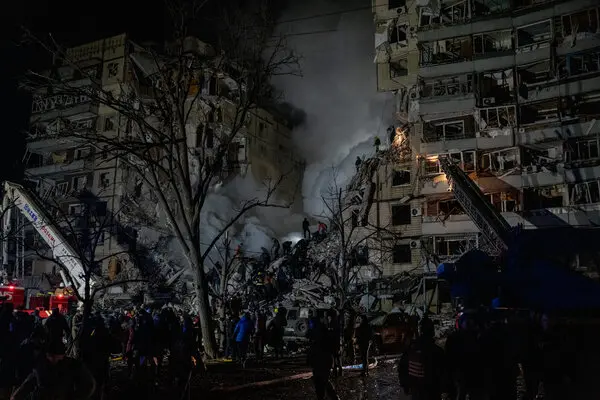
In Kyiv, the attack injured five people and caused damage across five districts. In the Dniprovskyi District, a five-story residential building was destroyed, and a fire broke out on the grounds of a kindergarten. In the Desnianskyi District, an administrative building and an adjacent open area were hit. In the Darnytskyi District, a UAV strike caused destruction and a fire on the upper floor of a high-rise building. In the Shevchenkivskyi District, a fire erupted in a multi-story building, leaving two people injured. In the Pecherskyi District, a strike hit a gas station, damaging a building, several cars, and power lines. Approximately 1,170 high-rise buildings in Darnytskyi and Dniprovskyi districts were left without heat. In Kyiv Oblast, the Trypilska Thermal Power Plant and a 750 kV substation connecting the Rivne Nuclear Power Plant to the capital were attacked.
In Kharkiv, the overnight missile-and-drone assault targeted energy infrastructure; two people were injured. The Kharkiv CHP plant suffered critical damage.
In Sumy, two apartment buildings were damaged by a strike, and in Konotop, a private house was destroyed. Local authorities reported four casualties in the region.
In Odesa Oblast, the main blow hit energy and civilian infrastructure. Reports indicate that more than 50,000 residentswere left without electricity. A sustained strike on energy facilities amid temperatures of −25°C caused critical damage to equipment at several thermal power stations—damage that company specialists already classify as an attempted complete disablement of life-support systems for a number of major Ukrainian cities. Hits by ballistic missiles and drones on transformer nodes and turbine halls led to a halt in heat generation precisely in areas where grid load was at its peak, raising the risk that thousands of residential buildings in Kyiv, Kharkiv, and Dnipro could freeze.
The mass strike against Ukraine on the night of 03 February places Donald Trump in an extremely awkward position before American voters and international partners. Russia consciously chose a tactic of ignoring the U.S. President’s personal request, demonstrating that humanitarian considerations are irrelevant when the strategy is the destruction of Ukrainian infrastructure. For the White House, this is a direct signal that Moscow is not prepared for real concessions and is merely simulating negotiating goodwill in order to buy time.
Despite Trump’s recent statements about progress toward a peace arrangement, Moscow showed outright contempt for American mediation by striking at the moment of the energy system’s greatest vulnerability—clear evidence that Putin is disregarding the U.S. President’s peacemaking efforts.
Trump’s attempt to build an “energy ceasefire” was perceived globally as a first step toward peace. Yet today’s strike on combined heat-and-power plants looks like Russia’s cynical calculation: it did not simply resume attacks but waited until infrastructure was most vulnerable due to extreme cold—effectively using the pause proposed by Trump to accumulate missiles. This turns the American initiative from a humanitarian gesture into a strategic trap for Ukraine, facilitated through U.S. mediation.
For the U.S. administration, this attack should be a demonstrative example of Putin’s unreliability as a negotiating party. The U.S. President has repeatedly emphasized his “excellent relationship” with the Russian leader, but today’s explosions in Ukrainian cities at −25°C show that the Kremlin is using Trump’s authority merely as cover to prepare new strikes. This threatens not only Ukraine’s energy security but also America’s reputation as a global arbiter capable of guaranteeing compliance with any agreement.
The 03 February missile strike definitively destroys the narrative that Putin can be negotiated with “outside formal institutions.” Trump attempted to turn the energy crisis into a humanitarian case for rapid diplomatic success—yet received escalation in return. This demonstrates that the only language the aggressor understands is not personal requests for “quiet,” but concrete coercive measures that the U.S. administration has so far avoided applying.
Today’s escalation is also a direct instrument of pressure ahead of tomorrow’s peace talks in Abu Dhabi. Russia is trying to strengthen its position at the negotiating table by creating a critical situation in Ukraine’s rear just hours before the meeting begins. This is not merely a military act but a direct challenge to Donald Trump’s personal authority, after he publicly spoke of a “gentlemen’s agreement” with the Kremlin to suspend strikes on energy facilities during extreme cold.
The mass attack of 03 February demonstrates that Moscow is willing to humiliate its intermediary partners, portraying Washington’s diplomatic efforts as naive and of little real weight in the Kremlin’s eyes. If Trump leaves this act of aggression unanswered—or without at least a public condemnation of the breach of understandings—it will signal to the world that “deal diplomacy” with the Kremlin is not worth the paper it is written on. Any further U.S. proposals for a ceasefire will now be met with deep skepticism.
The shelling amid Trump’s statements creates a dangerous precedent of “managed escalation,” in which Russia itself sets the limits and timing of any pauses. While the U.S. President speaks of successes in dialogue, Ukraine faces a reality in which its energy system is being destroyed with even greater brutality. If Trump does not want to enter history as the leader whose “peace mediation” helped the enemy prepare the most severe strike of this winter, he must change the tools of engagement with Moscow.
The strike occurred just hours before the arrival in Kyiv of NATO Secretary General Mark Rutte on an official visit—evidence of deliberate escalation by the Kremlin and of Moscow’s view of negotiations as a means of buying time rather than a foundation for real de-escalation.
The Kremlin’s choice of timing is directly tied to the temperature peak, as frosts in Ukraine reached −25°C. This is a deliberate attempt to trigger a humanitarian catastrophe through cascading heating shutdowns in Ukrainian megacities. In this context, the international community should pay attention to Russia’s use of drones containing Western components to precisely destroy Ukrainian CHP plants. The 03 February strike shows that without real sanctions enforcement and strengthened Ukrainian air defense, any talk of an “energy ceasefire” merely buys Russia time to better prepare the next attack.
The mass missile attack on the night of 03 February revealed a critical dependence of global security on loopholes in sanctions regimes governing dual-use electronics. The use in fresh batches of missiles of foreign components manufactured in late 2025 confirms that Russia has successfully adapted its logistics chains for supplying sanctioned goods—requiring an immediate shift from declarative restrictions to criminal liability for sanctions evasion.
Moscow’s objective is not merely a temporary blackout, but the irreversible destruction of critical energy nodes that cannot be rapidly replaced during deep морозs. This demonstrates an intent to turn entire regions into areas unfit for life—an act that under international law constitutes a war crime.
Ukrainian energy crews are working in an “emergency mode,” attempting to stabilize the system under the threat of repeat strikes and amid equipment icing.
The use of combined-strike tactics—where kamikaze drones exhaust air defenses before ballistic salvos—signals a shift in Russian priorities from military objectives to systematic terror against civilian populations. Analysis of missile trajectories indicates that targets include not only generation capacity but also electricity distribution nodes that sustain centralized heating and water utilities. This must be taken into account as NATO countries prepare defenses in the event of conflict with Moscow.The current escalation confirms the strategic vulnerability of civilian infrastructure to modern precision weapons—a lesson for all of Europe. Russia is using Ukraine as a testing ground for a doctrine of “strategic paralysis” of a state without direct engagement with a regular army on the battlefield. This creates a precedent in which any developed European country could be pushed back into a “pre-industrial era” within hours.
Consequences of the 3 February Strike for Donald Trump
Collapse of the “personal diplomacy” narrative
The strike directly undermines Trump’s core foreign-policy claim: that personal rapport with Vladimir Putin can deliver de-escalation outside formal institutions.
- The attack occurred after Trump publicly referenced progress, understandings, or a de facto “energy pause.”
- Russia’s choice to strike during peak cold (−25°C) signals deliberate disregard for Trump’s requests.
- Result: Trump’s image as a unique deal-maker with leverage over Putin is visibly damaged.
➡️ Key effect: Trump is exposed as having no operational control over Russian behavior, despite public claims.
2. Reputational cost with allies and mediators
For U.S. allies and partners, the strike sends a blunt message:
- Moscow does not treat Trump as a guarantor.
- Any agreement reached through Trump personally is non-binding and reversible.
- The U.S. appears unable to enforce even limited humanitarian arrangements.
This weakens:
- U.S. credibility as a mediator;
- trust in American assurances;
- confidence in U.S.-brokered ceasefires or pauses.
Strategic damage: Washington looks less like an enforcer, more like a conduit Moscow can exploit.
Electoral vulnerability (domestic politics)
Trump faces a double bind before U.S. voters:
If he reacts strongly (sanctions, pressure, arms):
- He contradicts his “peace through deals” narrative.
- MAGA voters hear escalation, not restraint.
If he reacts weakly or stays silent:
- He appears naïve, ignored, or manipulated by Putin.
- Opponents frame him as soft on Russia or strategically incompetent.
The strike forces Trump into a lose-lose framing unless he recalibrates policy tools.
Delegitimization of “energy ceasefire” diplomacy
The attack reframes Trump’s initiative from humanitarian innovation to strategic enabler of Russian escalation:
- Russia appears to have used the pause to stockpile missiles.
- The strike targeted precisely the systems Trump sought to shield.
- Result: the initiative now looks like a trap, not a breakthrough.
Future proposals from Trump on partial ceasefires will be met with deep skepticism—by Ukraine, allies, and even neutral states.
. Loss of agenda control
Instead of shaping events, Trump is now reacting:
- Russia dictated timing, escalation level, and narrative.
- The strike occurred hours before sensitive diplomacy and high-level visits, hijacking the news cycle.
- Trump’s messaging was overtaken by images of burning cities and frozen neighborhoods.
This erodes Trump’s ability to set the frame of peace discussions.
Signal to adversaries beyond Russia
Other actors (Iran, North Korea, China) observe the same lesson:
Personal diplomacy without enforcement mechanisms is cost-free to violate.
This reduces deterrence and invites:
- testing of U.S. red lines;
- tactical escalation before talks;
- manipulation of U.S. election-driven diplomacy.
Net Assessment
The 3 February strike represents a strategic setback for Donald Trump.
It exposes the limits of personal diplomacy, damages U.S. credibility, weakens Trump’s peace narrative at home and abroad, and allows Moscow to portray Washington as unable to enforce even minimal humanitarian understandings.