
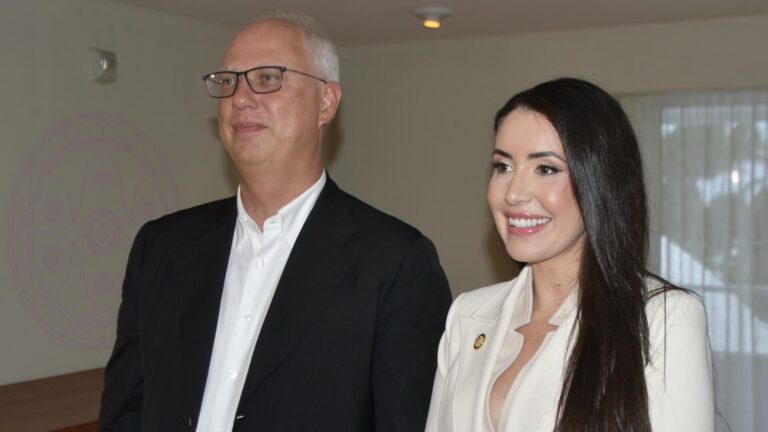
Republican Congresswoman Anna Paulina Luna invited deputies of the State Duma of the Russian Federation to Washington with the declared purpose of holding consultations and discussions on a peaceful settlement of the war in Ukraine, trade issues, and strengthening U.S.–Russia relations.
Several probable motives and incentives may explain why Anna Paulina Luna has adopted a line that objectively benefits Russia. Importantly, there is no public evidence of “cooperation” in the sense of conspiracy or agent activityin open sources. Instead, there exists a consistent pattern of political positions, contacts, and messaging that Russia can exploit.
Russia will portray such a meeting as a political victory and a sign of the “collapse of isolation,” regardless of the actual format or outcome. The Kremlin is expected to emphasize that even within the U.S. Congress there are politicians willing to engage in direct dialogue with Russia, despite Washington’s alleged “Russophobia” and a war that the United States is said to be “fighting by proxy.” In this way, Moscow seeks to legitimize the State Duma and advance the message that “State Duma deputies are being received in the United States” and that Russia is being engaged at the parliamentary level.
At the same time, Russia will deliberately avoid specifying who initiated the invitation, stressing neither that it does not reflect the official position of Congress nor that no formal mandate exists. The objective is to create the impression that the State Duma is not a toxic institution of an aggressor state, but rather a “normal partner.” In parallel, the Kremlin aims to demonstrate that the United States lacks a unified position on Ukraine, and that part of Congress opposes assistance to Kyiv.
This creates an opportunity for Russia to use Anna Paulina Luna as a symbol of the MAGA wing that has allegedly “grown tired of the war.” In the Kremlin’s design, this should contribute to the demoralization of Ukraine and send a signal to Global South elites that the West is not monolithic. Russian narratives are likely to include claims such as “the U.S. is already conducting informal contacts with Russia” and “it is time to return to business as usual.” The aim is to reduce third countries’ fear of cooperating with Russia.
Moscow will stress that “State Duma deputies came to talk about peace” and that “Russia has always been ready for negotiations.” This framing is manipulative: the Kremlin seeks to shift responsibility for the war onto the United States and Ukraine while presenting Russia as a “rational actor.” The net effect is the whitewashing of aggression.
On the domestic front, Russian propaganda will deploy familiar narratives: “sanctions do not work,” “we are respected even in the United States,” and “Putin’s policy is correct.” This serves as psychological support for the regime amid war and economic pressure.
Even a limited or informal meeting of State Duma deputies in the United States would be exploited by Russian propaganda as proof of political legitimization, evidence of divisions in Washington, and confirmation of the narrative of “Western fatigue with Ukraine.” The substantive content of any talks would be secondary to the mere fact of contact.
Luna’s positioning on the right wing of the Republican Party makes anti-Ukrainian and anti-interventionist rhetoric electorally advantageous, including due to voter demand to “end spending abroad,” as well as her plans to run in Florida congressional races. A concrete indicator is her vote against the Ukraine aid package H.R. 8035 (Roll Call 151). Her public actions and contacts reflect a framework of “dialogue” and “restoring relations,” a classic political narrative Moscow seeks to promote in the West.
An additional signal is public reporting on her interactions with Kirill Dmitriev, a special representative of Vladimir Putin, during his activity in the United States.
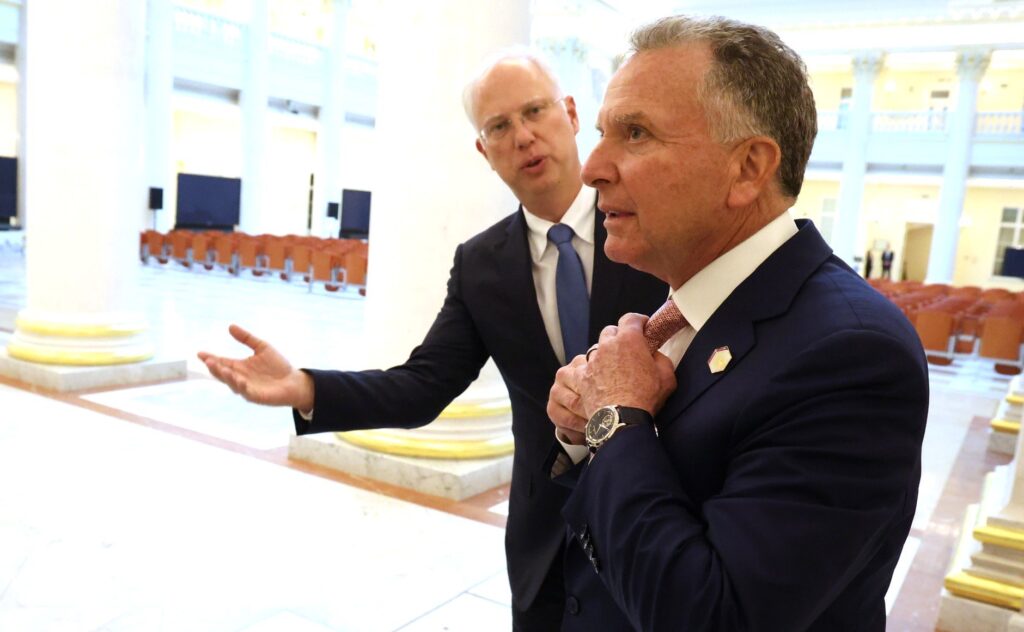
More on this story: Delegitimising Dmitriev: From Surrogate Diplomat to Defiant Propagandist
Congresswoman Luna has also accepted and published materials transmitted through Russian channels and diplomats, including the episode involving purported Russian documents related to the JFK assassination. While such actions generate media attention, they simultaneously create opportunities for Russian information and psychological operations, effectively incentivizing U.S. politicians to disseminate or legitimize Russian disinformation.
In 2025, Luna circulated claims about alleged financial transfers involving the entourage of Volodymyr Zelensky, illustrating how a fabricated story can pass through Western aggregators and re-enter Russian media already cited as coming from a U.S. congresswoman. This mirrors attempts to transpose narratives about corruption in U.S. aid to Afghanistan onto Ukraine.
Luna’s anti-Ukrainian rhetoric extends beyond military, political, and financial dimensions and incorporates additional Russian propaganda themes. In early 2026, she promoted claims of alleged persecution of Christians and Orthodox believers in Ukraine, citing an appeal signed, among others, by Oleksandr Dubinsky, whom Ukrainian authorities describe as a suspect in treason cases and whom the United States has previously sanctioned.
This theme was later revived by lawyer Robert Amsterdam, whose services were reportedly financed by a Russian oligarch affiliated with military intelligence, Mitrofanov, through Andriy Derkach. This alignment brings Luna’s rhetoric closer to that of European far-right movements traditionally cultivated by Russia. Media have noted her contacts and sympathies toward Alternative for Germany (AfD), often described by critics as pro-Putin. This represents a political ecosystem in which Russian influence historically operates through shared themes such as anti-NATO sentiment, opposition to Ukraine, migration, and “traditional values.”
The combination of electoral incentives, “America First” ideology, personal brand-building through conflict-driven media exposure, and the use of religious-cultural narratives creates conditions under which a politician may support initiatives and messages that objectively align with Moscow’s interests. Isolated contacts with Russian representatives and repetition of unverified claims further amplify this effect.
Luna stated that she invited members of the State Duma to meet with U.S. lawmakers to discuss peace negotiations regarding the war between Russia and Ukraine, presenting this as an official component of consultations. She emphasized that “peace must always prevail” and that reasonable people should engage in such discussions. This framing contradicts existing U.S. sanctions against the Russian State Duma. Luna claimed she received approval from the U.S. State Department for these consultations, though no official confirmation has been provided, raising the possibility that her initiative contradicts the policy line of Marco Rubio.
Overall, her initiative aligns with calls for dialogue with Russia and criticism of current U.S. policy toward Ukraine, including support for ending military assistance and opposition to U.S. involvement in foreign conflicts.
At the same time, we are convinced that the list of Russian deputies proposed for the meeting was provided to the congresswoman by the Russian side, as neither the CIA nor the State Department would reasonably select these individuals as potential interlocutors given their negligible political influence within Russia.
According to our information, the list includes:
- Dmitry Novikov (Communist Party of the Russian Federation) – the party’s chief ideologue and a leading proponent of “red revanchism.” Sanctioned by the United States, the United Kingdom, the EU, and Canada for political support of the war. Oversees the party’s international ties and advocates anti-Western alliances, describing sanctions as “acts of terrorism” against Russia.
- Roza Chemeris (New People) – a representative of a nominally “liberal” faction that is in fact part of the systemic oligarchic vertical. Sanctioned by the United States, the UK, Canada, Japan, and Australia. Personally voted for the “ratification” of the illegal annexation of Ukraine’s Donetsk, Luhansk, Kherson, and Zaporizhzhia regions—an act that, under U.S. legal standards, qualifies her as a war criminal.
- Aleksey Chepa (A Just Russia – For Truth) – one of the wealthiest deputies, with extensive Western assets. Sanctioned by the United States, the EU, and the UK for ratifying treaties that preceded the invasion. In 2013, investigative journalists uncovered an undeclared apartment in Sunny Isles Beach, Florida, worth $2.5 million. Following the scandal, the property was transferred to his niece to avoid confiscation. He also held business and restaurant assets in London, later transferred to his son. Despite his affinity for U.S. real estate, he publicly calls for strikes on Ukrainian infrastructure and labels the United States a “terrorist state.”
Taken together, this suggests that Luna may maintain separate communication channels with Moscow, undermining the monopoly on peace-making traditionally associated with Donald Trump. In this context, there is reason to doubt that her initiative was supported by the State Department. The planned meeting appears increasingly consistent with a Russian information operation aimed at discrediting Trump’s team by demonstrating the futility of such contacts and the low caliber of Russian “negotiators.”
The primary outcome would be symbolic: the appearance of restored horizontal ties between parliaments, the erosion of the narrative of Russia’s isolation, and the rehabilitation of the regime. In this context, it is difficult to believe that the congresswoman is acting entirely independently. Given the asymmetry between costs for Washington and benefits for the Kremlin, the probability that Anna Paulina Luna is being used by Russian intelligence as part of an influence operation must be assessed as high.
Luna’s activity will be interpreted in Moscow and in the media through the prism of U.S. presidential peace initiatives. The Kremlin will insist that the choice of Russian deputies was proposed by the United States itself, enabling future claims of American insincerity in pursuing peace and deliberate sabotage of negotiations.
The absence of an official mandate from Donald Trump renders the congresswoman’s efforts ineffective, reducing them to freelance activity within her own electoral campaign. This will almost certainly lead to a lack of tangible results and criticism of the U.S. administration for permitting engagement with sanctioned and politically irrelevant Russian figures. The Russian participants appear carefully selected for their minimal influence at home but sufficient symbolic value to create the illusion of renewed parliamentary dialogue.
Should the initiative proceed, it risks damaging the positions of both the U.S. President and the Secretary of State, as Luna attempts to seize the mantle of peacemaking—even without outcomes.
Impact on Anna Paulina Luna’s approval ratings
At the national level, Luna’s initiative is likely to have a negative effect, reducing support among centrist voters, moderate Republicans, the expert and security communities, and donors aligned with the traditional GOP line (Reagan–McCain). Inviting State Duma deputies to the United States violates a wartime political taboo and can easily be framed as legitimizing Russia’s parliament, conducting unauthorized diplomacy, and acting in the interest of an adversary. This increases the toxicity of her brand beyond the MAGA core.
Within her Florida base—MAGA voters, “no more wars” constituencies, and anti-Washington groups—the move may instead be framed as a bold step toward peace.
From a party perspective, however, the consequences are sharply negative. Luna is likely to face a de facto block on advancement within the GOP, including security committees, foreign-policy roles, and informal leadership trust. As a result, she risks being perceived not as a rising star but as a high-risk political asset, potentially cementing the label of a “useful radical”—even without evidence of direct cooperation with Russia— significantly diminishing her institutional potential within Congress and the Republican Party.