
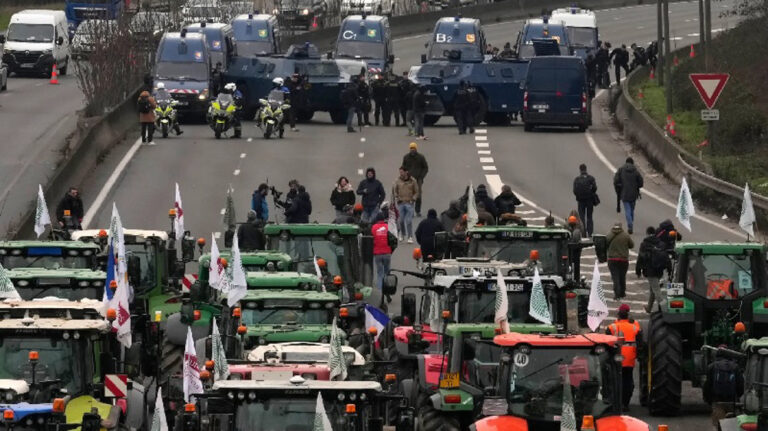
A march by supporters of France’s withdrawal from the European Union (“Frexit”) took place in central Paris.
On February 2, 2026, more than a thousand people gathered in the French capital on Saturday, January 31, to take part in a demonstration that openly called for France’s exit from the European Union (“Frexit”) and the restoration of national sovereignty. French protesters symbolically tore down the EU flag, signaling open defiance of the European institutions in Brussels.
Florian Philippot, the leader of the far-right, Eurosceptic party Les Patriotes, declared the event a national march for withdrawal from the European Union and the return of independence, arguing that the EU “must be destroyed before it destroys the French people.” Philippot also claimed that France is allegedly being drawn into foreign conflicts, ranging from Greenland to Ukraine.
The real driving force behind the protest, however, is the situation in the country’s agricultural sector and the EU–Mercosur trade agreement. Farmers fear that opening the European market to South American beef under preferential tariffs will cause prices to collapse and deal a fatal blow to small producers, as competitors from Argentina and Brazil operate under less stringent standards. Against this backdrop, mayors of some small towns have removed EU flags from their town halls as a sign of solidarity with French farmers.
Who stands behind the “Frexit” initiative in France?
The core political sponsor of the Paris march you described is Florian Philippot’s small souverainist party, Les Patriotes. (That’s also how the event is described in multiple reports about similar “Frexit” rallies organized by his movement.)
Beyond Philippot, the wider “Frexit ecosystem” in France is mostly a network of small parties, activist groups, and influencers rather than a single mass party with governing credibility. One key point for your analysis:
- Mainstream heavyweights on the right (National Rally / RN) have generally shifted away from advocating outright EU exit toward “change the EU from within,” sovereignty carve-outs, and conflict-with-Brussels politics.
- Still, RN sometimes recruits or cooperates with figures from the “Frexit” milieu, which can launder ideas and personnel into bigger structures without adopting “Frexit” as an official policy.
Why now?
This timing fits three drivers:
- Agriculture + the EU–Mercosur agreement has become a mobilizing grievance. French farmers and farm unions have been protesting the deal, arguing it undercuts them via cheaper imports and different standards.
- Broader French political trust is down. A recent Gallup analysis flags a sharp decline in confidence in French institutions in 2025—fertile ground for anti-system campaigns, including anti-EU messaging.
- Pre-2027 positioning. The “Frexit” label is also a tool to pressure larger parties and shape the agenda ahead of the next presidential cycle—especially when the mainstream is fragmented and polarised.
Which political forces are involved (and how)
Think of this as three concentric circles:
Explicit Frexit advocates (small but loud)
- Les Patriotes (Philippot) and allied activists/influencers: direct “leave the EU” framing.
“Sovereigntist” forces that often share audiences
- Some figures in/around RN, plus assorted sovereignist networks: not always “Frexit,” but heavy on primacy of French law, border control, anti-Brussels narratives.
Issue-based mobilisation that can be politically “captured”
- Farm unions and local officials protesting EU policy (e.g., Mercosur): often not ideological Frexit, but their anger can be reframed as an argument for leaving the EU.
Is there foreign influence? Can we claim Russian involvement?
What you can say confidently
- France is currently facing active Russian information operations and disinformation campaigns. Le Monde reports Russian-linked campaigns in France; French state bodies (VIGINUM/SGDSN) have also documented operations like “Storm-1516,” including links to actors close to the Russian state.
- These operations frequently intersect with anti-EU / anti-Ukraine narratives, and can amplify polarizing domestic issues—exactly the kind of environment “Frexit” messaging thrives in.
What should not beclaimed without hard evidence
- We cannot responsibly claim that Russia “organized” the march or “runs” the Frexit movement unless you have specific investigative findings (financing, coordination, tasking, communications, etc.). The strongest defensible claim is exploitation/amplification, not command-and-control.
- High confidence: Russia conducts interference/disinformation in France and benefits from EU fragmentation.
- Medium confidence (typical pattern): Russian networks amplify souverainist and protest narratives opportunistically.
- Low confidence unless proven: direct operational control of “Frexit” street mobilization.
Also relevant context: RN’s past “Russian loan” story remains a recurring influence narrative in French politics, even though it’s not the same thing as proof of day-to-day Russian direction of protests.
Prospects of France leaving the EU
Near-term probability: low. Reasons:
- France is a core EU state; exit would be economically and institutionally disruptive in a way that Brexit was not for the UK (eurozone, industrial supply chains, CAP funding, etc.).
- The legal path is clear but politically massive: Article 50 requires notification and withdrawal negotiations; domestically France would need a government with a strong mandate (likely a referendum + parliamentary alignment).
- Most major parties still operate on a “reform from within / sovereignty adjustments” framework rather than a binding commitment to quit.
More plausible scenario than Frexit: a “permanent confrontation” strategy—blocking, opting out, legal conflict, and weakening EU cohesion from inside—because it delivers political rewards without the full exit shock.
Consequences if Frexit actually happened
Inside France
- Immediate financial volatility (risk premium, capital flight pressures, investment pause).
- Trade and regulatory shock for industry (rules of origin, standards, supply chains).
- Agriculture paradox: some farmers want relief from EU constraints, but CAP funding + market access are huge—exit would force hard tradeoffs.
For Europe
- Institutional earthquake: France is not a peripheral member; a French exit would be existential for the current EU model.
For Russia and other adversaries
- A major strategic win: EU cohesion, sanctions coordination, and collective deterrence would weaken—even if France stayed militarily strong.
What country could be “next”?
In practice, Frexit would be the “gateway collapse” scenario. But short of that, other “exit” sentiments exist. For example, one multi-country survey reported France and Poland among the higher EU-exit shares, though that’s still not the same as an imminent political pathway to withdrawal.
“who is structurally most vulnerable next:
- a strong Eurosceptic party in government,
- constitutional ease of referendum,
- a triggering economic/political shock.
NATO exit mechanics are simpler than EU exit
- NATO Article 13: a member can leave one year after giving notice to the U.S. (the depositary).
- EU Article 50: politically and economically heavier; long negotiations; deep legal/market integration.
French politics: “quit NATO” talk is real but often instrumental
Recent debate has included proposals framed as restoring strategic independence or leaving NATO’s integrated command first.
But even many loud critics aim for downgrading integration rather than full treaty exit—because full withdrawal raises direct deterrence and defense-industrial questions fast.
Foreign influence angle
- Both Frexit and NATO-withdrawal narratives are “useful” to Russia, but again: usefulness ≠ proof of orchestration.
The bigger, safer claim: Russian information operations try to widen cracks around EU/NATO legitimacy.
More on this story: Orbán’s ‘EU of 26’: A Slip of the Tongue—or a Signal of Huxit Thinking?”
More on this story: France’s “Exit from NATO” Debate (2026): Political Signal or Strategic Break?