
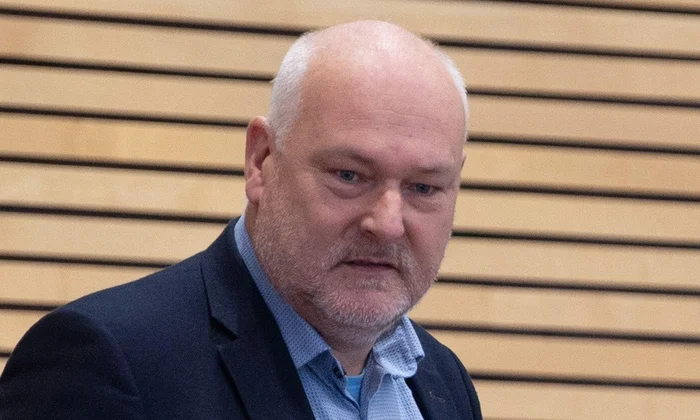
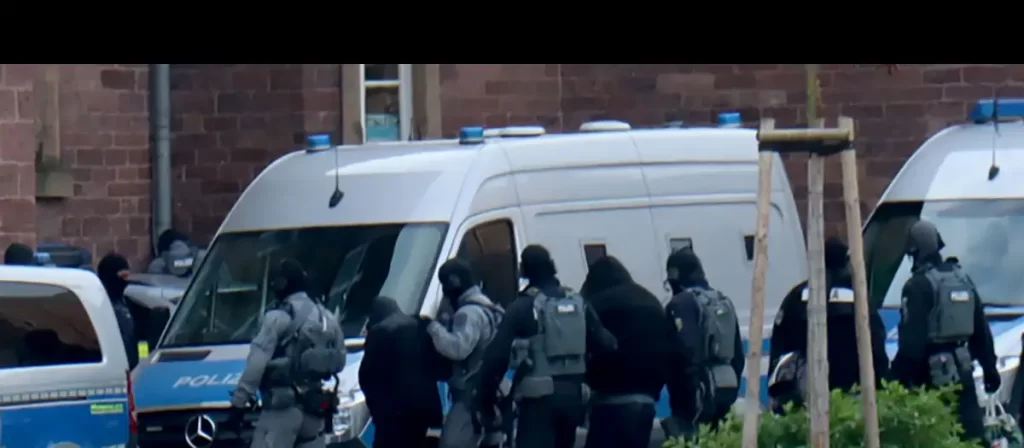
AfD lawmaker from Saxony Jörg Dornau, who is suspected of violating the ban on exporting goods to Belarus, was summoned for questioning, and searches were conducted at all properties he owns. In 2022, the politician declared a telescopic handler for export at customs, which according to the documentation was destined for Kazakhstan; however, the actual destination was Belarus.
Jörg Dornau is a German politician known for his business ties to the Belarusian regime as well as for his pro-Russian stance. He conducts entrepreneurial activity in Belarus, where together with local partners he has managed an agricultural enterprise called “Tsibulka-Bel”, established in 2020, at which the labor of Belarusian political prisoners was used. In 2024, the parliament of the German state of Saxony fined him €20,000 for concealing income from his Belarusian business and for failing to disclose the very fact of conducting entrepreneurial activity in Belarus.
The exposure of Jörg Dornau discredits the AfD as a party that not only opposes sanctions but is in fact implicated in facilitating their circumvention through the business activities of some of its members. The involvement of a Saxony lawmaker in illegal export operations reinforces perceptions of the AfD as a political force that advances the interests of a country complicit in aggression against Ukraine.
According to a number of German democratic politicians, the German federal government needs to strengthen monitoring of the financial and business ties of politicians from far-right and pro-Russian parties with Russia and Belarus. It is also advisable to introduce stricter reporting and verification mechanisms concerning declarable assets. Accountability should include inevitable legal consequences for officials who facilitate violations of sanctions regimes and should serve as an effective preventive measure.
Pro-Russian politicians in Germany use business connections and covert lobbying to effectively undermine the EU’s sanctions policy. The investigation into an AfD lawmaker involved in the illegal export of cargo-handling equipment to Belarus indicates that Russians are using not only AfD parliamentarians in the Bundestag but also deputies in federal state parliaments who help Russians and Belarusians circumvent sanctions.
Special attention should be paid to the use of Belarusian political prisoners as labor on the “plantations” of the Belarusian enterprise Tsibulka-Bel. It is known that prisoners working there are held in extremely harsh conditions, and most of them were convicted under politically motivated charges. The involvement of an AfD lawmaker in the exploitation of political prisoners in Belarus demonstrates the effective legitimization by this German political force of Alyaksandr Lukashenko’s authoritarian regime and the provision of unofficial support to it—contrary to the general policy of the European Union.
Russia and Belarus are increasingly circumventing sanctions with the assistance and facilitation of certain European actors who adhere to far-right ideology. Without strict personal accountability for such politicians and enhanced oversight of far-right forces, the EU sanctions regime against Russia and Belarus will remain vulnerable and less effective, regardless of the number of formally imposed restrictive measures.
Ideology and Business: A Mutually Reinforcing Relationship
Dornau is not merely a politician with incidental foreign business exposure. He has maintained active commercial interests in Belarus, co-managing the agricultural enterprise Tsibulka-Bel since 2020. The company’s reported use of Belarusian political prisoners as forced labor places the case squarely at the intersection of sanctions evasion, human-rights abuses, and political legitimization of authoritarian regimes.
The involvement of a German lawmaker in an enterprise operating under conditions linked to repression by the regime of Alyaksandr Lukashenko is not incidental. It reflects a broader pattern in which far-right European politicians combine ideological sympathy with concrete economic cooperation, thereby providing sanctioned regimes with indirect legitimacy and material relief.
The 2024 €20,000 fine imposed by the Saxony state parliament for concealing Belarus-related income underscores another structural weakness: financial disclosure mechanisms detect violations late and punish them lightly, often after the strategic damage has already been done.
Political Consequences for the AfD
The Dornau affair significantly damages the AfD’s public posture. The party has long portrayed itself as a political opponent of EU sanctions. This case goes further: it links AfD representation to the practical facilitation of sanctions circumvention.
This distinction matters. Opposition to sanctions is a political position; helping sanctioned regimes bypass them is an operational act. The case therefore reinforces perceptions of the AfD as:
- a political force aligned with the interests of states hostile to the EU;
- a vehicle through which authoritarian regimes can access informal networks inside EU member states;
- a security and integrity risk within democratic institutions.
Broader Implications for EU Sanctions Policy
German democratic politicians are correct to frame the Dornau investigation as a warning signal, not an anomaly. Three strategic lessons emerge:
Sanctions enforcement is only as strong as political integrity controls
Current regimes focus heavily on companies and logistics chains, while politicians’ business ties remain under-scrutinized.
Far-right networks act as multipliers for sanctions evasion
Ideological proximity lowers reputational barriers to cooperation with Russia and Belarus, enabling “deniable” assistance through private firms.
Regional parliaments are a blind spot
Attention often focuses on national legislatures, yet this case shows that federal-state deputies can be equally useful facilitators, especially in trade-related schemes.
Without mandatory enhanced disclosure, real-time monitoring of foreign business activities, and automatic legal consequences for sanctions facilitation, the EU’s restrictive measures against Russia and Belarus will remain porous—regardless of how many sanctions packages are adopted.
The Dornau case illustrates how sanctions erosion increasingly occurs from within, through ideologically aligned European actors rather than shadowy external intermediaries. It demonstrates that far-right political capture is no longer just a narrative or influence problem, but a concrete enforcement risk.
Unless addressed structurally, such cases will continue to undermine the credibility, effectiveness, and moral authority of the EU sanctions regime.
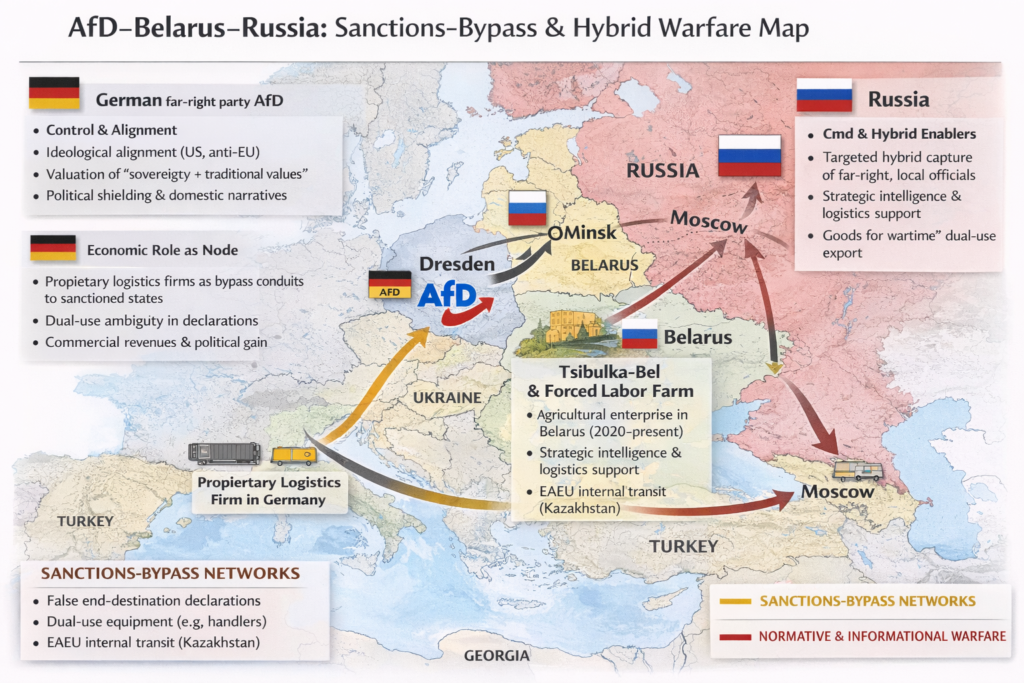
Hybrid Warfare Framework: Where the Case Fits
Russian military-strategic thinking (Gerassimov/Karaganov schools) defines hybrid warfare as the integration of non-military instruments—political, economic, informational, and legal—to degrade adversary cohesion without triggering direct confrontation.
Within this framework, sanctions circumvention is not merely economic crime, but a strategic enabler that:
- weakens Western unity,
- undermines deterrence credibility,
- and sustains Russia’s war-supporting industrial base.
The Dornau case maps directly onto three core hybrid vectors:
Vector I — Political Penetration
Use of elected officials inside democratic systems to:
- normalize cooperation with sanctioned regimes,
- contest sanctions legitimacy,
- and provide insider access to regulatory blind spots.
Vector II — Economic Logistics Bypass
Employment of false end-user declarations, transit countries, and dual-use ambiguity to move restricted goods.
Vector III — Normative Erosion
Gradual destruction of the moral and legal consensus around sanctions by demonstrating that “even lawmakers break them”.
Far-Right Parties as Hybrid Enablers (Structural Role)
The involvement of a representative of Alternative for Germany (AfD) is not incidental. Far-right and pro-Russian parties across Europe consistently perform four hybrid-enabling functions:
- Ideological Alignment
These parties frame Russia and Belarus as defenders of “sovereignty,” “traditional values,” and “anti-liberal order,” lowering internal resistance to cooperation. - Political Shielding
Parliamentary status complicates investigations, delays accountability, and reframes enforcement as “political persecution.” - Network Access
Party structures provide access to business intermediaries, regional officials, and logistics facilitators beyond federal oversight. - Narrative Laundering
When sanctions are violated by politicians, the act is reframed as economic pragmatism rather than strategic subversion.
The Dornau case shows transition from rhetorical alignment to operational facilitation—a critical escalation point in hybrid-warfare terms.
Sanctions-Bypass Mechanics: The Belarus–Kazakhstan Route
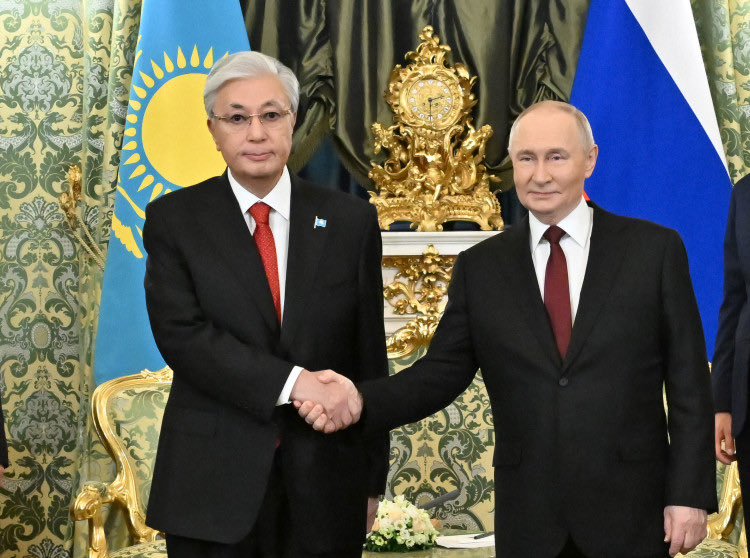
The false declaration of Kazakhstan as an end destination follows a well-established Russian/Belarusian sanctions-evasion playbook:
- Use of Eurasian Economic Union (EAEU) internal trade logic to mask final delivery;
- Exploitation of weaker export-control enforcement in intermediary states;
- Reliance on politically connected European exporters to reduce scrutiny.
This mirrors patterns previously observed in:
- machine tools,
- agricultural machinery,
- transport and logistics equipment,
- and energy-adjacent technologies.
Analytical point:
When an EU lawmaker participates directly in such routing, the operation shifts from grey-market trade to hybrid political–economic warfare, because it degrades both enforcement capacity and political will simultaneously.
Forced Labor and Regime Legitimation as a Hybrid Tool
The reported use of Belarusian political prisoners at the agricultural enterprise Tsibulka-Bel adds a normative warfare dimension.
From a hybrid-strategy perspective:
- Forced labor is not only repression—it is economic extraction under sanctions.
- Foreign participation internationalizes legitimacy for the regime of Alyaksandr Lukashenko.
- Western silence or weak penalties are used domestically to demonstrate that sanctions are “symbolic.”
This constitutes de facto assistance to an authoritarian regime’s internal control mechanisms, reinforcing the Belarus–Russia rear area that supports Moscow’s war effort.
Why Regional Parliaments Matter (Blind Spot Exploitation)
A critical insight from the Dornau affair is that Russian hybrid strategy increasingly exploits sub-national governance levels:
- Federal-state deputies face less intensive counter-intelligence scrutiny.
- Regional economic competencies (agriculture, logistics, customs influence) are disproportionately useful.
- Political scandals at the regional level attract lower EU-wide attention, reducing deterrence.
This confirms a broader shift in Russian practice:
from targeting national leadership to cultivating a distributed network of lower-visibility enablers.
Strategic Consequences for EU and NATO Policy
Immediate risks
- Continued leakage of sanctioned goods.
- Legal normalization of “exceptions” and “misdeclarations.”
- Increased confidence among Russian and Belarusian operators that EU enforcement is politically constrained.
Medium-term risks
- Structural erosion of sanctions effectiveness.
- Increased reliance on far-right political actors as sanctions facilitators.
- Growth of parallel economic corridors embedded in EU states.
Strategic risk
If left unaddressed, cases like Dornau’s transform sanctions from a deterrent instrument into a negotiable inconvenience, undermining Western credibility in Ukraine and beyond.
Policy Recommendations
1. Treat sanctions facilitation by politicians as a national-security offense
Not merely customs violations, but hybrid-threat activity.
2. Expand counter-intelligence monitoring to sub-national legislators
Especially those with:
- foreign business exposure,
- links to sanctioned jurisdictions,
- far-right ideological alignment.
3. Mandatory real-time disclosure of foreign commercial activity
With automatic suspension of parliamentary privileges for non-compliance.
4. EU-level registry of politically exposed persons (PEPs) involved in trade with sanctioned states
Shared across customs, financial intelligence units, and export-control bodies.
The Dornau case demonstrates that Russian hybrid warfare no longer relies primarily on covert operatives, but increasingly on ideologically aligned European politicians who convert political capital into logistical access. Sanctions bypass, political cover, and normative erosion now operate as a single integrated system.Until Western governments recognize far-right political capture as a sanctions-enforcement threat, Russia and Belarus will continue to exploit democratic institutions as tools of hybrid war—without firing a single shot.
Other Allegations and Investigations (Indirect / Political)
There are other AfD-related controversies and allegations — but these differ in nature from direct sanctions violation cases:
a. Maximilian Krah — Investigation for Alleged Foreign Money
- German prosecutors reportedly opened an investigation into AfD national MP Maximilian Krah over reports he took money from Russian and Chinese sources during his time as an MEP. He denies the allegations.
- While not directly tied to sanctions busting, this accusation feeds into broader concerns about foreign influence and compromise within parts of the AfD.
b. Broad Party Patterns of Pro-Russia Alignment
- AfD leaders and MPs (e.g., Tino Chrupalla, Stefan Keuter, Markus Frohnmaier) are well-documented as opposing sanctions against Russia, traveling to Russia, and maintaining deep political ties — in some cases attracting scrutiny or allegations of pro-Kremlin support.
- These behaviors are not themselves legal sanctions violations, but they provide fertile ground for potential future misuse of political status to facilitate evasion.
Current Enforcement Landscape
Recent German and EU enforcement efforts show multiple parallel investigations and arrests involving sanctions circumvention networks — though not all involve AfD figures directly:
- German authorities recently arrested five individuals for running a sophisticated export network that shipped restricted industrial and defense-related goods to Russian military firms, using shell companies and false documentation — a clearly documented sanctions-evasion ring.
- Prosecutors believe Russian state agencies were involved in that network, indicating organized external actors’ continuing interest in sanctions bypass.
These broader enforcement actions show the environment in which the Dornau case sits — a landscape of active trafficking and evasion — but they do not currently implicate additional AfD lawmakers by name.
4. Summary
Direct cases of AfD lawmakers being legally implicated in sanctions bypass are so far limited to the Jörg Dornau investigation.
Other AfD figures have been accused of questionable ties to Russia or foreign funding, but none have been formally charged with sanctions-evasion crimes to date (based on available reporting).
The Dornau case is important because it crosses the line from political sympathy and rhetoric into documented economic activity that appears to contravene EU/ German sanctions law, making it a unique and significant precedent.
More on this story: Russian Hybrid Operations and the Threat of Extremist Convergence in Germany
More on this story: Kazakhstan’s Expanding Role in Russia’s Sanctions-Evasion Architecture