


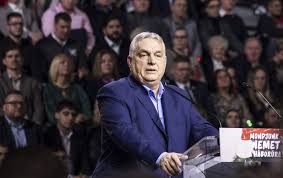
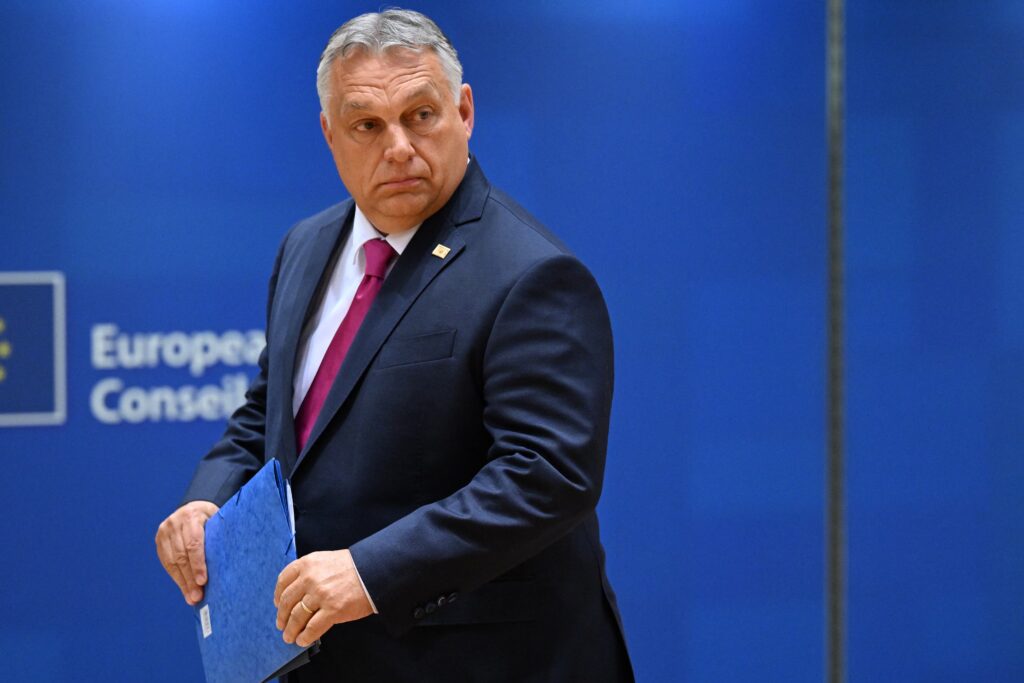
Hungarian Prime Minister Viktor Orbán has escalated his anti-EU rhetoric by claiming that Hungary should fear the European Union more than Russia, dismissing concerns about Vladimir Putin as “primitive and unserious.” He has portrayed upcoming parliamentary elections as a choice between “war and peace” and pledged to eliminate “foreign influence” and its “agents” ahead of the vote.
This framing represents a deliberate political strategy rather than a spontaneous ideological statement.
Why This Is Happening Now
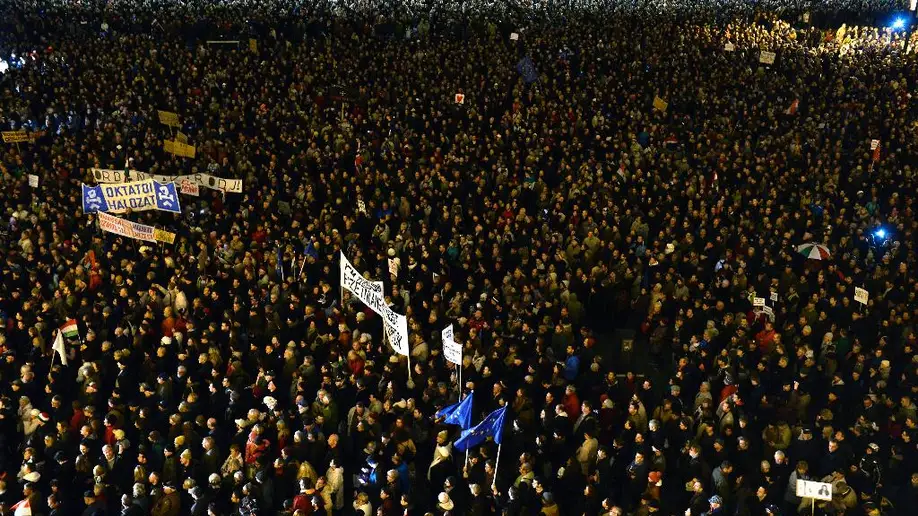
1. Electoral mobilization ahead of parliamentary elections
Orbán’s remarks come in the run-up to parliamentary elections, where Fidesz faces mounting economic and social pressures. Casting the EU as an external threat allows Orbán to:
- Mobilize nationalist voters,
- Reframe domestic governance failures as foreign interference,
- Polarize the electorate around identity and sovereignty rather than economic performance.
By presenting the election as a binary choice between “war” (EU/NATO alignment, support for Ukraine) and “peace” (Hungary’s “sovereign” path), Orbán simplifies a complex geopolitical reality into an emotionally resonant campaign narrative.
Strategic deflection from Russia-related criticism
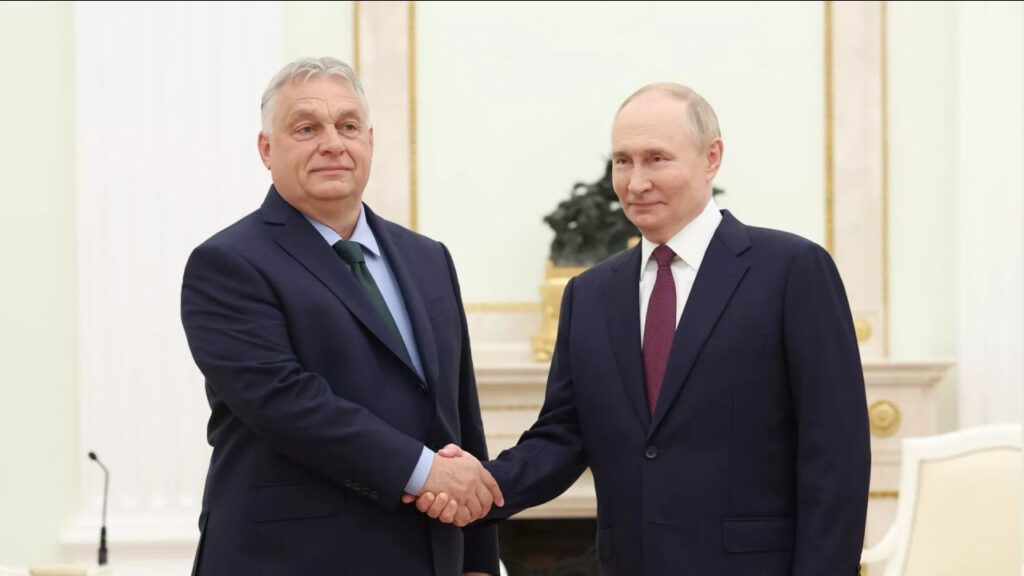
Hungary’s long-standing political and economic engagement with Russia—especially in energy cooperation—has made Orbán vulnerable to accusations of enabling Kremlin interests. By dismissing fear of Russia and elevating the EU as the primary threat, Orbán:
- Normalizes Russia as a non-threatening actor,
- Shifts public discourse away from Moscow’s war against Ukraine,
- Aligns Hungary’s narrative with Kremlin-friendly messaging that portrays the EU as an imperial, coercive structure.
This rhetorical inversion mirrors Russian information strategies that frame Western institutions as aggressors while downplaying Russia’s own revisionist behavior.
Delegitimizing EU conditionality and rule-of-law pressure
The EU’s use of funding conditionality, rule-of-law mechanisms, and legal oversight has directly affected Hungary, including the freezing of billions of euros in EU funds. By comparing the EU to the Soviet regime that once dominated Hungary, Orbán seeks to:
- Recast legal accountability as political repression,
- Undermine the legitimacy of EU institutions among Hungarian voters,
- Justify further centralization of power as “defense of sovereignty.”
This historical analogy is politically potent domestically.
EU Membership and Sovereignty: What Hungary Legally Agreed To
Sovereignty in the EU is shared by consent, not imposed
When Hungary joined the European Union in 2004, it did so voluntarily and by treaty, accepting that EU membership entails the pooling and limitation of certain sovereign competences.
This is a legal reality enshrined in the Union’s founding documents, first and foremost the Treaty on European Union (TEU).
Article 1 of the TEU explicitly states that EU member states confer competences on the Union to attain common objectives. This means sovereignty is shared by choice, not lost by coercion.
Hungary explicitly accepted the supremacy of EU law
A core principle of EU membership—recognized and accepted by Hungary at accession—is the primacy of EU law over national law in areas of EU competence.
By ratifying the EU treaties, Hungary agreed that:
- EU law takes precedence where competences are shared or exclusive,
- National legislation and constitutional practices must conform to EU obligations,
- The European Court of Justice has final authority in interpreting EU law.
This framework is not optional. It is the legal backbone of the Union.
Rejecting it would not constitute a “defense of sovereignty,” but a breach of treaty obligations.
Rule of law conditionality is not “political pressure” but treaty enforcement
Hungary also accepted that EU membership is conditional on adherence to:
- Judicial independence,
- Democratic governance,
- Protection of fundamental rights.
These principles are codified in Article 2 TEU, which defines the Union’s foundational values.
When Brussels applies rule-of-law conditionality, it is not expanding EU power, but enforcing obligations Hungary already accepted.
There is no legal basis in EU law for selective compliance—i.e., accepting funds and market access while rejecting oversight.
The false narrative of “imposed sovereignty loss”
Claims by Prime Minister Viktor Orbán that the EU represents an external force limiting Hungary’s sovereignty are legally misleading.
In reality:
- Hungary chose to limit aspects of sovereignty in exchange for membership benefits,
- Those limits are contractual, not ideological,
- No EU institution can impose new competences without member-state consent through treaty change.
The EU cannot legally behave like an empire; it operates only within the competences granted by its members—including Hungary.
The legal consequence of rejecting shared sovereignty: exit, not renegotiation
EU law provides only one mechanism for a member state that no longer accepts the treaty framework: withdrawal under Article 50 TEU.
There is no legal pathway for:
- Remaining in the EU while rejecting treaty obligations,
- Selectively obeying EU law,
- Claiming full national sovereignty alongside full EU benefits.
Therefore, if Budapest now claims that:
- EU oversight is illegitimate,
- Rule-of-law enforcement violates sovereignty,
- EU institutions are equivalent to foreign domination,
then the only legally coherent position would be to initiate withdrawal.
Hungary has not done so—because the government understands the economic, political, and strategic costs of leaving.
Strategic conclusion
Hungary’s current position is not a sovereignty dispute, but a political contradiction:
Budapest seeks to retain EU money, market access, and veto power
while rejecting the legal constraints that make those benefits possible.
From a treaty perspective, this is unsustainable.
Either:
- Hungary accepts the limits on sovereignty it voluntarily agreed to in 2004, or
- It acknowledges that rejecting those limits requires leaving the Union.
There is no third option under EU law.
Leveraging perceived U.S. engagement for domestic legitimacy
The announced visit of U.S. Secretary of State Marco Rubio is likely to be framed by Orbán as implicit international validation of his leadership. Regardless of Washington’s actual intentions, Orbán can present the visit as:
- Evidence that Hungary is not isolated,
- A signal of Western acceptance of his political course,
- A counterweight to EU criticism.
Such optics are particularly valuable during an election cycle.
Consequences
1. Further erosion of EU unity
Orbán’s rhetoric deepens fractures within the EU by:
- Undermining collective positions on Russia and Ukraine,
- Encouraging other illiberal or Eurosceptic actors,
- Weakening the EU’s ability to present a unified foreign and security policy.
This creates structural vulnerabilities the Kremlin can exploit.
Increased normalization of pro-Russian narratives
By portraying Russia as less threatening than the EU, Hungary contributes to the normalization of narratives that:
- Downplay Russian aggression,
- Question the legitimacy of Western security concerns,
- Blur the moral and legal clarity of the war in Ukraine.
Even without explicit coordination, this narrative convergence objectively benefits Moscow.
3. Domestic democratic backsliding
Labeling EU institutions and civil society as “foreign agents” raises the risk of:
- Expanded legal and political pressure on independent media and NGOs,
- Further restrictions on political pluralism,
- The use of national security rhetoric to justify repression.
Such dynamics resemble patterns seen in other illiberal regimes.
Strained transatlantic relations
While Orbán may seek to use U.S. engagement symbolically, sustained anti-EU rhetoric complicates Hungary’s position within NATO and the broader transatlantic community. Over time, this could:
- Reduce trust among allies,
- Limit Hungary’s influence in strategic decision-making,
- Increase its dependence on non-Western partners.
Orbán’s assertion that the EU poses a greater threat than Russia is not a policy assessment but a domestic political instrument. It serves electoral mobilization, deflects criticism of Russia ties, and delegitimizes external constraints on his power.
The consequences, however, extend beyond Hungary: they weaken EU cohesion, normalize Kremlin-aligned narratives, and contribute to democratic erosion inside a member state. In strategic terms, the rhetoric may yield short-term political gains for Orbán—but at the cost of Hungary’s long-term position within the European and transatlantic order.
What Orbán actually wants
Stay inside the EU, reshape it from within
Orbán’s strategy is best described as “internal obstruction and renegotiation,” not exit. Hungary gains enormously from EU membership:
- Net recipient of EU funds (infrastructure, agriculture, cohesion)
- Single Market access for exports and investment
- Political cover and veto power inside EU institutions
Leaving would sacrifice these advantages with no compensating upside.
Reduce EU oversight over domestic politics
Orbán’s core conflict with Brussels is rule-of-law conditionality (courts, media, corruption). His aim is to:
- De-legitimize EU enforcement by framing it as “foreign interference”
- Mobilize voters against Brussels to justify further centralization of power
- Force the EU into a political compromise on funds and oversight
This is why EU institutions are portrayed as a greater threat than Russia—it reframes legal accountability as existential coercion.
3) Use “exit talk” as bargaining leverage
Hints about sovereignty, comparisons to the Soviet era, and “foreign agents” rhetoric are tools to:
- Signal to Brussels that Hungary has alternatives
- Rally Eurosceptic allies inside the EU
- Extract concessions (funds, flexibility, delays)
Crucially, Orbán never initiates the legal steps required for withdrawal (Article 50). The rhetoric rises when pressure rises—and recedes after deals.
Article 50 TEU — The only legal path to reclaim full sovereignty
“Any Member State may decide to withdraw from the Union in accordance with its own constitutional requirements.”
“A Member State which decides to withdraw shall notify the European Council of its intention.”
Legal meaning:
If a state no longer accepts:
- Shared sovereignty,
- EU legal supremacy,
- Institutional oversight,
the treaties provide one—and only one—solution: withdrawal.
There is no treaty mechanism for partial membership, selective compliance, or “sovereignty à la carte.”
What Orbán does not want
A real “Huxit”
An EU exit would:
- Trigger capital flight and currency shock
- Collapse investor confidence
- Remove Hungary’s veto leverage
- Isolate Budapest economically and politically
No serious preparation for exit—legal, economic, or administrative—has occurred.
Why the rhetoric escalates now
- Elections: framing Brussels as the enemy mobilizes nationalist voters
- Frozen EU funds: pressure tactic to force compromise
- Ukraine war: distancing from EU consensus allows Orbán to maintain Russia ties
- Alliance signaling: testing how far Brussels and Washington will tolerate divergence
This is controlled escalation, not strategic rupture.
Constraints Orbán cannot cross
- Public opinion: A majority of Hungarians consistently support EU membership
- Economic dependence: Hungary’s economy is structurally EU-integrated
- Elite interests: Business and regional elites depend on EU money
- Legal reality: Exit requires sustained political consensus—absent today
Orbán is not preparing to leave the EU.
He is preparing to weaken EU influence over Hungary while staying inside the system.
The strategy:
This posture benefits Russia indirectly by weakening EU cohesion, but it is driven first and foremost by domestic power consolidation, not by a genuine plan to quit the EU.
How the EU Can Influence Hungary: Tools, Limits, and Likely Effects
Executive judgment
The European Union cannot force Hungary to comply politically, but it can impose sustained economic, legal, and reputational costs that shape Budapest’s choices.
The most effective levers are financial conditionality + institutional isolation, not rhetorical pressure.
What the EU can do instead (maximum pressure short of expulsion)
Although expulsion is impossible, the EU has powerful coercive tools that can make continued membership politically and economically painful.
1) Article 7 TEU — suspension of rights (not membership)
Under Article 7, the EU can:
- determine a serious and persistent breach of EU values,
- suspend certain rights, including voting rights in the Council.
What Article 7 does not do:
- It does not remove membership.
- It does not cancel treaty obligations.
- It does not restore full sovereignty.
A sanctioned state remains bound by EU law but loses influence—a worst-of-both-worlds outcome.
Financial conditionality and fund freezes
The EU can:
- freeze cohesion and recovery funds,
- block disbursements indefinitely,
- condition releases on verified compliance.
This affects:
- state budgets,
- municipalities,
- business elites,
- political patronage networks.
In practice, this is the EU’s strongest pressure tool.
Legal enforcement and fines
The EU can:
- pursue infringement procedures,
- impose fines via the European Court of Justice,
- escalate non-compliance into cumulative penalties.
Again: no expulsion, but rising costs.
Institutional and political isolation
The EU can:
- sideline the member in informal negotiations,
- form coalitions that work around it,
- exclude it from leadership roles and influence.
This reduces the value of staying inside while opposing the system.
Why forced expulsion was deliberately excluded
The EU’s founders intentionally rejected the idea of expulsion because:
- The EU is a union of law, not an empire.
- Forced removal would contradict voluntary integration.
- It would create dangerous precedents for political abuse.
- It could destabilize the Union by turning disputes into exit crises.
Instead, the system is designed to:
Make non-compliance costly, but exit voluntary.
The strategic paradox for a defiant member state
A government that rejects EU obligations faces a dilemma:
| Option | Result |
| Stay and comply | Loss of illiberal leverage |
| Stay and obstruct | Loss of funds, isolation, sanctions |
| Leave voluntarily | Economic and political shock |
This is why leaders like Viktor Orbán use exit rhetoric but never trigger Article 50.
- The EU cannot expel a member state.
- The EU can make continued membership increasingly costly.
- If a state truly rejects shared sovereignty, the only legal exit is voluntary withdrawal.
In practice, the EU’s strategy is not to push states out—but to force a choice between compliance and self-exit.
Financial pressure: the EU’s strongest tool
Rule-of-law conditionality & fund suspension
The EU can (and already does) withhold cohesion and recovery funds over rule-of-law violations.
Why this works
- Hungary is a net beneficiary of EU funds
- EU money underpins infrastructure, municipalities, agriculture, and patronage networks
- Long-term freezes hurt Orbán’s domestic coalition, not just the state budget
Limits
- Orbán uses delays to fuel anti-EU narratives
- Partial releases can blunt leverage if not coordinated
Assessment:
Most effective tool, especially if sustained and conditional, not symbolic.
Legal pressure: slow but cumulative
Infringement procedures & ECJ rulings
The EU can bring Hungary before the European Court of Justice for violations of EU law (media freedom, judiciary independence, asylum, NGO laws).
Why this matters
- ECJ rulings create binding legal obligations
- Fines and compliance deadlines accumulate
- Provides legal justification for further funding freezes
Limits
- Slow timelines
- Orbán can delay compliance while claiming “technical adjustments”
Assessment:
Effective as a supporting tool, not a standalone solution.
Institutional isolation: reducing Hungary’s influence
Marginalization inside EU decision-making
While Hungary cannot be expelled, the EU can:
- Sideline Budapest in informal negotiations
- Build coalitions that work around Hungarian veto threats
- Reduce Hungarian access to agenda-setting roles
Why this hurts
- Orbán values veto power and visibility
- Isolation weakens Hungary’s ability to trade obstruction for concessions
Limits
- Formal veto rights remain in some areas (foreign policy, sanctions)
- Overuse risks deepening resentment
Assessment:
Politically effective, especially when combined with financial pressure.
Article 7 and voting rights: high signal, low payoff
Suspension of voting rights
The EU can theoretically suspend Hungary’s voting rights under Article 7.
Reality check
- Requires unanimity (minus Hungary)
- Poland or other states can block
- Seen as “nuclear option”
Assessment:
Low practical impact, high symbolic value only.
Direct engagement with Hungarian society (bypassing the government)
Supporting municipalities, NGOs, academia
The EU can:
- Channel funds directly to cities and regions;
- Increase visibility of EU-funded projects;
- Support independent media and civil society within EU law.
Why this matters
- Undercuts Orbán’s narrative that “Brussels punishes Hungarians”;
- Builds long-term domestic counterweights.
Limits
- Orbán may restrict access or stigmatize recipients;
- Slow political returns.
Assessment:
Strategically important for long-term influence, not short-term compliance.
External pressure via allies (U.S., markets, investors)
Transatlantic signaling
Coordinated pressure from the U.S. and EU—on corruption, democratic standards, or strategic alignment—raises costs for Budapest.
Market discipline
- Investor confidence
- Credit ratings
- Currency stability
Why this works
- Hungary’s economy is highly integrated with Western markets
- Financial instability quickly becomes political
Assessment:
Effective indirectly, especially during economic stress.
What does not work
- Moral condemnation alone
- Public shaming without material consequences
- One-off compromises without enforcement
- Threats of EU exit (which Orbán exploits)
Why Brussels must stay disciplined
The EU’s main risk is inconsistency:
- Releasing funds too early
- Accepting cosmetic reforms
- Allowing Hungary to trade minimal concessions for full relief
This reinforces Orbán’s strategy of delay, divide, and extract.
Likely outcomes (scenario assessment)
| EU approach | Outcome |
| Sustained funding conditionality + isolation | Behavioral adjustment by Hungary |
| Symbolic pressure only | Orbán escalation + no compliance |
| Fragmented EU response | Orbán victory, weakened EU authority |
| Long-term societal engagement | Gradual rebalancing post-Orbán |
Bottom line
The EU can make Hungary listen, but only if it:
- Treats the issue as structural, not personal;
- Maintains financial pressure over time;
- Coordinates legally, politically, and externally;
Orbán’s strategy depends on Brussels blinking first.
If the EU holds the line, Hungary adapts. If it doesn’t, Orbán escalates.
Hungary can move very close to de facto isolation without leaving the EU, but it cannot be fully isolated so long as it remains a member. The most realistic end-state is “institutional isolation with economic dependency”—a position that is politically painful, strategically weakening, and domestically destabilizing, yet still short of exit.
What “de facto isolation” actually means in the EU context
Because the European Union cannot expel a member, isolation manifests as:
- Loss of influence (voice without impact),
- Loss of funds (membership costs without benefits),
- Loss of trust (exclusion from coalitions and informal power),
- Loss of credibility (markets, allies, and institutions discount Budapest).
This is not symbolic isolation; it is functional marginalization.
The isolation ladder: how far Hungary can go
Stage 1 — Political marginalization (already happening)
Status: Current / ongoing
Characteristics
- Hungary excluded from informal decision-shaping groups
- Other states coordinate positions before Council meetings
- Budapest becomes predictable “outlier,” not a swing vote
Impact
- Veto power remains, but bargaining power declines
- Orbán’s leverage shifts from “deal-maker” to “obstructionist”
Reality check:
This stage is reversible, but only with sustained cooperation.
Stage 2 — Financial isolation (partially in place)
Status: ✔ Partially active
Mechanisms
- Rule-of-law conditionality
- Freezing of cohesion and recovery funds
- Delayed or partial disbursement tied to benchmarks
Impact
- Municipalities and businesses feel direct pain
- Patronage networks weaken
- Long-term development slows
Why this matters
Hungary is a net EU fund beneficiary. Prolonged freezes turn membership into a net liability.
Stage 3 — Institutional isolation (next escalation threshold)
Status: Possible within 12–24 months
Triggers
- Persistent non-compliance with ECJ rulings
- Systematic obstruction on sanctions / Ukraine / enlargement
- Escalation of “foreign agents” or anti-EU legal measures
Consequences
- Hungary sidelined from leadership roles
- Reduced access to Commission working groups
- De facto loss of agenda-setting capacity
Key insight
At this stage, Hungary is inside the EU but outside the system that actually governs it.
Stage 4 — Rights suspension under Article 7 (symbolic but corrosive)
Status: Difficult but not impossible
What happens
- Suspension of voting rights in the Council
- Continued obligation to obey EU law
- No exit, no sovereignty restoration
Effect
- Worst-case scenario for Budapest:
“Rules without voice, obligations without influence.”
Why this matters
This is the closest the EU can come to quasi-pariah status without expulsion.
Stage 5 — Economic and reputational isolation (external spillover)
Status: Contingent but plausible
Drivers
- Investor risk reassessment
- Credit rating pressure
- Currency volatility
- Reduced Western strategic trust
Compounding factor
Hungary cannot replace EU integration with Russia or China without:
- higher financing costs,
- reduced market access,
- increased political dependence.
This creates asymmetric dependence, not autonomy.
What stops full isolation
Structural EU constraints
- No expulsion mechanism
- Need for unanimity on some sanctions
- Desire to avoid creating a “martyr state”
Hungarian domestic constraints
- Majority public support for EU membership
- Business elite reliance on EU markets
- Regional governments dependent on EU funds
NATO and security reality
Hungary remains embedded in NATO, which limits total Western disengagement even amid political friction.
How close is Hungary really?
Current position:
Between Stage 1 and Stage 2
Maximum realistic endpoint without exit:
Stage 3–4 (deep institutional + partial rights isolation)
What would push Hungary further
- Escalating anti-EU legal measures
- Open defiance of ECJ authority
- Coordinated obstruction on core EU security issues
What would pull it back
- Partial compliance on judiciary and media
- Tactical cooperation on EU foreign policy
- Acceptance of conditionality as a cost of funds
Hungary can get very close to de facto isolation—politically sidelined, financially constrained, and institutionally marginalized—without ever leaving the EU.
But this is a high-cost equilibrium:
- Orbán gains short-term domestic mobilization,
- Hungary loses long-term influence, investment, and credibility.
The EU’s leverage lies not in expulsion, but in making non-compliance more painful than cooperation.
More on this story: Hungary’s Espionage Against EU Institutions:
More on this story: Hungary’s Balancing Act: Strategic Risks of Budapest’s Covert Ties with Russia
More on this story: Orbán’s ‘EU of 26’: A Slip of the Tongue—or a Signal of Huxit Thinking?”

More on this story: The Kremlin’s Battle for Budapest: Russia’s Hybrid War to Keep Orbán in Power