
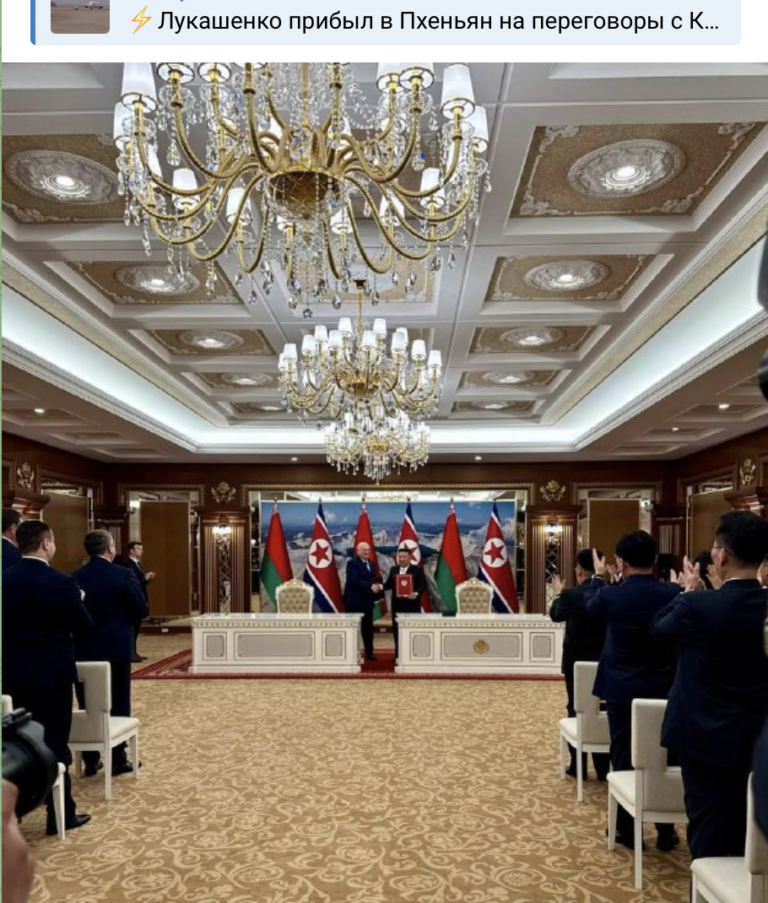
The dictator of Belarus, Alexander Lukashenko, paid his first official visit to North Korea, where he met with Kim Jong Un to “develop cooperation” between the two countries. Evidently, Moscow is strengthening its ties with North Korea by incorporating Belarus into this alignment as a subordinate ally.
Both regimes share key characteristics: authoritarian governance, support for Russia in its war against Ukraine, and international isolation due to Western sanctions. The visit is intended to reinforce political and economic ties, define priority projects, and demonstrate solidarity in opposing the Western-led international order.
North Korea has already provided military assistance to Russia, including ground forces, artillery, and missiles, while Belarus has served as a staging ground for the invasion of Ukraine. This cooperation demonstrates that Minsk and Pyongyang are capable of coordinating actions in the military and strategic domains, creating direct threats to the United States and its allies.
Moreover, this rapprochement reduces North Korea’s isolation, undermining U.S. sanctions policy. Lukashenko has confirmed his readiness to actively expand political and economic relations with Pyongyang, further integrating Belarus into Russia’s geopolitical orbit.
The expansion of cooperation facilitates:
- the exchange of military technologies,
- financial support,
- and the flow of resources that enhance North Korea’s capabilities.
For the United States, this translates into growing threats across military, political, and economic domains in Asia, driven by a more empowered North Korea pursuing an increasingly aggressive policy.
It is also likely that Washington’s sanctions regime will become more difficult to enforce as Minsk–Pyongyang ties deepen with Moscow’s support. As a result, the Russia–Belarus–Pyongyang triangle is emerging as a long-term platform for coordinated actions against U.S. interests.
North Korea remains one of the principal challenges to U.S. security due to its nuclear and missile programs. While U.S. sanctions constrain its economy, cooperation with Russia and Belarus allows Pyongyang to offset some of these limitations.
North Korea has already deployed thousands of soldiers and supplied weapons in support of Russia. Assistance from Belarus and Russia could further expand opportunities for military technology transfers and increase North Korea’s geopolitical weight in the region.
The strengthening of this anti-Western alignment complicates peace initiatives and negotiations on the denuclearization of the Korean Peninsula. In this context, the integration of Belarus, Russia, and North Korea creates long-term risks for the strategic position of the United States.
Lukashenko’s visit to North Korea serves to deepen political and economic ties and demonstrates the solidarity of authoritarian regimes and their willingness to coordinate joint actions against Western influence, particularly that of the United States.
The growing alignment along the Russia–Belarus–North Korea axis undermines efforts to maintain stability in the international order. The United States may be forced to reassess its deterrence strategies in both East Asia and Europe.
The coordination between Minsk, Pyongyang, and Moscow creates a multidimensional threat encompassing diplomatic, economic, and military challenges for the United States and its allies.
The Moscow–Minsk–Pyongyang Axis: Strategic Convergence and the Erosion of Western Deterrence
Executive Assessment
The visit of Alexander Lukashenko to North Korea and his meeting with Kim Jong Un signal more than symbolic diplomacy—it reflects the consolidation of a coordinated authoritarian alignment anchored by Russia. This emerging triangle—Russia, Belarus, and North Korea—represents a multi-domain challenge that blends military cooperation, sanctions evasion, and geopolitical signaling.
The axis is not a formal alliance, but a functional coalition of sanctioned regimes seeking to offset Western pressure, enhance strategic autonomy, and expand operational capabilities across regions.
Key Judgments
The Russia–Belarus–North Korea alignment is evolving into a coordinated sanctions-resilience ecosystem, not merely a political partnership.
Belarus is transitioning from a passive ally into an active intermediary and facilitator, particularly in sanctions evasion and logistics.
North Korea’s growing integration into this axis is likely to accelerate its military modernization, especially in missile and potentially nuclear delivery systems.
Structural Logic of the Emerging Axis
The convergence of Moscow, Minsk, and Pyongyang is driven by shared constraints and complementary capabilities:
- Russia provides:
- strategic coordination
- military-industrial expertise
- global diplomatic cover
- Belarus contributes:
- logistical access to Europe
- experience in sanctions circumvention
- territorial and infrastructural support
- North Korea offers:
- manpower and ammunition
- scalable weapons production
- willingness to operate outside international norms
This creates a mutually reinforcing system, where each actor compensates for the others’ vulnerabilities.
Belarus as a Strategic Enabler
Lukashenko’s role is evolving beyond symbolic alignment.
Belarus functions as:
- a forward operating platform (as seen during the invasion of Ukraine),
- a sanctions evasion hub, leveraging:
- re-export schemes
- dual-use goods
- opaque financial channels
➡️ By engaging North Korea, Belarus extends these mechanisms into East Asia, effectively:
- bridging two sanctioned systems,
- facilitating resource and technology exchange.
This elevates Minsk from a junior partner to a critical node in transregional coordination.
North Korea’s Strategic Gains
For North Korea, this alignment delivers three major advantages:
A. Sanctions Dilution
Cooperation with Russia and Belarus:
- opens alternative trade routes
- reduces dependency on limited partners
- weakens enforcement of U.S.-led sanctions
B. Military Enhancement
Potential areas of exchange include:
- missile technology refinement
- satellite and targeting capabilities
- battlefield experience transfer from Ukraine
C. Political Legitimacy
High-level engagement with Belarus—and indirectly Russia—helps:
- break diplomatic isolation
- reinforce regime stability
- signal resilience against Western pressure
Military Dimension: Toward Operational Coordination
Evidence of North Korean support to Russia—including:
- artillery systems
- missiles
- reported personnel deployments
suggests the axis is already operationally active.
The next phase may include:
- coordinated military production chains
- joint adaptation of battlefield technologies
- indirect interoperability through shared doctrine and experience
This creates a feedback loop, where:
- war in Ukraine accelerates North Korean capabilities,
- which in turn reinforces Russia’s war effort.
Sanctions Evasion as a System
The trilateral alignment is particularly dangerous because it:
- does not merely evade sanctions
- but institutionalizes evasion
Mechanisms likely include:
- falsified end-user certificates
- re-labeling of goods via Belarus
- shadow financial transactions
- use of third-country intermediaries
Over time, this can:
- erode the credibility of sanctions regimes
- encourage other sanctioned states to adopt similar models
Strategic Implications for the United States
A. Cross-Theater Security Convergence
The U.S. must now manage:
- European security (Russia, Belarus)
- East Asian security (North Korea)
as interconnected theaters, not separate domains.
B. Erosion of Deterrence
The axis:
- distributes risk across multiple actors
- complicates retaliation
- increases ambiguity
Traditional deterrence models become less effective.
C. Increased Military Risk in Asia
A strengthened North Korea:
- expands missile and nuclear capabilities
- adopts more aggressive posturing
- raises the risk of escalation on the Korean Peninsula
D. Pressure on Sanctions Architecture
The U.S. faces:
- declining enforcement efficiency
- increased cost of monitoring global networks
- need for adaptive sanctions strategies
Strategic Outlook (2026–2030)
Best-Case Scenario
- cooperation remains limited and transactional
- internal constraints (economic, political) limit deep integration
Baseline Scenario
- gradual expansion of coordination
- sustained sanctions evasion
- incremental military capability growth
Worst-Case Scenario
- formalization of the axis into a quasi-alliance
- large-scale military-technical exchange
- synchronized geopolitical actions across regions
Core Analytical Conclusion
The Russia–Belarus–North Korea alignment represents a shift from isolated authoritarian regimes to a networked system of mutual reinforcement, capable of undermining Western pressure and reshaping regional security dynamics.
How to Read the Triangle (Structured Flows)
Core Nodes
- Russia (top vertex) – strategic coordinator
- Belarus (left vertex) – logistics & sanctions hub
- North Korea (right vertex) – military production & manpower
Directional Flows
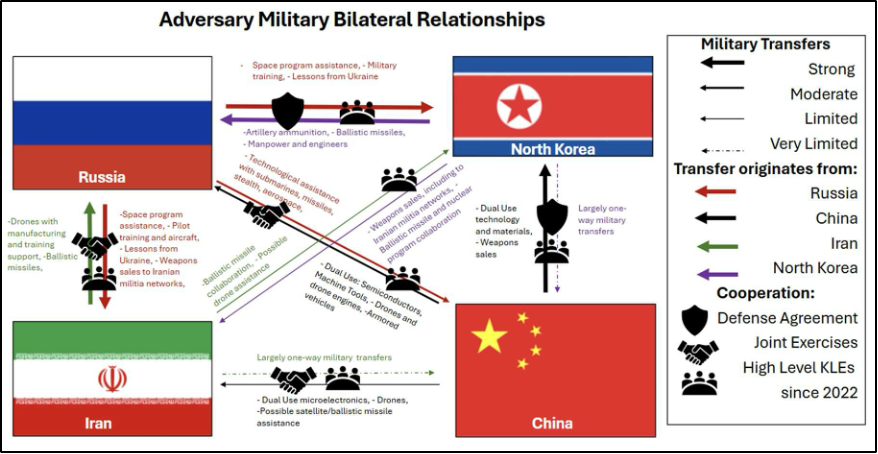
. Russia → North Korea
Technology & Strategic Support
- Missile and satellite technology transfer
- Military know-how (battlefield adaptation from Ukraine)
Diplomatic cover in international forums