
Calls within France to suspend sanctions on Russian oil and gas reflect a broader and more dangerous trend: the gradual politicization and potential fragmentation of the Western sanctions regime. While framed as a response to short-term energy market volatility, such proposals risk producing long-term strategic gains for Russia.
Even limited or temporary sanctions relief has already demonstrated its impact—allowing Moscow to stabilize revenues, sustain military operations, and regain economic maneuverability. If replicated at the European level, this dynamic could erode deterrence, prolong the war in Ukraine, and reintroduce structural vulnerabilities into Europe’s energy security architecture.
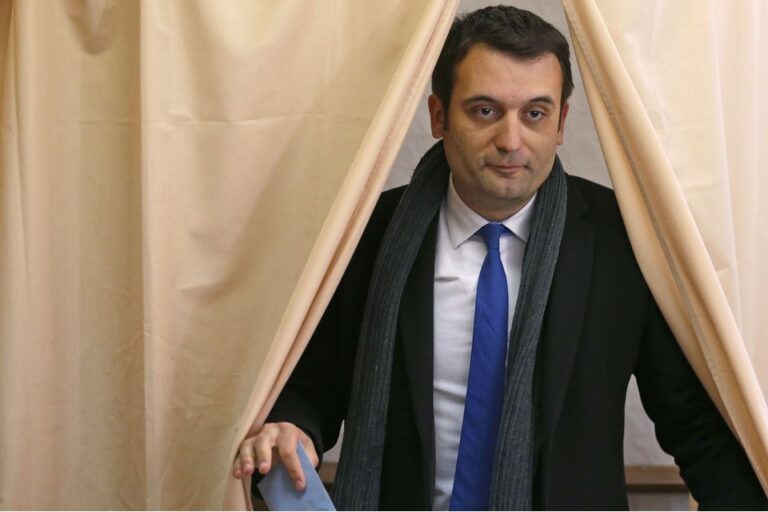
The leader of the French party Patriots, right-wing populist Florian Philippot, has called on France to follow the example of the United States and South Korea and suspend anti-Russian sanctions on oil and gas due to disruptions in the global energy market.
“The United States has suspended sanctions against Russia, and the Republic of Korea has done the same. France should follow suit, as we have gas and oil at our disposal that are essential for normal life. However, to do this, we would need to leave the European Union, because this decision depends on Brussels—not Paris, but the EU. Therefore, if we want to do this, we must become an independent country; we need Frexit,” Philippot stated during a protest against anti-Russian sanctions held on March 28.
The French party The Patriots (French: Les Patriotes) is a small right-wing, nationalist and strongly Eurosceptic political movement founded in 2017 by Florian Philippot. after he left the National Front (now National Rally).
- The split was driven by disagreements over:
- leaving the euro;
- strategy after the 2017 French elections.
In simple terms:
It is a breakaway movement from Marine Le Pen’s party, with a more radical sovereignty agenda.
Ideology (Core Ideas)
The party is built around “sovereigntism” — the idea that France must regain full national control.
Key positions:
- Hard Euroscepticism (strong opposition to the EU);
- Exit from the eurozone;
- Frexit (France leaving the EU entirely).
- Opposition to NATO;
- Emphasis on French nationalism and state sovereignty
Ideological mix:
- Nationalism;
- Gaullism (state independence tradition);
- right-wing populism.
Political Positioning
The Patriots position themselves as:
“Anti-system” — against Brussels, globalism, and Western alliances.
They often campaign on:
- lifting sanctions on Russia;
- reducing support for Ukraine;
- criticizing EU economic policies.
Political Weight
- The party has very limited electoral success
- Example:
- ~0.6% in the 2019 European elections;
- no major parliamentary representation.
Reality:
It is more influential in media and protests than in elections
What Makes It Relevant
Despite low votes, the party matters because:
- It is highly active in protests and social media
- It pushes strong, polarizing narratives:
- anti-sanctions
- anti-NATO
- pro-sovereignty
- Its messaging is often picked up in broader geopolitical debates
Simple Explanation
Think of Les Patriotes as:
A small but loud nationalist movement focused on
France leaving the EU and restoring full independence
- Founded by Philippot after leaving Le Pen’s party
- Strongly anti-EU, anti-NATO, pro-sovereignty
- Politically marginal — but narratively influential
In March 2026, the United States temporarily suspended certain sanctions on Russian oil and petroleum products for 30 days, particularly those already loaded onto tankers at sea. This allowed other countries, including South Korea, to purchase Russian oil without the risk of secondary U.S. sanctions.
This step was linked to the need to stabilize global oil prices, which had surged sharply following U.S. and Israeli strikes on Iranian targets. The measure is temporary and does not отменяет the core sanctions against Russia; rather, it allows “stranded” oil shipments to be released in order to mitigate price shocks.
Assessment
Philippot’s statement goes far beyond domestic French politics. It represents a proposal that undermines the EU’s unified sanctions strategy and creates a long-term threat to European security. Under current conditions, any calls to ease pressure on Russia directly serve its strategic interests.
Statements suggesting a possible revision of sanctions strengthen the Kremlin’s position by creating the perception that Western pressure may weaken. This reduces Russia’s incentive to compromise in negotiations, as it anticipates sanctions relief without making concessions. As a result, Moscow’s confidence in its strategy increases, prolonging the search for peaceful solutions.
The temporary easing of U.S. sanctions has already demonstrated that even limited exceptions allow Russia to stabilize revenues, rebuild capacity, and secure additional resources to continue its war against Ukraine. Any crack in the sanctions regime quickly translates into a strategic advantage for the Kremlin.
Implications
- If France were to suspend sanctions on Russian oil and gas, it would set a dangerous precedent for other EU states.
The sanctions regime could fragment into separate segments, significantly reducing its effectiveness. - Russia would gain additional financial resources to continue the war against Ukraine and expand hybrid influence operations in Europe.
- A return to Russian energy imports would once again make France vulnerable to political coercion by the Kremlin, as energy dependence has historically been used as a geopolitical pressure tool.
- Such a move would undermine trust in France as a reliable partner within the EU and NATO.
- Even the limited U.S. sanctions relief—intended as a temporary stabilization measure—creates risks of a broader revision of sanctions policy. For Ukraine, this would mean reduced pressure on Russia and a potential prolongation of the war.
If the sanctions front against Russia begins to erode, the consequences for Europe will be severe. The Kremlin will gain greater room for economic and political maneuvering and will intensify its use of energy as a geopolitical weapon.
Ultimately, this would not only weaken Ukraine but also increase long-term security risks for France and the European Union.
Key Judgments
- Sanctions cohesion is more important than sanctions intensity — fragmentation, even partial, undermines effectiveness.
- Temporary exceptions create permanent strategic effects, signaling weakness and encouraging Russian intransigence.
- Energy dependence remains a core geopolitical vulnerability that Russia can rapidly re-exploit.
- Domestic political narratives can become instruments of external strategic advantage.
- The current debate risks transforming economic pressure into strategic relief for Moscow.
From Tactical Adjustment to Strategic Precedent
The U.S. decision to temporarily ease certain restrictions on Russian oil shipments was a tactical measure aimed at stabilizing global energy prices, not a shift in long-term policy.
However, when interpreted politically—such as by Florian Philippot—this limited step becomes a strategic precedent.
Critical distinction:
- U.S. move → short-term market stabilization
- Political reinterpretation → justification for structural sanctions rollback
This misalignment transforms a controlled adjustment into a potential policy rupture.
The Fragility of Sanctions Unity
Sanctions regimes function as collective instruments of pressure, not isolated national policies.
If a major EU state such as France were to suspend restrictions:
- The system risks fragmentation into national approaches
- Enforcement becomes inconsistent
- Loopholes multiply across jurisdictions
Systemic effect:
Sanctions do not fail all at once—they erode gradually through exceptions, precedents, and political divergence.
Strategic Signaling to Moscow
Perhaps the most immediate impact of sanctions debates is psychological and strategic signaling.
From Moscow’s perspective:
- Calls for easing pressure suggest Western fatigue
- Internal divisions indicate declining political will
- Time appears to be working in Russia’s favor
Result:
Russia becomes less incentivized to negotiate, expecting eventual sanctions relief without concessions.
This reinforces a key Kremlin assumption:
endurance outperforms compromise.
Economic Effects: Small Openings, Large Gains
Even limited sanctions relief produces disproportionate economic benefits:
- Release of “stranded” oil increases liquidity
- Higher global prices amplify revenue effects
- Additional income feeds directly into:
- military spending
- sanctions adaptation mechanisms
Key insight:
Sanctions operate on pressure margins —
even minor reductions can significantly weaken overall impact.
Energy as a Weapon: The Return of Dependency
A potential resumption of Russian energy imports would reintroduce a structural vulnerability that Europe has spent years attempting to reduce.
Historically, Russia has used energy exports as:
- a tool of political leverage
- a means of dividing European states
- a mechanism for influencing policy decisions
- Re-engagement risks:
- renewed exposure to coercion
- erosion of strategic autonomy
- reversal of diversification gains
Political Narratives as Strategic Instruments
Domestic political messaging—particularly in times of economic strain—can unintentionally align with adversarial interests.
Proposals framed as:
- economic relief
- sovereignty restoration
- energy pragmatism
…may function in practice as:
- strategic enablers for Russia
This reflects a broader pattern:
Hybrid competition increasingly operates through internal political discourse, not just external pressure.
Outlook: From Erosion to Breakdown
If current trends continue:
Short-term:
- Increased debate on sanctions adjustments
- selective national exceptions
Medium-term:
- fragmentation of EU sanctions regime
- normalization of partial compliance
Long-term:
- collapse of unified pressure architecture
- expanded Russian economic and geopolitical maneuverability
Policy Implications for the U.S. and EU
- Reinforce sanctions unity as a strategic priority
Political cohesion must be treated as a core security asset. - Clearly communicate the temporary nature of exceptions
Avoid misinterpretation as policy shifts. - Target enforcement gaps aggressively
Prevent the emergence of parallel national approaches. - Accelerate energy diversification efforts
Reduce structural exposure to Russian leverage. - Counter disinformation and political narratives
Address internal messaging that undermines strategic coherence.
The risk is not an immediate collapse of sanctions—but a gradual erosion driven by political reinterpretation and selective relaxation.
Even small cracks in the sanctions regime can become strategic openings for Russia.
If left unaddressed, these cracks may ultimately transform economic pressure into strategic advantage for Moscow.
There is no publicly proven direct operational or financial link between Florian Philippot and the Kremlin, but there is substantial evidence of political alignment, narrative convergence, and indirect amplification through pro-Russian ecosystems.
Political Positioning: Consistently Pro-Russian Narrative
Philippot is widely described as holding pro-Russian or Russia-aligned positions, especially since 2022:
- Criticizes Western support to Ukraine;
- Calls for lifting sanctions on Russia;
- Opposes NATO and EU policies toward Moscow.
Analysts note he has shown:
“a strong … pro-Russian stance”
French sources also indicate:
- He defended Russian positions during the Ukraine war;
- Spread misleading or pro-Russian narratives about Ukraine.
Interpretation:
Not a formal alliance — but consistent alignment with Kremlin geopolitical messaging
Narrative Amplification by Russian Media
Philippot’s statements and protests are frequently:
- Picked up by Russian state or pro-Kremlin media;
- Amplified globally as “evidence” of Western dissent.
Example:
- His anti-NATO protests in Paris were reframed by Russian media as broader anti-West sentiment
Mechanism:
Russia does not need control — it leverages:
- useful political voices
- existing dissent narratives
Indirect Contact Signals (Weak Evidence)
There are very limited and weak indications of personal-level proximity:
- A suspected pro-Kremlin-linked individual claimed to have met Philippot at a public event
- Philippot denied any meaningful relationship
Assessment:
- No verified operational ties;
- No evidence of coordination.
Ideological Ecosystem: Where the Link Actually Exists
Philippot operates within a broader political space that:
- Is Eurosceptic;
- Opposes sanctions;
- Supports rapprochement with Russia.
Historically, this ecosystem has had documented links to Russia (e.g., financial ties involving figures from his former party, National Front).
Important distinction:
- That does NOT automatically prove Philippot himself is funded or controlled
- But it places him in a network historically penetrated by Russian influence.
Intelligence Assessment (Most Accurate Framing)
What is NOT proven:
- Direct Kremlin control;
- Financial payments to Philippot;
- Intelligence collaboration.
What IS observable:
- Narrative alignment with Russian strategic interests
- Amplification by Russian information channels
- Political positions that objectively benefit Moscow
Key Analytical Insight
The relationship is best understood not as “control,” but as convergence.
Russia’s strategy in Europe often works through:
- alignment of interests
- exploitation of domestic actors
- amplification, not ownership
Florian Philippot is not proven to be “linked” to Russia in a direct operational sense.
However:
His positions, messaging, and political agenda consistently align with Kremlin strategic objectives,
and his voice is systematically amplified within pro-Russian information ecosystems.
What Motivates Philippot’s Pro-Russia Positions?
Executive Judgment
Philippot’s stance is best explained by a combination of ideological alignment, domestic political strategy, and strategic opportunism—not proven direct ties to Russia.
Ideological Driver: Sovereignty vs EU/NATO
Philippot’s core ideology centers on:
- Frexit (France leaving the EU);
- Opposition to NATO;
- Rejection of supranational governance.
In this worldview:
- The EU = constraint on French sovereignty;
- NATO = instrument of U.S. dominance.
Russia, by contrast, is framed as:
- a counterweight to Western institutions
- a symbol of “sovereign state power”
Conclusion:
Support for Russia is often indirect — rooted in opposition to the EU/NATO system.
Political Strategy: Mobilizing Discontent
Philippot operates outside mainstream French politics and relies on:
- Protest movements;
- Anti-establishment narratives;
- Economic grievances (energy prices, inflation).
Key messaging themes:
- “Sanctions hurt France more than Russia”;
- “France is sacrificing itself for Ukraine”.
This resonates with:
- lower-income voters;
- protest movements;
- Eurosceptic audiences.
Conclusion:
Pro-Russia positioning is politically useful for building a niche base.
Energy Narrative: Economic Framing
A central pillar of his messaging:
- lifting sanctions = lower energy prices
- restoring Russian imports = economic stability
This reframes geopolitics into:
- household economics;
- cost-of-living crisis.
Important:
This argument is simplified but effective politically, even if strategically risky.
Information Ecosystem Incentives
Philippot’s messaging is frequently:
- Amplified by pro-Kremlin media;
- Circulated in alternative media ecosystems.
Result:
- Increased visibility;
- Reinforcement of messaging;
- Feedback loop of influence.
Key insight:
He benefits from attention amplification, even without coordination.
Structural Convergence with Russian Strategy
Russia’s objectives in Europe include:
- weakening EU unity,
- undermining sanctions,
- reducing support for Ukraine.
Philippot’s positions:
- align with all three
This creates what analysts call:
“alignment without control”
What Is NOT Proven
There is no credible evidence of:
- Russian funding to Philippot
- Direct coordination with the Kremlin
- Intelligence or operational links
Motivation Matrix
| Driver | Strength | Explanation |
| Ideology (sovereignty) | 🔴 High | Core worldview |
| Political survival | 🔴 High | Niche positioning |
| Economic narrative | 🟠 Medium–High | Energy messaging |
| Media amplification | 🟠 Medium | Visibility boost |
| Direct Russian ties | ⚪ None proven | No evidence |
Strategic Interpretation
Philippot is not necessarily “pro-Russian” in intent—
he is anti-system (EU/NATO).
But:
In the current geopolitical environment,
anti-system = objectively pro-Russian effect
Philippot’s support for Russia is driven less by loyalty to Moscow and more by domestic political incentives and ideological opposition to the Western system.
Core peers: most similar to Philippot
Viktor Orbán
Orbán is the clearest governing counterpart on the energy-plus-sovereignty axis. Reuters reports that Hungary urged the EU to suspend sanctions on Russian energy in March 2026, and Hungary has repeatedly used EU decision points to seek carve-outs or concessions connected to Russian oil and sanctions policy.
Robert Fico
Fico is closest to Philippot on the “sanctions hurt us more than Russia” argument. Reuters reported that Fico long opposed sanctions on Russia on the grounds that they harmed Slovakia and the EU more than Moscow, and that Slovakia joined Hungary in holding up EU sanctions decisions in 2026.
Marine Le Pen / National Rally
Le Pen is not identical to Philippot, but she belongs in the same broader French sovereigntist space. Reuters documented National Rally’s 2014 Russian-linked loan and the party’s later legal settlement over that debt, making her case more concrete on the documented overlap dimension than Philippot’s.
Secondary peers: similar motivations, weaker or more mixed overlap
Sahra Wagenknecht
Wagenknecht fits the “peace / anti-arms / anti-establishment” lane. Reuters reported that her BSW party conditioned regional coalition support on less hawkish positions on Ukraine and on calls to stop arming Kyiv. That is not the same ideology as Philippot’s right-wing sovereigntism, but the practical effect can converge: reduced support for Ukraine and greater pressure for accommodation.
Matteo Salvini
Salvini is a looser fit. Reuters reported that he questioned continued aid to Ukraine in late 2025 and has a history of being seen as comparatively soft toward Russia inside Italian politics. His motivation looks more like electoral opportunism plus anti-establishment nationalism than a fully developed sanctions doctrine.
Party ecosystem with partial overlap
AfD milieu
AfD is best understood as a party ecosystem, not one uniform motivation set. Reuters reported scrutiny of AfD over alleged Kremlin ties and visits to Russia by party lawmakers, while other reporting says German institutions limited some disclosures because of fears of leaks. That makes AfD more relevant on the documented scrutiny / overlap side than on a single motivation profile.
Motivation clusters
A. Sovereignty first
These actors frame the EU and NATO as constraints on national independence. That is Philippot’s home terrain, and it strongly overlaps with Orbán and, in different ways, Le Pen and Salvini.
B. Energy-price opportunism
These actors use inflation, fuel prices, and energy insecurity to argue for easing sanctions or maintaining Russian energy channels. Orbán and Fico are the strongest examples; Philippot echoes the same logic in France.
C. “Peace” framing / anti-aid politics
These actors say they want de-escalation, negotiations, or an end to arms deliveries. Wagenknecht is the clearest case here; parts of AfD and Salvini’s rhetoric sometimes converge with this frame.
D. Institutional or financial overlap
This is the narrowest and most serious category. Le Pen’s party had a documented Russian loan; AfD has faced sustained scrutiny over alleged ties and contacts; Philippot, by contrast, is better described as a figure whose messaging has been amplified by pro-Russian ecosystems rather than a politician with proven direct operational ties.
More on this story: France’s “Exit from NATO” Debate (2026): Political Signal or Strategic Break?