
Skip to content

Robert Lansing Institute

Robert Lansing Institute
Twitter Linkedin
Menu
  • Home
  • Who We Are
    • About Robert Lansing
    • About Robert Lansing Institute
    • What we do
    • Research
  • Analysis
    • Conflict
    • Corruption
    • Democracy
    • Economy
    • Energy
    • Drug trafficking
    • Food Security
    • Geopolitics
    • Governance
    • Intelligence ops
    • Opinion
    • Peacekeeping
    • Propaganda and Disinformation
    • Psyops
    • Terrorism
    • Warfare
  • Must Read
    • Analytic papers
    • Infographics we recommend
Generic selectors
Exact matches only
Search in title
Search in content
Post Type Selectors
Filter by Categories
-
climate change
Conflict
Corruption
Coup
Democracy
Drug trafficking
ecology
Economy
Energy
Estimates
Food Security
Geoeconomics
Geopolitics
Governance
Healthcare
ideology
Intelligence ops
migration
Must Read Infographics
Must Read PDF
National Security
Nonproliferation
Opinion
Peacekeeping
profile
Propaganda and Disinformation
Psyops
Situation Reports
Terrorism
War crimes
Warfare
  • Home
  • Who We Are
    • About Robert Lansing
    • About Robert Lansing Institute
    • What we do
    • Research
  • Analysis
    • Conflict
    • Corruption
    • Democracy
    • Economy
    • Energy
    • Drug trafficking
    • Food Security
    • Geopolitics
    • Governance
    • Intelligence ops
    • Opinion
    • Peacekeeping
    • Propaganda and Disinformation
    • Psyops
    • Terrorism
    • Warfare
  • Must Read
    • Analytic papers
    • Infographics we recommend
Robert Lansing Institute
Twitter Linkedin

National Security

Moscow’s Arctic Red Lines: How Russia Could Respond to the Militarisation of Greenland
Posted inConflict Geopolitics National Security

Moscow’s Arctic Red Lines: How Russia Could Respond to the Militarisation of Greenland

Russian Foreign Minister Sergey Lavrov stated that if Greenland is militarized and actions threatening Russia are implemented there, Moscow will take military-technical measures. “Of course, in the event of the militarization of…
Read More
February 12, 2026Tags: Greenland, Russia, USA
Russia’s Borderlock in Central Africa: Gold, Gray Zones, and the Erosion of U.S. Leverage
Posted inConflict Geopolitics National Security Warfare

Russia’s Borderlock in Central Africa: Gold, Gray Zones, and the Erosion of U.S. Leverage

Russia’s actions along the Sudan–CAR border following the gold-mine incident represent not a security response, but a deliberate territorial control operation. By sealing cross-border routes, detaining civilians, and denying access to observers, Moscow…
Read More
February 9, 2026Tags: CAR, gold, Russia, Sudan, USA
Paks II: Engineering Red Flags and the Political Economy of Nuclear Risk in Central Europe
Posted inCorruption Geoeconomics National Security

Paks II: Engineering Red Flags and the Political Economy of Nuclear Risk in Central Europe

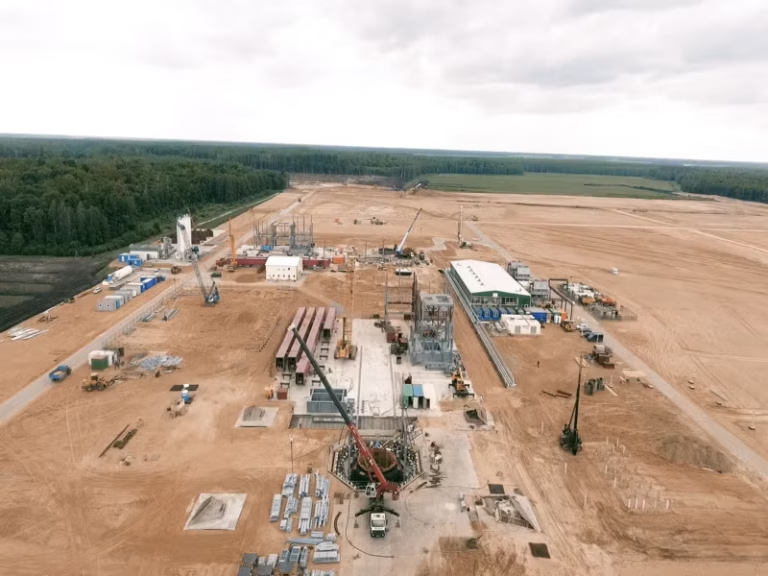
The ceremonial launch of the first concrete pour for Unit 5 of the Paks II Nuclear Power Plant was staged with great pomp and, according to the plan of Prime Minister Viktor…
Read More
February 7, 2026Tags: Hungary, Rosatom
Parliamentary Contact as a Tool of Influence: How Moscow Will Exploit Anna Paulina Luna Initiative
Posted inGeopolitics Intelligence ops National Security

Parliamentary Contact as a Tool of Influence: How Moscow Will Exploit Anna Paulina Luna Initiative

Republican Congresswoman Anna Paulina Luna invited deputies of the State Duma of the Russian Federation to Washington with the declared purpose of holding consultations and discussions on a peaceful settlement of the war in…
Read More
February 2, 2026Tags: Russia, Ukraine, USA
China’s Hidden Role in Russia’s Missile War: Mapping the Electronics Supply Chain
Posted inGeoeconomics National Security Warfare

China’s Hidden Role in Russia’s Missile War: Mapping the Electronics Supply Chain

China is becoming a party to the Russia–Ukraine conflict by increasing supplies of components to enterprises of Russia’s military-industrial complex, including those used in the production and modernization of missiles…
Read More
January 26, 2026Tags: China, Russia, Sanctions
Russia’s “Internet Kill Switch” Export: How Moscow Helped Iran Crush Protests
Posted inDemocracy Intelligence ops National Security

Russia’s “Internet Kill Switch” Export: How Moscow Helped Iran Crush Protests

Russia allegedly helped Iran disable mobile communications and isolate the country from the global Internet as mass anti-government protests escalated into the most serious domestic challenge the Islamic Republic has…
Read More
January 16, 2026Tags: Cyberattacks, Iran, Russia
France’s “Exit from NATO” Debate (2026): Political Signal or Strategic Break?
Posted inGeopolitics Governance National Security

France’s “Exit from NATO” Debate (2026): Political Signal or Strategic Break?

In January 2026, parts of the French opposition reignited a familiar theme in French strategic culture: “strategic autonomy” and skepticism toward NATO as a US-led security architecture. The immediate catalyst has been…
Read More
January 13, 2026Tags: France, NATO
Trump’s Threats to “Hit Land” in Mexico: Escalation Logic, Operational Limits, and Political Effects
Posted inDrug trafficking Governance National Security Warfare

Trump’s Threats to “Hit Land” in Mexico: Escalation Logic, Operational Limits, and Political Effects

In early January 2026, President Donald Trump signaled that the U.S. would begin “hitting land” against drug cartels, asserting that cartels are “running Mexico,” and suggesting that military action could…
Read More
January 9, 2026Tags: Mexico, USA
The Graham Sanctions Bill: Strategic Escalation Against Russia’s Shadow Economy
Posted inGeoeconomics National Security

The Graham Sanctions Bill: Strategic Escalation Against Russia’s Shadow Economy

What the Lindsey Graham Sanctions Bill Is—and What It Signals The sanctions initiative associated with Lindsey Graham represents a qualitative escalation in U.S. economic warfare against Russia. Unlike earlier sanctions rounds that focused primarily…
Read More
January 8, 2026Tags: Russia, Sanctions, USA
Patrick Egan’s Media Ecosystem: Orbán’s Anglosphere Weapon and Its Convergence With Russian Interests
Posted inIntelligence ops National Security Propaganda and Disinformation

Patrick Egan’s Media Ecosystem: Orbán’s Anglosphere Weapon and Its Convergence With Russian Interests

Over the past decade, Patrick Egan has emerged as a central node in Viktor Orbán’s international media strategy. An American strategist and media advisor, he is now widely identified as a key Anglosphere…
Read More
January 6, 2026Tags: Hungary, Russia, USA

Posts pagination

Previous page 1 2 3 4 … 22 Next page

Partner Institutes

The Center for Nationalism Studies (CNS)

Headquarter: director@lansinginstitute.org

Africa: africa@lansinginstitute.org

America: america@lansinginstitute.org

Asia: asia@lansinginstitute.org

Europe: europe@lansinginstitute.org

Headquarter:
19 Holly Cove Ln., Dover,  Kent,  Del., 19901.

Phone: +1 302.499.20.07

European branch:
La Grande Arche – Paroi Nord La Défense FR,
1 Tunnel de Nanterre-La Défense, 92044 Paris, France
Phone: +33 695.42.57.44

Copyright 2019-2026— Robert Lansing Institute e. All rights reserved.
Scroll to Top