
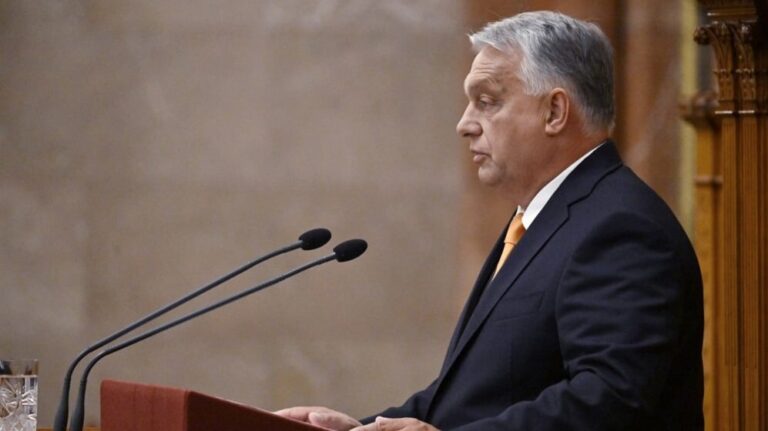
The lead opposition figure in Hungary, Péter Magyar, has called on Prime Minister Viktor Orbán to resign in the wake of a major child-abuse scandal. According to Magyar, the government must step down after a public revelation of prolonged abuse of children and minors at a state-run juvenile facility in Budapest. The allegations — which reportedly span many years — include physical violence, and have recently been underscored by a newly released video showing children being assaulted
Although the acting head of the institution has resigned and police carried out a raid on the facility, opposition lawmakers demand a full-scale investigation — including into alleged sexual violence and an alleged prostitution ring organized by the previous director of the centre. Prosecutors reportedly have detained several individuals and are investigating the former director for serious crimes, including human-trafficking and forced sexual exploitation of minors.
Magyar argues that such systemic abuses, occurring under state supervision, cannot be treated as isolated misdeeds.He holds Orbán’s administration directly accountable, calling it morally and politically bankrupt. In his statement, Magyar urged the head of state to publicly comment on the scandal and demanded the rapid scheduling of early parliamentary elections
This is not the first time Magyar has publicly confronted Orbán’s regime over child-protection failures. In 2024, a different scandal erupted when it emerged that then-president Katalin Novák had pardoned a man convicted of covering up child sexual abuse at a state orphanage. That pardon, seen by many as a craven act of clemency, provoked widespread public outrage — forcing Novák and the then-justice minister to resign and triggering one of the worst political crises in nearly two decades of Orbán rule.
It was in the aftermath of that 2024 scandal that Magyar founded his opposition party TISZA, which has since surged in the polls. TISZA is a viable challenger to Orbán’s ruling party, Fidesz, ahead of the next parliamentary elections, expected in April 2026
Opponents of Orbán now argue that the latest scandal strikes at the core of his government’s long-promoted image as a defender of “Christian values,” “family morality,” and the moral protection of children. They contend the revelations expose the hypocrisy of a regime that simultaneously bans LGBTQ advocacy under the banner of child protection while failing to shield actual children from abuse in state-managed institutions
As public pressure mounts, the Orbán government has responded by placing several state-run juvenile detention centres under direct police oversight — a move interpreted as an attempt to contain the fallout. Prosecutors say multiple people have been detained in connection with the scandal, and a full investigation is underway.
Why Viktor Orbán Bears Responsibility in This Case
- Ultimate Political Responsibility — As Prime Minister and head of the government, Orbán presides over the institutions that run or supervise state-managed children’s homes and juvenile detention centres. When systemic abuses occur under those institutions’ watch, the political and moral responsibility lies at the top. The fact that such abuses reportedly persisted for years — without detection or intervention — suggests systemic negligence or willful disregard by the authorities.
- Legacy of a Previous Scandal under His Rule — The 2024 pardon scandal (in which the head of state — a close Orbán ally — cleared a convicted child-abuse cover-up perpetrator) already revealed how deeply the regime can influence institutions of justice and pardon. That scandal severely damaged the government’s claim to uphold “family values,” and led to resignations at the highest symbolic level. The recurrence of a new scandal underlines that the structural and institutional failures remain unaddressed under Orbán’s leadership.
- Crisis of Credibility and Hypocrisy — Orbán and his party have built much of their political identity around conservative, Christian-moral rhetoric — emphasising protection of family and children, often used to justify restrictive legislation (e.g., anti-LGBT laws). Yet, when children under state care suffer abuse — allegedly including sexual exploitation — the regime’s moral authority is severely undermined. Such a contradiction erodes public trust and raises serious questions about whether the government’s proclamations are genuine or merely rhetorical.
- Failure of Oversight and Prevention — The state-run juvenile institution that allegedly allowed long-term abuse reflects systemic weaknesses: lack of oversight, accountability, and effective protection mechanisms. For such failures to occur, there must have been either neglect, incompetence, or deliberate cover-up by those in charge — all of which ultimately fall under the government’s responsibility.
Given these factors, many opposition politicians and parts of Hungarian society believe that Orbán cannot remain in power while such scandals — especially involving children — continue to surface. They argue that only a full change of government can begin to restore trust and reform the institutions responsible for protecting vulnerable children.
The scandal did not occur in a private institution or informal environment — it happened inside a state-run juvenile facility, legally controlled by the government. That means:
- the state had a duty to supervise staff,
- ensure safe living conditions,
- and guarantee professional standards of care.
If abuse continued for years, this is evidence of systemic failure in state monitoring. Not a single incident — a structural breakdown.
A government that promotes “child protection” laws must demonstrate internal control over institutions where children are entirely dependent on the state.
2. Lack of transparency and measurable accountability
Hungary does not publish detailed annual budget data on funding for juvenile facilities, which prevents:
- monitoring of spending,
- understanding of whether facilities are under-resourced,
- and assessing how money is used for child protection.
This lack of transparency creates perfect conditions for neglect, exploitation, and cover-ups.
When a government refuses to provide disaggregated budget data, it cannot claim to prioritise the protection of institutionalised children.
Hypocrisy in political messaging
The Orbán government’s political identity is based on:
- defending Christian morality,
- protecting the traditional family,
- and passing strict anti-LGBT child-protection laws.
Yet under its rule, children inside state care were subjected to physical and possibly sexual abuse, without intervention or oversight.
This contradiction is politically devastating:
It is morally inconsistent to portray oneself as a defender of children against “liberal immorality,” while state-run institutions fail to protect real children from real violence.
This is not moral conservatism — it is selective morality, useful only as a political identity toolkit.
Repeat scandals indicate deeper structural rot
The 2024 pardon scandal (former President Novák granting clemency to a perpetrator who helped cover up child abuse) already showed:
- political interference in the justice system,
- tolerance for internal wrongdoing,
- and poor safeguarding standards.
Now the 2025 scandal shows:
- no reform was made,
- no oversight mechanism was introduced,
- no systematic audit was performed,
even after the largest political crisis of the Orbán era.
The government had full knowledge of structural risk and ignored it.
When the same category of abuse scandal erupts twice in two years, it becomes proof of institutional negligence, not a coincidence.
Failure to create professional safeguarding capacity
Juvenile facilities require:
- trained child psychologists,
- welfare professionals,
- trauma specialists,
- and independent inspectors.
Instead, many Hungarian state institutions operate with:
- undertrained staff,
- inadequate supervision,
- high turnover,
- and no independent ombudsman access.
Children with no agency or external support live in a closed system:
Any closed institution without external inspection automatically produces conditions for abuse.
This is a policy failure — not an accident.
Political accountability lies at the top
Orbán’s centralised governance style reduces the government’s ability to claim “lower-level incompetence.”
The state he built has:
- top-down appointment systems,
- loyalist control over public institutions,
- centralised political supervision.
Therefore, if a facility is dysfunctional, the responsibility cannot be pushed down to anonymous bureaucrats.
Orbán’s entire political model is designed so that the state is accountable to him — including its failures.
This is the cost of centralised rule:
- but also own every systemic failure
There is no democratic justification to accept responsibility only for the former.
Absence of independent oversight and civil-society safeguards
A healthy democratic child-protection system must allow:
- civil-society access to facilities,
- whistleblower protection,
- independent audit mechanisms,
- public budget review.
The Hungarian system has almost none of these:
- journalists and NGOs report intimidation,
- whistleblowers have limited legal protection,
- institutions function with minimal public visibility.
Without independent eyes, abuse automatically proliferates.
In Hungary, the government has invested enormous political energy into policing identity, culture, and morality — but left the most vulnerable children inside state institutions without protection, supervision, voice, or legal recourse. This is not a failure of ideology — it is a failure of governance.
This is systemic:
- not blaming every staff member, but
- holding the government accountable for:
- budgeting,
- oversight,
- transparency,
- standards,
- institutional design,
- crisis response.
That makes it politically hard to defend and morally difficult to excuse.
The situation regarding child sexual exploitation (CSE) in Hungary is complex, under-researched in many respects, and has recently drawn renewed public attention — especially following a spate of scandals involving state-run institutions.
Domestic & institutional abuse cases have come to light
- Recent reporting has revealed “horrific” conditions in some state-run children’s homes / juvenile institutions: one investigation described children sleeping on filthy mattresses, an 18-month-old boy tied to a radiator, and accounts of both sexual and violent abuse perpetrated by some staff members.
- More broadly, research on child sexual abuse (CSA) in Hungary shows that over the years many minors have been treated in hospitals after suspected sexual abuse — highlighting that CSA is not rare or marginal.
- According to a country-overview by ECPAT International / Hintalovon Child Rights Foundation, children living in state care are particularly vulnerable to sexual exploitation and abuse, and safeguards for them have often been inadequate.
- Trafficking and exploitation remain a challenge
- According to the most recent report by GRETA (the Council of Europe’s Group of Experts on Action against Trafficking in Human Beings), between 2019 and 2022 Hungary identified 754 victims of human trafficking. About 16% of these victims were children. Sexual exploitation remains the main form of exploitation among identified cases
- However, GRETA notes that although legislation and national strategies have been improved in recent years, in practice victims (especially minors) still face significant barriers — for instance limited access to free legal aid and inadequate victim support services
• Legal and institutional shortcomings persist — particularly for online exploitation and child-protection for vulnerable groups
- A 2021 ECPAT/Hintalovon report highlighted that Hungary’s legal framework was insufficiently adapted to online child sexual exploitation, forced/early marriage, and exploitation of children in precarious circumstances (including children in state care
- Reporting mechanisms, protective measures for victims — especially children in care — and preventive safeguards have long been criticised as weak or inefficient.
Data gaps & systemic problems
- There is no comprehensive national dataset publicly available that tracks the total number of child sexual-exploitation or abuse cases per year, broken down by age, institutional status (in care vs private home), outcome, etc. This makes it difficult to map the scale of the problem and discern trends over time.
- Many cases likely remain unreported — especially for abuse inside state-run care homes or involving trafficking/sexual exploitation, due to fear, stigma, or lack of trust in authorities. Reports from NGOs repeatedly highlight that many victims come from marginalized backgrounds (e.g., children in state care, ethnic minorities, Roma).
- Legal and institutional reforms have been made (e.g., updated anti-trafficking laws, national strategy, some guidelines), but implementation remains uneven: victims still struggle to access legal aid, and protection services are described as limited
Recent developments — why the issue is more visible now
- The 2025 scandal involving a state-run juvenile facility in Budapest (exposing systemic abuse, neglect, possibly sexual exploitation) has triggered public outrage, media investigations, and calls for institutional reform.
- As a result, the government has reportedly placed juvenile detention centres under direct police oversight.
- Civil-society organisations and child-rights NGOs (like Hintalovon / ECPAT) have intensified their advocacy: calling for stronger child-protection mechanisms, transparent data collection, legal reforms to better address both in-institution abuse and online exploitation, and improved support for trafficking victims.
Overall assessment: still a serious and under-addressed problem
Given the evidence and the persistent institutional shortcomings, the situation of child sexual exploitation in Hungary remains a serious problem — especially for children in state care, marginalized groups, and trafficking victims. The lack of reliable, up-to-date, and disaggregated statistics makes it difficult to assess the full scale, but available reports — from hospitals, NGOs, and international institutions — indicate systemic vulnerability and repeated failures in protection and oversight.
What this means in practice: key concerns & implications
- Children in institutional care remain among the most vulnerable — exactly the ones who should be safest under state supervision, but instead face high risk of abuse or exploitation.
- Under-reporting is likely large — social stigma, frightened children, lack of trust, or institutional pressure may suppress disclosure.
- State response is inconsistent — legislation and strategies exist, but implementation, transparency, victim-support and accountability remain weak.
- Trafficking and exploitation networks remain a threat — as shown by GRETA data: sexual exploitation and trafficking continue to be detected, albeit not always prevented.
- Public scandals and media revelations (like the 2025 juvenile-home case) periodically bring these issues to light — but structural reform and sustainable prevention seem still lacking.