
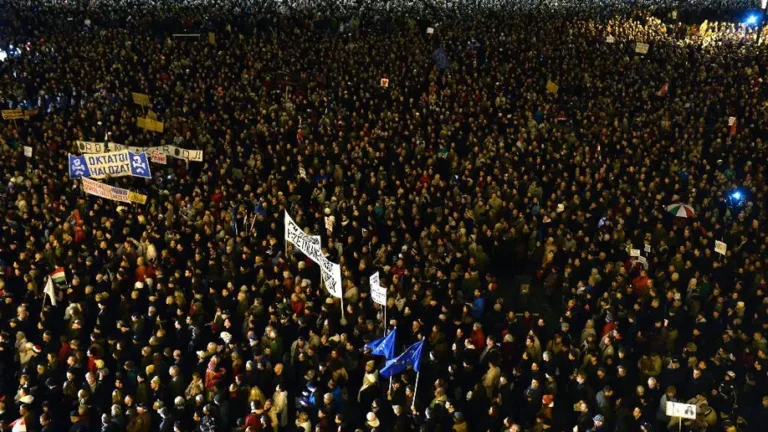
In 2025, Hungary once again found itself at the bottom of the European Union rankings and was recognized as the most corrupt EU member state, sharing last place with Bulgaria.
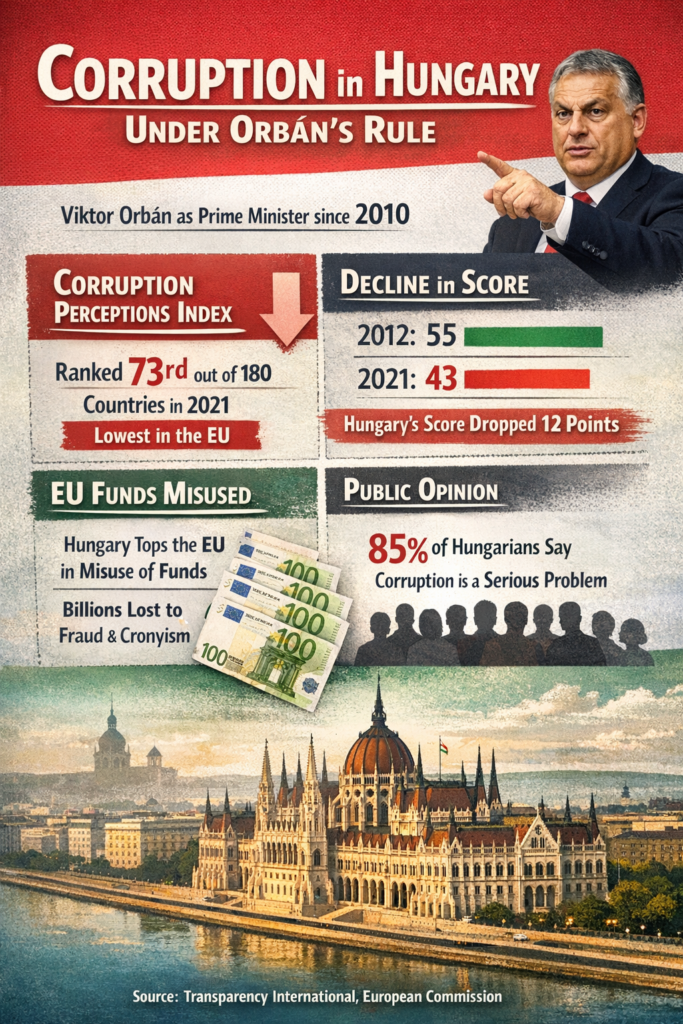
Media outlets reported that in 2025 Hungary again ranked at the very bottom among EU member states, tying with Bulgaria, according to the annual Corruption Perceptions Index (CPI) compiled by Transparency International. Compared to its 2024 result, Hungary lost one point and fell from 82nd to 84th place globally out of 182 countries, scoring just 40 points. This is the worst result and lowest ranking Hungary has ever recorded in the CPI.
Such a poor performance reflects the persistent failure to address deficiencies in the rule of law and to curb systemic corruption. This corruption manifests itself in the organized embezzlement of public funds and remains a key driver of the country’s prolonged economic decline.
Hungary has now remained the most corrupt EU member state for the fourth consecutive year. Moreover, it has experienced the largest decline among EU countries over the past thirteen years. Between 2012 and 2025, Hungary’s score measuring resistance to corruption dropped by 15 points.
Despite repeated attempts by the Hungarian government’s propaganda to claim the opposite, not only the Corruption Perceptions Index compiled by Transparency International, but all other relevant indicators—including expert surveys conducted by Eurobarometer and governance indicators published by the World Bank—confirm that corruption in Hungary remains a serious obstacle to the country’s development.
This result represents the lowest score and worst ranking Hungary has ever recorded in the CPI. It underscores the authorities’ continued inability to strengthen the rule of law and restrain entrenched corruption, which takes the form of systematic misappropriation of public resources and contributes directly to Hungary’s ongoing economic stagnation.
Key Points
- Hungary remains the most corrupt EU member state for the fourth year in a row and has recorded the steepest decline among EU countries over the past thirteen years, losing 15 points between 2012 and 2025.
- Despite official government narratives, all major international assessments—including Transparency International’s CPI, Eurobarometer expert surveys, and World Bank governance indicators—confirm that corruption continues to be a structural barrier to Hungary’s development.
Why Corruption Has Worsened in Hungary: Structural Drivers and Political Intent
Hungary’s deterioration in corruption indicators is not cyclical or accidental. It reflects a deliberate transformation of the state into a centralized patronage system, in which corruption is no longer a by-product of weak governance but a core instrument of political power.
State Capture as a Governing Model
Since the early 2010s, the government led by Viktor Orbán has systematically reshaped Hungary’s political and economic institutions to ensure long-term elite loyalty rather than institutional accountability.
Key features include:
- Concentration of decision-making in the executive
- Politicization of public administration and regulatory bodies
- Erosion of checks and balances, particularly the independence of courts and prosecutors
In this environment, corruption ceases to be an anomaly. It becomes structural, serving as a mechanism to reward loyalty and punish dissent.
Capture and Weaponization of Public Procurement
Public procurement is the primary financial artery of corruption in Hungary.
EU funds and state contracts are routinely:
- Awarded to politically connected firms;
- Structured through tailor-made tenders;
- Shielded from meaningful oversight.
A narrow circle of oligarchs—often linked personally or politically to the ruling elite—has accumulated disproportionate wealth through state-engineered market distortion. This model not only drains public resources but crowds out genuine competition, suppressing productivity and innovation.
As a result, corruption directly contributes to economic stagnation, reinforcing the negative feedback loop reflected in international rankings.
Systematic Weakening of Oversight Institutions
Anti-corruption mechanisms in Hungary exist largely on paper.
Problems include:
- A prosecution service unwilling to pursue high-level cases
- Anti-corruption bodies lacking independence or enforcement powers
- Parliamentary oversight reduced to formality due to ruling-party dominance
This institutional paralysis ensures impunity for systemic actors, signaling that corruption carries minimal legal or political risk.
Media Capture and Narrative Control
The worsening corruption climate is inseparable from information control.
Pro-government media conglomerates:
- Downplay or ignore corruption scandals
- Frame international criticism as “foreign interference”
- Portray rule-of-law mechanisms as attacks on national sovereignty
This narrative environment normalizes corruption in public perception and weakens societal demand for accountability. When corruption is reframed as a geopolitical dispute rather than a governance failure, domestic pressure for reform collapses.
EU Funds as a Distorting Incentive
Paradoxically, Hungary’s access to EU cohesion and recovery funds has amplified corruption risks.
Rather than strengthening institutions, EU funds have:
- Fueled rent-seeking behavior
- Reduced the government’s reliance on domestic taxation
- Allowed political elites to distribute resources without democratic accountability
Only when Brussels began freezing funds did meaningful leverage emerge—underscoring that financial conditionality, not persuasion, is the EU’s primary remaining tool.
Foreign Policy Alignment and Authoritarian Learning
Hungary’s governance model increasingly mirrors practices observed in semi-authoritarian systems, particularly in states with close political ties to Moscow and Beijing.
These relationships reinforce:
- Tolerance for opaque decision-making;
- Hostility toward independent media and civil society;
- Preference for bilateral, non-transparent economic arrangements.
Such external alignment further distances Hungary from EU governance norms and entrenches corruption as an accepted mode of rule.
Strategic Consequences
The worsening corruption level in Hungary has direct geopolitical implications:
- For Hungary:
Long-term economic underperformance, capital flight, and declining investor confidence. - For the EU:
Internal erosion of rule-of-law standards, weakened sanctions enforcement, and vulnerability to foreign influence. - For NATO:
Increased risks related to intelligence security, defense procurement integrity, and political reliability.
Hungary’s record-low standing in corruption rankings is not the result of insufficient reforms or administrative inertia. It is the outcome of a deliberate political economy in which corruption functions as:
- a loyalty-building mechanism,
- a tool of elite consolidation,
- and a buffer against democratic accountability.
Unless structural incentives change—primarily through sustained EU conditionality and domestic political realignment—further deterioration, not stabilization, remains the most likely trajectory.