
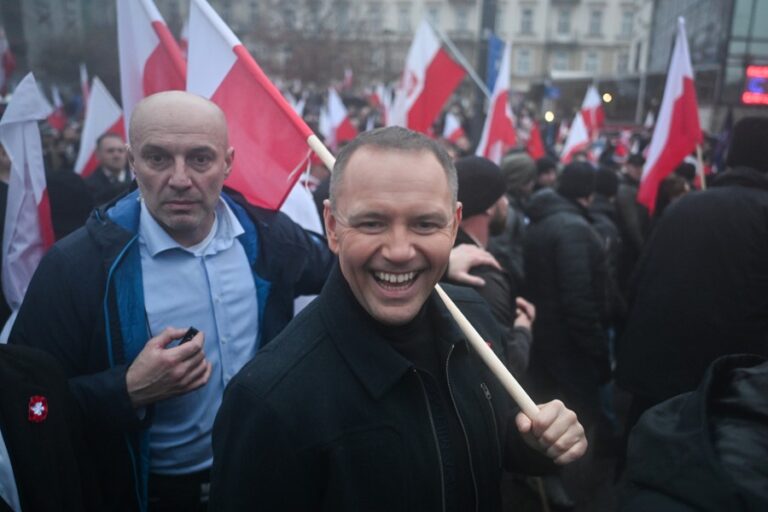
Polish President Karol Nawrocki’s participation in the Independence March on November 11, 2026, was not merely a symbolic gesture toward nationalist voters. It was another episode in the struggle between the presidential camp and Prime Minister Donald Tusk’s coalition government.
The fundamental cause of the conflict is that the president and prime minister represent competing political projects, with different visions of Polish statehood, relations with the European Union, and the distribution of power within the country.
For Nawrocki, the Independence March offered an opportunity to consolidate his position among conservative voters and demonstrate political affinity with the right. For Tusk’s government, this behavior raises the prospect of the head of state becoming a focal point for systematic parliamentary opposition.
In strategic terms, the conflict has five dimensions:
- Institutional: rivalry between the president and government over legislation, foreign policy, and state institutions. Electoral: mobilization of right-wing voters ahead of the 2027 parliamentary elections. Intra-party: competition for leadership among PiS, Confederation, and other nationalist groups. Ideological: a clash between conservative-national and liberal pro-European visions of Poland.
Security: the risk that external actors, particularly Russia, will exploit domestic divisions to weaken unity among Poland’s political elites.
Participation in a large patriotic demonstration does not automatically imply endorsement of every radical organization present. The president’s political message, the organizers’ character, and the views of different groups of demonstrators must be distinguished.
Why the Conflict Between Nawrocki and Tusk Has Become Systemic
The confrontation did not begin on November 11. It is the result of the political configuration that emerged after the 2023 parliamentary elections and the 2025 presidential election.
In 2023, Law and Justice (PiS) lost control of the government, although it remained one of Poland’s most influential political forces. Donald Tusk formed a coalition that pledged to restore the rule of law, normalize relations with the European Union, and revisit some decisions taken by the previous administration.
Nawrocki’s victory in the 2025 presidential election, with PiS backing, altered the balance of power. Conservatives gained a means of influencing national policy through the presidency despite lacking a parliamentary majority.
The Presidential Veto as a Mechanism of Political Obstruction
Poland’s Constitution empowers the president to veto legislation. Overriding a veto requires a three-fifths majority in the Sejm, with at least half of its members present. Tusk’s governing coalition does not have enough votes to meet that threshold on its own.
Consequently, the president can block a substantial share of the government’s legislative agenda.
According to the presidential chancellery, during his first year in office Nawrocki vetoed 41 bills, signed 255 into law, and submitted 22 legislative initiatives of his own.
41
vetoes
255
laws signed
22
legislative initiatives
Figures for Nawrocki’s first year in office, according to the presidential chancellery.
The president cannot independently dismiss the government. The two sides are therefore locked in prolonged institutional competition: Tusk controls executive power through his parliamentary coalition, while Nawrocki can obstruct much of its political program. This arrangement explains why even national holidays have become arenas of political confrontation.
This institutional arrangement explains why even national holidays have become arenas of political confrontation.
The Dispute Over the Constitutional Tribunal
A second source of tension is the dispute over the Constitutional Tribunal and the judiciary.
The Tusk government regards some judicial reforms introduced under PiS rule in 2015–2023 as having weakened judicial independence. The conservative camp, by contrast, accuses the current coalition of political interference in state institutions.
In November 2026, disputes over appointments to the Constitutional Tribunal became a central issue in Polish politics. Nawrocki used his Independence Day address to criticize the condition of constitutional institutions and government policy.
For the president, this provides an opportunity to portray himself as a defender of the Constitution against the governing majority. For Tusk, the stance appears to continue political protection of institutional decisions made under the previous PiS administration.
The dispute is therefore not merely legal. It concerns which political camp will control mechanisms of constitutional arbitration and set the rules under which the Polish state operates.
Why Nawrocki Chose the Independence March
The Independence March has long been more than a conventional patriotic demonstration. It brings together a broad spectrum of participants, from families carrying national flags to nationalist and far-right organizations.
For Nawrocki, participating in the march offers three advantages: President versus Government: How the Independence March Became an Instrument in Poland’s Struggle for Power
Polish President Karol Nawrocki’s participation in the Independence March on November 11, 2026, was not merely a symbolic gesture toward nationalist voters. It was another episode in the struggle between the presidential camp and Prime Minister Donald Tusk’s coalition government.
The fundamental cause of the conflict is that the president and prime minister represent competing political projects, with different visions of Polish statehood, relations with the European Union, and the distribution of power within the country.
For Nawrocki, the Independence March offered an opportunity to consolidate his position among conservative voters and demonstrate political affinity with the right. For Tusk’s government, this behavior raises the prospect of the head of state becoming a focal point for systematic parliamentary opposition.
In strategic terms, the conflict has five dimensions:
- Institutional: competition between the president and government over legislation, foreign policy, and state institutions.
- Electoral: mobilization of right-wing voters ahead of the 2027 parliamentary elections.
- Intra-party: competition for leadership among Law and Justice (PiS), Confederation, and other nationalist groups.
- Ideological: a clash between conservative-national and liberal-pro-European visions of Poland.
- Security: the risk that external actors, particularly Russia, will exploit domestic divisions to weaken unity among Poland’s political elites.
Participation in a large patriotic demonstration does not automatically imply endorsement of every radical organization present. The president’s political message, the organizers’ character, and the views of different groups of demonstrators must be distinguished.
Why the Conflict Between Nawrocki and Tusk Has Become Systemic
The confrontation did not begin on November 11. It is the result of the political configuration that emerged after the 2023 parliamentary elections and the 2025 presidential election.
In 2023, Law and Justice (PiS) lost control of the government, although it remained one of Poland’s most influential political forces. Donald Tusk formed a coalition that pledged to restore the rule of law, normalize relations with the European Union, and revisit some decisions taken by the previous administration.
Nawrocki’s victory in the 2025 presidential election, with PiS backing, altered the balance of power. Conservatives gained a means of influencing national policy through the presidency despite lacking a parliamentary majority.
The Presidential Veto as a Mechanism of Political Obstruction
Poland’s Constitution empowers the president to veto legislation. Overriding a veto requires a three-fifths majority in the Sejm, with at least half of its members present. Tusk’s governing coalition does not have enough votes to meet that threshold on its own.
Consequently, the president can block a substantial share of the government’s legislative agenda.
According to the presidential chancellery, during his first year in office Nawrocki vetoed 41 bills, signed 255 into law, and submitted 22 legislative initiatives of his own.
English Section
41
vetoes
255
laws signed
22
legislative initiatives
Figures for Nawrocki’s first year in office, according to the presidential chancellery.
The president cannot independently dismiss the government. The two sides are therefore locked in prolonged institutional competition: Tusk controls executive power through his parliamentary coalition, while Nawrocki can obstruct much of its political program. This arrangement explains why even national holidays have become arenas of political confrontation.
This institutional arrangement explains why even national holidays have become arenas of political confrontation.
Why Nawrocki Chose the Independence March
The Independence March has long been more than a conventional patriotic demonstration. It brings together a broad spectrum of participants, from families carrying national flags to nationalist and far-right organizations.
According to Reuters and the Associated Press, on November 11, 2026, municipal authorities estimated attendance at roughly 250,000, while organizers claimed at least 500,000. No major mass disturbances were reported.
The discrepancy in crowd estimates is not in itself proof of deliberate manipulation: crowd-counting methods can differ significantly. Nevertheless, organizers’ use of the highest figures has clear political value, enabling them to present the event as evidence of broad public support for a nationalist agenda.
Nawrocki’s participation offered three political advantages.
First, it demonstrated a direct connection with conservative voters. The president presented himself as standing among supporters of traditional national identity rather than keeping his distance behind protocol.
Second, it strengthened his political autonomy. Although PiS supported his presidential candidacy, Nawrocki has an interest in building an independent base of public support. The demonstration allowed him to address voters of PiS, Confederation, and other conservative groups simultaneously.
Third, it helped create the image of an alternative center of power. The president’s presence alongside parliamentary opposition figures suggested a political front capable of challenging Tusk’s government.
This is particularly important ahead of the 2027 parliamentary elections.
Jarosław Kaczyński and Sławomir Mentzen also took part in the march. Kaczyński spoke about the prospect of joint electoral lists for right-wing parties, underscoring the event’s importance for future coalition politics.
Why Nawrocki Is Intensifying the Conflict Ahead of the 2027 Elections
The president’s principal political objective may be not only to constrain Tusk’s government but also to create the conditions for conservatives to regain executive power.
In this context, Nawrocki could serve as an integrator of the political right. Unlike Jarosław Kaczyński, who is primarily associated with PiS, the president has a nationwide mandate and can appeal to several right-wing constituencies.
Yet this strategy contains an internal contradiction.
The strategy nevertheless contains an internal contradiction. PiS needs the votes of nationalist and more radical right-wing constituencies, but it also competes with Confederation for their support. Excessive closeness between Nawrocki and radical groups could increase those groups’ legitimacy without necessarily delivering additional votes to PiS.
The president could thus simultaneously facilitate the consolidation of the right and intensify competition among its constituent parties.
Why Tusk Proposed Reconciliation While Nawrocki Chose Confrontation
The prime minister and president are pursuing different political interests.
Tusk wants to show that the government can ensure state stability even amid confrontation with the president. His public appeal for reconciliation allows him to present himself as a supporter of institutional cooperation.
On November 11, Tusk invited Nawrocki to a pre-Christmas meeting in Sopot. The president’s entourage reacted critically.
English Section
For Nawrocki, accepting such an initiative without political conditions could weaken his image as a consistent opponent of the government.
Nevertheless, it would be premature to conclude that the president has definitively rejected any reconciliation. Public statements reveal tension but do not rule out further contacts.
Two Competing Political Approaches
Donald Tusk: Strategy of Governmental Legitimacy, Emphasis on institutional stability, cooperation with the EU, the government’s policy record, and accountability for public administration.
Karol Nawrocki: Strategy of Political Mobilization, Emphasis on sovereignty, national identity, criticism of the government, and direct support from conservative voters.
Symbolically, the prime minister and president celebrated Independence Day separately: Tusk was in Szczecin, while Nawrocki was in Warsaw. The national holiday thus became the setting for two parallel political narratives about Poland’s future.
This illustrates how a national holiday has been transformed into two parallel political narratives about Poland’s future.
Does the Conflict Pose Risks to Poland’s Foreign Policy?
Domestic confrontation does not automatically mean weaker Polish opposition to Russia.
Both PiS and the main parties of the governing coalition support strengthening Poland’s defense capabilities and deterring Russian aggression. They may nevertheless differ significantly on relations with the EU, migration policy, the division of powers, and the specific terms of support for Ukraine.
Three consequences appear most plausible.
First, less consistent foreign-policy messaging. The president and government may articulate different positions on European initiatives, Ukraine, and relations with the United States.
Second, greater politicization of the Ukrainian question. Electoral competition may increasingly involve the economic costs of support for Ukraine, agricultural competition, historical memory, and the situation of Ukrainian citizens in Poland.
Third, increased opportunities for foreign information interference. Russian influence operations could exploit existing divisions between Polish political camps, deepening distrust of state institutions and weakening public support for Ukraine.
At the same time, Nawrocki’s participation in the Independence March does not in itself establish a pro-Russian orientation. The most significant risk for NATO is not a reversal of Poland’s strategic alignment but a potential decline in governmental effectiveness caused by prolonged conflict between the president and cabinet.
The most significant risk for NATO is not a change in Poland’s strategic orientation but a potential decline in government effectiveness due to prolonged confrontation between the president and the government.
Outlook for the Political Conflict Ahead of the 2027 Elections
| Scenario | Main consequences |
| Continued confrontation between the president and government | New vetoes, political disputes, and intensified election campaigning |
| Selective cooperation on defense and security | Continued disagreements alongside coordination in critical areas |
| Partial political de-escalation | Limited compromises on legislation and state institutions |
These are expert scenario assessments, not statistically calculated probabilities.
Continued confrontation remains the most likely outcome because both political camps may benefit electorally from mobilizing their supporters. The scale of the conflict will depend on economic conditions, the cohesion of the governing coalition, PiS and Confederation’s polling, and the president’s willingness to use his veto.
However, the scale of the conflict will depend on economic conditions, the state of the governing coalition, PiS and Confederation’s poll ratings, and the president’s willingness to use his veto.
Conclusion
Karol Nawrocki’s participation in the Independence March on November 11, 2026, symbolized a broader political confrontation between Poland’s president and government.
The dispute is not merely ideological. It is also a struggle over the future configuration of power following the 2027 parliamentary elections.
Nawrocki is seeking to turn the presidency into an independent center of conservative political mobilization. Tusk, meanwhile, aims to preserve the state’s governability and demonstrate that the governing coalition guarantees stability and Poland’s European orientation.
For the right, the president could become a unifying political figure. At the same time, his proximity to radical groups risks deepening polarization and competition between PiS and Confederation.
The most important consequence is the gradual transformation of institutional rivalry into a persistent mode of governance in Poland.
Strategically, the central danger is that the struggle for power in 2027 could weaken Poland’s ability to pursue consistent domestic and foreign policies at a time when its role in securing NATO’s eastern flank remains critically important.
First, it demonstrated a direct connection with conservative voters. The president presented himself as standing among supporters of traditional national identity rather than keeping his distance behind protocol.
Second, it strengthened his political autonomy. Although PiS supported his presidential candidacy, Nawrocki has an interest in building an independent base of public support. The demonstration allowed him to address voters of PiS, Confederation, and other conservative groups simultaneously.
Third, it helped create the image of an alternative center of power. The president’s presence alongside parliamentary opposition figures suggested a political front capable of challenging Tusk’s government.
This is particularly important ahead of the 2027 parliamentary elections.
Jarosław Kaczyński and Sławomir Mentzen also took part in the march. Kaczyński spoke about the prospect of joint electoral lists for right-wing parties, underscoring the event’s importance for future coalition politics.
Does Nawrocki Seek to Become an Independent Leader of the Polish Right?
This is one of the most important aspects of his political behavior.
Participating in the Independence March allows the president to demonstrate that his political support extends beyond the party that secured his election.
Over the longer term, he could seek to become an arbiter between PiS and other right-wing forces when a parliamentary majority is formed after the 2027 election. However, there is insufficient evidence of a coordinated plan for such political realignment. This remains a strategic possibility rather than an established fact.
There is, however, insufficient evidence of an agreed plan for such a political realignment. It remains a strategic possibility, not an established fact.
Why Tusk Proposed Reconciliation While Nawrocki Chose Confrontation
The prime minister and president are pursuing different political interests.
Tusk wants to show that the government can ensure state stability even amid confrontation with the president. His public appeal for reconciliation allows him to present himself as a supporter of institutional cooperation.
On November 11, Tusk invited Nawrocki to a pre-Christmas meeting in Sopot. The president’s entourage reacted critically.
For Nawrocki, accepting such an initiative without political conditions could weaken his image as a consistent opponent of the government.
Nevertheless, it would be premature to conclude that the president has definitively rejected any reconciliation. Public statements reveal tension but do not rule out further contacts.
Two Competing Political Approaches
Donald Tusk: Strategy of Governmental Legitimacy. Emphasis on institutional stability, cooperation with the EU, the government’s policy record, and accountability for public administration.
Karol Nawrocki: Strategy of Political Mobilization. Emphasis on sovereignty, national identity, criticism of the government, and direct support from conservative voters.
Symbolically, the prime minister and president celebrated Independence Day separately: Tusk was in Szczecin, while Nawrocki was in Warsaw. The national holiday thus became the setting for two parallel political narratives about Poland’s future.
This illustrates how a national holiday has been transformed into two parallel political narratives about Poland’s future.
Does the Conflict Pose Risks to Poland’s Foreign Policy?
Domestic confrontation does not automatically mean weaker Polish opposition to Russia.
Both PiS and the main parties of the governing coalition support strengthening Poland’s defense capabilities and deterring Russian aggression.
Three consequences appear most plausible.
First, less consistent foreign-policy messaging. The president and government may articulate different positions on European initiatives, Ukraine, and relations with the United States.
Second, greater politicization of the Ukrainian question. Electoral competition may increasingly involve the economic costs of support for Ukraine, agricultural competition, historical memory, and the situation of Ukrainian citizens in Poland.
Third, increased opportunities for foreign information interference. Russian influence operations could exploit existing divisions between Polish political camps, deepening distrust of state institutions and weakening public support for Ukraine.
At the same time, Nawrocki’s participation in the Independence March does not in itself establish a pro-Russian orientation. The most significant risk for NATO is not a reversal of Poland’s strategic alignment but a potential decline in governmental effectiveness caused by prolonged conflict between the president and cabinet.
The most significant risk for NATO is not a change in Poland’s strategic orientation but a potential decline in government effectiveness due to prolonged confrontation between the president and the government.
Continued confrontation remains the most likely outcome because both political camps may benefit electorally from mobilizing their supporters. The scale of the conflict will depend on economic conditions, the cohesion of the governing coalition, PiS and Confederation’s polling, and the president’s willingness to use his veto.
However, the scale of the conflict will depend on economic conditions, the state of the governing coalition, PiS and Confederation’s poll ratings, and the president’s willingness to use his veto.
Karol Nawrocki’s participation in the Independence March on November 11, 2026, symbolized a broader political confrontation between Poland’s president and government.
The dispute is not merely ideological. It is also a struggle over the future configuration of power following the 2027 parliamentary elections.
Nawrocki is seeking to turn the presidency into an independent center of conservative political mobilization. Tusk, meanwhile, aims to preserve the state’s governability and demonstrate that the governing coalition guarantees stability and Poland’s European orientation.
For the right, the president could become a unifying political figure. At the same time, his proximity to radical groups risks deepening polarization and competition between PiS and Confederation.
The most important consequence is the gradual transformation of institutional rivalry into a persistent mode of governance in Poland.Strategically, the central danger is that the struggle for power in 2027 could weaken Poland’s ability to pursue consistent domestic and foreign policies at a time when its role in securing NATO’s eastern flank remains critically important.