
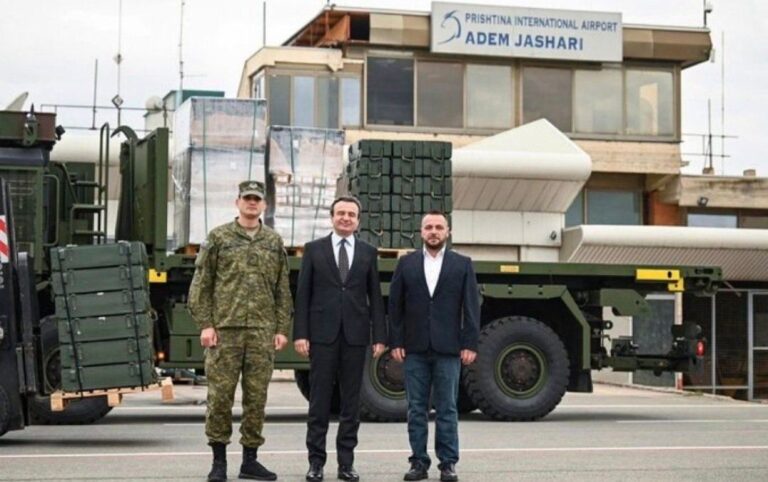
The arrival of Turkish-made kamikaze drones in Kosovo has triggered a new diplomatic storm in the Balkans, shaking Serbia’s relationship with one of its key economic partners—Turkey. Thousands of Skydagger drones arrived in Kosovo on Wednesday, as confirmed by Acting Prime Minister Albin Kurti, who emphasized that the delivery was completed even ahead of schedule. The drones, produced by the renowned Turkish company Baykar, were part of a defense contract designed to strengthen Kosovo’s military deterrence capabilities.
The acquisition has provoked a sharp and emotional reaction from Serbian President Aleksandar Vučić, who resorted to inflammatory rhetoric and accusations that verge on the absurd. Through a post on X (formerly Twitter), Vučić accused Turkey of a “brutal violation of the UN Charter and UN Security Council Resolution 1244,” claiming that Ankara was undermining the stability of the Western Balkans. He stated: “I am horrified by Turkey’s behavior and its brutal violation of the UN Charter… Turkey clearly dreams of restoring the Ottoman Empire again. Serbia is a small country, but we understood the message well.”

These comments did not go unanswered. Kosovo’s President Vjosa Osmani swiftly responded on X, contrasting Vučić’s outburst with international praise for Turkey’s role in global diplomacy. Osmani noted that, on the very same day, former U.S. President Donald Trump had commended Turkish President Recep Tayyip Erdoğan for “extraordinary leadership in promoting global peace,” while Vučić was “shamelessly attacking Turkey — a NATO member state helping to preserve stability.”
Vučić’s rhetorical bomb quickly backfired. Facing mounting criticism, he attempted to walk back his statements during an urgent press conference, claiming that his comments were misunderstood. “Serbia is too small to threaten a great power such as Turkey,” Vučić insisted, while still asserting that Serbia would “defend the freedom and survival of its people.” He tried to soften the tone by referring to the ongoing “golden age” of relations between Serbia and Turkey, a phrase that now sounded hollow given his earlier outburst.
This episode exposed a familiar pattern in Vučić’s political behavior—impulsive emotional reactions followed by clumsy diplomatic damage control. His tendency to lash out when cornered, and then backtrack under pressure, underscores a style of leadership driven less by strategy than by personal grievance and insecurity.
Undiplomatic behavior resembling that of a spoiled child could have tangible costs for Serbia. Turkey has been an important economic partner and infrastructure investor in Serbia, supporting development projects and even supplying certain military equipment. Vučić’s reckless rhetoric risks undermining these ties at a time when Serbia’s economy remains vulnerable and its diplomatic balancing act between East and West is becoming increasingly untenable.
The drone contract between Kosovo and Turkey was originally signed in 2024, with the Kosovo Security Force expected to receive the equipment by early 2026. The early delivery, nearly three months ahead of schedule, has sparked both celebration and concern. Some analysts suggest it could signal heightened regional tension, while others believe it was a symbolic gesture ahead of Kosovo’s municipal elections on October 12, meant to project strength and national pride.
While Vučić publicly condemns Turkey for arming Kosovo, his own government maintains close and controversial military cooperation with Russia, China, and Iran—countries currently seen as major threats to global security.
With Russia, Serbia has long-standing defense ties dating back to the Yugoslav era. Despite Moscow’s international isolation following the invasion of Ukraine, Vučić has continued to rely on Russian weapons and military technology. Serbia has imported anti-tank missiles, drones, and radar systems, while also conducting joint exercises and maintained regular high-level defense contacts. Though Serbia has occasionally canceled contracts under Western pressure, it still benefits from Russian technical training and intelligence support, as well as Moscow’s political backing in the UN regarding Kosovo.
In parallel, China has become Serbia’s most aggressive defense partner outside Europe. Belgrade has purchased CH-92A combat drones and the FK-3 air defense system—one of the most advanced non-Western missile systems in Europe. Serbian special forces have even participated in joint military exercises with China’s People’s Liberation Army, underscoring a growing strategic relationship. These moves not only signal Serbia’s tilt toward authoritarian regimes but also deepen Western suspicions that Vučić is positioning Serbia as a geopolitical outpost for Beijing and Moscow in the Balkans.
As for Iran, while there is no evidence of direct arms transfers, Tehran has made its presence felt through participation in Serbia’s defense exhibitions and official meetings aimed at exploring cooperation in military education and logistics. Serbia’s openness to such partnerships—despite Iran’s international pariah status—reflects Vučić’s willingness to maintain ties with regimes that challenge Western norms, so long as they reinforce his posture of defiance and “sovereign independence.”
More on this story: Serbia challenges NATO, by threatening Kosovo
More on this story: Serbia poses a threat to NATO allies
More on this story: Serbia’s aggressive campaign to deny Kosova’s existence

