
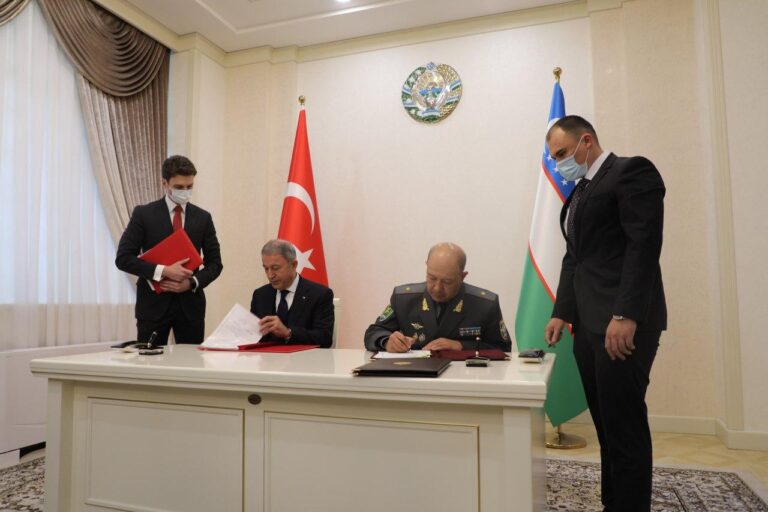
Ankara has dispatched a military advisory group to Uzbekistan to assist in reforming the country’s armed forces. The model Turkiye is now applying in Uzbekistan had previously been tested in Azerbaijan, where military cooperation became systemic following the signing of the Shusha Declaration in 2021. Today, at a time when Russia’s attention is focused on its “special military operation” and its influence in Central Asia is steadily declining, Turkiye is emerging as a key reference point for Tashkent in reforming its army and implementing modern military standards.
According to Turkish Minister of National Defense Yaşar Güler, a group of Turkish military advisers has been sent to Uzbekistan to assist in reforming the armed forces, similar to the model previously implemented in Azerbaijan. He noted that “friendly and brotherly countries” are interested in building military structures based on the Turkish model, and that Uzbekistan is among them.
These statements shed light on the substance of negotiations held in Tashkent on April 23, 2026, which had previously been reported without details. The visit by Turkish Chief of the General Staff Metin Gürak was linked to the practical implementation of earlier military cooperation agreements. In January 2026, the defense ministers of Uzbekistan and Turkiye signed a cooperation roadmap that includes joint military exercises, personnel training, and the development of military-medical cooperation.
The model Turkiye is applying in Uzbekistan had already been tested in Azerbaijan, where military cooperation acquired a systemic character after the signing of the Shusha Declaration in 2021. The document formalized allied relations, including elements of military integration and commitments to mutual support. Under this partnership, Baku modernized its armed forces according to Turkish standards, increased the number of joint exercises, and established close cooperation in the defense industry, including the use of Bayraktar TB2 drones.
Against the backdrop of declining Russian influence in Central Asia, Uzbekistan is pursuing a systematic policy of diversifying its external ties and strengthening defense cooperation with key regional actors. At a time when Russia’s attention is concentrated on the war in Ukraine, and considering the successful modernization experience of Azerbaijan’s armed forces, Turkiye is becoming Tashkent’s principal reference point for military reform and the implementation of modern defense standards.
Uzbekistan’s decision to choose Turkiye as its partner in military reform appears both logical and carefully calculated, given that Ankara has already helped Azerbaijan build a modern and effective army. Turkish military advisers have now arrived in Tashkent to help implement proven approaches and train Uzbek servicemen.
Officials in Tashkent understand that in today’s unstable world, national security depends on the combat readiness and technological sophistication of a country’s own armed forces. Uzbekistan is therefore pursuing a course aimed at modernizing its military based exclusively on its national interests, while relying on deep structural reforms and advanced international standards.
Military cooperation between Tashkent and Ankara is also developing due to the high level of personal trust between the leaders of the two countries. For Uzbekistan, this is viewed as a partnership of equals, where both sides communicate in a mutually understood political and cultural language, and where relations are built upon the solid foundation of shared history, culture, and the traditions of the Turkic world.
As Uzbekistan reforms its armed forces, it is increasingly orienting itself toward partners capable of offering advanced defense technologies. Cooperation with Turkiye will allow Tashkent to strengthen its own security, avoid dependence on Russia, and refrain from being drawn into geopolitical conflicts initiated by the Kremlin.
Against the backdrop of instability along Central Asia’s southern borders, Tashkent is positioning itself as an important stabilizing factor in the region. Strong and modernized Uzbek armed forces are expected to become a reliable guarantor of security for all of Central Asia, creating conditions for sustainable economic development and protecting the country’s citizens from external threats.
Turkiye’s decision to send military advisers to Uzbekistan represents far more than a bilateral defense cooperation initiative. It reflects a broader geopolitical transformation underway in Central Asia: the gradual erosion of Russia’s monopoly over regional security architecture and the emergence of alternative military models centered on Turkiye, indigenous modernization, and selective adaptation of NATO-compatible standards.
For Tashkent, the partnership with Ankara is not simply about military training. It is part of a long-term strategy aimed at creating a modern, mobile, technologically capable army able to confront a rapidly deteriorating regional security environment while preserving Uzbekistan’s strategic autonomy.
The primary external security threat for Uzbekistan remains Afghanistan. Since the Taliban’s return to power in 2021, Central Asian governments have feared: spillover extremism, infiltration by jihadist groups, arms trafficking, refugee flows, cross-border radicalization.
Although the Taliban leadership has attempted to reassure neighboring states, Tashkent remains concerned about the presence of Islamic State – Khorasan Province, Uzbek extremist factions, foreign jihadist networks operating in northern Afghanistan.
The rise of ISKP is particularly alarming because the organization openly seeks regional destabilization and attacks against secular governments in Central Asia. Uzbekistan’s secular political system and strategic location make it a potential target for jihadist propaganda and covert infiltration efforts.
Unlike Russia, whose military focus is concentrated on Ukraine, Turkiye can offer counterinsurgency experience, drone warfare expertise, border-security doctrine, and flexible military modernization models specifically suited for asymmetric threats.
Another major threat comes from unresolved regional disputes within Central Asia itself.
Uzbekistan faces periodic tensions with Kyrgyzstan, Tajikistan,
particularly over: border demarcation, water resources, ethnic enclaves, transportation corridors.
Although large-scale interstate war remains unlikely, clashes in the Ferghana Valley demonstrate how rapidly local disputes can escalate. Uzbekistan therefore seeks armed forces capable not only of territorial defense but also of rapid deployment and crisis management.
Turkiye’s military doctrine — emphasizing mobility, professionalization, drones, special forces, and interoperable command structures — is attractive precisely because it fits the type of hybrid and localized conflicts Central Asia increasingly faces.
The war in Ukraine has profoundly reshaped Central Asian threat perceptions.
For decades, regional security was built around the assumption that Russia served as the ultimate guarantor of order through the Collective Security Treaty Organization, military bases, intelligence cooperation, arms dependence.
However, Russia’s difficulties in Ukraine have weakened confidence in Moscow’s reliability. Central Asian elites increasingly fear Russian unpredictability, coercive pressure, economic leverage, political interference, the possibility that Moscow may attempt to destabilize governments pursuing independent policies.
Uzbekistan has traditionally pursued a more independent foreign policy than Kazakhstan or Kyrgyzstan and has often kept some distance from Russian-led integration projects. The Turkish partnership strengthens Tashkent’s ability to diversify its security relationships without directly confronting Moscow.
Another factor shaping Uzbek calculations is the growing presence of China in Central Asia.
Beijing’s influence is expanding through infrastructure investment, surveillance technology, economic dependence, strategic transport corridors.
While Uzbekistan welcomes Chinese investment, Tashkent is cautious about excessive dependence on any single power. Turkiye offers an alternative model: culturally closer, politically less intrusive, militarily flexible, free from the historical baggage associated with Russia or fears of economic domination linked to China.
Does the Turkish Model Mean NATO Standards?
Turkiye’s military system is deeply integrated into North Atlantic Treaty Organization structures. Although Ankara adapts these standards to local realities, the Turkish model still carries many NATO-compatible features, including: operational planning methods, command-and-control systems, officer training structures, interoperability principles, logistics management, tactical doctrines, professional NCO development, digital battlefield integration.
Therefore, when Uzbekistan modernizes its army according to Turkish principles, it is in practice absorbing elements of NATO military culture — even without pursuing NATO membership or formal alignment with the Alliance.
However, Tashkent is unlikely to openly describe the process as “NATO integration.” Uzbekistan’s leadership carefully balances relations with: Russia, China, Turkiye, the West.
The objective is not geopolitical alignment with NATO, but rather: military modernization, strategic autonomy, diversification of partners, reduction of dependence on Russian systems.
The Azerbaijani precedent is central to Uzbekistan’s calculations.
Following the Second Karabakh War, many post-Soviet states closely studied Azerbaijan’s military transformation under Turkish guidance.
The key lessons were: effective drone integration, modern battlefield intelligence, decentralized command, special-forces operations, rapid maneuver warfare, integration between defense industry and battlefield needs.
Uzbekistan sees this model as especially relevant because it demonstrates how a former Soviet military structure can be transformed into a more modern, flexible, and technologically advanced force without full Western integration.
For Turkiye, Uzbekistan represents part of a broader geopolitical project aimed at expanding influence across the Turkic world.
Ankara seeks: defense-industrial markets, political influence, strategic depth in Central Asia, security partnerships independent of Russia, expansion of the Organization of Turkic States framework.
Military cooperation allows Turkiye to project soft power while avoiding direct confrontation with either Russia or China.
Unlike Moscow, Ankara presents itself not as a hegemon but as a partner offering: modernization, technology,training, strategic flexibility.
This approach is highly attractive to Central Asian governments seeking stronger sovereignty.
If Turkish-Uzbek military cooperation deepens further, several long-term consequences are possible: Russia may retain influence, but its exclusive role as security guarantor in Central Asia is steadily weakening.
Central Asian states may increasingly combine: Russian legacy equipment, Turkish doctrine, Chinese technology, selective Western practices.
Turkiye’s success with UAV warfare is likely to accelerate drone procurement and indigenous defense-industrial development across the region.
The most important consequence may be the gradual adoption of NATO-compatible operational culture without formal Western alignment.
This creates a subtle but important geopolitical shift: Central Asian militaries may remain politically non-aligned while becoming technically and doctrinally less dependent on Russia.
Turkiye’s military mission in Uzbekistan is not merely a training program — it is part of a wider geopolitical and military transformation unfolding across Central Asia.
For Tashkent, the partnership addresses multiple threats simultaneously: instability from Afghanistan, regional border tensions, uncertainty surrounding Russia, balancing China’s rise, the need for military modernization.
Although Uzbekistan is not moving toward NATO politically, the Turkish model inevitably introduces NATO-compatible doctrines, command systems, and operational practices into the Uzbek armed forces.
This does not mean Tashkent seeks alliance membership with the West. Rather, it reflects a pragmatic strategy: adopting the most effective military standards available while preserving strategic independence.In practice, however, the long-term effect may still be profound. The deeper Turkiye’s influence becomes, the more Central Asian military culture may gradually shift away from Soviet-Russian traditions toward a more flexible, professionalized, and technologically integrated model rooted in Turkish interpretations of NATO warfare.
More on this story: The Waning Grip: The Decline of Russia’s Foreign Policy in the Global South