
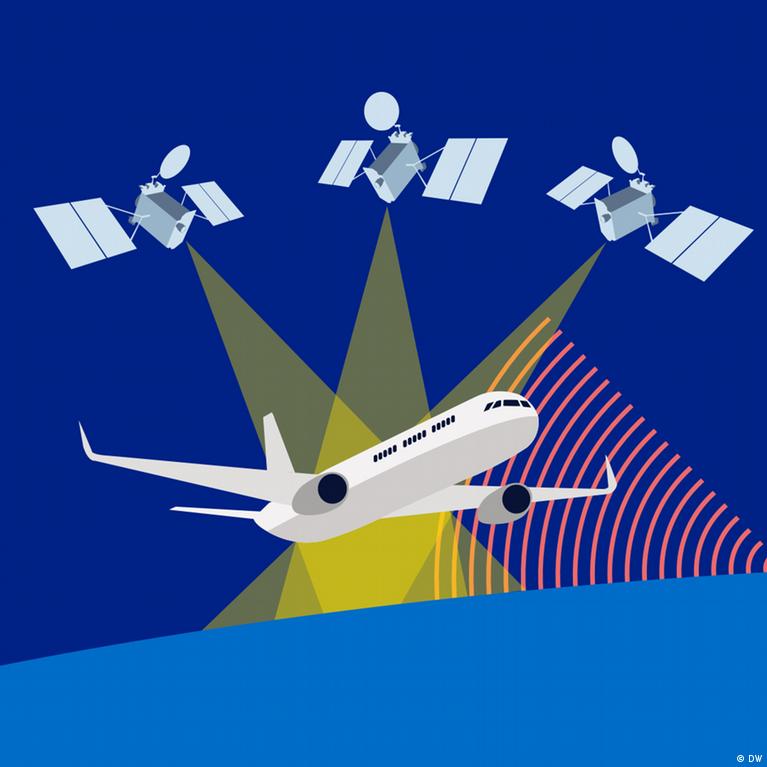
Russia is capable of deliberately distorting GPS signals across parts of Europe, creating risks for security and navigation. According to Darius Kulešius, deputy head of Lithuania’s communications regulator, Russia has significantly expanded the radius of GPS spoofing around Kaliningrad, increasing the number of transmitting antennas in the Russian semi-exclave from three at the beginning of 2025 to 36 antennas. False navigation signals can now reach most of Poland, as well as Lithuania, Latvia, Estonia, Belarus, and parts of Finland and Sweden at distances of up to 450 kilometers.
“Intermittent interference began during the 2023 NATO summit in Vilnius. Now they have built the infrastructure, and the interference has become a systemic, constant, uninterrupted Russian provocation against European security.”
Unlike GPS jamming, GPS spoofing involves broadcasting false location signals in order to mislead navigation systems. Since Russia’s full-scale invasion of Ukraine in 2022, European countries have repeatedly accused Moscow of interfering with navigation systems, though the Kremlin denies the allegations, calling them a “Western smear campaign.”
In March 2024, a Royal Air Force aircraft carrying then-British Defense Secretary Grant Shapps experienced GPS signal disruption while flying near Russian territory. In 2025, a military aircraft carrying Spanish Defense Minister Margarita Robles encountered GPS interference near Kaliningrad, while a plane transporting European Commission President Ursula von der Leyen experienced signal disruption during a flight to Bulgaria. A similar incident occurred near the Russian border on May 21, 2026, involving a Royal Air Force aircraft carrying British Defense Secretary John Healey. Experts believe Russia was behind these attacks.
Russia’s expansion of its GPS spoofing system around Kaliningrad indicates that the Kremlin is building a permanent infrastructure for hybrid attacks against Europe. Moscow is demonstrating its ability to interfere with the critical navigation systems of EU and NATO member states without direct military invasion. At the same time, the Kremlin is testing whether Europe is prepared to treat attacks on the navigation environment as a collective security threat.
Russia’s ability to distort GPS signals at depths of up to 450 kilometers means Moscow can affect not only border regions but also strategic infrastructure deep inside the EU and NATO. This includes potential threats to aviation, seaports, logistics hubs, energy infrastructure, and digital services that depend on satellite synchronization of time and coordinates. It creates a new type of asymmetric threat in which, even without missile strikes, Russia could destabilize Europe’s economic processes and transportation security.
• GPS spoofing is particularly dangerous because the victim often does not realize that interference has occurred. Unlike conventional jamming, where the signal simply disappears, coordinate distortion can cause aircraft, ships, or unmanned systems to receive false navigation data and make incorrect decisions. In civil aviation, this increases the risk of navigational errors and emergency situations, while for maritime transport and business it raises the risks of delays, financial losses, insurance disputes, and higher logistics costs.
• Russian attacks against aircraft carrying European officials are not merely technical in nature but also political and psychological. The Kremlin is demonstrating its ability to threaten even the most protected NATO and EU government aircraft, creating an atmosphere of psychological pressure and uncertainty. Such actions are part of a broader strategy aimed at intimidating Europe and reinforcing the perception that Russia can violate the Alliance’s security space with impunity.
• Most modern airliners and major airports do not rely exclusively on GPS and possess backup navigation systems. The existence of alternative navigation channels means that the Kremlin is currently incapable of completely paralyzing European aviation. However, it can systematically increase the burden on safety systems and create persistent risks for civilian transportation. The more frequent these incidents become, the higher the costs for airlines, insurers, and governments adapting to the new threat.
• Europe should treat GPS spoofing not as isolated technical incidents, but as a form of hybrid aggression by Russia. EU and NATO member states should initiate a systematic review of Russian actions within the International Civil Aviation Organization, the International Telecommunication Union, and the United Nations in order to secure international recognition of interference in civilian navigation systems. It is also important to establish a legal framework for new sanctions against Russian individuals and entities linked to electronic warfare and military infrastructure in the Kaliningrad region.
Russia’s expansion of GPS spoofing capabilities around Kaliningrad represents a major escalation in the militarization of the electromagnetic environment in Europe and poses growing risks to civil aviation safety. Unlike conventional military threats, GPS spoofing directly targets the integrity of navigation data relied upon by civilian aircraft, airports, logistics systems, and digital infrastructure. The systematic nature of these incidents suggests that the Kremlin is no longer conducting isolated experiments, but is instead building a permanent electronic warfare architecture capable of influencing the operational environment across large parts of Europe.
One of the most serious risks for civil aviation is that GPS spoofing can manipulate an aircraft’s perceived position without immediately alerting pilots or onboard systems. Modern commercial aviation increasingly relies on satellite-based navigation for area navigation (RNAV), Required Navigation Performance (RNP) procedures, precision approaches, route optimization, terrain awareness, and timing synchronization. When spoofed signals are introduced, aircraft systems may calculate incorrect positions, headings, or altitudes, potentially creating dangerous discrepancies between onboard instruments and actual flight conditions.
This threat becomes particularly acute during low-visibility landings; approaches to congested airports; flights over the Baltic Sea region; operations near military zones; automated flight management system (FMS) procedures.
Unlike traditional GPS jamming, where signal loss immediately alerts pilots and air traffic controllers to a problem, spoofing can create a “false reality” in which navigation systems continue functioning but operate on corrupted data. This significantly increases the probability of: navigational deviations; airspace incursions; incorrect descent profiles; runway alignment errors; loss of separation between aircraft.
For civil aviation authorities, spoofing is therefore more dangerous than conventional electronic interference because it undermines trust in the integrity of navigation systems themselves.
The concentration of incidents around Kaliningrad is not accidental. The region has evolved into one of Russia’s most militarized electronic warfare hubs and serves as a forward operating zone for testing hybrid warfare capabilities against NATO. The expansion from three to 36 spoofing transmitters strongly suggests the creation of a layered and redundant electronic warfare network designed for both peacetime intimidation and wartime disruption scenarios.
Several strategic motivations likely explain Russia’s rapid investment in GPS spoofing technologies.
First, the Kremlin views electronic warfare as a comparatively inexpensive asymmetric instrument against technologically superior NATO states. Russia cannot economically compete with NATO in conventional aerospace capabilities, but it can exploit vulnerabilities in Western dependence on satellite navigation and digital synchronization systems.
Second, Moscow likely sees GPS spoofing as an ideal “gray-zone” weapon because attribution remains politically complicated. Electronic attacks create disruption without crossing the threshold of kinetic warfare, allowing Russia to test NATO reactions while maintaining plausible deniability.
Third, the development of spoofing capabilities is closely connected to lessons learned from the war in Ukraine. Since 2022, both Russian and Ukrainian forces have heavily relied on electronic warfare to disrupt drones, precision-guided munitions, satellite navigation, and battlefield communications. The Kremlin appears to be adapting wartime electronic warfare experience into broader strategic tools targeting Europe’s civilian infrastructure.
Fourth, Russia likely seeks to normalize a permanent environment of low-level instability around NATO’s eastern flank. Frequent navigation incidents create psychological pressure on governments, airlines, insurers, and passengers while gradually increasing operational costs for Europe’s transportation and logistics sectors.
The implications for European airlines could become substantial over time. Repeated spoofing incidents may force rerouting of civilian air corridors; wider separation standards additional fuel reserves; increased cockpit workload; greater dependence on inertial navigation systems; more expensive avionics upgrades.
Insurance premiums for airlines operating in the Baltic region may also rise if spoofing incidents continue increasing in frequency and sophistication.
Large airports may eventually require dedicated anti-spoofing infrastructure, including: multi-source navigation verification systems; terrestrial backup navigation; enhanced signal authentication; AI-based anomaly detection; expanded use of inertial navigation cross-checking.
Russia’s activities may also accelerate Western efforts to reduce dependence on civilian GPS signals alone. NATO and EU states are already increasingly discussing: resilient Positioning, Navigation and Timing (PNT) systems; encrypted satellite navigation; eLoran terrestrial navigation networks; Galileo PRS (Public Regulated Service); quantum navigation technologies.
Several Russian defense and electronic warfare companies are believed to specialize in systems capable of GPS spoofing and satellite-navigation disruption. Among the most important are KRET (Concern Radio-Electronic Technologies), a subsidiary of Rostec, which develops numerous electronic warfare platforms for the Russian military. KRET has been linked to systems such as: Krasukha; Tirada; Murmansk-BN; Divnomorye.
Another important actor is JSC NPP Pulsar, which develops radio-electronic systems and components used in military communications and EW infrastructure.
JSC VNIIRA is also associated with navigation technologies and radio engineering systems connected to military aviation and electronic warfare.
Russia’s military-industrial ecosystem in this area also involves specialized institutes under Russian Ministry of Defenceand structures linked to the Federal Security Service and the Main Directorate of the General Staff of the Armed Forces of the Russian Federation, particularly in Kaliningrad and the Western Military District.
At the international level, Europe increasingly faces a strategic dilemma: whether GPS spoofing should be treated merely as a technical aviation hazard or as a coordinated form of hybrid aggression against NATO infrastructure.If incidents continue to escalate, pressure may grow within the Alliance to classify systematic electronic attacks on civilian navigation systems as hostile actions affecting collective security.
The broader danger is that Russia is effectively testing how far it can reshape Europe’s operational environment below the threshold of war. By interfering with navigation, timing, logistics, and transportation systems, Moscow is probing vulnerabilities in the digital foundations of modern European economies while avoiding direct military confrontation.
There are strong indications that the expansion of GPS spoofing infrastructure around Kaliningrad is part of a centrally coordinated Kremlin strategy for hybrid warfare against Europe rather than the isolated activity of local military commanders.
Several factors support this assessment.
First, the scale and speed of infrastructure expansion strongly suggest centralized planning and funding. Increasing the number of spoofing transmitters from three to 36 within roughly a year requires: coordinated military procurement; spectrum management authorization; integration with military command systems; logistical support; strategic prioritization at the federal level.
Such expansion is unlikely to occur without approval from the Russian Ministry of Defence and likely coordination with Russian electronic warfare command structures.
the geographic targeting aligns closely with Russia’s broader confrontation strategy against NATO’s northeastern flank. The affected zone includes: Poland; Lithuania; Latvia; Estonia; Finland; Sweden; Baltic Sea air and maritime corridors.
These are precisely the regions Moscow views as strategically sensitive after: Finland’s NATO accession; Sweden’s integration into NATO structures; NATO reinforcement in the Baltic region; increased Alliance military mobility near Kaliningrad.
The pattern suggests deliberate pressure against NATO’s operational environment rather than defensive protection of Kaliningrad alone.
The systematic nature of incidents involving aircraft carrying senior European officials indicates political signaling. The interference affecting flights connected to: Grant Shapps; Margarita Robles; Ursula von der Leyen;John Heale creates a strong impression that Russia is not merely testing electronic systems but demonstrating coercive reach. These incidents have strategic communication value and contribute to psychological pressure on NATO governments.
Fourth, the expansion fits Russia’s long-term doctrine of “gray-zone” or hybrid confrontation. Russian military thought increasingly emphasizes: non-kinetic disruption; electronic warfare; cyber operations; information warfare; infrastructure intimidation; deniable coercion below the threshold of open war.
The Kremlin likely views electromagnetic interference as especially attractive because attribution remains politically more difficult than for missile strikes or sabotage.
Fifth, lessons from the war in Ukraine almost certainly accelerated this development. Russia’s military has gained extensive battlefield experience in drone disruption; satellite-navigation interference; electronic suppression; electromagnetic spectrum warfare.
Kaliningrad may now serve as a strategic laboratory for adapting wartime electronic warfare methods into peacetime hybrid pressure tools against NATO states.
The Kremlin may additionally calculate that repeated non-lethal disruptions create gradual psychological fatigue within European societies and bureaucracies, especially if governments struggle to respond decisively.
At the same time, Russia probably assesses that NATO lacks a clearly defined escalation framework for electronic attacks against civilian infrastructure. This ambiguity creates an opportunity for Moscow to operate aggressively below the threshold likely to trigger collective retaliation.
Overall, the available evidence supports a high-confidence analytical assessment that the expansion of GPS spoofing around Kaliningrad is not an isolated defensive measure but part of a broader, centrally coordinated Russian hybrid warfare strategy aimed at shaping Europe’s security environment without crossing into overt military conflict.
The civilian aircraft most vulnerable to GPS spoofing attacks are generally those that rely heavily on satellite-based navigation, automated flight management systems, or operate in environments with limited terrestrial navigation backups. Vulnerability also depends on aircraft age, avionics architecture, pilot workload, and the operational environment.
Several categories are particularly exposed.
Regional and Short-Haul Commercial Aircraft
Regional jets and turboprop aircraft are among the most vulnerable categories because they frequently: operate at lower altitudes; fly into smaller airports; rely heavily on RNAV and GPS-based approaches; operate in poor weather conditions; fly in congested Baltic and Northern European airspace.
Aircraft such as the ATR 72, Bombardier CRJ900, and Embraer E175 often serve airports where ground-based navigation infrastructure is more limited than at major international hubs.
Spoofing during approach or departure phases could create: incorrect positional awareness; unstable approaches; navigation deviations; confusion during terrain avoidance procedures.
Business Jets and VIP Aircraft
Business aviation is highly vulnerable because many private jets rely extensively on advanced satellite-based avionics and often operate into secondary airports with less robust navigation infrastructure.
Aircraft such as Gulfstream G650; Bombardier Global 7500; Dassault Falcon 8 depend heavily on integrated GPS navigation and automated flight systems.
VIP government flights may be especially targeted for political and psychological reasons. Although government aircraft often possess military-grade communications and some hardened systems, they still frequently operate in civilian airspace environments dependent on commercial navigation infrastructure.
Helicopters
Civilian helicopters are particularly vulnerable because they: fly at low altitude; often operate visually in degraded weather; increasingly rely on GPS-assisted terrain navigation; conduct offshore, medical, rescue, and infrastructure missions.
Helicopter emergency medical services (HEMS), offshore oil transport, and search-and-rescue operations are especially exposed. Spoofed position data near terrain or urban environments could create highly dangerous flight conditions.
Aircraft such as the Airbus H145 or Leonardo AW139 increasingly integrate digital navigation ecosystems vulnerable to signal manipulation.
Cargo aviation faces elevated vulnerability because of: nighttime operations; long-duration flights; heavy dependence on automated routing; operations in remote regions.
Aircraft such as the Boeing 767 Freighter and Airbus A330F rely heavily on GPS-integrated logistics timing and routing systems.
Spoofing could disrupt: arrival sequencing; route optimization; airport slot coordination; fuel management calculations.
Even small navigation disruptions could produce cascading logistics and supply-chain effects across Europe.
Private civilian aircraft and small aviation operators are among the least protected categories because they often: lack advanced inertial backup systems; use commercial off-the-shelf GPS units; operate with smaller crews; have lower situational awareness capabilities.
Aircraft used for: pilot training; recreational flying; aerial surveys; agricultural operations particularly exposed to spoofing risks.
Unlike large commercial airlines, general aviation pilots may have limited training in identifying sophisticated spoofing conditions.
Civilian drones are probably the single most vulnerable aviation category.
Commercial UAVs used for: infrastructure inspection; media; mapping; delivery services; agriculture; industrial monitorin depend almost entirely on GNSS signals
Russian experience in Ukraine has shown how vulnerable civilian and military drones are to electronic warfare environments.
Paradoxically, some older aircraft may in certain circumstances be less dependent on GPS than modern digital aircraft because they retain stronger reliance on: inertial navigation systems (INS); VOR/DME navigation; pilot manual procedures.
However, aging aircraft may also suffer from: outdated avionics integration; weaker spoofing detection software limited cybersecurity protections.
Large modern commercial aircraft such as the: Airbus A350; Boeing 787 Dreamliner
generally possess multiple redundant navigation systems; inertial reference systems; radio navigation backups; cross-checking algorithms.
Pilots are trained to detect discrepancies between navigation sources. As a result, spoofing alone is unlikely to directly bring down a major modern airliner.
The real danger lies less in catastrophic failure and more in systemic stress accumulation across aviation networks.
Spoofing risks increase dramatically during: approach and landing; poor weather operations polar or maritime flights; low-altitude operations; high-density airspace; flights near Kaliningrad or the Baltic Sea; emergencies requiring rapid rerouting.
The larger threat is not necessarily immediate aircraft loss, but the gradual erosion of trust in satellite navigation reliability. increase airline operating costs;
This is precisely why GPS spoofing represents a powerful hybrid warfare instrument: it allows Russia to impose economic, psychological, and operational pressure on Europe without direct kinetic attacks.
Existing international law does not adequately address state-sponsored GPS spoofing and large-scale interference with satellite navigation systems. The current legal framework was largely developed before the emergence of persistent electronic warfare against civilian infrastructure in peacetime and therefore contains major gaps, ambiguities, and enforcement weaknesses.
Several areas of international law partially apply, but none were specifically designed for modern state-sponsored navigation spoofing campaigns like those attributed to Russia around Kaliningrad.
International Civil Aviation Law
The primary legal framework governing civil aviation is the International Civil Aviation Organization system established under the Convention on International Civil Aviation.
Under the Chicago Convention: states must avoid endangering civilian aviation; states are expected to cooperate in maintaining safe air navigation; unlawful interference with civil aviation safety is prohibited.
However, the convention was drafted in an era before satellite navigation and electronic warfare. It does not explicitly define: GPS spoofing; satellite signal manipulation; electromagnetic navigation attacks; hybrid electronic interference.
This creates a major legal ambiguity.
ICAO can issue: safety advisories; technical standards; recommendations; incident investigations.
But ICAO lacks: enforcement powers; sanction authority; coercive mechanisms against states.
As a result, even if spoofing is documented, holding a state legally accountable remains difficult.
The International Telecommunication Union regulates international radio spectrum usage.
Under ITU Radio Regulations: harmful interference with radio communications is prohibited; states must avoid unauthorized emissions affecting other countries;
- spectrum management obligations exist.
In theory, GPS spoofing violates the spirit — and likely the letter — of these regulations.
However, the ITU framework faces several limitations:
- weak enforcement; political dependency on member states; difficulty proving attribution; lack of rapid response mechanisms; no meaningful punitive instruments.
The ITU was designed for technical coordination, not geopolitical hybrid warfare.
Under customary international law, states can bear responsibility for internationally wrongful acts if: conduct is attributable to the state; an international obligation is breached.
If Russia deliberately interferes with civilian navigation systems in foreign airspace, affected states could argue: violation of sovereignty; unlawful interference with civil aviation;
- breach of due diligence obligations.
However, proving state responsibility in spoofing cases is extremely difficult because attribution is technically complex; spoofing is deniable; electromagnetic evidence is hard to publicly disclose intelligence sources may remain classified.
This creates a legal gray zone that hybrid warfare actors exploit intentionally.
Use of Force and Armed Attack Thresholds
One of the biggest unresolved legal questions is whether large-scale spoofing could constitute: a prohibited use of force; coercive intervention; an armed attack.
Under the United Nations Charter: states may not use force against other states; armed attacks may trigger self-defense rights.
But international law has not clearly established whether non-kinetic electronic attacks qualify.
Most legal scholars currently assess that: isolated spoofing incidents likely remain below the armed attack threshold; persistent large-scale disruption causing deaths or major accidents could potentially cross it.
For example if spoofing caused a civilian airliner crash; disrupted emergency services; disabled critical infrastructure; triggered maritime disasters; the legal interpretation could shift significantly.
However, there is no settled international consensus.
Modern hybrid warfare deliberately exploits the gap between: peace and war; civilian and military domains; technical incidents and hostile acts.
Russia’s approach appears designed specifically to remain below NATO Article 5 thresholds; below traditional armed conflict definitions; below levels likely to provoke military retaliation.
Current international law struggles precisely with these “sub-threshold” operations.
Maritime Law Implications
Spoofing also affects maritime navigation.
Under frameworks such as the United Nations Convention on the Law of the Sea: states must ensure maritime safety; interference with navigation may violate international obligations.
Yet UNCLOS similarly predates satellite-navigation dependency and contains no robust enforcement mechanisms for systematic electronic interference.
Cyber and Tallinn Manual Interpretations
Some legal experts increasingly interpret GPS spoofing through the lens of cyber and information operations.
The Tallinn Manual 2.0 — although non-binding — suggests that non-kinetic operations affecting critical infrastructure may violate international law under certain conditions.
The Tallinn framework indicates that severe electronic interference could breach sovereignty; coercive disruption may violate non-intervention principles; infrastructure manipulation could trigger state responsibility.
Problems of Attribution
One of the greatest legal obstacles is attribution.
Russia consistently denies responsibility for GPS interference and frames accusations as anti-Russian propaganda.
Even when Western intelligence strongly suspects Russian involvement: public evidence may remain classified; technical proof may be insufficient for legal proceedings; international organizations may avoid politically sensitive attribution.
Current international law is poorly adapted because it was built for: territorial invasions; kinetic attacks; traditional warfare; physical infrastructure sabotage.
Modern electronic warfare instead targets: data integrity; timing systems; digital trust; electromagnetic environments.
If spoofing incidents continue escalating, NATO and EU states may push for: formal ICAO attribution mechanisms; new ITU enforcement procedures; international conventions on navigation interference; sanctions frameworks for electronic warfare; definitions of hostile electromagnetic operations; expanded cyber-defense interpretations.
In practice, the legal ambiguity itself benefits Russia.
The Kremlin likely calculates that legal uncertainty delays Western responses deniability reduces escalation risks;fragmented international institutions struggle to react quickly.
This makes GPS spoofing an ideal hybrid warfare instrument: high strategic impact, relatively low cost, plausible deniability, and weak international enforcement exposure.
Overall, existing international law only partially addresses state-sponsored navigation spoofing and remains structurally inadequate for the realities of persistent electronic warfare against civilian infrastructure in peacetime Europe.
A future aviation accident credibly linked to Russian GPS spoofing could trigger a major NATO political crisis, especially if the incident involved mass civilian casualties; a NATO member-state aircraft; senior government officials;or disruption near sensitive Alliance infrastructure.
The severity of the crisis would depend on several factors: attribution certainty; scale of casualties; location of the incident; evidence of intent; and the political climate between Russia and NATO at the time.
Even without direct military escalation, such an event could fundamentally reshape NATO’s understanding of hybrid warfare and the threshold for collective response.
Up to now, most spoofing incidents have remained: disruptive; ambiguous; non-lethal; technically deniable.
This ambiguity has allowed European governments to treat them primarily as: aviation safety concerns; electronic interference; hybrid harassment.
A fatal crash would dramatically alter that perception.
Civil aviation occupies a unique psychological and political space because: civilian airliners symbolize international stability; aviation safety relies on trust in global systems; governments are expected to guarantee passenger safety; aviation accidents generate enormous public attention.
If spoofing were shown to have contributed to a crash, the incident would no longer be viewed merely as electronic interference but potentially as state-enabled endangerment of civilian lives.
Several scenarios could produce a serious political crisis.
Crash of a Civilian Airliner. A spoofing-induced navigational error causing the crash of a commercial aircraft over: the Baltic Sea; Poland; Lithuania; Finland; Swed could create immediate political shock across Europe.
If hundreds of civilians died, public pressure for retaliation against Russia would likely become enormous.
Governments would face demands to: strengthen sanctions; expel diplomats; isolate Russia internationally; reinforce NATO’s eastern flank; redefine hybrid attack thresholds.
Incident Involving Government Aircraft
An accident involving a plane carrying: NATO officials; EU leaders; defense ministers; military personne would be even more politically explosive.
Because several prior spoofing incidents already allegedly affected aircraft linked to: Grant Shapps; Margarita Robles; Ursula von der Leyen; John Healey Western governments may increasingly interpret future interference as deliberate political signaling rather than accidental spillover.
A fatal incident involving senior officials could be perceived as: reckless endangerment; coercive intimidation; or even indirect hostile action.
A large-scale spoofing campaign disrupting: airport operations; collision avoidance systems; approach sequencing; airspace managemen could trigger continent-wide aviation paralysis.
Even without a crash, widespread disruption affecting thousands of flights could generate: economic losses; panic; loss of public trust; insurance crises.
The most sensitive question would be whether spoofing-related deaths could trigger NATO consultations under: Article 4; or, in extreme cases, debates around Article 5.
North Atlantic Treaty Organization was originally designed around conventional military attacks, not hybrid electromagnetic operations.
However, NATO has gradually expanded its interpretation of threats to include: cyberattacks; hybrid warfare; sabotage; infrastructure disruption.
If a spoofing attack caused mass casualties, some NATO members — especially:Poland; Lithuania; Latvia; Estonia; Finlan might argue that Russia had crossed a fundamentally new line.
Others might resist escalation due to: attribution uncertainty; fear of confrontation; legal ambiguity; economic concerns.
This could expose major divisions inside the Alliance.
A spoofing-induced aviation disaster could create political tension between: eastern NATO members demanding a hard response; western European governments favoring restraint.
The debate could revolve around: whether the incident constituted an attack; whether intent can be proven; proportionality of response; escalation risks.
Russia would likely exploit these divisions aggressively through
disinformation; denial; conspiracy narratives; diplomatic pressure.
The Kremlin’s strategy likely depends heavily on ambiguity.
Russia would almost certainly:
- deny responsibility; claim technical malfunction; accuse NATO of provocation; blame civilian aviation authorities; promote alternative explanations.
This means the crisis would become not only technical but informational and political.
Western intelligence agencies would face immense pressure to rapidly declassify evidence; prove attribution publicly; avoid revealing sensitive collection capabilities.
Despite these risks, the Kremlin may calculate that spoofing remains useful because: attribution remains difficult; escalation thresholds remain unclear; NATO consensus is hard to achieve; operations stay below kinetic warfare; Europe remains dependent on vulnerable navigation systems.
In other words, spoofing occupies a dangerous gray zone where Russia can impose pressure while betting the West will hesitate to respond decisively.
The greatest long-term danger may not be a single catastrophic crash but the gradual normalization of persistent electronic attacks against civilian infrastructure.
A growing number of states — and in some cases non-state actors — use spoofing and related electronic navigation manipulation technologies for military, intelligence, border-control, and strategic purposes. However, Russia currently appears to employ spoofing at one of the largest and most systematic operational scales against civilian and regional environments.
Several countries are known or strongly suspected to use GPS spoofing capabilities.
Russia is widely considered the most aggressive and operationally experienced user of GPS spoofing.
Russia has employed spoofing: in Syria; around the Kremlin; in the Arctic; in the Baltic Sea region; near Ukraine; around Kaliningrad; in the Black Sea.
Russian systems have reportedly affected: civilian aircraft; ships; drones; military navigation systems.
Moscow uses spoofing as part of a broader electronic warfare doctrine integrating: A2/AD strategy; hybrid warfare; drone defense; strategic intimidation; battlefield EW.
China is another major actor with advanced spoofing capabilities.
China has reportedly used spoofing: in the South China Sea; near disputed maritime territories; around strategic ports; in military testing environments.
Researchers have documented unusual GPS anomalies affecting ships near Chinese ports and maritime zones.
Beijing likely sees spoofing as useful for: maritime control; anti-drone defense; military deception; denial of adversary situational awareness.
Iran strongly supports the assessment that spoofing is part of broader PLA doctrine.
Iran has demonstrated sophisticated spoofing capabilities, especially against drones.
One of the most famous alleged cases occurred in 2011 when Iran claimed to have manipulated the navigation system of a U.S. Lockheed Martin RQ-170 Sentinel drone and forced it to land largely intact.
Whether the exact Iranian narrative was fully accurate remains debated, but Iran has clearly invested heavily in: GPS interference; drone disruption; electronic warfare.
North Korea has repeatedly conducted GPS jamming and likely spoofing operations against: South Korean aircraft; ships; border regions.
Pyongyang has targeted: civilian aviation; fishing fleets; military systems.
Israel has used GPS interference extensively for defensive military purposes.
Israel has disrupted satellite navigation signals: near Gaza; around Lebanon; during regional military operations.
The goal is usually: drone defense; missile disruption; protection against precision-guided attacks.
Israel’s spoofing and jamming activities increased significantly after: Iranian drone threats; Hezbollah UAV activity; regional missile escalation.
United States possesses highly advanced spoofing and electronic warfare capabilities, though its operational use against civilian environments is generally more restricted and less publicly visible.
The U.S. military develops spoofing technologies for: battlefield deception; drone warfare; navigation denial; EW training; anti-access operations.
American systems are operated by branches such as: the United States Space Force; the United States Navy; the United States Air Force.
The U.S. also conducts GPS-denied environment exercises to prepare for conflict with peer adversaries like Russia and China.
Several NATO countries possess spoofing capabilities primarily for: military training; EW exercises; drone defense; battlefield simulation.
Countries with advanced EW programs likely include: United Kingdom; France Germany; Turkiye.
However, NATO states generally operate under stricter legal and political constraints regarding civilian exposure.
Both India and Pakistan likely possess limited spoofing capabilities connected to: border conflict environments; drone defense; military EW development.
Growing drone tensions between the two countries have accelerated regional electronic warfare investment.
Some non-state actors increasingly experiment with basic spoofing technologies.
Examples include: militant drone operators; smugglers; organized crime groups; maritime sanctions evasion networks.
Commercially available spoofing equipment is becoming cheaper and more accessible.
Several global trends explain the spread of spoofing technologies.
The broader trend suggests that the electromagnetic spectrum is becoming a permanent arena of geopolitical competition.
Future conflicts may increasingly involve: navigation manipulation; timing disruption;digital infrastructure interference;