

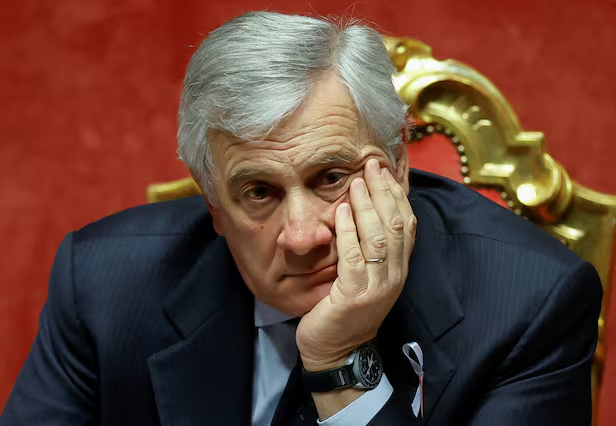
A new round of diplomatic confrontation has emerged between Italy and Russia over an espionage case. Moscow has expelled the Italian military attaché and one of his staff members, a move that Italian Foreign Minister Antonio Tajani described as a reciprocal response to Italy’s earlier expulsion of two Russian diplomats (military intelligence officers) in connection with the same case.
The expulsion of the Italian diplomats represents Moscow’s predictable response to the exposure of its intelligence officers, who, while operating under diplomatic cover, allegedly attempted to gain access to NATO military satellite technologies at a defense facility located in Italy. This case once again demonstrates that Russia continues to conduct active intelligence and subversive operations both in Italy and across the territory of other NATO member states.
The diplomatic confrontation between Italy and Russia underscores Moscow’s increasingly hostile policy toward Rome. The presence of a pro-Russian lobby among some Italian far-right and opposition politicians creates an additional security concern, as these actors effectively disregard the real nature of the threats facing the country. The exposure of the espionage network indicates that Russia is conducting subversive activities not only against Italy but against European democracies more broadly.
Such reciprocal expulsions have become a standard feature of Russia’s counterintelligence playbook, allowing Moscow to demonstrate political resolve while attempting to project parity despite having suffered an operational setback. In this case, the Kremlin’s response cannot obscure the more significant development—the disruption of an alleged Russian intelligence operation targeting sensitive NATO military satellite technologies at a defense facility in Italy.
The incident reinforces the assessment that Russia continues to assign high priority to intelligence collection against NATO’s technological and military capabilities despite its extensive intelligence losses across Europe since the full-scale invasion of Ukraine. Rather than reducing its intelligence footprint, Moscow appears to be adapting its operational methods by focusing on strategically important technologies, defense-industrial capabilities, and military logistics that directly influence NATO’s ability to support Ukraine and strengthen its own deterrence posture. Italy’s role as a major NATO member, host to critical military infrastructure, and participant in numerous Alliance space and defense programs makes it a particularly attractive target for Russian intelligence services.
The case also illustrates the broader transformation of Russian intelligence operations in Europe. Traditional espionage aimed primarily at collecting political or military information has increasingly evolved into a multidimensional campaign combining intelligence collection, cyber operations, sabotage planning, influence activities, and efforts to undermine public confidence in democratic institutions. The objective extends beyond acquiring classified information. it seeks to weaken NATO’s technological advantages, disrupt defense cooperation among Allies, and complicate the development and deployment of advanced military capabilities.
The renewed diplomatic confrontation between Rome and Moscow further demonstrates that bilateral relations have entered a prolonged period of strategic confrontation in which intelligence activity has become a central instrument of Russian foreign policy. Diplomatic missions increasingly serve not only as channels for interstate dialogue but also as platforms for intelligence collection, influence operations, and support to clandestine networks. Consequently, European counterintelligence services are likely to continue intensifying surveillance of Russian diplomatic personnel while imposing greater restrictions on their activities.
The affair also highlights the domestic dimension of Italy’s security challenge. Russian intelligence operations do not occur in isolation but seek to exploit existing political and societal divisions. Analysts have long expressed concern that pro-Russian narratives promoted by certain political actors, advocacy groups, or media platforms may create a permissive environment that complicates public recognition of Russian intelligence threats. While legitimate political debate remains a fundamental feature of democratic societies, foreign intelligence services routinely attempt to exploit polarization to weaken national consensus on security policy, sanctions, NATO cooperation, and support for Ukraine.
Strategically, the exposure of the espionage network demonstrates that Russia continues to regard Italy not merely as an individual intelligence target but as an important gateway into NATO’s broader military, technological, and political ecosystem. Intelligence operations directed against Italian institutions therefore have implications extending well beyond bilateral relations, affecting the collective security of the Alliance. As NATO increasingly integrates space-based capabilities, advanced communications, and intelligence-sharing into its operational planning, attempts to penetrate these systems are likely to become even more valuable objectives for Russian intelligence.Rather than representing an isolated espionage incident, the latest diplomatic confrontation should therefore be viewed as another manifestation of the long-term intelligence conflict unfolding between Russia and NATO. It underscores the growing importance of counterintelligence cooperation among Allied states and highlights the need for continuous protection of defense technologies, critical infrastructure, and classified research from increasingly sophisticated Russian intelligence operations.