
Polish Foreign Minister Radosław Sikorski’s statement that evidence exists of financial transfers and confidential talks between Russian representatives and Viktor Orbán’s entourage potentially moves the issue of Russian influence on Hungarian politics from political suspicion into the realm of counterintelligence and anti-corruption investigations. If the Polish information is corroborated by documents, it could indicate not only privileged relations between Budapest and Moscow but also mechanisms of deliberate Kremlin influence over political decisions in an EU and NATO member state.
It is essential to distinguish between three levels of potential Russian influence: political coordination, financial dependence, and Hungarian officials carrying out tasks in Moscow’s interests. Each has different legal and security implications. Diplomatic contacts or bank transfers alone do not prove illicit financing or an intelligence relationship. The decisive factors will be the origin of the funds, their ultimate beneficiaries, the content of the discussions, and any connection between Russian support and specific decisions by Hungary’s leadership.
At the same time, the political context gives Sikorski’s statement particular significance. During Orbán’s rule, Hungary repeatedly adopted positions consistent with the Kremlin’s strategic interests: it opposed certain sanctions initiatives, delayed decisions on support for Ukraine, maintained close energy cooperation with Russia, and used the EU’s unanimity rules to strengthen its own negotiating position.
These actions do not automatically prove external control. However, if financial support from Russian sources is confirmed, they could be examined as part of a broader system of political influence requiring an independent investigation.
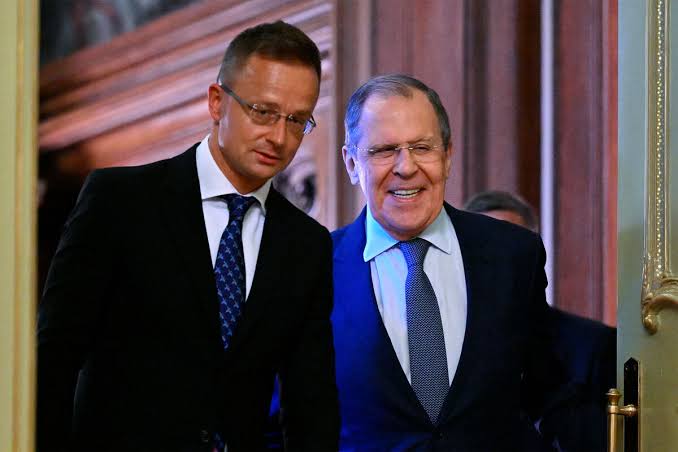
Sikorski’s description of Péter Szijjártó’s exchanges with Sergei Lavrov, likening the Hungarian diplomat’s behavior to that of a “schoolboy” or a “subcontractor,” is primarily political in significance. It suggests a possible asymmetry in the relationship between the two ministers, in which Hungary may have acted not merely as Russia’s partner but also as a participant in coordinating actions advantageous to Moscow.
The most serious risk lies not in Szijjártó’s contacts with Lavrov themselves, but in the possibility that Hungary used its access to internal EU and NATO deliberations in the interests of Russian diplomacy.
If the recordings confirm that Hungarian officials provided Russian representatives with nonpublic information about allied negotiating positions, coordinated tactics with Moscow to block European decisions, or received instructions regarding specific political actions, that would warrant conclusions far more serious than ordinary allegations of a pro-Russian orientation.
In that case, Hungary’s institutional status may have been used to advance Russian interests within Euro-Atlantic structures.
New Developments: The Financial Trail and Possible Breaches of EU Confidentiality
The Polish minister’s remarks take on added significance in light of an international journalistic investigation published by VSquare in spring 2026. According to the released recordings, Szijjártó discussed with Lavrov the possibility of passing on documents from closed EU meetings and facilitating the removal of certain Russian oligarchs and their relatives from sanctions lists. Other recordings indicate that Moscow was informed about talks among European leaders concerning the opening of EU accession negotiations with Ukraine.
Szijjártó did not deny that the conversations took place but described the release of the recordings as interference by foreign intelligence services.
The most important new element in Sikorski’s statement is his reference to financial transfers. Unlike the audio recordings, which were already publicly available, information about monetary transactions had not previously been presented publicly. The Polish minister did not specify the amounts, senders, recipients, or purposes of the transfers.
Establishing these details will make it possible to determine whether the transactions involved legitimate financial operations, support for political organizations, covert financing, or corrupt mechanisms of influence.
If the financial transfers were linked to specific political decisions by the Hungarian government, this could indicate a mechanism for exchanging political favors for material support. Such a model is considerably more dangerous than ordinary diplomatic rapprochement because it creates the risk that political leaders become dependent on a foreign state power center.
Why Is Warsaw Making These Allegations Public Now?
The political timing of the statement is important. Following Orbán’s defeat in the April 2026 parliamentary elections and the end of his 16 years in power, opportunities to scrutinize the activities of the previous Hungarian government have changed significantly. This suggests that Warsaw may be pursuing several interconnected objectives.
First, Poland may seek to move the issue of Russian influence on Orbán’s government from political debate to an official investigation. With the change of government in Budapest, new opportunities may emerge to obtain documents, examine financial transactions, and establish the nature of former officials’ contacts with Moscow.
Second, Sikorski’s statement may signal to other EU member states the need to reconsider practices for sharing confidential information with governments reasonably suspected of passing information to third countries.
Third, Warsaw may wish to determine how systematic Russian influence on Hungarian foreign policy was and whether the Kremlin used similar mechanisms in other Central European countries.
Implications for the EU and NATO
If the Polish evidence is confirmed, the case could provide grounds for reviewing European mechanisms for protecting confidential information, sanctions policy, and measures against foreign political financing.
Particularly dangerous is the potential precedent of an EU member state using its veto power or access to closed-door negotiations to advance a third country’s interests. In such circumstances, Russia could influence decisions not only through external diplomatic pressure but also through representatives of a state directly involved in shaping common European policy.
The potential implications for NATO are even more serious. If it is established that protected Alliance information was passed to Russia, questions will arise about the effectiveness of counterintelligence safeguards and controls over access to sensitive materials. At the same time, the publicly available recordings concerning EU documents do not constitute proof of a leak of classified NATO information.
European anti-corruption and law-enforcement bodies could have grounds to conduct inquiries if the relevant jurisdiction and indications of offenses are established. Sikorski’s statement alone, however, does not automatically trigger an EU-level investigation.
Radosław Sikorski’s statement potentially changes the assessment of Viktor Orbán’s government’s relations with Russia: from political rapprochement and alignment of foreign-policy positions to a possible system of financial incentives, exchanges of confidential information, and coordinated influence over EU decisions.
The most significant factor is the combination of two elements: already published evidence of the former Hungarian diplomatic leadership’s willingness to advance Russian interests and new information about possible financial mechanisms supporting Orbán’s government.
If a direct link between these elements is established, Russian-Hungarian relations during that period could be viewed not merely as an expression of political pragmatism or ideological affinity, but as a potentially organized system of foreign influence.The central question for European counterintelligence agencies is whether Moscow treated the Hungarian leadership as a political partner or used it as an instrument for obtaining information and influencing EU and NATO decisions.
More on this story: Hungary’s Espionage Against EU Institutions: