
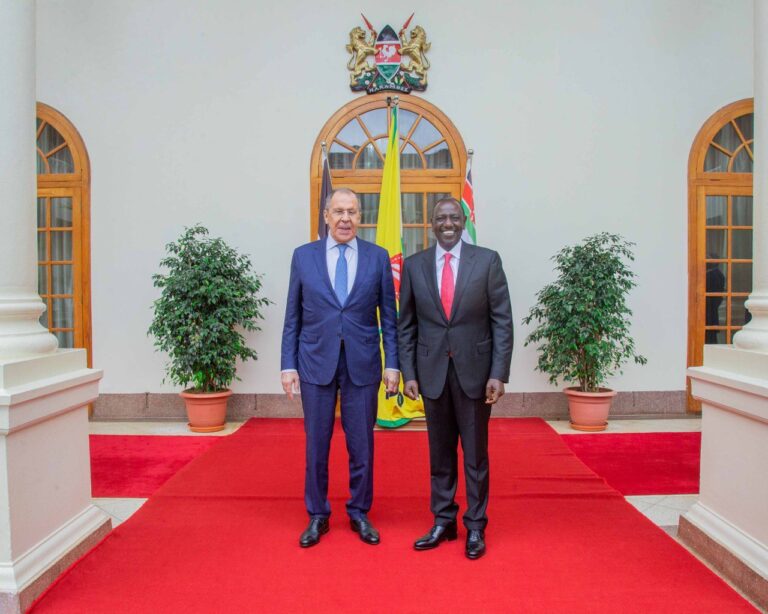
Moscow is building economic ties with Kenya that are calibrated to Nairobi’s state priorities under Vision 2030. The package includes negotiations on trade agreements, regular exchanges of business delegations, and alignment in logistics, agribusiness, construction, and tourism. As a result, Russian structures are securing long-term contracts and gaining access to the ports of Mombasa and Lamu, opening a direct gateway to EAC and AfCFTA markets.
For the United States, this means lost tenders and reduced economic leverage, which Washington previously used to promote transparency standards, sanctions discipline, and oversight mechanisms. Expanding trade and investment flows create space for alternative financial routes and re-export channels, complicating monitoring of economic activity, reducing regional elites’ sensitivity to American warnings, and shifting segments of political positions toward “neutrality” in UN and African Union forums.
The security dimension is also shifting to Washington’s disadvantage. Access to East Africa’s transport arteries and port infrastructure gives Russian companies and affiliated networks the ability to establish a deeper presence along the Northern Corridor toward the Great Lakes, while in ICT projects they can embed dual-use technological nodes. Such a system facilitates information operations, expands the space for political lobbying, and enhances the Kremlin’s ability to influence regional decisions on sanctions and military-technical cooperation with the West.
In the end, the United States faces a more fragmented coalition of partners in East Africa, higher costs of maintaining its presence in the Red Sea and Indian Ocean, and the risk of the emergence of stable channels through which Russian actors can gather resources, technology, and political support for global confrontation with Washington.
Russia actively uses economic offers as a tool of soft penetration into political processes in East African states. When Moscow supports infrastructure projects or proposes participation in joint programs, it effectively creates elite dependencies on Russian resources and decisions. Such dependence allows the Kremlin to subtly adjust partner positions in international formats—precisely where the United States expects consolidated support. The gradual shift in sentiment becomes advantageous for Moscow on issues of sanctions, security-related votes, or international crisis responses.
An additional risk lies in long-term penetration into key sectors—from IT to logistics. When Russian entities take root in transport hubs, digital services, or supply chains, they gain the ability to influence decisions of strategic importance. This presence creates channels through which the Kremlin can play its own game, shape its own information capabilities, and access flows critical for regional stability. For the United States, this dynamic means a gradual displacement of the center of gravity in the region and an increased risk that critical decisions will be made not in a “partner-friendly” but in a “neutral-to-Russian” direction.
Russian presence in Kenya enables the use of economic ties as political leverage, gradually shifting the balance of regional interactions. When Moscow establishes durable cooperation channels in trade, infrastructure, and the private sector, it gains access to influence instruments that go beyond ordinary commercial interests. This process allows Russia to move proactively, capturing initiative in areas where the United States traditionally held an advantage. The steady rise of Russian influence reshapes the tone of dialogue and creates an environment where American policies no longer receive automatic support.
The expansion of Moscow’s economic activity creates alternative routes for financial flows that can weaken sanctions mechanisms. As partnerships expand, the number of points through which goods, resources, or technologies can transit with minimal visibility increases. Such multi-channel networks elevate tolerance for opaque operations among regional actors. As a result, Washington faces a more complex oversight environment, where Russian activities become harder to detect.
Russia’s investments in logistics and technology sectors create conditions for deeper entrenchment in administrative and digital processes. Presence in key transport arteries and digital services enables influence over decisions that determine the movement of goods and data. This level of access opens the door for economic engagement to be used for non-economic objectives. For the United States, this means a risk of opaque decisions with significant geopolitical consequences.
Russia actively employs disruptive influence methods to increase its weight and weaken the position of its rivals. By acting through economic projects, information narratives, or informal channels, it creates environments where trust between partners erodes. This approach allows the Kremlin to exploit contradictions and provoke instability wherever it finds advantage. For the United States, this generates a complex array of risks that extend beyond individual sectors and affect the broader regional dynamic.
The gradual shift of parts of African elites into the orbit of Russian influence reduces the space for constructive engagement with Washington. When political decisions depend more on external incentives than on domestic logic, the likelihood increases that positions will be taken in ways that undermine unity among international partners. This shift creates a new reality in which the United States faces not isolated setbacks, but a systemic loss of influence. Ultimately, Russian activity in Kenya and across East Africa becomes a catalyst for deeper changes that run counter to American interests.
Threats to the United States From Russia’s Partnership With Kenya
Russia’s deepening political, security, and economic engagement with Kenya transforms Nairobi from a traditionally pro-Western anchor in East Africa into a potential neutralizer of U.S. influence in a region critical for counterterrorism, maritime security, and global supply-chain resilience.
While Kenya is unlikely to become a full Russian client, Moscow’s methodical penetration creates strategic risks in intelligence, military access, energy/logistics, and UN diplomacy.
Strategic Threats
Erosion of U.S. influence in East Africa
Kenya is traditionally one of Washington’s most reliable partners in:
- counterterrorism operations against al-Shabaab;
- intelligence collection in the Horn;
- regional crisis diplomacy (Sudan, Somalia, Ethiopia);
- security access to the Indian Ocean.
A Russian presence dilutes this architecture and undermines the U.S. strategic position at a time when China is already entrenched.
Threat:
The U.S. risks losing primacy in one of Africa’s most geopolitically pivotal states.
Security & Military Risks
Russian access to Kenyan security and intelligence institutions
Russian “security cooperation,” training, and equipment packages often include:
- embedded advisors,
- signals-intelligence support,
- technology that collects data for Moscow,
- influence inside police, cyber, and military units.
Threat:
Potential compromise of U.S.–Kenya intelligence sharing and U.S. operations in the region.
Russian military presence on Kenyan soil (covert or dual-use)
Moscow may push for:
- naval logistics access
- “anti-terrorism training centers”
- private military contractors (Africa Corps)
- arms storage or maintenance facilities
Kenya’s ports (Mombasa, Lamu) are highly strategic for Indo-Pacific access.
Threat:
Russian military footprint complicates U.S. maritime and counterterrorism operations
and provides Moscow with an Indian Ocean forward node.
Political & Diplomatic Risks
Shift in Kenya’s UN voting behavior
Kenya’s vote matters at the UN on:
- Ukraine-related resolutions;
- sanctions;
- cybersecurity norms;
- African peacekeeping mandates;
Russia uses bilateral deals to influence African voting blocs.
Threat:
Kenya becomes part of a Russia-friendly diplomatic shield, undermining U.S. initiatives.
Authoritarian learning and propaganda partnerships
Russia exports:
- disinformation playbooks,
- anti-West messaging,
- cyber “assistance,”
- election interference techniques.
If Kenya absorbs these tactics, its political system becomes more resistant to U.S. governance influence.
Threat:
A governance drift toward Russian-style illiberalism, complicating long-term U.S.–Kenya cooperation.
Economic & Infrastructure Risks
Russian entry into Kenya’s energy and mining sectors
Russia seeks:
- rare earths,
- titanium,
- oil and gas opportunities,
- nuclear energy partnerships (Rosatom).
Rosatom in particular is a geopolitical instrument, not a civilian energy provider.
Threat:
Russian control or influence in critical resources and energy infrastructure can
undermine U.S. supply chains and create strategic vulnerabilities.
Port and logistics infiltration
Moscow shows interest in:
- Lamu Port (LAPSSET corridor);
- Mombasa’s deep-water terminals;
- shipping security agreements.
Threat:
Potential compromise of maritime security cooperation,
risk of Russian logistical hubs,
and loss of Western leverage over Indo-Pacific trade flows.
Regional Stability Risks
Impact on the Horn of Africa power balance
A Russia–Kenya axis complicates:
- Somalia stabilization
- Ethiopia–Somalia–Kenya coordination
- Sudan peace processes
- anti-piracy missions in the Indian Ocean
Threat:
Kenya’s mediation role weakens if Moscow uses Nairobi to influence regional positions
aligned with Kremlin interests.
Space for Russian penetration in neighboring states
If Russia gains secure footing in Kenya, it can project influence toward:
- Tanzania;
- Uganda;
- South Sudan;
- the wider Horn (Eritrea, Ethiopia).
Threat:
Russia becomes a parallel external actor challenging U.S. missions across East Africa.
Intelligence & Cyber Risks
Increased SVR/GRU presence in Nairobi
Russian embassies routinely host:
- SVR officers under diplomatic cover
- GRU operatives
- cyber units
- influence networks
Kenya’s open information environment is attractive for Russian penetration.
Threat:
Russian intelligence can monitor U.S. activities in Nairobi, including
CIA, AFRICOM, and embassy operations.
Cybersecurity vulnerabilities
Russia may supply Kenya with dual-use cyber tools or training.
Threat:
Russian cyber capabilities inside Kenya create risks of:
- surveillance of U.S. communications
- infiltration of regional networks used by U.S. agencies
- cyber attacks masked as local activity
Overall Assessment
Danger Level: High and rising
A deeper Russia–Kenya partnership threatens U.S. interests across six domains:
- military access;
- intelligence security;
- regional diplomacy;
- counterterrorism operations;
- strategic infrastructure;
- UN diplomacy.
Why it matters: Kenya is not a marginal African state — it is an anchor state for U.S. Africa policy, an East African gateway, and a major node for maritime security.
Russian penetration here is far more consequential than in smaller Sahelian or Central African states.