
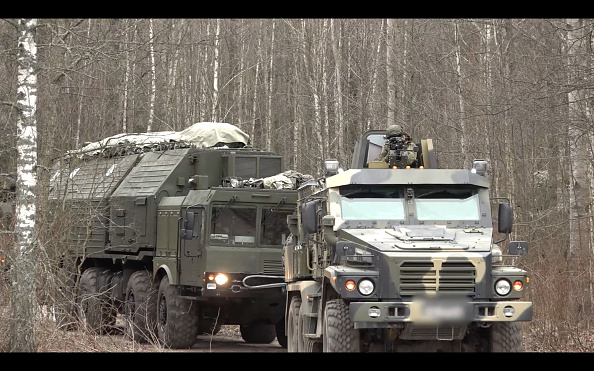
Russia, as part of large-scale three-day exercises on the preparation and potential use of nuclear weapons (May 19–21), delivered nuclear munitions to field storage sites on the territory of Belarus.
The Belarusian Ministry of Defense released video footage allegedly showing the “delivery of nuclear munitions during the exercise to field storage facilities located within the deployment area of a missile military unit in the Republic of Belarus.” In turn, the Russian Ministry of Defense stated that “personnel of a missile formation of the Republic of Belarus are carrying out training and combat tasks involving the receipt of special munitions for the Iskander-M operational-tactical missile system, equipping missile carriers with them, and covertly deploying to designated areas in preparation for launch operations.”
It remains unclear exactly where in Belarus the exercises took place and whether Russia in fact transferred nuclear munitions onto Belarusian territory — either as part of the drills or for another purpose.
The transfer of nuclear munitions to field storage sites in Belarus and the preparation of Iskander-M units to operate with special warheads indicate Belarus’s growing integration into Russia’s nuclear infrastructure. Belarusian territory is increasingly being used as a forward military staging ground for Russia against Europe. By turning Belarus into a platform for the deployment of Russian missile systems, the Kremlin has shifted toward a policy of nuclear intimidation directed at Europe. Moscow seeks to demonstrate that, in the event of a “nuclear scenario,” it would be capable of launching strikes from Belarusian territory against Europe’s largest states.
The Kremlin is using nuclear force exercises to convince Europeans that any further increase in support for Ukraine could lead to a direct confrontation between nuclear powers. The primary objective of such rhetoric is to intensify fear within the European information space and deepen political divisions inside NATO and the EU. At the same time, Moscow is attempting to pressure the West into abandoning the introduction of new sanctions.
Against the backdrop of the prolonged war, Russia is increasingly exploiting the nuclear factor as an instrument of psychological coercion against the EU and the United States. Moscow conducts such exercises on a regular basis and uses them as demonstrations of strength toward the West. At the same time, the escalation of nuclear rhetoric raises the overall level of international tension and increases the risks of accidental or uncontrolled escalation.
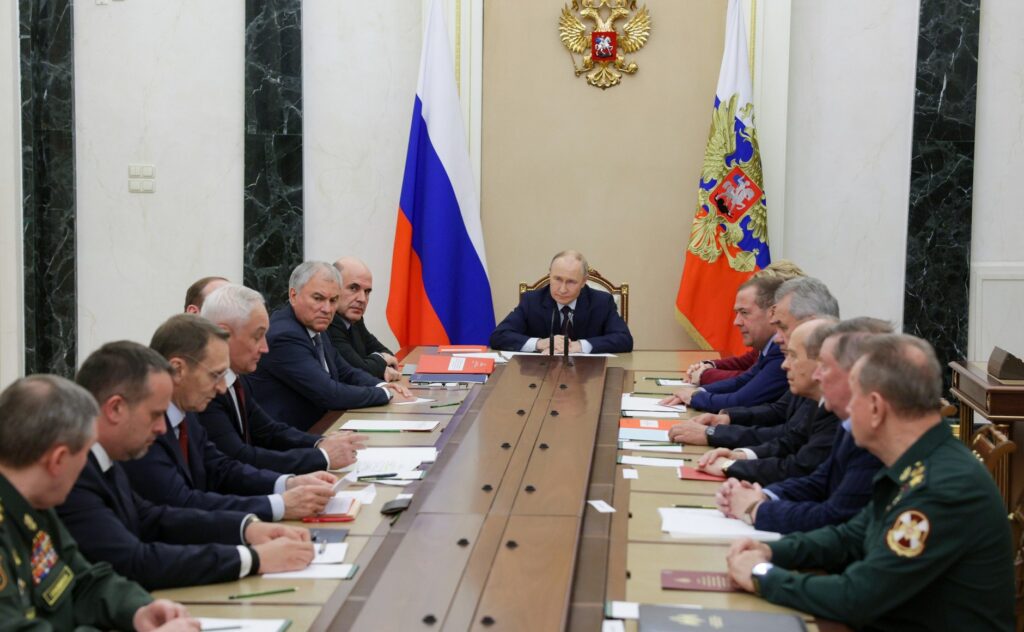
The synchronization of the nuclear exercises with Putin’s visit to the PRC is intended to create the impression that Russia retains its status as one of the world’s major centers of power. The Kremlin seeks to demonstrate its military capability, readiness for a prolonged confrontation with the West, and ability to maintain strategic pressure on the United States and Europe amid its aggression against Ukraine.
Simultaneously with the nuclear exercises, Russian authorities are accusing NATO countries of “provoking escalation,” attempting to shift responsibility for rising tensions onto the West. Through information pressure and public statements, the Kremlin seeks to influence the positions of European states, intensify disputes within NATO, and reduce further military support for Ukraine.
Russia’s reported transfer of nuclear munitions to field storage facilities in Belarus during the May 19–21 nuclear exercises represents another step in the gradual integration of Belarus into Moscow’s strategic military infrastructure. Even if the actual deployment of nuclear warheads cannot be independently verified, the political and psychological effect of such messaging is itself a key objective of the Kremlin. Russia increasingly relies not only on conventional military force, but also on nuclear signaling and strategic intimidation as instruments of geopolitical influence against Europe and the United States.
The involvement of Belarusian missile units equipped with the Iskander-M system demonstrates that Minsk is no longer merely a political ally of Moscow, but is becoming operationally integrated into Russia’s nuclear command-and-deterrence architecture. This significantly changes the military-strategic landscape on NATO’s eastern flank. Belarus is evolving into a forward military platform that allows Russia to shorten response times, increase pressure on neighboring NATO states, and complicate Western defense planning in Central and Eastern Europe.
The Kremlin’s actions indicate a transition from symbolic nuclear rhetoric toward practical military integration measures. The use of field storage facilities, mobile deployment procedures, and exercises involving “special munitions” reflects preparation for operational scenarios in which Belarusian territory could serve as a launch zone in a broader regional confrontation. Such steps increase uncertainty for NATO planners because they blur the line between demonstration exercises and genuine military preparations.
Moscow’s strategic objective is not necessarily the preparation for immediate nuclear use, but rather the creation of a permanent atmosphere of fear and unpredictability. Russia seeks to convince European societies that continued support for Ukraine carries the risk of escalation into a direct nuclear confrontation. This strategy is designed primarily for political and psychological impact. By raising fears of escalation, the Kremlin aims to weaken Western unity, fuel anti-war narratives inside Europe, strengthen pro-Russian political forces, and increase pressure on governments advocating continued military assistance to Kyiv.
The timing of the exercises is also politically significant. Their synchronization with Vladimir Putin’s visit to the China was likely intended to reinforce the perception that Russia remains a global strategic power despite Western sanctions and international isolation. The Kremlin seeks to demonstrate that it retains escalation dominance and the ability to shape the broader international security agenda. In this context, nuclear signaling becomes part of Moscow’s wider geopolitical messaging campaign directed simultaneously at Washington, Brussels, Beijing, and domestic Russian audiences.
At the same time, the Kremlin continues its long-standing information strategy of portraying NATO as the main source of escalation. By accusing the Alliance of “provoking tensions,” Moscow attempts to shift responsibility for the deterioration of European security onto the West while justifying its own militarization policies. This narrative is aimed particularly at audiences within Europe where political fatigue over the war in Ukraine and concerns about economic stability are growing. Russia’s leadership understands that sustaining internal divisions within NATO and the EU may ultimately prove more strategically valuable than achieving limited battlefield gains in Ukraine.
The broader danger of such exercises lies in the normalization of nuclear threats in European security discourse. Repeated demonstrations involving tactical nuclear systems gradually reduce the psychological threshold surrounding nuclear escalation and increase the risk of miscalculation. In a highly militarized environment marked by hybrid warfare, cyber operations, and constant military activity near NATO borders, even limited incidents or technical misunderstandings could generate rapid escalation dynamics.
Russia’s growing reliance on nuclear intimidation also reflects structural weaknesses within its broader strategic position. The Kremlin increasingly uses nuclear rhetoric to compensate for the limitations of its conventional military capabilities, the economic pressure created by sanctions, and the prolonged attritional nature of the war against Ukraine. In this sense, nuclear coercion has become not only a military tool, but also a political instrument intended to preserve Russia’s image as a global power capable of forcing concessions from the West through fear of escalation.
The probability of Russia launching nuclear missiles from Belarus in the near term remains relatively low, but it is no longer negligible. The main danger today is less about an intentional large-scale nuclear strike and more about coercive nuclear signaling, escalation management failures, or the use of limited tactical nuclear options during a severe military or political crisis.
Estimated Probability Assessment
- Strategic nuclear strike against NATO from Belarus:
Very low — approximately 1–3% - Limited tactical nuclear use connected to the war in Ukraine:
Low but meaningful — approximately 5–10% - Nuclear deployment for intimidation without actual use:
High — approximately 70–85%
Russia currently gains greater strategic value from the threat of nuclear escalation than from actual use. The Kremlin understands that real nuclear employment would fundamentally transform the war, likely trigger severe Western retaliation, deepen dependence on China, and risk uncontrollable escalation with NATO.
Belarus offers Moscow several military and political advantages shorter flight times to NATO’s eastern flank; psychological pressure on Poland, the Baltic states, and Germany; increased survivability through dispersed deployments; additional uncertainty for NATO missile-defense planning; the ability to portray Belarus as a co-participant in “shared nuclear deterrence.”
The deployment of systems such as the Iskander-M creates ambiguity because these systems can carry either conventional or nuclear warheads. That ambiguity itself is strategically valuable to the Kremlin.
The highest-risk scenario is not a deliberate Russian decision to begin nuclear war with NATO. Rather, it is a scenario where Russia faces major battlefield setbacks in Ukraine; the Kremlin perceives risks to regime stability; Western military support dramatically increases; Moscow believes conventional escalation options are exhausted.
Under those conditions, the Kremlin could consider a limited tactical nuclear demonstration strike — potentially against a military target or sparsely populated area — as a means of forcing negotiations and freezing the conflict on Russian terms.
Belarus could become useful in such a scenario because it: expands launch geography; complicates attribution and response calculations; creates additional panic within Europe; demonstrates that Russia can project nuclear pressure directly from NATO’s borders.
Several factors still strongly deter Moscow from crossing the nuclear threshold: Fear of NATO Response. Even without a nuclear retaliation, NATO could respond with overwhelming conventional strikes against Russian military assets. The Kremlin cannot reliably predict alliance behavior after nuclear use.
Chinese Pressure. Xi Jinping and the Chinese leadership have repeatedly signaled opposition to nuclear escalation in Ukraine. Beijing views nuclear instability as economically and strategically dangerous.
Risk of Losing Remaining Neutral States. Countries attempting to remain neutral or semi-neutral toward Russia — especially in the Global South — could sharply distance themselves after nuclear use.
Regime Survival Logic. The Kremlin’s core objective remains regime preservation. Actual nuclear use introduces enormous unpredictability, including the possibility of direct NATO intervention.
Even if Russia never intends immediate nuclear use, the exercises themselves are strategically important because they normalize nuclear rhetoric; train Belarusian infrastructure and personnel; create escalation ambiguity; pressure European publics psychologically; test NATO intelligence and response mechanisms; increase Moscow’s leverage during diplomatic confrontations.
Over time, repeated deployments and exercises gradually integrate Belarus into Russia’s permanent nuclear posture. That process itself changes the European security environment regardless of whether nuclear weapons are ever used.
Publicly available evidence does not conclusively prove that Russia transferred actual nuclear warheads to Belarus during the May exercises. At present, there are three main analytical possibilities assessed by Western observers and intelligence communities.
The most probable scenario is that Russia conducted a highly controlled demonstration involving: specialized nuclear-support logistics, transport procedures, storage-site activation, and possibly training containers or inert warhead simulators rather than fully operational nuclear warheads.
This would allow the Kremlin to achieve maximum psychological and political impact while minimizing the risks associated with moving live nuclear weapons.
Several indicators create uncertainty:
Neither NATO nor Western governments publicly confirmed the presence of operational nuclear warheads in Belarus during the exercises.
If intelligence agencies had clear evidence of a large-scale transfer of live warheads, some level of coordinated signaling or deterrent messaging from NATO would likely have followed.
The Kremlin deliberately cultivates ambiguity in nuclear matters. Moscow benefits strategically when: Europe fears the worst, intelligence agencies remain uncertain, and public debate focuses on escalation risks.
Ambiguity itself is part of Russian deterrence doctrine.
Moving live nuclear warheads creates: transportation vulnerabilities, security risks, satellite visibility, and command-and-control complications.
Russia generally treats operational nuclear movements with extreme secrecy.
Russian and Belarusian officials referred to: “special munitions,” “receipt procedures,” and “equipping missile carriers. This terminology can refer either to actual warheads or to training protocols using mock systems.
Russia has spent considerable effort: modernizing storage sites, adapting Belarusian delivery systems, training crews, and integrating Belarus into nuclear logistics structures.
This would make little sense if no real deployment option existed.
The Kremlin increasingly wants NATO to believe Belarus is now part of Russia’s operational nuclear perimeter.
A limited deployment of several warheads for readiness purposes could reinforce that message.
During the Cold War, Soviet nuclear weapons were stationed in Belarus for decades. Existing infrastructure and military culture reduce technical barriers to renewed deployments.
Many Western analysts likely assess the situation approximately as follows: Training simulators and procedural drills Highly likely. Temporary presence of limited real nuclear warheads during exercises: Plausible but unconfirmed. Large-scale permanent tactical nuclear deployment in Belarus: Not yet conclusively verified publicly.
From a strategic perspective, the distinction is becoming less important over time.
Even if current exercises primarily involve simulators, Russia is: normalizing nuclear deployments in Belarus; building operational infrastructure; integrating Belarusian personnel; rehearsing wartime procedures; and conditioning NATO to treat Belarus as a potential nuclear launch zone.
That gradual institutional integration may ultimately matter more than whether live warheads were physically present during a single exercise.
The most important overall intelligence question is not simply whether nuclear warheads are physically present in Belarus. The deeper issue is whether Russia is transforming Belarus into a permanent forward nuclear operating zone designed to: pressure NATO psychologically, complicate Western military planning, lower escalation thresholds, and institutionalize nuclear coercion as a routine instrument of Russian foreign policy.
Formally, Belarus remains a sovereign state with its own armed forces, Ministry of Defense, and constitutional institutions. In practice, however, Belarus’s military decision-making autonomy has been significantly reduced since 2020 and especially after Russia’s full-scale invasion of Ukraine in 2022.
Today, Belarus increasingly functions as a military-strategic extension of Russia rather than as a fully independent security actor. The key analytical question is not whether Minsk has formally lost sovereignty, but rather how much real operational independence still exists within Belarusian defense and security structures.
Current Assessment
Alexander Lukashenko still retains formal political control over the Belarusian state apparatus and continues attempting to preserve room for maneuver between total dependence on Moscow and the survival of his regime.
Lukashenko’s main objective is regime survival, not national strategic independence. Since the 2020 protests, his dependence on the Kremlin for: political backing, economic support, security guarantees, and internal repression assistance has dramatically increased.
As a result, Moscow gained unprecedented leverage over Belarusian decision-making.
Belarusian defense planning is now deeply integrated with Russian military structures through: the “Union State” framework; joint regional force groupings; integrated air-defense systems; shared military exercises; intelligence cooperation; and Russian military presence on Belarusian territory.
This integration gives Moscow substantial influence over Belarusian military policy.
During the 2022 invasion of Ukraine, Russia used Belarusian territory as: a staging ground, missile-launch platform, logistics corridor, and air operation zone.
Evidence strongly suggests Minsk had limited practical ability to refuse Russian use of its territory once Moscow made the decision.
That became a critical indicator of constrained sovereignty.
The deployment of Russian nuclear-related infrastructure further reduces Belarusian autonomy.
The likely reality is: Russia controls warheads, Russia controls authorization systems, Russia controls strategic command structures, while Belarus provides territory, logistics, and delivery infrastructure.
This resembles asymmetrical military dependency rather than equal alliance coordination.
Despite deep integration, Belarus is not yet fully absorbed militarily into Russia.
One of the strongest indicators of residual sovereignty is that Belarusian troops have not directly entered combat in Ukraine despite significant Russian pressure.
Lukashenko appears highly concerned that: direct involvement could destabilize his regime; the Belarusian military may resist; domestic opposition could intensify; and casualties could trigger internal unrest.
This suggests Minsk still retains some ability to resist the Kremlin on highly sensitive issues.
Many Belarusian military and state elites reportedly fear: loss of institutional autonomy, permanent Russian military dominance, and eventual de facto annexation through security dependence.
This creates internal resistance to complete integration.
Realistic Model of Belarusian Sovereignty Today
Belarus increasingly resembles a dependent military client state, a strategic buffer zone, or a semi-sovereign security satellite of Russia.
But it is not yet equivalent to occupied territory, direct annexation, or a fully subordinate military district.
The relationship is best understood as “conditional sovereignty under strategic dependency.”
The central strategic question for NATO is: At what point would Belarus lose the ability to refuse Russian military decisions?
That threshold may already have been crossed regarding: missile deployments, Russian troop presence, nuclear infrastructure, and operational access.
But it may not yet have been crossed regarding: direct Belarusian participation in war, full permanent Russian basing, or irreversible political integration.
The trajectory since 2020 clearly points toward progressive erosion of Belarusian sovereignty; growing Russian control over defense infrastructure; deeper operational integration; and gradual transformation of Belarus into Russia’s western military forward zone.
If this process continues unchecked, Belarus could evolve into: a permanent Russian military outpost on NATO’s border; including long-term nuclear infrastructure; integrated command systems, and reduced independent strategic decision-making by Minsk.
More on this story: The Global Consequences of a Nuclear Detonation in Low Earth Orbit