
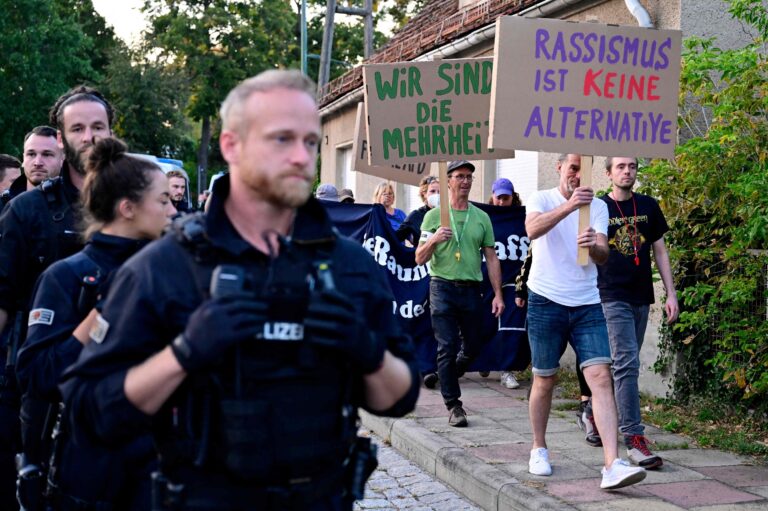
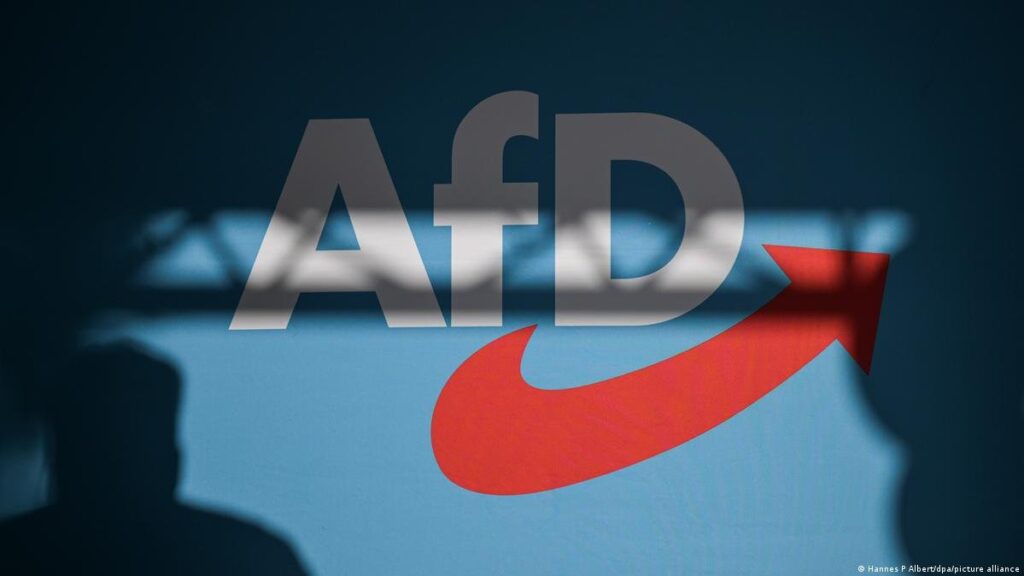
The public organization Turkish Community in Germany has warned of a critical increase in the threat of physical violence from right-wing extremists, correlating with the growing popularity of the far-right party Alternative for Germany.
According to the organization, the high approval ratings of AfD in eastern German states are creating an atmosphere of impunity, transforming extremist political rhetoric into real-world attacks. Statistics reportedly show that in Mecklenburg-Vorpommern and Saxony-Anhalt, the rate of far-right extremist crimes is three times higher than the national average in Germany.
Particular concern has also been raised over growing public indifference. Representatives of the organization cited an incident on a train in Brandenburg, where passengers and railway staff allegedly ignored racist threats directed at women.
Ahead of upcoming autumn state elections in several German regions, members of the Turkish diaspora stress that the strengthening influence of AfD is causing millions of people to lose trust in the German state as a guarantor of security and fundamental human rights.
The growing influence of AfD, particularly in eastern Germany, is creating an environment in which xenophobic rhetoric is gradually becoming normalized and increasingly translating into real acts of intimidation and violence against ethnic minorities. Against this backdrop, the risks of deeper social polarization and weakening trust in democratic institutions are increasing.
The consolidation of AfD’s political position also poses risks to Germany’s internal security. Critics argue that the party’s radical rhetoric legitimizes xenophobia, fuels the activities of ultra-right groups, and shifts the boundaries of what is considered acceptable in public discourse. As a result, Germany risks damaging its international reputation as a state founded on the principles of democracy, tolerance, and human rights.
Warnings from the Turkish Community in Germany about rising far-right violence reflect a broader transformation underway inside Germany. The growing strength of Alternative for Germany, particularly in eastern German states, is increasingly associated not only with anti-immigrant radicalization, but also with broader geopolitical influence operations linked to Russia.
German security agencies, media investigations, and European intelligence discussions have repeatedly raised concerns regarding AfD’s alignment with Kremlin strategic narratives, especially on anti-NATO rhetoric, opposition to sanctions on Russia, anti-Ukrainian messaging, anti-migrant mobilization, and efforts to deepen political polarization inside Germany.
The rapid electoral rise of AfD, especially in eastern German regions such as Saxony-Anhalt, Thuringia, and Mecklenburg-Vorpommern, has coincided with a visible increase in far-right extremist incidents.
German intelligence assessments and independent reporting increasingly describe the party as contributing to an environment where xenophobic rhetoric becomes normalized in public discourse. Germany’s domestic intelligence service, the BfV, officially classified AfD as an extremist organization in 2025, citing anti-Muslim and ethnically exclusionary ideology.
According to the Turkish Community in Germany, the political atmosphere in eastern Germany increasingly creates a sense of impunity among right-wing extremists, turning inflammatory rhetoric into real-world violence and intimidation against minorities.
The danger is not only physical violence itself, but the gradual social normalization of hostility toward minorities racist threats in public spaces, growing indifference from bystanders, anti-Muslim rhetoric, and increased pressure on migrant communities to self-isolate socially and politically.
Moscow has long viewed far-right populist movements in Europe as strategic instruments for weakening European unity and undermining liberal democratic institutions.
AfD became especially attractive to the Kremlin because many within the party openly oppose sanctions against Russia, criticize NATO, support restoring ties with Moscow, oppose military aid to Ukraine, and amplify narratives favorable to Russian geopolitical interests.
Numerous investigations and intelligence concerns have linked AfD networks to Russian influence structures German lawmakers accused AfD figures of acting in ways beneficial to Russian intelligence interests, including gathering sensitive infrastructure information. Russian disinformation campaigns repeatedly amplified AfD narratives during German elections. Kremlin officials publicly defended AfD after Germany classified the party as extremist.
Russia’s strategic objective is not necessarily to bring AfD fully to power nationwide. Rather, Moscow benefits from political fragmentation, weakening trust in democratic institutions, rising ethnic tensions, paralysis inside the EU, and growing hostility between Germans and migrant communities.
This reflects a classic Kremlin destabilization model: exploit identity conflict, radicalize political discourse, weaken social cohesion, and undermine democratic consensus from within.
The Kremlin’s relationship with European far-right movements is deeply paradoxical.
Official Russian propaganda frequently frames Moscow as the heir of the Soviet victory over Nazism in World War II. Yet simultaneously, Russia actively cultivates alliances with ultranationalist and extremist movements across Europe when such forces help destabilize Western societies.
In Germany, this strategy appears focused on encouraging anti-immigrant radicalization, ethnic polarization, anti-Muslim sentiment, distrust toward democratic institutions, and hostility toward multiculturalism.
Russian influence operations do not necessarily seek a direct revival of historical Nazism in ideological terms. Instead, Moscow benefits from stimulating political extremism, racial hostility, and authoritarian nationalism because these dynamics weaken the cohesion of NATO and the European Union.
German intelligence officials have repeatedly warned that Russian propaganda networks amplify extremist narratives and deepen social divisions.
From Moscow’s perspective, a polarized Germany becomes less capable of supporting Ukraine, less united internally, more vulnerable to political paralysis, and less effective as a leader inside Europe.
1961–1973: Labor Migration Era
- West Germany signs labor recruitment agreements with Turkey in 1961.
- Hundreds of thousands of Turkish “Gastarbeiter” (guest workers) arrive to fill industrial labor shortages.
- German authorities initially assume migrants will eventually return home.
Key Dynamic:
Economic integration without long-term social integration planning.
1970s–1980s: Permanent Settlement and Social Friction
- Many Turkish workers remain permanently and bring families. Economic downturns increase anti-immigrant sentiment. Turkish communities become socially concentrated in urban districts.
Consequences emergence of parallel societies rising cultural tensions, growth of anti-Turkish stereotypes.
1990s: Post-Reunification Radicalization
Following German reunification, eastern Germany experiences severe economic instability and identity crises.
Major racist attacks occur Rostock-Lichtenhagen riots, Mölln arson attack (1992),
- Solingen arson attack (1993) Turkish minorities become primary targets of neo-Nazi violence.
Consequences fear among migrant communities, growth of far-right skinhead movements, early normalization of anti-immigrant extremism in eastern Germany.
2000–2011: NSU Terror Network
The neo-Nazi terrorist group National Socialist Underground murdered multiple Turkish-origin residents across Germany.
The scandal severely damaged trust in German security institutions after authorities failed for years to recognize racist motives behind the killings.
Consequences: Turkish diaspora distrust toward police, accusations of institutional blindness toward far-right extremism, deeper ethnic alienation.
2015–2016: Migration Crisis and AfD Expansion
The European migrant crisis transformed immigration into Germany’s central political issue.
AfD shifted from Euroskeptic populism toward hardline anti-immigration nationalism.
Turkish and Muslim communities increasingly became targets of anti-Muslim rhetoric, conspiracy narratives and “replacement” theories promoted within extremist circles.
Turning Point:
Migration fears became fully integrated into mainstream far-right mobilization.
2020–2024: Radicalization and Polarization
COVID-era conspiracy movements merged with far-right extremist ecosystems.
AfD expanded support in eastern Germany while anti-migrant incidents increased.
Russian information operations amplified anti-government distrust, anti-migrant narratives, anti-Ukrainian sentiment, and anti-EU rhetoric.
2025–2026: Security Fears Inside the Turkish Diaspora
The Turkish Community in Germany warns that migrant communities increasingly fear physical violence in eastern German states.
Germany’s intelligence structures now openly classify AfD as extremist due to ethnically exclusionary ideology and anti-Muslim rhetoric.
The combination of economic anxiety, migration tensions, Russian information warfare, and normalization of extremist rhetoric creates the most serious ethnic polarization environment in Germany in decades.
The rise of AfD represents more than a domestic German political phenomenon. It increasingly intersects with broader Russian geopolitical objectives aimed at weakening Europe internally through polarization and social fragmentation.
Moscow benefits strategically from ethnic tensions, anti-immigrant radicalization, distrust toward democratic institutions, and the weakening of German political cohesion.
The Turkish minority has become one of the primary social groups affected by this process. Historical tensions dating back to the Gastarbeiter era are now being intensified by modern disinformation campaigns, extremist mobilization, and the normalization of xenophobic rhetoric.
If these dynamics continue unchecked, Germany risks entering a prolonged period of deeper ethnic polarization, weakening democratic consensus, increased extremist violence, and growing vulnerability to foreign influence operations designed to destabilize Europe from within.
After the 1961 labor recruitment agreement between West Germany and Turkey, millions of Turkish workers gradually became part of West German society.
From the Soviet perspective, this development created several strategic opportunities: cultural tensions inside a NATO member state, competition between left-wing and nationalist Turkish diaspora groups, social unrest potential, and possibilities for infiltrating migrant political organizations.
Importantly, Turkey itself was a frontline NATO member bordering the Soviet sphere. Therefore, Turkish diaspora politics in Europe became intertwined with Cold War intelligence competition.
The Kremlin did not necessarily seek only anti-Turkish hostility. Instead, Soviet intelligence aimed to maximize instability through multiple channels simultaneously.
This included encouraging polarization between Germans and migrants, infiltrating Turkish political movements, exploiting labor unrest, amplifying anti-state radicalism, and supporting narratives portraying West Germany as socially unstable or “fascist.”
The Soviet approach followed a classic “active measures” doctrine: intensify existing divisions rather than create them from nothing.
The KGB and Stasi conducted extensive operations inside West Germany targeting: migrant organizations, labor unions, left-wing student groups, and ethnic activist movements.
Turkish migrant communities became areas of intelligence interest because they contained: leftist organizations, Kurdish movements, Turkish ultranationalist groups, labor activists, and anti-state factions.
Both Soviet and East German intelligence services monitored and sometimes infiltrated these networks.
One of the most controversial historical questions concerns whether Soviet intelligence indirectly benefited from or manipulated far-right extremism in West Germany.
While direct evidence of Moscow organizing neo-Nazi attacks against Turks remains limited, historians and intelligence researchers widely acknowledge that Soviet “active measures” frequently aimed to amplify fears of fascism inside West Germany.
The USSR consistently portrayed West Germany as insufficiently de-Nazified, vulnerable to fascist revival, and structurally hostile toward minorities.
Every racist incident or neo-Nazi attack became propaganda material for Soviet media.
This strategy intensified during periods of economic crisis, migration tensions, and political instability.
During the 1970s and 1980s, parts of the Turkish diaspora in Germany became heavily politicized.
Several Turkish leftist organizations operating in Europe had ideological or indirect links to Soviet-aligned communist networks.
The USSR viewed these movements as useful tools for: anti-NATO mobilization, anti-American agitation, labor radicalization, and political destabilization.
At the same time, violent clashes emerged between Turkish leftist groups, Turkish ultranationalists such as the Grey Wolves Kurdish militants, and German far-right extremists. This created a highly fragmented environment that Soviet intelligence could exploit.
East Germany played an especially important role.
The Stasi maintained one of the most extensive surveillance and infiltration systems in Europe. West Germany’s migrant communities were closely monitored because they were viewed as politically volatile.
Stasi archives show efforts to recruit informants inside migrant communities, track ethnic conflicts, manipulate activist networks, and exploit social unrest narratives.
East German propaganda also frequently highlighted racist attacks in West Germany to discredit the Federal Republic internationally.
Throughout the Cold War, Soviet propaganda consistently promoted the narrative that West Germany never fully eliminated Nazism.
Racist attacks against Turkish migrants became powerful propaganda tools supporting this claim.
The Kremlin’s messaging aimed to weaken trust in West German democracy, divide NATO societies, portray liberal capitalism as socially violent, and undermine Bonn’s international legitimacy.
This narrative strongly resembles modern Russian information warfare tactics used today against Europe and the United States.
Continuity With Modern Russian Strategy
Modern Russian influence operations often replicate Cold War methods almost directly.
Today, Moscow benefits from anti-migrant polarization, tensions between Germans and Muslim minorities, distrust toward democratic institutions, and the rise of extremist political forces.
The Kremlin simultaneously amplifies anti-Muslim far-right narratives, anti-government conspiracy theories, and social fragmentation.
This creates a paradoxical strategy: Russia publicly claims to fight “Nazism,” while often supporting or amplifying ultranationalist movements abroad if they weaken Western cohesion.
The current tensions surrounding Alternative for Germany reflect many structural similarities to Soviet-era active measures exploitation of identity conflicts, amplification of fear, normalization of extremism, and erosion of trust in democratic institutions.
There is no definitive evidence that the USSR directly orchestrated anti-Turkish violence in West Germany. However, Soviet and East German intelligence structures clearly viewed ethnic tensions, migrant unrest, and far-right radicalization as exploitable vulnerabilities inside a key NATO state.
The Soviet strategy centered on amplifying existing divisions, manipulating extremist narratives, infiltrating politicized communities, and portraying West Germany as socially unstable and morally compromised.
Many of these Cold War methods have strong parallels with contemporary Russian influence operations in Europe today. The underlying geopolitical objective remains largely unchanged to weaken Western unity by deepening internal polarization and mistrust between communities.

More on this story: Threat Assessment: Kremlin Exploitation of Pacifist Networks in Germany
More on this story: Russian Hybrid Operations and the Threat of Extremist Convergence in Germany

More on this story: Kremlin to use Germany for EU breakup