
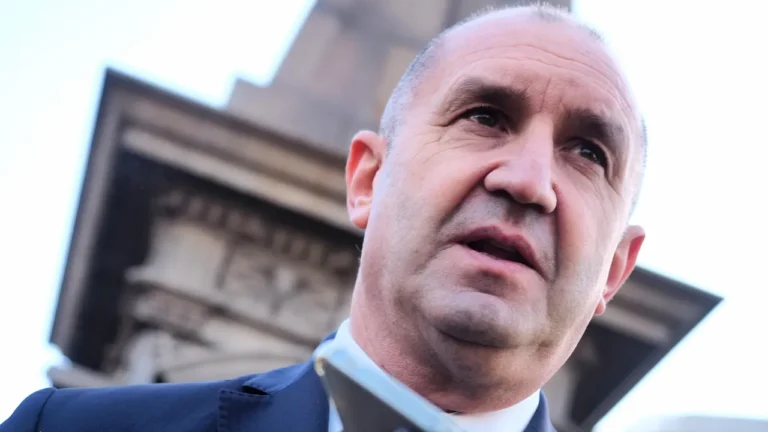
Former Bulgarian president Rumen Radev, known for his pro-Russian stance, is leading the electoral race by leveraging anti-corruption rhetoric.
Rumen Radev announced his early resignation from the presidency on January 19, 2026, one year before the end of his second term. He is currently the leader of the political force (the “Progressive Bulgaria” coalition) and an active participant in the parliamentary elections. He stepped down in order to create and lead his own party and to run in the early parliamentary elections scheduled for April 19 this year. Radev’s goal is to become prime minister and obtain real levers of influence within the executive branch. The presidency in Bulgaria has significant constitutional limitations in terms of decision-making and real political power.
At present, Bulgaria is experiencing a deep and systemic political crisis, with eight elections held in four years. Radev presents himself as a “savior of the nation,” capable of overcoming chaos. If his political force wins, Bulgaria is likely to strengthen its pro-Russian policy vector and distance itself from the European Union.
Rumen Radev is a well-known Bulgarian populist and pro-Russian politician whose tenure from 2017 to 2026 was marked by increasing internal political instability and economic challenges. He consistently opposed the pro-European government that sought to implement reforms and reduce dependence on Russian energy resources.
He advocates for Bulgarian “neutrality” on the issue of Ukraine and opposes military assistance to Ukraine. During his presidency, he repeatedly attempted to block military aid packages to Ukraine through presidential vetoes, although parliament, backed by a pro-European majority, managed to override them.
If he comes to power, Radev may move toward open confrontation with Brussels over reducing dependence on Russian energy and could use veto powers as a tool of pressure to weaken European unity and legitimize Russian interests within the European Union. Such a strategy could turn Bulgaria into a disruptive member of the EU capable of blocking key decisions on major security issues.
He is widely regarded as a lobbyist for the interests of Gazprom, which is reflected in efforts to obstruct the construction of interconnectors with Greece and Romania, thereby preserving the monopoly of Russian gas on the Bulgarian market for years. If he becomes prime minister, he is expected to initiate a “pragmatic revision” of gas contracts, potentially aiming—under the pretext of stabilizing prices in the eurozone—to restore direct purchases from Russia.
Radev has openly stated that Bulgaria should serve as a “bridge for restoring relations between the West and Russia.” If he comes to power, he is likely to advocate for the gradual lifting or easing of sanctions against Russia, justifying this by “economic pragmatism” and the need for cheaper Russian energy resources. Although Radev is running on anti-corruption slogans, his conflicts with pro-European reformers raise concerns in Brussels and could lead to the “Orbánization” of Bulgaria.
Rumen Radev is perceived as close to Russia not because of a single factor, but due to a combination of structural, political, and strategic reasons that shape his positioning.
At the structural level, Bulgaria has historically had deep ties with Russia. These include cultural and religious affinity, energy dependence, and long-standing political networks dating back to the Soviet period. Any Bulgarian politician operating within this environment inevitably engages with these legacies. Radev’s stance reflects continuity with parts of the political elite and electorate that still view Russia as a natural partner rather than a strategic adversary.
A key driver is energy politics. Bulgaria has traditionally relied heavily on Russian gas supplies, particularly through Gazprom. Radev has consistently supported policies that either maintain or restore this relationship, framing it as economic pragmatism. From his perspective, cheaper and stable energy supplies are presented as a national interest, even if they conflict with EU diversification strategies. This positions him closer to Russian economic interests, especially in debates over interconnectors and alternative energy routes.
Another important factor is domestic political positioning. Radev has built much of his political appeal on anti-establishment and anti-corruption rhetoric, combined with skepticism toward what he portrays as externally imposed policies from Brussels and Washington. By advocating for “neutrality” in the war in Ukraine, he appeals to segments of Bulgarian society that are wary of confrontation with Russia and fatigued by geopolitical alignment pressures. This stance is not necessarily pro-Russian in explicit ideological terms, but it objectively aligns with Moscow’s interests by weakening unified Western positions.
His relationship with Russia is also shaped by strategic balancing. Radev often frames his approach as defending Bulgarian sovereignty against both Russian and Western pressure, but in practice this results in resistance to key Euro-Atlantic policies, such as military support for Ukraine or stricter sanctions on Russia. This creates a pattern where his policies consistently reduce Bulgaria’s alignment with NATO and EU priorities, even if not openly rejecting them.
There is also a geopolitical logic behind his positioning. By presenting Bulgaria as a potential “bridge” between the West and Russia, Radev seeks to elevate the country’s diplomatic role. However, this concept inherently assumes engagement with Moscow and implicitly legitimizes Russia as a partner despite ongoing conflict. In the current context, such positioning is interpreted by many Western actors as indirect support for Russian strategic objectives.
Finally, Radev’s stance reflects broader trends in European politics. Similar to figures like Viktor Orbán, he operates within a political space where skepticism toward liberal EU policies, emphasis on national sovereignty and pragmatic engagement with Russia are combined into a coherent political strategy.
In sum, Radev’s perceived closeness to Russia is not simply ideological alignment. It is the result of economic interests (especially energy) domestic political strategy, historical ties, and a broader geopolitical vision that prioritizes flexibility over strict alignment.
The outcome, however, is consistent: his policies tend to align with Russian interests more often than with the strategic direction of the EU and NATO, which is why he is widely viewed as a pro-Russian actor.
Victor Orban and Radev Both operate within the European system while simultaneously challenging its core political logic. They do not reject the EU outright, but they resist deeper integration when it conflicts with national sovereignty or domestic political priorities. In practice, this means selectively cooperating with Brussels on economic issues while opposing it on strategic and political questions, particularly those related to Russia, energy policy, and security alignment.
A key similarity is their approach to Russia. Neither openly aligns themselves as “pro-Russian” in formal terms, yet both consistently advocate for positions that reduce confrontation with Russia. Orbán has maintained close economic and political ties with Moscow, especially through energy cooperation, while Radev promotes “neutrality” regarding the war in Ukraine and opposes military support. In both cases, this positioning weakens unified EU and NATO policies and creates openings for Russian influence.
Energy policy is central to this alignment. Both leaders treat dependence on Russian energy not as a vulnerability to be eliminated, but as a pragmatic relationship to be managed. By advocating continued or renewed cooperation with entities like Gazprom, they frame energy ties with Russia as an economic necessity, even when this contradicts EU diversification strategies. This creates a structural overlap between domestic economic arguments and Russian geopolitical interests.
Their political style is also comparable. Both rely heavily on populist narratives, presenting themselves as defenders of the nation against corrupt elites and external pressure. Orbán does this through a long-standing ideological project of “illiberal democracy,” while Radev frames himself as a crisis manager and “savior” capable of restoring order in a fragmented political system. In both cases, anti-corruption rhetoric is combined with skepticism toward liberal democratic institutions, especially when those institutions constrain executive authority.
Another similarity lies in their use of institutional tools. Orbán has systematically reshaped Hungary’s political system to consolidate power, while Radev has used the presidency—and now seeks the premiership—as a platform to influence government direction and block policies he opposes. Both understand how to operate within formal democratic structures while bending them toward greater centralized control.
Geopolitically, they both attempt to position their countries as intermediaries between East and West. Orbán explicitly frames Hungary as a bridge between Europe and Russia (and increasingly China), while Radev speaks of Bulgaria as a link for restoring relations between the West and Russia. This “bridge” narrative enhances their domestic legitimacy and international visibility, but it also introduces strategic ambiguity that complicates EU and NATO cohesion.
Finally, both figures benefit from—and contribute to—a broader trend within Europe: the rise of leaders who combine sovereignty-first politics, pragmatic engagement with authoritarian powers, and resistance to liberal consensus. Their policies do not dismantle Western institutions from the outside; instead, they reshape them from within by slowing decision-making, blocking consensus, and introducing alternative agendas.The core similarity can be summarized simply:
both Orbán and Radev are system actors who remain inside the Western framework while strategically weakening its unity, particularly on issues where Russian interests are at stake.
The electoral bases in Bulgaria’s 2026 parliamentary elections are highly fragmented and socially segmented, reflecting the country’s broader political crisis. Each major force draws support not only from ideological voters, but from distinct socioeconomic, geographic, and identity-based groups, which explains why coalition-building remains so difficult.
The traditional center-right bloc around GERB, led by Boyko Borisov, continues to rely on a structured and resilient electoral machine. Its base is rooted in local administrations, public-sector employees, business networks tied to state contracts, and older voters who prioritize stability over reform. GERB performs particularly well in smaller towns and regions where municipal influence and patronage networks remain strong. Its electorate is less ideological and more pragmatic, often motivated by expectations of order, access to resources, and continuity of governance.
In contrast, the reformist and pro-European camp—represented by formations like “We Continue the Change” and “Democratic Bulgaria”—draws support from a younger, urban, and highly educated electorate. This base is concentrated in Sofia and other major cities, as well as among professionals in the IT, legal, and academic sectors. These voters are strongly pro-EU, anti-corruption, and supportive of judicial reform and Euro-Atlantic integration. However, their weakness lies in limited penetration outside urban centers, which constrains their ability to build national majorities.
The nationalist and pro-Russian segment, including parties such as “Revival” (Vazrazhdane), has a different profile. Its electorate consists of economically vulnerable groups, rural populations, and segments of society with strong cultural or historical affinity toward Russia. This base is also fueled by anti-establishment sentiment, skepticism toward NATO and the EU, and opposition to sanctions and military support for Ukraine. These voters are particularly responsive to narratives about sovereignty, traditional values, and economic hardship.
The Turkish minority party, the Movement for Rights and Freedoms (DPS), maintains one of the most stable and disciplined electoral bases in the country. Its support comes primarily from ethnic Turkish and Muslim communities, especially in specific regions of southern and northeastern Bulgaria. DPS benefits from strong internal organization, high voter turnout among its base, and entrenched local structures. Unlike other parties, its electorate is less volatile and more identity-driven, making it a consistent kingmaker in coalition scenarios.
The emergence of Rumen Radev as a political actor introduces a more complex and cross-cutting electoral base. His support is drawn from voters disillusioned with the entire political class, including both left-leaning and nationalist segments. This includes working-class voters, pensioners, and parts of the security sector, as well as citizens frustrated by repeated elections and governmental paralysis. His appeal is built on anti-corruption rhetoric and a promise of stability, but also on a more ambiguous geopolitical stance that resonates with voters skeptical of full alignment with Western policies.
The Bulgarian Socialist Party, although historically significant, now commands a shrinking and aging electorate. Its base consists largely of older voters nostalgic for the social guarantees of the past, along with some lower-income groups. However, it has lost much of its influence to newer actors like Radev and nationalist formations that have captured parts of its traditional electorate by combining social messaging with stronger populist narratives.
Overall, the defining feature of Bulgaria’s electoral landscape is not just fragmentation, but segmentation. Each political force is anchored in a specific social group, with limited overlap between them. This creates a system where parties can reliably mobilize their core voters but struggle to expand beyond them. As a result, elections tend to produce inconclusive outcomes, reinforcing the cycle of instability.
This structure also has geopolitical implications. Pro-European urban voters, pro-Russian rural and nationalist groups, minority-based constituencies, and anti-system protest voters coexist within the same electoral field without a unifying narrative. The balance between these blocs will determine not only the composition of the next government, but also Bulgaria’s strategic orientation within the EU and NATO.
The Bulgarian political landscape is highly fragmented, with no party capable of securing a majority independently. The key forces can be grouped into four broad blocs.
The first is the traditional conservative establishment, represented by GERB–SDS, associated with former Prime Minister Boyko Borisov. This bloc draws support from administrative structures, business networks, and older conservative voters, particularly in urban areas. Despite consistently finishing first in previous elections, GERB has failed to translate electoral victories into stable governance.
Pro-European urban voters, pro-Russian rural and nationalist groups, minority-based constituencies, and anti-system protest voters coexist within the same electoral field without a unifying narrative.
The expected results of the April 2026 parliamentary elections in Bulgaria point toward a clear winner—but not a clear government. The most likely outcome is a fragmented parliament with a dominant first force and difficult coalition arithmetic.
Projected vote shares
All major polling trends converge on the same picture:
Rumen Radev’s coalition is leading decisively, but far from a majority.
- Progressive Bulgaria (Radev): ~30–33%;
- GERB–SDS (Boyko Borisov): ~18–20%;
- Pro-European reformists (PP–DB): ~11–12%;
- DPS (minority party): ~9–10%;
- Nationalist/pro-Russian (Revival): ~6–7%;
- Others (BSP, smaller parties): near or below threshold.
Recent polling even projects Radev’s bloc at around 32% and roughly 90 seats, well ahead of GERB with about 55 seats .
Key takeaway: no majority
Despite this strong lead, the central fact is No party is expected to win anywhere near 50% of seats
Even optimistic scenarios leave Radev short of a majority.
This means Bulgaria is almost certain to face another coalition government, or continued political deadlock.
Most likely parliamentary configuration
The next parliament will likely include 4–5 main blocs:
Radev’s Progressive Bulgaria (dominant but not decisive);
GERB (still a major institutional force);
Pro-European reformists (urban liberal bloc);
DPS (kingmaker role);
Nationalists (smaller but influential)
This structure guarantees that no two-party coalition is sufficient
at least three forces will be needed for stability.
Most probable scenarios:
Radev-led coalition (most likely) Radev finishes first and attempts to form government.
The most realistic combinations: Progressive Bulgaria + reformists (PP–DB). Progressive Bulgaria + DPS or a broader multi-party arrangement.
However, tensions are high—especially with pro-European forces—so coalition talks will be complex and unstable .
Hung parliament / failed coalition (very plausible)
If negotiations fail again:
Given the country has already had eight elections in recent years, this is not a theoretical risk but a recurring pattern .
Anti-Radev coalition (less likely but possible)
In theory, other parties could try to block Radev by forming a coalition without him.
But:
ideological divisions are too deep, trust between parties is extremely low.
This scenario is structurally weak.
Strategic interpretation of results
The expected result is not just about numbers—it signals a shift in political gravity:
Radev becomes the central political actor
traditional parties (like GERB) decline but remain relevant;
pro-European forces remain influential but not dominant;
nationalist/pro-Russian voices stay in parliament but limited.
Most importantly:
The election will not resolve Bulgaria’s instability—it will reorganize it around a new center of power.
Winner: Radev’s coalition (~30–33%)
No majority: highly fragmented parliament;
Outcome: coalition bargaining or renewed instability.
The most realistic forecast is Radev wins the election, but governing remains uncertain—and potentially unstable.