
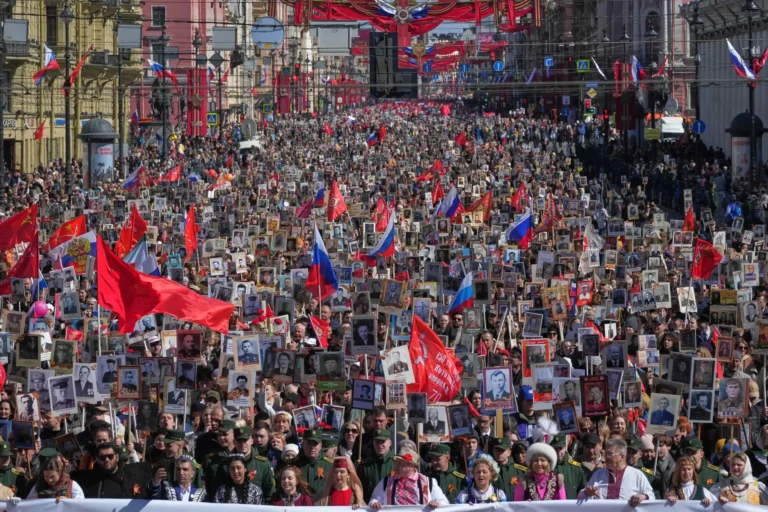
The decision by Berlin authorities to again prohibit the display of Russian and Soviet symbols on May 8–9 should be understood not as a narrow public-order measure, but as part of a broader counter-hybrid policy aimed at limiting the Kremlin’s use of historical memory as a political weapon inside Europe.
Berlin police will once again ban the use of Russian and Soviet symbols during events on May 9. For the fourth consecutive year, restrictions will be imposed on the use of propagandistic symbols near Soviet war memorials in Berlin on May 8 and 9.
In particular, flags and symbols of the former USSR, Belarus, and the Chechen Republic, as well as those associated with their leaders, will be prohibited. Limited exceptions apply only to diplomats and World War II veterans. The ban will also cover military uniforms and their elements, military insignia, the display of the letters “V” and “Z,” and St. George ribbons. Additionally, the performance of Russian marching and military songs will be prohibited, along with symbols glorifying Russia’s war against Ukraine. This includes maps depicting Ukraine without its temporarily occupied territories and flags of separatist entities in regions annexed by Russia. The Russian Embassy in Germany has described the ban as unjustified.
The introduction of strict restrictions in Germany for the fourth consecutive year is a preventive measure aimed at distinguishing between the historical commemoration of World War II victims and the contemporary ideological propaganda of a state that uses such symbolism to justify its armed aggression against Ukraine.
Over the past five years, the German federal government has sought to curb pro-Russian demonstrations formally tied to the end of World War II and to prevent the use of Soviet and Russian symbols for propaganda purposes. Nevertheless, ethnic Russians living in Germany attempt each year to circumvent these bans and restrictions, often provoking tensions within German society.
Public interest in Russia among Europeans has steadily declined. Today, the Russian flag in central Berlin is associated less with the victory of 1945 and more with the Kremlin’s war crimes in Bucha and Mariupol. The ban on Russian symbols reflects the view that Moscow has forfeited its claim to the status of “liberator from Nazism” after becoming an aggressor state.
The number of Germans who share Russia’s so-called “spiritual and moral values” has been steadily decreasing since 2022, and Germany is clearly distinguishing between honoring the victims of Nazism and rejecting contemporary Russian propaganda. Today, Russia’s aggression and the Kremlin’s war crimes require an unequivocal assessment by an international tribunal.
The Kremlin traditionally seeks to use May 9 to mobilize pro-Russian forces in Europe, spread propaganda, and create the appearance of public support for Vladimir Putin’s policies in Germany. In response, German authorities emphasize that commemorations must remain dignified and peaceful, and that the flags of states currently violating international law and European borders have no place at memorial sites.
The embassies of Russia and Belarus attempt each year to challenge these restrictions, describing them as “rewriting history.” However, German courts consistently uphold the police’s right to limit Soviet and Russian militarized symbols in the interest of public order. In doing so, German law enforcement provides a clear legal framework for such measures and minimizes the risk of provocations by supporters of the so-called “Russian world.”
The central issue is the transformation of WWII remembrance into a tool of contemporary state propaganda.
Since 2022, symbols historically associated with the defeat of Nazism—Soviet flags, St. George ribbons, military insignia—have been recontextualized by Moscow to legitimize Russia’s war against Ukraine.
This creates a dual-use problem: legitimate historical memory vs. politically mobilized symbolism tied to an ongoing conflict.
Germany’s restrictions are therefore designed to separate remembrance from mobilization.
German authorities have carefully grounded these measures in public-order law, not political censorship: restrictions are time-bound and location-specific exceptions are granted (e.g., diplomats, WWII veterans).
Courts have repeatedly upheld police authority
This is critical: Germany is not banning history—it is regulating the context in which symbols are used to prevent escalation and provocation.
May 9 has become a recurring operational window for Russian influence activities in Europe.
Key objectives typically include mobilizing pro-Russian diaspora networks, staging visible demonstrations to signal “support”, provoking confrontation with authorities or counter-protesters, amplifying narratives of “Russophobia” in international media. In this framework, symbols function as trigger mechanisms, not just identity markers. Berlin’s policy therefore aims to preempt escalation before it occurs, rather than react to incidents.
The repeated attempts by segments of the Russian-speaking population in Germany to circumvent restrictions reflect: identity-based attachment to Soviet victory narratives, exposure to Russian media ecosystems, politicization of historical memory.
However, these actions also risk increasing social polarization; creating localized flashpoints of tension; feeding into broader information campaigns.
The state response is thus also about protecting social cohesion.
A significant structural change underpins these policies: prior to 2022: Russia associated with WWII victory narrative. Post-2022: Russia increasingly associated with aggression and war crimes.
This shift reduces the symbolic legitimacy of Soviet-era imagery in Europe. The Russian flag in Berlin no longer carries neutral or historical meaning—it is politically charged in the present context.
Berlin’s approach sends three key signals To domestic audiences: commemoration is protected, but politicization is not public order takes precedence over symbolic confrontation. To Russia: historical narratives cannot be used as a shield for current aggression influence operations will be actively constrained. And To EU partners: hybrid threats can be addressed through legal and proportional measures; democratic systems can respond without abandoning rule-of-law principles.
Russian and Belarusian diplomatic missions predictably frame these measures as: “rewriting history” and discrimination against Russian speakers.
This reaction is part of a standard counter-narrative strategy aimed at: delegitimizing European actions, mobilizing sympathy among diaspora communities and reinforcing internal propaganda within Russia.
Thus Short-term risksare: localized protests and clashes; attempts to test enforcement limits; increased disinformation activity.
Medium-term risks are: further politicization of diaspora communities; normalization of symbolic confrontation;escalation into broader influence campaigns.
Mitigating factorsare: strong legal backing; predictable enforcement and public communication strategy.
Berlin’s restrictions represent a mature adaptation to hybrid threats, where symbolic and informational dimensions are treated as integral to security.
The key shift is conceptual: memory is no longer neutral—it is contested terrain. Germany is not restricting history, but defending the boundary between remembrance and political manipulation.
The regulation of Russian and Soviet symbols in Berlin reflects a broader European shift toward recognizing historical memory as a domain of hybrid warfare, requiring proactive and legally grounded countermeasures.
Russia uses history not as remembrance, but as a political weapon. The goal is to legitimize current aggression, mobilize loyal audiences abroad, divide Western societies, and portray Moscow as the permanent victim and moral victor of the 20th century.
Main Narrative Pillars
“Russia defeated Nazism alone.”. This erases the role of other Soviet republics, especially Ukraine, Belarus, and the Baltic peoples, and allows Moscow to claim exclusive ownership of Victory Day.
“Modern Russia is the heir of anti-fascism.”. The Kremlin uses Soviet victory symbolism to present itself as morally superior, even while committing aggression against Ukraine.
“Ukraine and the Baltic states are Nazi or fascist.”. This narrative is designed to delegitimize sovereign governments, justify intervention, and confuse Western audiences unfamiliar with regional history.
“Europe is rewriting history.”. When Germany, Poland, or the Baltic states restrict Soviet/Russian symbols, Moscow frames this as an attack on memory rather than a response to propaganda.
“Russian speakers are persecuted.”. The Kremlin uses diaspora communities as proof of alleged Russophobia, turning local disputes into international propaganda.
“NATO and the EU are heirs to anti-Russian aggression.”. This links WWII trauma to today’s security debates, portraying Western deterrence as a continuation of historical hostility toward Russia.
Russia uses May 9, Soviet flags, St. George ribbons, military songs, uniforms, and WWII memorials as political tools. These symbols create emotional legitimacy and help disguise contemporary propaganda as historical commemoration. Russian embassies, cultural organizations, veterans’ groups, Orthodox-linked networks, and pro-Kremlin activists mobilize Russian-speaking communities for visible public events. The goal is to create images of “mass support” for Moscow inside Europe.
Activists deliberately test bans on Russian or Soviet symbols, hoping to provoke police action. Any restriction is then reframed by Russian media as censorship, discrimination, or “rehabilitation of Nazism.”.
Russian state media and Telegram networks recycle footage from European memorial events to claim that Europeans support Russia or that Western governments suppress historical truth.
Russia reverses perpetrator and victim roles. Ukraine, Poland, the Baltics, and Germany are accused of fascism, while Russia presents itself as the defender of peace, even as it wages war.
Russian and Belarusian embassies challenge restrictions in courts, issue protest notes, and accuse host governments of desecrating memory. This keeps the issue alive and feeds propaganda cycles.
What are Targeted Audiences:
Domestic Russian audience: to sustain wartime legitimacy and portray Russia as encircled by enemies.
Russian-speaking diaspora: to preserve loyalty, identity attachment, and emotional dependence on Moscow.
European far left and far right: to amplify anti-NATO, anti-U.S., and anti-EU narratives.
Global South audiences: to present Russia as an anti-colonial power fighting Western hypocrisy.
Undecided Western publics: to create confusion, moral ambiguity, and fatigue over Ukraine.
Russia’s historical narrative operations aim to weaken European unity, delegitimize Ukraine, normalize Russian aggression, polarize societies, and constrain Western governments from adopting tougher policies.
The most dangerous effect is not persuasion, but confusion. Moscow does not need Europeans to believe Russia’s version of history; it only needs them to doubt their own governments, question Ukraine’s legitimacy, and view the war as morally ambiguous.
Russia’s approach has become less effective since 2022 because its own actions have destroyed the moral capital of the WWII victory narrative. In Europe, Russian symbols are increasingly associated not with liberation, but with Bucha, Mariupol, occupation, deportation, and war crimes.
Germany’s restrictions on May 9 symbolism show that democratic states are learning to distinguish between remembrance and propaganda. This weakens Moscow’s ability to hide aggression behind history.Thus, Russia’s use of historical narratives is a hybrid warfare tool designed to convert memory into influence, symbols into mobilization, and commemoration into geopolitical pressure. Countering it requires protecting genuine remembrance while denying Moscow the ability to weaponize it in support of aggression.
More on this story: Russian intelligence plotting primitive psyop for May 9