
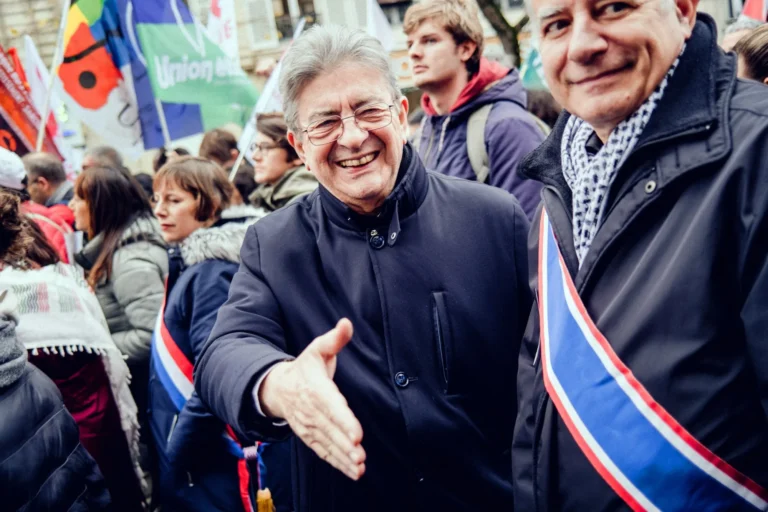
The leader of the far-left party La France Insoumise (Unbowed France), Jean-Luc Mélenchon, has publicly announced his intention to run in the 2027 French presidential election, which would mark his fourth attempt to reach the Élysée Palace. The politician, who placed third in the previous election (behind Emmanuel Macron and Marine Le Pen), is known for his openly pro-Russian stance. He has also advocated for France’s withdrawal from NATO.
As head of the far-left La France Insoumise, Mélenchon supports dialogue between the European Union and Russia, opposes military assistance to Ukraine, and calls on Western states to take Russia’s security concerns into account—positions that make him a favorable candidate for the Kremlin in the context of the French presidential race.
Mélenchon can be characterized as a typical populist politician who criticizes the current government while offering his electorate primarily promises, without presenting a coherent political strategy or a well-developed economic program.
Mélenchon’s 2027 Bid: Populism, Strategic Ambiguity, and Implications for European Security
The announcement by Jean-Luc Mélenchon, leader of La France Insoumise, to run in the 2027 French presidential election marks a continuation of his long-term political strategy to position himself as the primary challenger to the French political establishment. Having placed third in the previous presidential election—behind Emmanuel Macron and Marine Le Pen—Mélenchon remains a structurally significant actor within France’s fragmented political landscape.
Ideological Positioning: Anti-System and Strategic Autonomy
Mélenchon’s platform is rooted in a left-populist, anti-system narrative that combines:
- criticism of neoliberal economic governance
- opposition to transatlantic security structures
- advocacy of “strategic autonomy” for France and Europe
His calls for France’s withdrawal from NATO and for a reconfiguration of relations with Russia reflect a broader ideological framework that prioritizes sovereignty and non-alignment over alliance-based security.
However, this positioning also creates strategic ambiguity. While framed as independence, such policies would objectively weaken NATO cohesion and could reduce Europe’s deterrence posture.
Russia Factor: Alignment by Outcome, Not Necessarily by Intent
Mélenchon’s positions on Russia—advocating dialogue, opposing military assistance to Ukraine, and emphasizing the need to consider Russian security concerns—do not necessarily imply direct alignment with the Kremlin.
However, they produce outcomes that are favorable to Russian strategic interests, including:
- weakening Western unity on Ukraine
- slowing or limiting military support
- legitimizing narratives about “shared responsibility” for conflict
From a geopolitical perspective, this represents convergent interests, even if not coordinated policy.
Electoral Logic: Populism and Polarization
Mélenchon’s rhetoric is consistent with broader European populist trends:
- framing politics as a struggle between “the people” and “elites”
- offering broad redistributive and social promises
- emphasizing crisis narratives (economic inequality, war fatigue, democratic deficit)
This approach is effective in mobilizing a loyal but capped электорат, particularly among younger voters and urban constituencies.
However, it also limits his ability to expand beyond a core base due to:
- perceived radicalism;
- concerns over economic feasibility;
- foreign policy positions seen as destabilizing;
Structural Constraints on Electoral Success
Despite his visibility, Mélenchon faces significant structural barriers: the French two-round electoral system favors coalition-building, which he struggles to achieve; competition with both centrist and far-right candidates; fragmentation within the left.
Unlike figures such as Marine Le Pen, who have broadened their appeal over time, Mélenchon has remained relatively ideologically rigid, limiting second-round viability.
Strategic Implications for Europe
If Mélenchon were to gain power, the implications would be substantial:
For NATO
- potential withdrawal or reduced participation by France
- weakening of collective defense cohesion
- increased uncertainty in European deterrence architecture
For the EU
- stronger push for strategic autonomy; possible tensions with Eastern European member states; rebalancing of internal power dynamics.
For Russia
- indirect strategic gains through reduced Western unity
- expanded diplomatic space
- weakening of sanctions consensus
Scenario Assessment (2027 Election)
Scenario 1: Mélenchon remains a third-place candidate (most likely, 50–60%)
- maintains strong base but fails to expand
- limited systemic impact
Scenario 2: Advances to second round (moderate probability, 25–35%)
- benefits from fragmentation of other blocs
- becomes a major disruptor in the political landscape
Scenario 3: Electoral victory (low probability, 10–15%)
- requires:
- collapse of centrist coalition
- unified left
- strong anti-establishment wave
Mélenchon represents a structurally important but constrained challenger within French politics. His platform reflects broader European trends toward populism and strategic autonomy, but his foreign policy positions—particularly on Russia and NATO—carry significant geopolitical implications.
While his intentions may be framed in terms of independence and dialogue, the practical effect of his policies would likely be to weaken Western cohesion at a time of heightened geopolitical competition.
Mélenchon is less a direct pro-Russian actor than a systemic disruptor whose policies would objectively align with Kremlin strategic interests by fragmenting Western unity and reducing deterrence capacity.
Based on the latest polling, political structure, and scenario modeling, the probability of Jean-Luc Mélenchon winning the 2027 French presidential election is low—but not negligible.
Recent polling gives the clearest quantitative picture:
- In second-round simulations vs far-right candidate (e.g., Bardella): Mélenchon: ~26–33%; Opponent: ~67–74%.
This is a decisive defeat margin, far larger than typical French runoff gaps.
- Broader polling trends show: Far-right candidates leading nationally. Left fragmented and struggling to unify.
- Public perception: Around 81% of voters oppose Mélenchon as president.
This is a critical indicator: high rejection limits second-round viability.
Even more decisive than polls are structural factors: Two-round system problem
France’s system requires: broad coalition-building in round 2.
Mélenchon: has a strong base, but very high rejection ceiling.
This is his biggest weakness.
B. Fragmented left
- Left voters want unity (≈60%), but it is not achieved. Mélenchon refuses primaries → limits coalition potential. Thus , he may not even reach the second round.
C. Strong competitors
Likely opponents: far-right (e.g., Bardella / Le Pen); centrist/right candidate (e.g., Philippe). Both outperform him in broad electorate appeal.
D. Polarizing profile:
Described as divisive and controversial. High “negative rating” among moderates
In French elections, polarization = second-round weakness.
First round (reach runoff): 25–35% probability.
Depends on: fragmentation of center/right; left consolidation.
Second round (win presidency): 10–15% probability.
Requires: exceptional conditions; major systemic shock.
Integrated probability of overall victory: ~10% (low probability scenario).
His probability rises only under non-standard conditions: Scenario 1: Left unification (key trigger): single candidate; broad coalition.
Then probability rises to 20–25%.
Scenario 2: Collapse of center
- no strong Macron-style successor; voter shift to extremes.
Scenario 3: Anti-system wave
- economic crisis; social unrest; war fatigue.
Scenario 4: Opponent weakness
- far-right candidate disqualified or weakened; internal scandals.
Mélenchon is: structurally strong enough to influence the race, but structurally weak to win it under current conditions.
Mélenchon’s probability of winning the presidency in 2027 is low (~10%), primarily due to high rejection rates and inability to build a second-round coalition, despite a solid first-round base.
There is no credible evidence of direct, organized Russian support (financial, operational, or institutional) for Jean-Luc Mélenchon comparable to cases seen with some far-right actors in Europe.
However, there are indirect, narrative, and strategic forms of alignment that can be understood as “passive or opportunistic support” from Russia’s perspective.
Unlike cases such as loans to political parties or documented meetings (e.g., other European actors), there is: no proven Russian funding; no confirmed coordination with Kremlin-linked structures; no documented institutional ties to Russian state actors.
Even critics acknowledge that Mélenchon himself denies any link and has also condemned Russia’s invasion of Ukraine; hosted Russian opposition figures in France.
Where Russia benefits is not through direct support—but through narrative alignment.
Key Mélenchon positions that align with Russian interests:
- opposition to arms deliveries to Ukraine; emphasis on “negotiations” and compromise; framing conflict as requiring recognition of Russian “security concerns”; criticism of NATO.
These positions weaken Western cohesion on Ukraine; slow decision-making inside EU/NATO; legitimize multipolar narratives promoted by Moscow.
This is what analysts call “alignment by outcome, not coordination.”
The most tangible “support” comes through media and narrative amplification:
Russian state and pro-Kremlin media tend to: highlight Mélenchon’s criticism of NATO and sanctions; present him as a “realist” or “anti-war” voice; contrast him with “pro-war Western elites”. This is selective amplification—not creation of his positions.
Some analysts and commentators have described Mélenchon as: sympathetic to Russia or “Putin-understanding”; supportive of Russia in earlier phases (e.g., Crimea framing).
However: his stance evolved after 2022; he publicly distanced himself from pro-Kremlin positions;he cut ties with some pro-Russian actors.
This creates a mixed perception in Russia: useful politically, but not fully reliable.
Russia benefits from Mélenchon not because he is “their candidate,” but because: he fragments the French political system; weakens centrist consensus and complicates EU decision-making. This fits a broader Russian strategy: not to control actors but to increase division and unpredictability.
From a Kremlin perspective, Mélenchon is: Useful but risky.
- Has strong rhetoric against NATO;
but ideologically left-wing and unpredictable; supports social movements, not authoritarian models.
Russia typically prefers: more controllable actors; clearer transactional relationships.
Mélenchon is not a Kremlin-backed candidate, but his political positions create strategic advantages for Russia by weakening Western unity and reinforcing narratives favorable to Moscow.
Russia does not need to “support” Mélenchon in a traditional sense.
It only needs: his positions to exist and to amplify them when useful.
A victory by Jean-Luc Mélenchon in 2027 would represent a systemic shift in France’s political and strategic direction, with consequences extending well beyond national policy into European and transatlantic structures.
Domestic Policy Consequences
1. Institutional Reconfiguration and Governance Style. Mélenchon has advocated for a transition toward a Sixth Republic, implying: constitutional reform to reduce; presidential powers; stronger parliamentary role; expanded direct democracy mechanisms.
This would trigger institutional instability in the short term, as existing power structures are challenged.
Economic Policy: Expansionary and Redistributive Shift
Expected measures include: significant increases in public spending, higher taxation on wealth and corporations, expansion of social welfare programs and rollback of certain market-oriented reforms.
Thus, Likely consequences are: short-term boost in domestic demand; medium-term pressure on public finances and investor confidence and potential tension with EU fiscal rules.
Energy and Industrial Policy: acceleration of green transition, skepticism toward nuclear energy (with internal debate), stronger state role in strategic sectors.
This Could lead to restructuring of France’s energy mix and friction within EU energy coordination.
5. Political Landscape is waiting for intensification of polarization between left and right blocs, stronger mobilization of opposition forces (especially far-right).Thus, France could enter a highly confrontational domestic political phase.
1. NATO and Transatlantic Relations
Mélenchon has proposed: withdrawal from NATO integrated command; reassessment of France’s role in the alliance.
This will lead to weakening of NATO cohesion; strategic uncertainty on Europe’s western flank; strain in relations with the United States
Policy Toward Russia and Ukraine
Likely shifts: reduction or suspension of military support to Ukraine; push for negotiations with Russia; emphasis on “security guarantees” for all sides.
Likely Effects: fragmentation of EU unity on Ukraine; increased diplomatic space for Russia; tension with Eastern European allies.
European Union Dynamics
Mélenchon supports: renegotiation of EU economic rules; greater national sovereignty; resistance to austerity frameworks.
Consequences: conflict with EU institutions; alignment with other “sovereigntist” actors; risk of institutional gridlock within the EU.
Global Positioning: Non-Alignment and “Multipolarity”
France would likely: pursue a more independent foreign policy; engage more actively with Global South actors; reduce alignment with U.S.-led initiatives.
This would reposition France as a balancing power rather than a bloc-aligned actor.
Defense and Strategic Posture
reduced emphasis on expeditionary operations; possible reorientation toward territorial defense and diplomacy.
This lead to Risk of reduced credibility of France as a security provider, that impact on EU defense initiatives.
For Europe: weakening of Western cohesion; emergence of competing strategic visions within the EU; increased influence of both Russia and non-Western actors.For NATO: loss of a key military and political pillar; internal fragmentation; reduced deterrence coherence.
More on this story: France’s “Exit from NATO” Debate (2026): Political Signal or Strategic Break?