
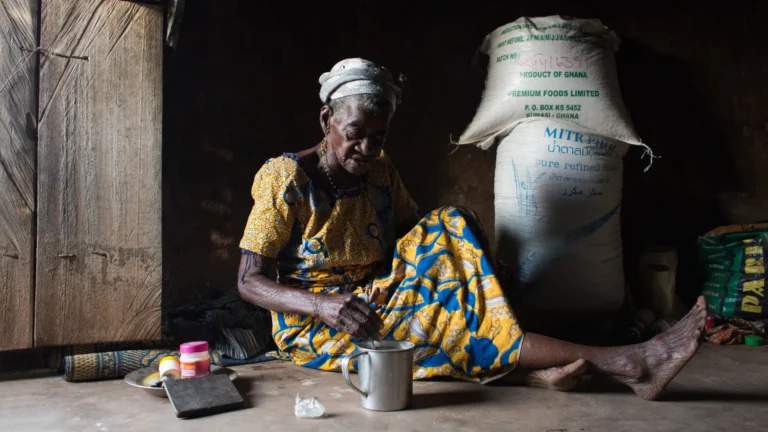
Six years after the killing of 90-year-old Akua Denteh in Ghana, the country has still not enacted specific legislation criminalizing witchcraft accusations. The continued delay highlights a deeper problem: Ghana is attempting to address through criminal law a phenomenon rooted in traditional belief systems, gender inequality, poverty, disputes over property and inheritance, weak rural policing, and the social marginalization of older women.
On July 23, 2020, Denteh was beaten to death in Kafaba in Ghana’s Savannah Region after being accused of witchcraft. Two women involved were subsequently convicted of manslaughter and sentenced in 2023 to 12 years in prison. Yet the prosecution demonstrated the limits of Ghana’s existing approach: authorities could punish perpetrators for the physical violence, but Ghana lacked legislation directly addressing the accusation, stigmatization and banishment that frequently precede such violence. (Amnesty International USA)
The Denteh killing therefore became a catalyst for legislative reform rather than an isolated criminal case.
A problem much older than the Akua Denteh case
Belief in witchcraft has existed in Ghanaian communities for generations and cannot simply be attributed to modern religious extremism or criminality. Historically, supernatural explanations have sometimes been used to interpret otherwise inexplicable illness, death, crop failure, infertility and economic misfortune.
The security problem arises not from belief itself but from accusation followed by punishment outside the formal justice system.
In northern Ghana in particular, accusations have frequently fallen on socially vulnerable people—especially older women. Once accused, victims can face assault, expulsion from their families, confiscation or loss of property and permanent exclusion from their communities.
This produced one of Ghana’s most unusual social institutions: the so-called witch camps.
Sites including Gambaga, Gnani and Kukuo developed as places where accused women could seek protection after being driven from their communities. Although these settlements provide a degree of physical security, they also institutionalize displacement. Women may spend years or decades there despite never having committed an offence.
Amnesty International documented more than 500 people living in four such informal camps during visits in 2023 and 2024. Most were older women and many lacked adequate access to food, healthcare, water, housing and economic opportunities. (Amnesty International)
The camps therefore expose the central contradiction of Ghana’s response: the victim, rather than the accuser, is effectively removed from society.
Why women are disproportionately targeted
The phenomenon also has a pronounced gender dimension.
Witchcraft accusations can provide a culturally acceptable justification for resolving underlying social and economic conflicts. An elderly widow without strong family protection is particularly vulnerable.
In some cases, an accusation may follow a death, illness or unexplained misfortune. In others, underlying disputes over inheritance, land, family authority or property can contribute to accusations.
This pattern is not unique to Ghana.
Across parts of sub-Saharan Africa, older people—and particularly older women—have been attacked after being blamed for droughts, illness, deaths or other community misfortunes. Poverty, demographic pressures and misunderstanding of age-related conditions such as dementia can reinforce the phenomenon. (AP News)
Consequently, the issue is better understood as a form of socially legitimized violence against vulnerable people than simply as a dispute about supernatural beliefs.
The failed legislative breakthrough of 2023
The killing of Denteh generated political momentum for reform.
In July 2023, Ghana’s Parliament passed the Criminal Offences (Amendment) Bill intended to prohibit witchcraft accusations and witch-finding practices. The legislation would have made it unlawful to declare, label or identify another person as a witch and prohibited people from operating as witch doctors or witch finders for this purpose. (Ghana News Agency)
However, the bill did not become law.
Former President Nana Akufo-Addo did not assent to it, citing constitutional concerns connected with its status as a private member’s bill rather than government-sponsored legislation. The bill subsequently lapsed and, according to Amnesty International’s July 2026 assessment, has not been reintroduced. (Amnesty International USA)
The result is a significant protection gap.
Ghana can prosecute murder, assault and other crimes committed against an accused person, but the mechanisms that initiate the persecution—public accusation, organized witch-finding and forced banishment—remain inadequately addressed by specific national legislation.
The experience of other African countries suggests that legislation is necessary but rarely sufficient.
South Africa: criminalizing the accusation itself
South Africa offers one of the clearest legal parallels.
Its Witchcraft Suppression Act, amended in 1970, made it an offence to identify another person as a witch or to attribute disease, injury or damage to that person through alleged supernatural means. Where such an accusation contributed to the victim’s death, the legislation provided for particularly severe punishment. (Government of South Africa)
The conceptual approach is important for Ghana.
Instead of requiring courts to determine whether witchcraft exists, the law focuses on observable conduct: accusation, intimidation and resulting harm.
This is broadly the logic behind Ghana’s proposed legislation.
The South African experience nevertheless demonstrates the limitations of criminalization. Witchcraft-related accusations and violence have not disappeared entirely. Legislation can establish a deterrent and prosecution mechanism, but it cannot by itself eliminate deeply rooted beliefs.
Lesson for Ghana: criminalize harmful accusation and persecution without attempting to criminalize belief itself.
Nigeria: legislation combined with victim rehabilitation
Nigeria provides another relevant comparison, although the principal victims in parts of southern Nigeria have often been children rather than elderly women.
In Akwa Ibom and Cross River states, children have been accused of causing illness, economic hardship or family misfortune through witchcraft. Some have been beaten, abandoned or subjected to violent “deliverance” or exorcism practices.
Federal and state legislation provides protections against such abuse, and Akwa Ibom introduced legal measures against stigmatizing children as witches. Yet accusations have persisted. Reuters reported in 2025 that NGOs estimated tens of thousands of Nigerian children had faced witchcraft accusations over the previous two decades. (Reuters)
Nigeria’s more successful interventions have therefore combined law with rescue and rehabilitation.
Organizations such as the Child Rights and Rehabilitation Network provide accused children with shelter, education and pathways toward eventual reintegration. Some former victims have subsequently entered higher education. (Reuters)
The African Committee of Experts on the Rights and Welfare of the Child nevertheless found Nigeria in violation of several protections in 2025 over its inadequate response to children subjected to witchcraft accusations. (IHRDA – Defend, Edicate, Inform.)
Nigeria therefore provides both a positive and negative lesson: Passing legislation without systematic enforcement, education and reintegration does not eliminate witchcraft accusations.
For Ghana, simply criminalizing accusations while leaving hundreds of women isolated in camps would address only part of the problem.
Kenya: protecting potential victims before attacks occur
Kenya’s experience provides another potentially useful model.
In Kilifi County, killings of elderly people accused of witchcraft became sufficiently serious that authorities adopted a preventive approach. In 2021, regional authorities ordered local chiefs to identify residents aged 50 and above and take responsibility for protecting vulnerable elderly people.
More than 60 elderly people had reportedly been murdered in Kilifi during the previous year. Authorities also sought cooperation between government chiefs and traditional Kaya elders, who had established rescue centres for people accused of witchcraft. Witness-protection measures were proposed because intimidation had undermined prosecutions. (kenyanews.go.ke)
This addresses one of the weaknesses in Ghana’s system.
Police intervention often occurs after an accusation has escalated into assault, expulsion or murder. Kenya’s approach attempted to identify high-risk individuals and communities beforehand.
Lesson for Ghana: local authorities should treat witchcraft accusations as an early-warning indicator of potential violence.
A reported accusation against an elderly woman should therefore trigger preventive intervention rather than waiting for a criminal assault.
Zambia: the danger of criminalizing “witchcraft” rather than persecution
Zambia illustrates a different—and potentially problematic—approach.
Its colonial-era Witchcraft Act continues to regulate purported supernatural practices. In 2025, two men were convicted after being accused of participating in a plot to use witchcraft to kill President Hakainde Hichilema. The unusual case reopened debate over whether colonial legislation effectively validates supernatural claims by treating witchcraft itself as a prosecutable phenomenon. (AP News)
For Ghana, this distinction is critical.
A modern law should not require the state to decide whether supernatural powers are real.
Instead, it should punish objectively identifiable actions:
accusing, threatening, assaulting, forcibly displacing, exploiting or organizing persecution against another person because of an alleged supernatural identity.
The target of legislation should therefore be harm, not metaphysical belief.
Why Ghana has struggled to resolve the problem
Ghana’s difficulty reflects four interconnected obstacles.
First, witchcraft beliefs remain socially embedded in some communities. Criminal legislation that appears to attack traditional belief rather than violence could therefore encounter resistance.
Second, many victims are economically and socially marginalized. Older women living in remote communities frequently lack the political influence, financial resources or family networks necessary to obtain protection.
Third, prosecutions generally address the final violent act rather than the chain of events producing it.
Fourth, closing witch camps without first making communities safe could actually expose residents to renewed persecution.
This last point is particularly important.
The objective should not simply be to close the camps. It should be to make them unnecessary.
What appears to work elsewhere
Comparative African experience indicates that no single intervention solves the problem. The more effective model combines several measures:
Legal prohibition + early intervention + prosecution + victim protection + community education + economic support + reintegration.
South Africa demonstrates the importance of criminalizing harmful accusations.
Nigeria demonstrates the importance of rehabilitation and education.
Kenya demonstrates the potential value of community-level early warning and protection.
At the same time, persistent accusations in all three countries demonstrate that legislation alone does not eradicate the underlying phenomenon.
Ghana therefore requires a broader national strategy rather than simply another parliamentary vote.
What Ghana should do
The first requirement is to reintroduce the Anti-Witchcraft Accusations legislation as a government-sponsored bill, addressing the constitutional objections that prevented the 2023 legislation from taking effect.
Second, legislation should distinguish clearly between private belief and harmful conduct. Holding a supernatural belief should not itself constitute an offence; accusing an identifiable person in circumstances that expose them to violence, banishment or discrimination should.
Third, police and district authorities in high-risk northern regions should establish an early-warning mechanism. Reports of public accusations, witch-finding rituals or threats should automatically generate a vulnerability assessment.
Fourth, Ghana should create protected reporting and witness mechanisms. Families and neighbours frequently know when an accused woman is in danger, but fear of community retaliation can inhibit cooperation with police.
Fifth, reintegration must accompany protection. Residents of witch camps should receive voluntary pathways to housing, healthcare, psychological support, legal assistance and economic independence.
Finally, traditional chiefs, religious authorities and community leaders need to become part of the solution. Because accusations originate within communities, a purely Accra-driven criminal justice response is unlikely to transform behaviour on its own.
Assessment
The Akua Denteh killing should be understood not simply as an exceptionally brutal murder but as a visible manifestation of a much older institutional weakness.
Ghana has gradually moved from treating witchcraft accusations primarily as a traditional or community issue toward recognizing them as a human-rights, gender-protection and criminal-justice problem. The 2023 bill represented an important transition, but its failure to become law left that transition incomplete.
Comparative African experience suggests that Ghana does not need to choose between respecting traditional belief and protecting victims.
The workable distinction is between belief and coercion.
The state does not need to determine whether witchcraft exists. It needs to establish that no citizen can be assaulted, dispossessed, expelled, imprisoned informally or killed because another person claims that they possess supernatural powers.
The most effective strategy would consequently combine the South African legal model of criminalizing accusations, the Kenyan model of preventive local intervention, and the Nigerian model of shelter, education and rehabilitation.
If Ghana merely passes the Anti-Witchcraft Accusations Bill, violence is unlikely to disappear. If it combines legislation with local enforcement, victim protection, reintegration and sustained community education, however, the country has a realistic opportunity to dismantle the system that transforms an accusation into a de facto sentence of exile—or, in cases such as Akua Denteh’s, a death sentence.
Key Intelligence Judgment
Ghana’s witchcraft-accusation problem persists not principally because the state lacks laws against murder or assault, but because intervention generally occurs too late in the persecution cycle.
The strategic objective should therefore be to move state intervention upstream:
accusation → stigmatization → threat → displacement → violence
rather than relying primarily on prosecution after violence has already occurred.
The experience of other African states indicates that the most promising solution is neither prohibition of traditional belief nor criminal law alone, but an integrated system in which accusations themselves trigger protection mechanisms before they escalate into violence.
Witchcraft accusations in Africa did not originate from a single tradition or historical event. Beliefs in harmful supernatural agency existed in many African societies long before European colonialism, but the contemporary phenomenon—especially accusations leading to expulsion, lynching, “witch camps,” or abuse of children—is the product of several historical layers.
Pre-colonial origins: explaining misfortune. In many pre-colonial African cosmologies, the visible and spiritual worlds were interconnected. Illness, infertility, unexpected death, crop failure, livestock losses, or sudden economic misfortune could therefore have both natural and supernatural explanations.
Importantly, concepts translated into English as “witchcraft” were highly diverse. Different societies distinguished between sorcery involving deliberate techniques, inherited supernatural powers, spirit possession, divination, curses, and ritual specialists. European observers frequently collapsed these very different concepts into the single category “witchcraft.”
Accusations also served a social function. Anthropological research, most famously E. E. Evans-Pritchard’s work among the Azande, showed that witchcraft could provide an explanation for why a particular misfortune happened to a particular person at a particular moment, even where its physical cause was understood.
Thus an accusation could emerge from tensions already present inside a family or village.
Accusations were also mechanisms of social control
Pre-colonial accusations were not necessarily random. They often reflected existing disputes involving: inheritance and property; marriage and fertility; competition between families; unexplained illness or death; political rivalry; jealousy over economic success; violations of community norms.
The identity of likely victims varied greatly between societies. Women were disproportionately accused in some regions, whereas men could constitute a substantial proportion—or even the majority—in others.
This matters for Ghana: the modern association between elderly, socially isolated women and witchcraft accusations should not automatically be projected backward onto all pre-colonial African societies.
Colonialism changed rather than created the phenomenon. European colonialism did not introduce belief in witchcraft to Africa. What colonial governments did was transform the institutional environment surrounding it.
British, French, Belgian, Portuguese and other colonial administrations generally rejected supernatural accusations as legally unverifiable. Colonial governments introduced various forms of witchcraft legislation intended either to suppress alleged practitioners or, increasingly, to punish people claiming to identify witches.
The result was contradictory.
Traditional mechanisms that had previously mediated accusations could be weakened, while colonial courts were often incapable of resolving the underlying dispute. In some territories, people therefore concluded that the colonial state was effectively protecting alleged witches.
South Africa’s Witchcraft Suppression Act of 1957 is an important descendant of this approach: rather than proving supernatural activity, legislation targeted practices such as accusing another person of being a witch.
Christian missions introduced another transformation.
Christianity produced an even more complicated effect.
Mission churches generally condemned traditional divination and African religious practices. But Christian theology also contained concepts of Satan, demons, possession and supernatural evil.
During the twentieth century—and particularly with the enormous expansion of Pentecostal and charismatic Christianity from the 1970s onward—these traditions sometimes merged.
A pastor or self-described prophet could replace the traditional diviner as the person identifying the supposed source of supernatural harm.
This helps explain an apparent paradox: Modernization and Christianization did not necessarily eliminate witchcraft accusations; in some environments they changed the vocabulary and institutions through which accusations were expressed.
The language might shift from traditional witchcraft toward demonic possession, deliverance, spiritual warfare or satanic influence.
The child-witch phenomenon is comparatively modern
One of the most disturbing contemporary developments—the accusation of children—became particularly prominent in parts of Nigeria, the Democratic Republic of Congo, Angola and neighbouring countries.
This is not simply an unchanged ancient tradition.
Urbanization, war, displacement, family fragmentation, poverty and some revivalist churches contributed to an environment in which children could be blamed for unemployment, illness, infertility or household misfortune.
UNICEF has documented how accusations against children in parts of Africa have been associated with abandonment, abuse and violent purported exorcisms.
This demonstrates why describing the entire phenomenon as an “ancient African tradition” is misleading.
Economic crises can intensify accusations
Witchcraft accusations frequently become more dangerous during periods of rapid social disruption.
When communities experience disease, unemployment, migration, war, environmental stress or abrupt inequality, people search for explanations for why some individuals prosper while others suffer.
The accusation can consequently become a mechanism for converting an abstract crisis into an identifiable human enemy.
This helps explain why accusations have survived modernization. New forms of wealth can generate accusations just as readily as crop failure did historically.
Why elderly women became particularly vulnerable in Ghana; Ghana illustrates another transformation.
In parts of northern Ghana, accusations have disproportionately affected older women, particularly widows and women with limited family protection. The phenomenon produced the settlements commonly described as witch camps, including Gambaga, Gnani, Kukuo and others.
\
The vulnerability of older women can result from several overlapping factors: widowhood, dependence on relatives, inheritance disputes, poverty, social isolation, illness and accusations following unexplained deaths within extended families.
The accusation can therefore conceal a more ordinary conflict.
A dispute may superficially concern supernatural powers while underneath it concerns land, inheritance, family authority, caregiving burdens or property.
That is one reason legislation aimed solely at “witchcraft” can fail to address the underlying drivers.
Post-colonial states inherited the contradiction. After independence, many African governments inherited colonial-era laws while simultaneously governing populations in which supernatural beliefs remained socially influential.
Governments therefore faced a difficult problem: Should the state prosecute witchcraft—or prosecute people who accuse others of witchcraft?
Countries have answered differently.
South Africa historically emphasized suppression of accusations and witch-finding. Ghana has moved toward criminalizing harmful accusations. Some other jurisdictions retain laws that can be interpreted as recognizing or criminalizing alleged witchcraft practices themselves.
This difference is fundamental because criminalizing “witchcraft” can unintentionally legitimize the premise that courts can determine who is a witch.
The historical evolution can therefore be summarized as:
Pre-colonial cosmology
→ supernatural explanations for otherwise inexplicable misfortune
Community dispute resolution
→ diviners and traditional authorities identify or mediate alleged supernatural responsibility
Colonial intervention
→ traditional mechanisms weakened and European criminal law introduced
Christianization
→ traditional concepts interact with Christian ideas of demons, Satan and possession
Post-colonial socioeconomic disruption
→ urbanization, inequality, war, migration and weakened family structures create new categories of vulnerable victims
Pentecostal/charismatic expansion
→ some pastors and prophets become modern “witch identifiers”
Contemporary accusations
→ elderly women, widows, children and socially isolated people become particularly vulnerable in certain regions.
The most important analytical point is that modern witchcraft persecution in Africa should not be described simply as a surviving pre-colonial custom.
It is better understood as a hybrid institution.
Traditional supernatural beliefs supplied the conceptual foundation, but colonial disruption, Christian demonology, post-colonial economic insecurity, changing family structures, property disputes and modern religious entrepreneurship transformed how accusations operate and who becomes vulnerable.
This also explains why modernization alone has not eliminated the phenomenon. The belief system continuously adapts to new social conditions.For Ghana, therefore, the Akua Denteh case represents not merely the persistence of an “ancient belief,” but the contemporary manifestation of a historical institution that has repeatedly changed its form. The policy implication is significant: criminalizing accusations is necessary, but eliminating the violence requires addressing the economic, familial and religious mechanisms that continue to make accusations socially useful to those who make them.