Environmental and anti-nuclear organizations staged a protest outside the nuclear fuel manufacturing plant in Lingen, Lower Saxony, following the approval of the facility’s cooperation with the Russian state nuclear corporation Rosatom. The demonstrators argue that involving a Russian state-owned partner poses significant security risks and have called for the partnership to be terminated, citing concerns over espionage, sabotage, and the reinforcement of Europe’s dependence on Russia’s nuclear industry.
The decision to authorize the production of fuel assemblies in Lingen for Russian-designed nuclear reactors has drawn criticism from environmental organizations and several political figures. Although the cooperation was approved subject to a number of restrictions, critics contend that allowing an entity affiliated with Russia’s nuclear sector to participate in the project creates additional risks to Europe’s energy and national security at a time when Russia continues its war against Ukraine.
The planned expansion of nuclear fuel production at the Lingen facility through cooperation with Rosatom risks prolonging Europe’s dependence on Russian nuclear technologies and fuel supply chains. Moreover, the participation of a Russian state-owned corporation in a commercial project generates additional financial revenues for sectors linked to Russia, contradicting the European Union’s broader strategy of reducing its economic dependence on Moscow during the ongoing war against Ukraine.
Environmental activists have also highlighted the security implications of Framatome’s cooperation with Rosatom, warning of the potential leakage of sensitive technological information, espionage activities, and the use of academic and industrial partnerships to advance Kremlin interests. In their view, the German government’s decision to authorize the cooperation reflects an inadequate assessment of the potential threats facing Europe’s critical infrastructure.
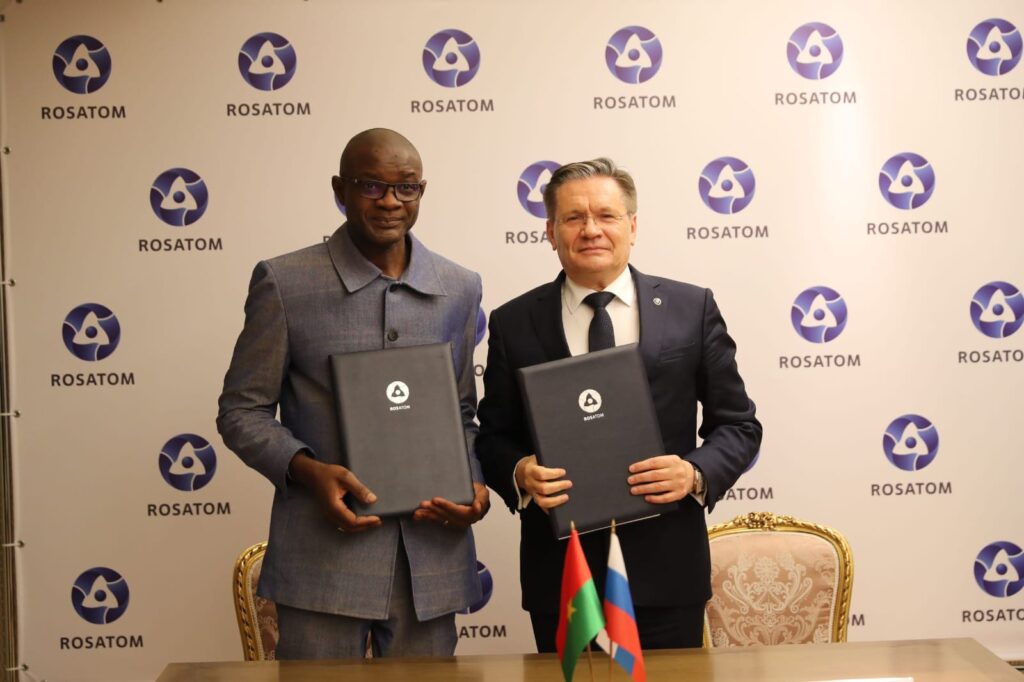
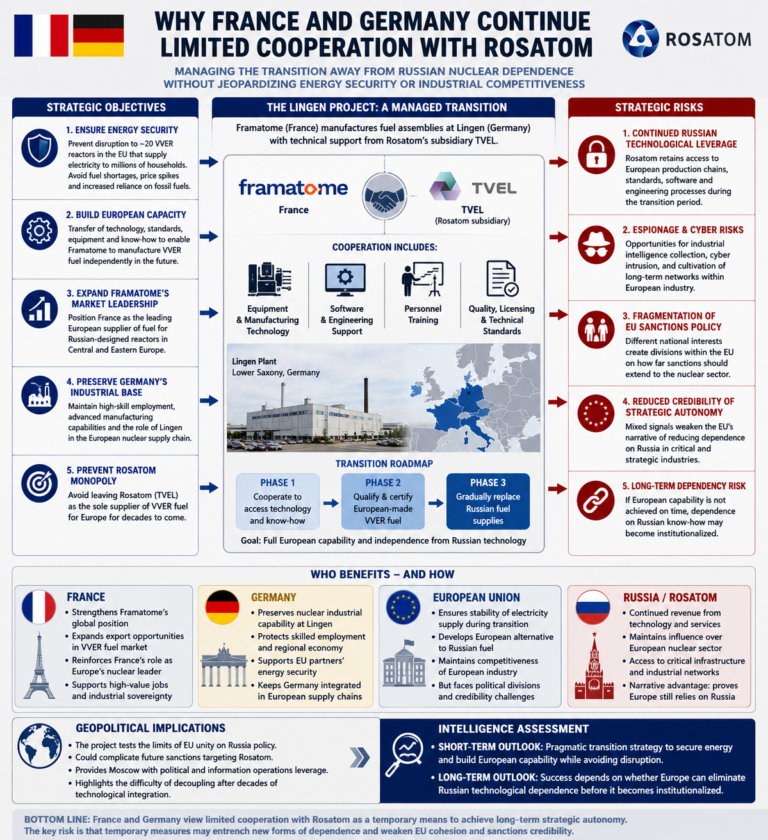
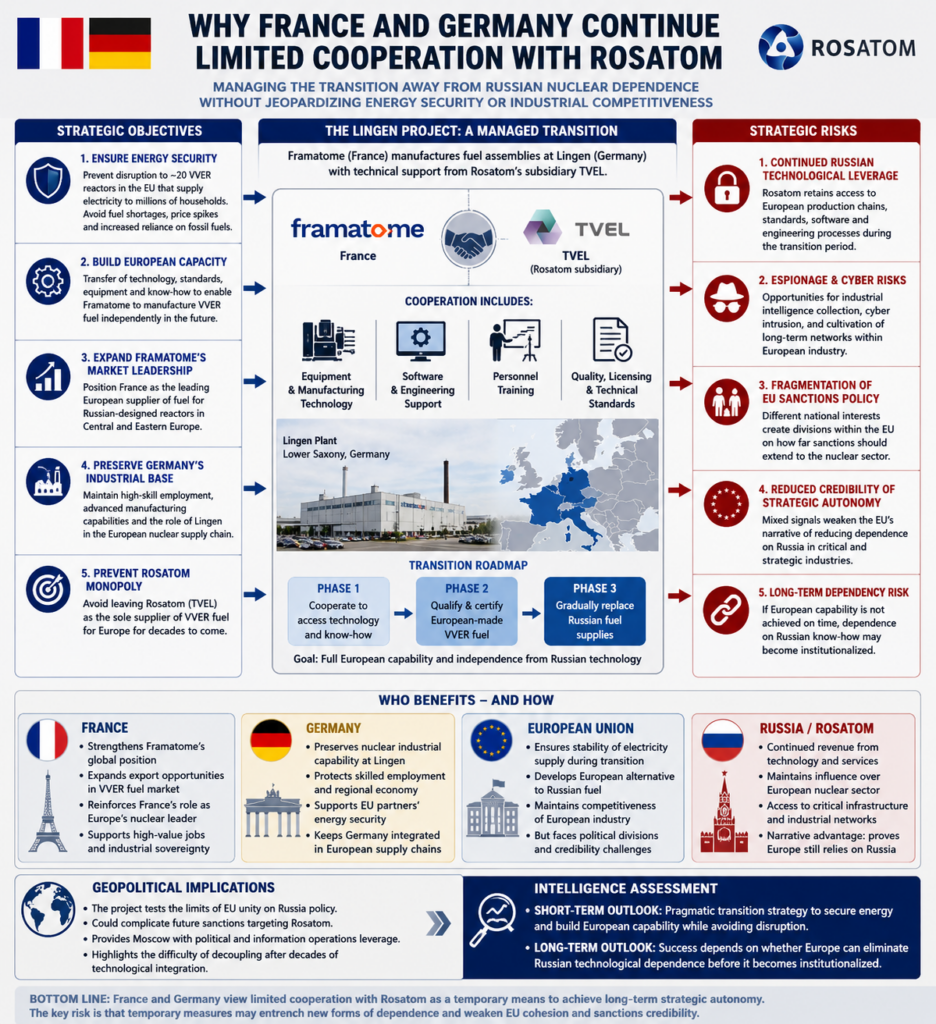
Under the agreement, the French company Framatome will manufacture fuel assemblies for Soviet-designed nuclear reactors operating in Eastern Europe, while Rosatom’s subsidiary TVEL will provide equipment, software, and personnel training. Journalists have argued that France is effectively using Germany as a platform to preserve and expand its nuclear business with Rosatom, while German authorities have been unable to block a project that could expose critical infrastructure to espionage, sabotage, and Russian access.
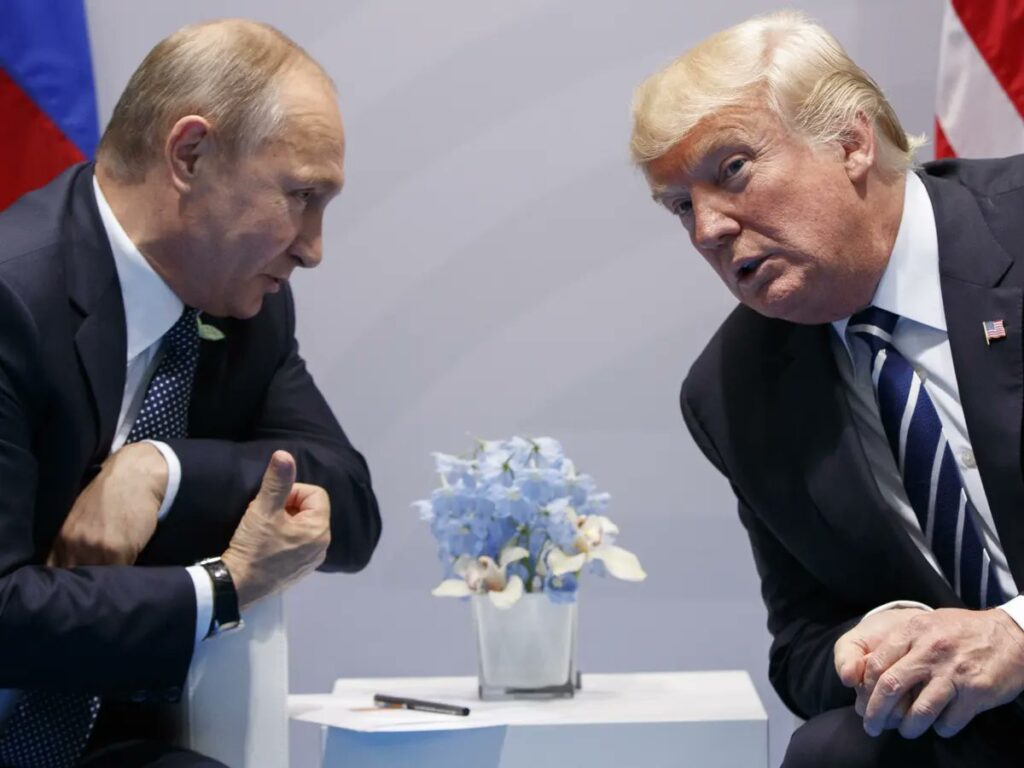
Critics further contend that France is prioritizing its commercial interests over the European Union’s sanctions policy. From this perspective, the primary beneficiary of the arrangement is Vladimir Putin, as Russia continues to generate revenue from its nuclear industry while maintaining strategic influence over Europe’s energy sector.
By continuing its cooperation with Rosatom, Framatome is viewed by its critics as disregarding the security implications of partnering with a Russian state-owned corporation closely associated with Russia’s military-industrial complex. They argue that this approach places commercial considerations above the need to strengthen oversight of strategic technologies and creates opportunities for the Kremlin to exploit European industrial partnerships to advance Russian geopolitical interests.
More broadly, Framatome’s decision to maintain its partnership with Rosatom suggests that segments of the European business community remain willing to cooperate with Russian state entities despite their role in supporting the Kremlin’s policies. According to critics, this creates a growing contradiction between the commercial interests of individual companies and the European Union’s broader strategic objective of reducing Russian influence across critical sectors.
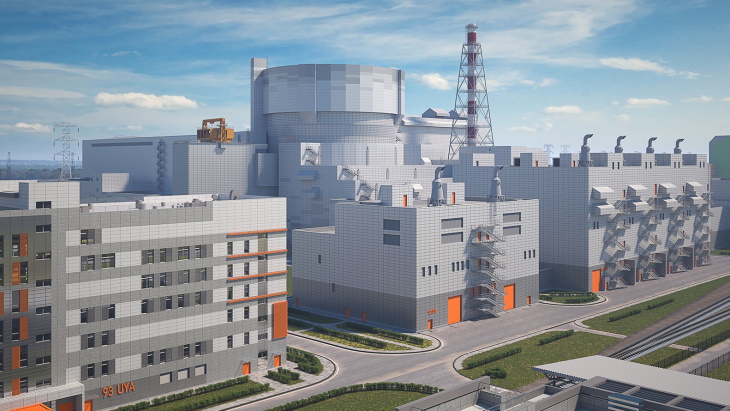
The decision to permit the expansion of nuclear fuel production at the Lingen facility through cooperation between Framatome and Rosatom’s subsidiary TVEL reflects a broader strategic dilemma confronting Europe: reducing dependence on Russian energy while maintaining the operational viability of Soviet-designed nuclear reactors still operating across Central and Eastern Europe.
From a commercial perspective, the project enables Framatome to enter a highly specialized market for fuel assemblies compatible with VVER reactors. Until recently, Rosatom maintained a near-monopoly over this segment. By acquiring access to Russian manufacturing standards, equipment, software, and technical expertise, Framatome seeks to position itself as a long-term supplier capable of gradually replacing direct Russian fuel deliveries while preserving access to a market comprising dozens of operating reactors across Europe.
For Germany, the approval reflects economic and regulatory rather than political priorities. Although Germany has phased out domestic nuclear power generation, it remains an important industrial hub for the European nuclear fuel cycle. Allowing production at the Lingen facility helps preserve highly specialized industrial capabilities, protects skilled employment, and strengthens Germany’s role within the European nuclear supply chain. Berlin also seeks to avoid supply disruptions that could affect the energy security of EU member states still dependent on VVER reactors, including Bulgaria, Slovakia, the Czech Republic, Hungary, and Finland.
France’s motivations are more strategic. As Europe’s largest nuclear power producer, France views the expansion of Framatome’s capabilities as essential to preserving its leadership in the global nuclear fuel market. By participating in the production of fuel for Russian-designed reactors, Paris aims to prevent Rosatom from retaining an exclusive position in this commercially valuable sector while simultaneously expanding Framatome’s technological portfolio and future export opportunities.
However, the paradox of the arrangement is that achieving this objective currently requires continued technical cooperation with Rosatom. TVEL’s participation in providing manufacturing equipment, software, engineering support, and personnel training inevitably maintains a degree of technological dependence on the Russian state nuclear industry. Consequently, although the long-term objective may be diversification away from Russian fuel supplies, the short-term implementation preserves Russian access to sensitive elements of Europe’s nuclear fuel production chain.
This creates several strategic vulnerabilities. The continued involvement of a Russian state-owned corporation in an industrial project located within the European Union may increase opportunities for industrial espionage, technology collection, cyber intrusion, and the cultivation of long-term professional relationships that could be exploited by Russian intelligence services. While there is no public evidence that Rosatom is using the Lingen project for intelligence purposes, Russian state corporations have historically operated in close coordination with broader Russian state interests, making such risks a legitimate consideration for counterintelligence authorities.
The project also highlights persistent differences within the European Union regarding the balance between economic pragmatism and strategic decoupling from Russia. While Brussels has sought to reduce dependence on Russian hydrocarbons since 2022, the nuclear sector remains only partially integrated into that strategy because many Member States continue to rely on Russian-designed reactors and fuel technologies. France therefore appears to prioritize maintaining the competitiveness of its nuclear industry and ensuring continuity of fuel supplies, whereas Germany has accepted a compromise that protects European energy resilience while allowing limited cooperation with a Russian state enterprise.
From Moscow’s perspective, the arrangement delivers several strategic benefits. Even if Rosatom gradually loses market share as Framatome expands production capabilities, Russia retains influence over European nuclear supply chains through the transfer of technology, manufacturing standards, software, and engineering expertise. The cooperation also generates revenue for Rosatom and demonstrates that parts of Europe’s strategic industrial base remain willing to engage commercially with Russian state enterprises despite the broader political confrontation resulting from Russia’s war against Ukraine.
Ultimately, the Lingen project illustrates that Europe’s effort to reduce dependence on Russia is constrained by decades of technological integration. Rather than representing a straightforward continuation of business with Moscow, the cooperation reflects an attempt by France and Germany to manage a complex transition in which strategic autonomy, commercial competitiveness, and energy security remain difficult to reconcile. At the same time, the arrangement exposes an enduring contradiction within European policy: while seeking to weaken Russia’s economic leverage, certain sectors continue to rely on limited cooperation with Russian state-controlled industries to safeguard the stability of Europe’s own critical infrastructure.
Impact on European unity
It exposes divisions over sanctions policy. The project illustrates that EU Member States continue to differ over how far sanctions against Russia should extend. Since 2022, the EU has sought to reduce dependence on Russian fossil fuels, yet the nuclear sector has largely remained outside the sanctions regime because several Member States continue to rely on Russian-designed reactors and fuel.
This creates two competing camps within the EU: France, Hungary, Slovakia, Bulgaria and others argue that abrupt disengagement from Rosatom would threaten energy security and electricity generation. Poland, the Baltic States and many Nordic countries advocate a much faster reduction of all strategic cooperation with Russian state-owned enterprises, including the nuclear sector.
The Lingen project therefore reinforces existing fault lines within the Union rather than creating a unified approach.
It weakens the political narrative of strategic autonomy. Since Russia’s full-scale invasion of Ukraine, the EU has promoted the concept of strategic autonomy—reducing dependence on authoritarian states in critical sectors. However, cooperation with Rosatom sends mixed signals: Brussels urges Member States to reduce Russian influence.Simultaneously, one of Europe’s largest industrial projects in the nuclear sector continues to rely on Russian technology and technical support. Although legally permissible, this inconsistency allows critics to argue that Europe’s commitment to strategic autonomy remains selective.
It creates perceptions of unequal burden-sharing. Another political consequence is the perception that sanctions affect Member States unevenly.
Countries that have incurred significant economic costs by reducing trade with Russia may view continued nuclear cooperation as evidence that: large economies receive greater flexibility; strategic industries receive exemptions unavailable to smaller states; economic interests continue to influence sanctions implementation.
Even if these perceptions do not reflect formal EU policy, they can complicate efforts to maintain consensus on future sanctions packages.
It provides opportunities for Russian influence operations. From Moscow’s perspective, the project offers an opportunity to reinforce narratives that: European sanctions are inconsistent; major Western governments continue to cooperate with Russian state enterprises when economically advantageous; EU unity is fragile; commercial interests ultimately outweigh political declarations.
Russian information campaigns are likely to portray the project as evidence that even leading EU states recognize Rosatom as an indispensable partner.
It complicates future sanctions against Rosatom. Perhaps the most significant long-term consequence is institutional. If European companies become more deeply integrated with Rosatom through: licensing, engineering support, software, fuel qualification, personnel training, future sanctions against Rosatom become politically and economically more difficult because European companies themselves acquire an interest in preserving elements of that cooperation.
This may increase resistance within the EU to broader restrictions on Russia’s nuclear sector.
Strategic assessment
The Lingen project is unlikely to fracture the European Union, but it highlights the limits of sanctions unity when strategic industries are involved. While France and Germany frame the cooperation as a pragmatic means of ensuring fuel security and supporting the gradual diversification of VVER fuel production, many Eastern European governments and security analysts view any continued institutional relationship with Rosatom as inconsistent with the EU’s broader objective of reducing Russian strategic leverage.
The principal risk is therefore political rather than immediate operational: the project may undermine the coherence of the EU’s sanctions narrative, encourage perceptions of unequal application of strategic policies, and provide Moscow with opportunities to argue that Europe’s commitment to economic decoupling from Russia is conditional when major commercial interests are at stake.
Intelligence assessment
Probability that the Lingen project weakens EU political cohesion on Russia policy (2026–2028): 65–75% (moderate to high).
The project is unlikely to derail existing sanctions, but it increases the likelihood of more contentious negotiations over future measures targeting Russia’s nuclear sector, particularly if the EU considers expanding sanctions to Rosatom or its subsidiaries.
From a strategic perspective, France and Germany are pursuing different but complementary objectives. Their policy is less about preserving Rosatom’s role than about managing Europe’s transition away from Russian nuclear dependence without jeopardizing energy security or industrial competitiveness. At the same time, the approach creates contradictions that Moscow can exploit.
Overall assessment: France and Germany are attempting to balance three competing priorities: maintaining European energy security; strengthening Europe’s own nuclear industry; gradually reducing dependence on Russia without disrupting existing reactor operations.
Preserve European energy security during the transition
The immediate objective is to prevent disruption to the operation of approximately twenty VVER reactors that continue supplying electricity across several EU Member States.
An abrupt termination of cooperation with Rosatom could create: fuel shortages, licensing delays, higher electricity prices, increased dependence on fossil fuels.
France and Germany therefore appear to support a managed transition rather than immediate decoupling.
Strategic objective
Avoid an energy security crisis while alternative fuel production capabilities are developed.
Transfer technological know-how to European industry
France is pursuing a long-term industrial strategy.
Framatome currently seeks to manufacture fuel for Russian-designed reactors that have historically depended on TVEL.
During the initial phase, cooperation allows Framatome to acquire: manufacturing standards, engineering procedures, quality assurance methods, licensing experience, production equipment.
Once sufficient expertise has been accumulated, European production could become increasingly independent.
Strategic objective
Replace Rosatom as the principal supplier of VVER fuel rather than permanently cooperate with it.
Position France as Europe’s dominant nuclear supplier
Paris views nuclear energy as one of its principal strategic industries.
If Framatome successfully masters VVER fuel production, France could eventually become the preferred supplier for: Bulgaria,Czech Republic, Slovakia, Hungary, Finland (legacy support), Ukraine (where technically applicable and subject to qualification)
This would significantly expand France’s commercial and geopolitical influence.
Strategic objective
Convert dependence on Russian nuclear fuel into dependence on European suppliers led by France.
Preserve Germany’s nuclear industrial base
Although Germany has exited nuclear power generation, it retains important industrial capabilities.
Keeping the Lingen plant operational allows Germany to: preserve high-value industrial employment, maintain advanced manufacturing expertise, remain part of the European nuclear supply chain, support European partners operating nuclear reactors.
Strategic objective
Maintain strategic industrial capabilities despite Germany’s domestic nuclear phase-out.
Reduce—not immediately eliminate—dependence on Rosatom
European policymakers increasingly recognize that complete disengagement from Rosatom cannot occur overnight.
Instead, the apparent strategy is: cooperate sufficiently to establish European production; certify European-made fuel; gradually eliminate Russian deliveries.
Whether this strategy succeeds depends on Europe’s ability to develop genuinely independent manufacturing and licensing capabilities.
Prevent Rosatom from monopolizing Eastern European markets
If Framatome failed to enter the VVER fuel market, Rosatom would likely retain a dominant commercial position for many years.
France therefore seeks to deny Moscow this monopoly.
achieving this currently requires limited cooperation with Rosatom.
Risks and unintended consequences
The strategy also creates several significant risks.
Russian leverage
During the transition Russia continues to provide engineering expertise; manufacturing technology; software; technical documentation; personnel training.
This prolongs Russian influence over part of the European nuclear fuel cycle.
Counterintelligence concerns
Although no public evidence demonstrates espionage through the project, continued technical cooperation creates opportunities for: industrial intelligence collection; cyber reconnaissance; access to sensitive production processes;cultivation of long-term professional networks.
These risks require robust counterintelligence safeguards.
Political fragmentation
The project may deepen divisions within the EU between: Member States favouring pragmatic engagement for energy security; and Member States advocating comprehensive strategic decoupling from Russia.
This divergence could complicate consensus on future sanctions targeting Russia’s nuclear sector.
Kremlin assessment
From Moscow’s perspective, the arrangement provides several advantages: continued revenue for Rosatom; preservation of technical influence over European nuclear infrastructure during the transition; an opportunity to argue that Europe cannot fully disengage from Russian nuclear technology; evidence that commercial considerations continue to temper sanctions policy.
However, if Framatome ultimately develops a fully independent capability to manufacture and qualify VVER fuel without Russian assistance, Rosatom could lose one of its most valuable export markets. In that sense, Moscow may accept short-term cooperation while recognizing that it could facilitate the emergence of a future competitor.
Overall Judgment
France and Germany are not pursuing identical objectives, but their policies are strategically aligned. France seeks to transform Framatome into Europe’s leading supplier of fuel for Russian-designed reactors, thereby replacing Rosatom over time. Germany seeks to preserve critical industrial capacity and support European energy security during the transition. Both governments appear to view limited cooperation with Rosatom as a temporary means of achieving long-term strategic autonomy rather than as an endorsement of enduring dependence.The central uncertainty is whether the transition will remain temporary. If Framatome becomes fully independent of Russian technology within the planned timeframe, the strategy could strengthen European resilience. If, however, cooperation with Rosatom becomes entrenched, Europe risks institutionalizing a new form of strategic dependence that could weaken the credibility of its broader sanctions and economic decoupling policies.
More on this story: Rosatom violates non-proliferation treaty in Iran