

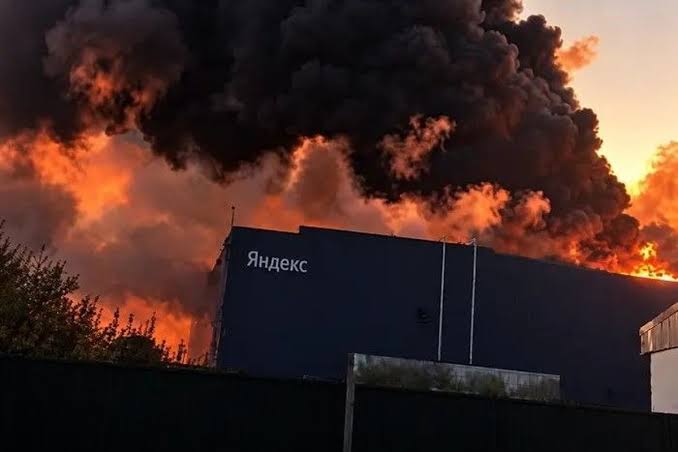
The October 8–11, 2026 strikes on Yandex data centers in Sasovo, the Kaluga region, and the Vladimir region created a unique opportunity to assess the extent to which Russian influence operations abroad may depend on centralized digital and computing infrastructure. Following the attacks, a sharp decline was recorded in automated traffic associated with the Yandex network, coinciding with reports of reduced activity among certain political networks on social media in the United States and Europe.
This correlation alone does not prove that the damaged data centers were directly managing Russian bot farms. It does, however, raise a more consequential question: Has Russia’s civilian technological infrastructure become a component of the state-run system for interfering in foreign elections?
From “Troll Factories” to a State Digital Ecosystem
Russian interference in U.S. and European elections is a documented practice. U.S. law enforcement agencies have established that Kremlin-linked companies, fake media outlets, fictitious accounts, covert advertising and AI-generated content have been used to influence political debate and voter behavior.
One illustrative example is Operation Doppelganger. In September 2024, the U.S. Department of Justice seized 32 domains used in a Russian influence operation. The U.S. investigation linked the campaign to the Social Design Agency, Structura National Technology and ANO Dialog, while tying its coordination to officials in the Russian presidential administration, including Sergei Kiriyenko. Operators created websites impersonating Western news organizations, deployed fake accounts and posed as Americans. Their objective was to promote Russian narratives, erode support for Ukraine and influence U.S. political debate.
Another case demonstrates Russia’s transition toward the use of artificial intelligence. In July 2024, U.S. law enforcement disrupted a Russian network of 968 fictitious social media accounts created and managed using a specialized AI system. The profiles impersonated real users, including U.S. citizens, and disseminated messages aligned with the interests of the Russian government.
Generative AI, therefore, has already become a practical instrument of Russian influence operations rather than merely a potential future threat.
Storm-1516: Scaling Up Election Interference
The next stage has been the development of an international influence network capable of targeting several national audiences simultaneously.
According to the European External Action Service (EEAS), the Russia-linked Storm-1516 network, also known as CopyCop or False Facade, operated 453 websites in 2025 targeting American, German, French, Moldovan and international audiences. Individual pieces of content generated as many as four million views.
The system relied on fabricated news outlets, clones of legitimate media organizations, social networks, influencers, fake accounts, and synthetic video, audio and imagery.
A defining feature of the Russian model is its ability to adapt propaganda to the domestic vulnerabilities of individual countries.
In the United States, these themes include immigration, spending on assistance to Ukraine, economic problems, isolationism and distrust of federal institutions. In Germany, they include migration, energy policy, the cost of supporting Ukraine and criticism of the federal government. In France, Russian influence campaigns can exploit social inequality, protest sentiment and disagreements over the country’s role in European security.
Moscow’s objective, therefore, is not necessarily to persuade voters to support Russia. It is considerably more effective to amplify existing domestic conflicts and steer them in a direction politically advantageous to the Kremlin.
Russia Does Not Create Political Movements — It Exploits Their Narratives
Russian information activity surrounding MAGA, AfD, isolationist, radical-right, conservative and other protest constituencies should be assessed in this context.
The fact that the positions of a political party or its voters overlap with Russian narratives does not prove that Moscow controls the movement. Nor should genuine supporters of political parties be equated with bots or coordinated inauthentic networks.
The Russian model operates differently. Its operators identify existing social and political divisions and use fake accounts, artificial amplification, fabricated media outlets and synthetic content to create the appearance of much broader public support for particular narratives.
U.S. investigations have already established that Russian operators posed as American citizens while attempting to conceal the foreign origin of political messaging.
The objective, therefore, is not so much to “create a pro-Russian voter” as to reshape the information environment in which voters make their decisions.
The Kremlin’s Strategic Objectives
Russian election interference serves several interconnected objectives.
First, Moscow seeks to weaken support for Ukraine. Assistance to Kyiv is portrayed as an excessive burden on taxpayers, a cause of domestic economic difficulties, or an example of elite policies allegedly running counter to the interests of ordinary voters.
The second objective is social polarization. Russian operators do not necessarily have to support only one side of the political spectrum. They can simultaneously amplify opposing radical positions if doing so increases confrontation and distrust among different segments of society.
The third objective is to undermine confidence in elections. Narratives alleging electoral fraud, illegitimate results, corrupt elites and the inability of state institutions to guarantee fair elections may prove more effective than directly supporting a particular candidate.
The fourth objective is to weaken transatlantic unity. Moscow has an interest in raising the domestic political cost of supporting Ukraine, maintaining sanctions against Russia and honoring NATO defense commitments.
The ultimate objective of such an operation may therefore be not the victory of a particular candidate, but the emergence of a parliament, administration or political environment in which pursuing a tougher policy toward Russia becomes politically more difficult.
Where Yandex May Fit Into This System
The significance of the October 8–11 attacks should be viewed in this context.
Yandex possesses high-performance computing systems, proprietary AI models and cloud infrastructure. The damaged supercomputers were used to train neural networks and process large volumes of data.
Technologically, such infrastructure is capable of providing components required for modern influence operations: generating text and multimedia content, automated translation, adapting messages for different linguistic audiences, analyzing user reactions and automating publication.
At the same time, the Russian state has documented mechanisms for obtaining access to certain Yandex services. The FSB has demanded access to data from Yandex Mail and Yandex Disk; Russian legislation imposes obligations on technology companies to retain and provide information to the security services; and following the 2024 restructuring, Yandex’s Russian business came entirely under the control of Russian owners.
This potentially makes Yandex infrastructure an important component of Russia’s broader state digital ecosystem.
However, there is currently no public evidence that the damaged Lyapunov, Chervonenkis and Galushkin supercomputers directly supported FSB, SVR or GRU operations aimed at interfering in U.S. or EU elections.
What the Post-Attack Disruption Revealed
Following the strikes, a sharp decline was recorded in automated traffic originating from the Yandex network. Reports suggested a decline of approximately 94 percent, falling close to zero during certain periods.
This demonstrates the scale of the disruption to automated infrastructure but does not constitute direct evidence that Russian political bot farms were paralyzed. A substantial portion of the Cloudflare traffic being measured was associated with YandexBot, the company’s legitimate search-engine crawler.
Similarly, reports of a 94 percent decline in activity supporting MAGA and a 56 percent decline in activity supporting AfD have yet to receive sufficient independent verification.
The timing of the disruption nevertheless creates an important intelligence opportunity.
If accounts previously and independently attributed by U.S. or EU authorities to Russian operators ceased activity simultaneously with the failure of Russian infrastructure, and subsequently resumed operations in synchronization with the restoration of those services, that would provide significantly stronger evidence of a technological connection.
A New Generation of Election Interference
The October attacks highlight a broader transformation in Russian influence operations.
The model associated with Yevgeny Prigozhin’s Internet Research Agency relied on thousands of human operators manually producing posts and comments. Generative AI potentially allows this model to be scaled dramatically: a single operator can manage large numbers of synthetic personas, automatically produce content in multiple languages and adapt messages to rapidly changing political developments.
Such a system could consist of several layers: Russian state structures → technology contractors → cloud and AI computing capacity → fake media outlets and accounts → social media platforms → real users.
This architecture makes attribution considerably more difficult. A voter may encounter a message posted by an account appearing to belong to an American farmer, a German worker or a French activist, even though the content may have been generated by an automated system and the campaign coordinated from another country.
Modern Russian election interference therefore increasingly differs from traditional propaganda. Its purpose is to imitate organic domestic political debate.
The strikes on Yandex data centers do not yet prove that the company served as a command center for Russian election-interference operations. They have, however, created an opportunity to test a considerably more important hypothesis: whether Russian state influence operations have become integrated into the country’s civilian cloud-computing and AI infrastructure.
The evidence for Russian interference in Western electoral processes is considerably stronger. U.S. investigations and EEAS reporting document the use of fabricated media outlets, fictitious American personas, bot networks, AI-generated content and large-scale digital infrastructure to covertly influence political debate in the United States and Europe.
Moscow’s strategic objective is not necessarily the direct promotion of a particular political party. Russia seeks to shape the political environment in which elections take place — intensifying polarization, undermining confidence in institutions, weakening support for Ukraine and increasing the electoral cost of confrontation with Moscow.
The key question following the October 8–11 attacks is therefore whether a technical connection can be established between networks already attributed to Russia — including Doppelganger and Storm-1516 — and the damaged digital infrastructure.
If such a connection is established, it would point to a qualitative transformation in the Russian model of election interference: from isolated “troll factories” to a state digital ecosystem in which civilian cloud services, artificial intelligence, intelligence-service contractors and networks of fake accounts can function as components of an integrated mechanism for influencing foreign elections.