
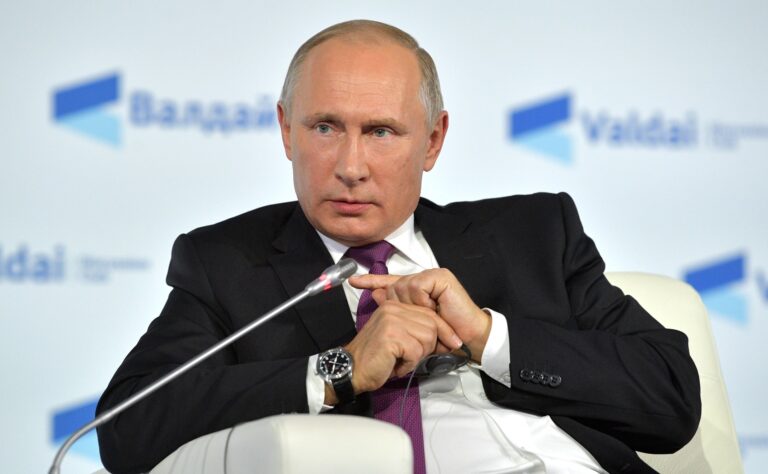
Vladimir Putin’s speech at the Valdai Club meeting on October 1, 2026, is important less for the novelty of Russia’s demands than for the moment at which they were formulated. It came after an intensification of U.S.-Russian contacts: Donald Trump’s special envoys Steve Witkoff and Jared Kushner met with Putin in Moscow, while Russian negotiator Kirill Dmitriev held talks in Washington in late September on ending the war and possible U.S.-Russian energy projects after it ends. In parallel, Trump and Volodymyr Zelensky discussed a possible mutual halt to strikes on energy infrastructure.
Valdai should therefore be viewed as a public formulation of Russia’s negotiating position ahead of the next stage of Trump’s diplomacy. Putin did not reject the U.S. peace proposals and said they contained decisions that would be difficult for Russia as well. At the same time, he showed no readiness to abandon Moscow’s fundamental political objectives regarding Ukraine.
The main signal to Washington can be formulated as follows: Moscow is prepared to bargain over the mechanism for ending the war, but so far it has shown no readiness to abandon its attempt to shape Ukraine’s postwar strategic status.
Putin is not closing Trump’s peace track. On the contrary, the very reference to “difficult decisions” for Russia is significant. It leaves political space for compromise and allows the Kremlin to portray possible concessions not as a retreat, but as part of a broader agreement with the United States. At the same time, Putin said he was ready to meet with Trump and Xi Jinping provided that the agenda was agreed in advance.
But the Kremlin is trying to shift the negotiations from a formula of “ending the war” to one of “agreeing on a new security system.” Putin again named Ukraine’s neutral status as one of Russia’s objectives. This means Moscow wants to discuss not only a ceasefire, the front line, or territorial exchanges, but also Ukraine’s future military and political status.
Valdai compounds the problem for Trump’s step-by-step diplomacy. In recent weeks, Washington has explored the possibility of limited arrangements, primarily concerning energy infrastructure and the Black Sea. Zelensky said he was ready for a reciprocal energy ceasefire, while Secretary of State Marco Rubio spoke of both sides’ interest in a limited ceasefire covering energy and grain exports. Putin, however, rejected at Valdai the idea of halting Russian strikes on Ukrainian targets in the Black Sea region.
Nuclear rhetoric concerning Kaliningrad is a parallel negotiating signal to the United States. Putin said that in the event of a direct attack on Russian territory, the question of using all available means, including nuclear weapons, would “inevitably” arise. This broadens the negotiating framework: Moscow is effectively reminding the Trump administration that it portrays the alternative to an agreement not simply as a continuation of the war in Ukraine, but as a more dangerous Russia-NATO escalation.
The Kremlin appears to be trying to use Trump’s desire for a deal as leverage while simultaneously leaving him room to claim a diplomatic result. This may explain the combination of hard strategic demands with the conspicuous acknowledgment that compromise would require “difficult decisions” from Russia as well.
Putin Has Effectively Responded to Trump’s Peace Strategy
Recent U.S. moves make it possible to reconstruct Washington’s approximate logic.
Rather than trying to negotiate a comprehensive peace immediately, the Trump administration appears to be testing a phased model of de-escalation: energy ceasefire → Black Sea arrangement → broader ceasefire → political negotiations → postwar economic agreements.
Elements of such a model already exist. After meeting Trump, Zelensky said Ukraine was ready for any format of reciprocal cessation of strikes on energy infrastructure. Rubio reported interest among the parties in a limited ceasefire covering energy and grain. At the same time, Dmitriev discussed in Washington not only a peace settlement but also potential U.S.-Russian energy projects after the war.
Putin’s Valdai position partly conflicts with this structure.
Moscow is effectively saying that local arrangements are possible only insofar as they lead to discussion of Russia’s fundamental demands.
The biggest problem for Trump’s peace efforts is therefore the difference between Washington’s ceasefire diplomacy and Moscow’s strategic settlement diplomacy.
Trump is trying to stop the fighting and use a ceasefire as the basis for subsequent negotiations.
Putin seeks guarantees regarding the postwar order before Russia loses its main instrument of pressure — the continuation of hostilities.
Ukraine’s Neutrality Remains the Central Problem
The most important element for U.S. diplomacy is not the nuclear portion of the speech, but Putin’s repetition of the demand for Ukraine’s neutral status.
Putin stated directly that neutrality remains among Russia’s objectives.
This fundamentally changes the nature of possible negotiations.
If territory were the only central dispute, a potential agreement could theoretically be built around the de facto line of control, a ceasefire regime, demilitarized zones, and a deferred resolution of sovereignty questions.
The demand for neutrality, however, concerns Ukraine’s sovereign right to determine its own foreign and defense policy.
The Trump administration therefore has to deal with at least three distinct packages: territory — security — Ukraine’s geopolitical orientation.
The third package may prove the most difficult.
Putin Is Also Raising the Cost of Negotiating Failure
The Valdai speech contained another important element — a demonstrative reminder of the possibility of uncontrolled escalation.
Putin warned of approaching a “point of no return” and separately raised the possibility of using Russia’s entire arsenal in the event of a direct attack on Kaliningrad or other Russian territory.
This rhetoric should not automatically be interpreted as an intention to use nuclear weapons. NATO, by contrast, responded publicly with restraint: Mark Rutte said the assessment of the immediate threat to Alliance territory had not changed.
But in the negotiating context, it serves another function.
Moscow is increasing the perceived cost of diplomatic failure for Washington.
The logic of the signal may be as follows: if Trump’s diplomacy fails, the next phase may be not simply another year of war, but a potential expansion of escalation between Russia and NATO.
For a U.S. president who seeks to present himself as a mediator capable of ending wars, this creates an additional political incentive to continue negotiations.
But Trump Is Also Gaining Additional Leverage
The Valdai speech contained an indication pointing in the opposite direction.
Putin acknowledged that Ukrainian strikes on Russian oil refineries had produced results and, by his estimate, had cost Russia about 1% of GDP.
This is an important acknowledgment.
It means that the energy war is imposing tangible economic costs on the Kremlin. At the same time, it creates problems for Trump himself: the wars in Ukraine and Iran, refining disruptions, and Russian restrictions on diesel exports are contributing to pressure on the global fuel market.
An energy ceasefire may therefore be a potential point of intersection among the interests of Moscow, Kyiv, and Washington, although the parties’ conditions remain different.
For Ukraine, it would reduce the threat to the energy system ahead of winter.
For Russia, it would protect refineries and fuel infrastructure.
For Trump, it would reduce one source of pressure on global fuel prices.
This is why the energy track may remain the most realistic initial element of U.S. diplomacy.
An Economic Deal Is Becoming Part of the Peace Architecture
Dmitriev’s talks in Washington are particularly revealing.
According to Reuters, he met with representatives of the U.S. Treasury and Department of Energy, and the subjects discussed included possible U.S.-Russian energy initiatives after the end of the war.
This means the negotiations may already include positive incentives, rather than sanctions relief alone.
A possible structure may be emerging: ceasefire → political settlement → partial sanctions relief → economic normalization → U.S.-Russian energy projects.
At Valdai, Putin additionally said that, under a favorable scenario, Western companies might in the future recover assets transferred to Russian control.
This can also be read as a signal that the Kremlin continues to view economic normalization as part of a potential broader agreement with the West.
The Main Risk for Trump: Negotiations Could Become a Tool for Managing the War Rather Than Ending It
This is where the main dividing line lies between two possible interpretations of the Valdai speech.
The first, more optimistic interpretation is that Putin is preparing the Russian public for compromise and is therefore stating unusually explicitly that the U.S. proposals would require “difficult decisions” from Russia as well.
The second is that the Kremlin seeks to preserve the negotiating process without abandoning continued military pressure.
The available facts currently support consideration of both possibilities but do not conclusively establish either one.
It is notable that only days before Valdai, the negotiating signals were similarly contradictory: Rubio reported interest in a limited ceasefire, while Lavrov publicly argued that Europe wanted a pause only to rearm Ukraine.
Moscow may therefore be trying to pursue two policies simultaneously: negotiations with the United States + continued military pressure on Ukraine.
For the Trump administration, this creates the risk that a diplomatic process will continue to exist without generating sufficient incentives for a transition to a general ceasefire.
What Valdai Changes for Trump’s Policy
After Putin’s speech, the U.S. administration has a clearer picture of the limits of Russia’s current position.
Washington will have to address not one but two distinct tasks: stop the fighting, and determine which questions concerning Ukraine’s postwar status can legitimately be subjects of negotiation with Russia and which should remain decisions for Ukraine itself and its partners.
If these two levels are not separated, the negotiations may become trapped in a vicious circle: Moscow will demand strategic guarantees before a ceasefire, while Kyiv will demand security guarantees before accepting political compromises.
The most revealing next indicator will therefore be not another Trump-Putin meeting, but Moscow’s response to specific limited arrangements — an energy ceasefire and a Black Sea ceasefire.
If Russia agrees to a verifiable reciprocal halt to strikes, it would indicate that the negotiating channel is capable of producing practical results.
If Moscow continues to link even a limited ceasefire to resolving questions of Ukrainian neutrality, NATO, sanctions, and the broader European security architecture, it would indicate that the Kremlin sees Trump’s negotiations primarily as a path toward a major geopolitical agreement with the United States rather than as a separate mechanism for ending the war.
The Valdai speech does not appear to amount to Putin rejecting Trump’s peace efforts. The Kremlin demonstratively kept the U.S. channel open and acknowledged the possibility of decisions that would be difficult for Russia. At the same time, Putin showed that Moscow seeks a negotiating agenda considerably broader than a simple ceasefire.
For Trump’s policy, this means moving from the question of “how to stop the shooting” to the far more difficult question of “what security order should emerge afterward.”
This is where the parties’ interests diverge most sharply.
The Trump administration has a political incentive to obtain a visible and rapid result — a halt to strikes, a ceasefire, or another measurable step. Judging by the Valdai speech, the Kremlin is trying to use the U.S. desire for a deal to place Ukraine’s neutrality, Russia-NATO relations, sanctions, and future economic normalization on the negotiating table.
Valdai therefore does not close Trump’s diplomatic window, but raises the price of success. Putin is effectively signaling that he is prepared to discuss peace, but wants the outcome of the negotiations to be not merely an end to the war, but a partial reshaping of the European security order on terms acceptable to Moscow.
The most important KIQ now is: is the Kremlin prepared to agree to a limited, verifiable ceasefire without Washington and Kyiv first accepting Russia’s demands regarding Ukrainian neutrality? The answer will largely determine whether Trump’s peace efforts develop into a genuine mechanism of de-escalation or remain a negotiating channel operating in parallel with the continuation of the war.