
The paradox of Russia’s current political system is that the measures intended to guarantee Vladimir Putin’s personal security — continuing the war, eliminating alternative centers of power, repression, militarizing the state, and refusing to establish a clear succession model — may simultaneously increase the long-term vulnerability of the regime he has built.
In August 2026, The Economist, citing a source inside the Russian system, reported that at some point during the war Putin allegedly told members of his inner circle: “They will hang me.”
If the report is accurate, it points to a critically important problem: for Putin, the outcome of the war may now be connected not only to geopolitics or his political legacy, but also to the question of his personal security after the loss of absolute power.
This can create a dangerous trap: fear of losing power → inability to end the war without a “victory” → escalation → rising economic and social costs → elite dissatisfaction → intensified repression → even greater dependence on the security apparatus → still greater fear of losing power.
Gaddafi: A Documented Fear of the Violent Collapse of a Regime
If one looks for a historical figure whose fate demonstrably made a strong impression on Putin, it is more likely Muammar Gaddafi.
After Gaddafi’s death in 2011, Putin repeatedly returned to the subject.
In December 2011, he expressed outrage that the world had been shown Gaddafi’s bloody killing and accused Western states of creating the conditions for his elimination through their intervention. Earlier that April, Putin had publicly asked who had given other states the right effectively to decide the Libyan leader’s fate without a trial.
He later repeatedly used Libya as evidence for his argument about the dangers of Western regime-change policy. At the 2016 Valdai forum, Putin again linked the destruction of Libyan statehood to Western military intervention.
The underlying pattern is the same: a powerful personalist leader → loss of control over the system → defection by part of the elite/security apparatus → rapid regime disintegration → the former ruler’s physical vulnerability.
It is the final link in this chain that is particularly important.
Putin Has Built a System That Is Increasingly Difficult for Him to Leave
A personalist regime has a fundamental problem: the longer a leader remains in power, the more difficult it becomes to guarantee his security after transferring that power.
For Putin, this problem is particularly acute.
The 2020 constitutional reform created a legal path for Putin to remain president until 2036. At the same time, the system became even more personalist.
A 2026 OSW study describes the Russian system as one in which real power rests to a considerable extent not on formal institutions, but on personal ties to Putin and competition among patron-client groups for access to the president.
This means Putin does not merely head the system.
He is its principal arbiter.
This is where the trap emerges.
To prepare a controlled succession, he would need to create a successor strong enough to command the system.
But a sufficiently strong successor automatically becomes a potential alternative center of power.
Thus, what protects Putin today — the absence of an obvious successor — may make the system considerably more dangerous for him tomorrow.
OSW explicitly highlights this dilemma: the Kremlin needs to prepare a succession in order to preserve the system, but strengthening a successor too early could create the risk of an internal coup.
The War Has Sharply Raised the Cost of Losing Power
Before 2022, it was theoretically possible to imagine a model of controlled transition.
For example: Putin → chosen successor → security guarantees → retention of some influence → immunity for his family and closest associates.
After nearly five years of full-scale war, implementing such a scenario has become considerably more difficult.
The war has created a vast array of new interests, conflicts, redistributed assets, and groups whose security is tied to the continuation of the existing system.
OSW notes the intensification of repression, ideological control, redistribution of property, and elite dependence on the Kremlin since 2022.
At the same time, Chatham House notes growing tensions between the Kremlin and parts of the political and economic elite, while stressing that there are currently no signs of an imminent regime collapse.
This is an important caveat.
This is not a forecast of Putin’s fall, but an assessment of accumulating structural risks.
The “Victory Trap”
If the report about the phrase “They will hang me” accurately reflects Putin’s logic, the war ceases to be an ordinary foreign-policy campaign.
It becomes a mechanism for legitimizing the regime.
The problem is that after years of propaganda, it is becoming increasingly difficult for the Kremlin to define what would constitute a sufficient victory.
If the war ends without an outcome that can convincingly be sold to the elite and the public as a victory, an unavoidable question arises: what were the years of war, mobilization, sanctions, losses, repression, and deterioration of relations with the West for?
This is the problem described by The Economist: according to the publication’s sources, dissatisfaction among parts of the Russian elite is growing not only over economic problems, but also over the amount of time spent on a war with no obvious end.
Putin therefore needs more than simply an end to the war.
He needs a politically usable explanation for how it ends.
Why the Kremlin May View Compromise as More Dangerous Than Continuing the War
This helps explain one of the central contradictions in Russia’s negotiating behavior.
Economically, ending the war could benefit Russia.
Politically, not necessarily.
If a compromise is perceived by the elite as a defeat, it could weaken a central proposition of the Putin system:
Putin guarantees stability because Putin always controls the situation.
This is why the Kremlin needs an agreement that can be presented not as a compromise with Ukraine, but as a Russian victory in its strategic confrontation with the West.
This helps explain why, at Valdai on October 1, Putin simultaneously kept the negotiating channel with Donald Trump open while maintaining hard-line rhetoric toward NATO and Kaliningrad. He even warned of the possible use of Russia’s entire arsenal in the event of a direct attack on Russian territory.
This does not prove that personal fear determines his decisions. But such behavior is consistent with a regime logic in which compromise must be packaged as victory.
The More Putin Fears Weakness, the More He Creates the Conditions for Future Weakness
This is the central paradox.
To reduce threats to the regime, the Kremlin relies on repression, censorship, nationalization, control over the elite, the security services, militarization, and the elimination of autonomous political centers.
In the short term, this works.
In its September 2026 Russia Stability Tracker, CNAS likewise assesses Putin as retaining firm control over the system. At the same time, it records deterioration across several pillars of regime stability: economic well-being, elite cohesion, information control and, in its assessment, the reliability of the security apparatus.
What is especially important is that these problems are beginning to interact.
Economic stagnation by itself is not necessarily dangerous.
Elite dissatisfaction by itself is not necessarily dangerous either.
Nor are Ukrainian strikes on Russian territory by themselves.
But economic difficulties + a prolonged war + the absence of an obvious victory + elite competition for resources + repression create a qualitatively different environment.
Repression Solves the Problem of Disloyalty – but Creates an Information Problem
The more severely Putin punishes dissent, the fewer people are willing to give him unwelcome information.
This is a classic problem of personalist regimes.
OSW describes an increasing requirement for Russian officials to demonstrate not merely loyalty but public adherence to a pro-war and anti-Western ideology.
The result is a system in which it is safer for one’s career to say “the situation is under control” than “the strategy is not working.”
This increases the risk of strategic mistakes.
And every new mistake may require another round of repression to conceal the consequences of the previous one.
The Most Dangerous Moment for the Regime May Be the Transition From War to Peace
This may be crucial to understanding Putin’s behavior.
During wartime, the system has a clear structure: there is an external enemy → mobilization is necessary → criticism is equated with disloyalty → Putin is indispensable as the supreme arbiter.
Peace dismantles part of this structure.
Once the war ends, a series of questions inevitably emerges:
What was achieved?
Who is responsible for the mistakes?
Who will receive the reduced military budgets?
What should be done with the veterans?
How should assets be redistributed?
Will wartime windfall profits remain?
Is the same level of repression still necessary?
And finally: does the system still need Putin in the same role?
Paradoxically, therefore, a successful end to the war could create a different type of risk for a personalist regime than continuing it.
Prigozhin Showed How Quickly Perceptions of Power Can Change
Yevgeny Prigozhin’s 2023 mutiny remains an important precedent.
It demonstrated how quickly an ostensibly monolithic system can face an internal armed challenge.
CFR notes that the Kremlin restored control after the mutiny, but internal elite politics remain opaque, while the war continues to generate economic pressure and increase the potential for struggles within the system.
This is an important lesson for Putin himself: the most dangerous threat may arise not from the street, but from within the coercive system he created.
This Is Where the “Mussolini Syndrome” Becomes Relevant
Not as a literal historical analogy, but as a model.
Mussolini did not lose power through ordinary elections. In July 1943, part of his own Fascist leadership turned against him, after which the king ordered his arrest. Two years later, when the final collapse of the regime had become evident, he was captured and executed by partisans.
For a personalist ruler, the lesson of this history is simple: while a regime is strong, the elite remains loyal; once the elite concludes that the leader can no longer guarantee its survival, loyalty can change very quickly.
This is why an autocrat’s personal security depends not only on the regime’s capacity for repression, but on continuously persuading the elite that the alternative to the leader is more dangerous than keeping him.
Putin’s Policy Creates a Fundamental Contradiction
He seeks to convince the elite: without me, the system will collapse.
But the longer such a model exists, the more this proposition becomes true.
There are no strong independent institutions. There is no transparent succession mechanism.
There is no universally recognized number two. There is no independent arbiter between the security and economic factions.
OSW notes that Putin deliberately prevents any single group or individual from becoming too powerful, preserving his own position as the ultimate arbiter.
This is an extremely effective model for retaining power.
But it is potentially a very dangerous model for transferring power.
Putin May Be Creating the Very Scenario He Is Trying to Avoid
This produces the final paradox.
Fear of weakness drives repression.
Repression destroys mechanisms for correcting policy.
The absence of correction increases the likelihood of strategic mistakes.
Mistakes increase the perceived need for external conflict and mobilization.
War increases economic and social costs.
Those costs increase the elite’s dependence on state resources while simultaneously intensifying competition for them.
Intensifying competition pushes Putin to centralize the system still further.
And an over-centralized system becomes increasingly dependent on a single individual.
In September 2026, RUSI described Russia’s current condition as one of “high stress and increased vulnerability,” while explicitly cautioning that this assessment was not a prediction of regime collapse.
This distinction is important.
Vulnerability ≠ inevitable collapse.
The Most Dangerous Combination for the Kremlin
Taken separately, economic stagnation, military failure, elite conflict, or public dissatisfaction may all be manageable. The Russian system has already demonstrated a considerable capacity to absorb such shocks.
Far more dangerous would be their synchronization: an unfavorable end to the war → destruction of the victory narrative → elite struggles over responsibility and resources → doubts within the security apparatus → emergence of an alternative center → a sharp decline in the perception of Putin as the guarantor of stability.
CNAS identifies precisely such a convergence of multiple crises as a factor capable of increasing instability in long-lived authoritarian systems.
But at present, the key elements of this sequence have not occurred simultaneously.
The principal threat to Putin’s system may therefore not be that Putin will “end up like Mussolini.”
The more important conclusion is this: in seeking to minimize the risk of losing power, Putin has built a system in which the transfer of power itself is becoming increasingly dangerous.
If the report that he said “They will hang me” is accurate, it captures this dilemma remarkably well. But the structural problem exists even without the quotation.
Putin cannot easily lose the war because doing so could undermine his image as the guarantor of strength.
It is difficult for him to accept a compromise if it cannot be presented as a victory.
It is risky for him to designate a strong successor because that successor would become an alternative center of power.
It is difficult for him to significantly relax repression because doing so would create space for accumulated discontent.
At the same time, continuing the war increases economic, social, and elite costs.
This creates what can be called the self-preservation trap of a personalist regime: every decision that makes Putin’s rule safer today potentially reduces the number of safe options available tomorrow.
The key indicator of regime resilience is therefore not only the condition of the Russian economy or the situation on the battlefield. It is more important to watch for the moment when the basic equation among key elites changes from “Putin guarantees our security” to “Putin poses a greater risk to us than a system without him.”
Such a shift in perception, if it were ever to occur simultaneously among parts of the political, economic, and security elite, would be a far more important indicator of regime danger than public dissatisfaction or economic decline alone. Current assessments still describe the regime as resilient, albeit under growing multidimensional pressure.
Thus, Putin’s regime is unlikely to fall because of any single factor — an economic crisis, a military defeat, or protests. As of autumn 2026, researchers at Carnegie and Chatham House emphasize that the system remains capable of enforcing elite loyalty and that dissatisfaction by itself does not indicate an imminent collapse.
The most dangerous development for the system would be the simultaneous convergence of several crises, after which part of the security and political leadership ceased to regard Putin as the guarantor of its own survival.
Critical scenario: the war ends with an outcome that is difficult to present as a victory → the main justification for the costs already incurred collapses → economic and budgetary conflict intensifies → elites begin looking for those responsible and protecting their own assets → an alternative center of power emerges → part of the security apparatus adopts a neutral position or shifts toward that center → the belief that Putin controls the situation disappears →
The final three stages would be the most dangerous.
Military Failure Alone Would Not Bring Down the Regime
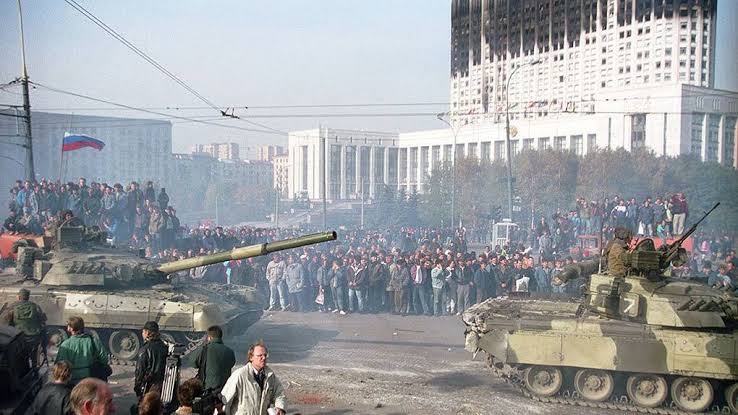
The Russian system has already survived the withdrawal from the Kyiv region, the loss of Kherson, mobilization, the sanctions shock, and Prigozhin’s mutiny.
Even a serious military setback therefore does not automatically mean the fall of the government.
The danger would arise if a military outcome destroyed the Kremlin’s ability to portray the war as successful.
Putin faces a particular problem here. Carnegie noted in June 2026 that despite economic difficulties, a battlefield stalemate, and internal tensions, his public position showed no readiness to soften his strategic demands.
The Critical Factor Would Be the Reaction of the Elite, Not the Public
This is a fundamental distinction.
For a personalist system, the dangerous moment comes when the ruling coalition changes the question from “What will happen to me if I turn against Putin?” to “What will happen to me if I remain with Putin?”
As long as the first question is more frightening, the regime remains stable.
Chatham House shows that the current model is still functioning: elites are becoming increasingly dependent on the Kremlin, even as the war simultaneously increases their costs, property confiscations, and risk of criminal prosecution.
But this changes the old bargain.
Previously it looked roughly like this: loyalty → money + property + security.
Now, increasingly: loyalty → the possibility of temporarily retaining one’s position.
This is a less stable arrangement.
A Conflict Within the Security Apparatus Would Be Especially Dangerous
Oligarchs are unlikely to remove Putin on their own.
Nor are technocrats.
Carnegie shows how much Russia’s civilian elite has lost political agency: it is effective at adapting the system to crises but has little ability to change its strategic course.
The decisive indicator would therefore be the behavior of the FSB, the National Guard, the presidential security apparatus, the military command, and other coercive networks.
The danger for the regime is not necessarily that all of them would turn against the president.
A different phenomenon could be sufficient: part of the security apparatus stops carrying out orders against another part of the elite.
Fear of the Kremlin would then fall sharply.
An Alternative Center of Power Would Be Necessary
A dissatisfied elite is not yet a conspiracy.
In 2026, Carnegie explicitly cautioned against interpreting public disputes within the Russian leadership as evidence of an imminent collapse.
A genuine regime crisis requires a focal point for coordination.
This does not necessarily have to be a single individual. In theory, it could be a coalition of elements of the security establishment, administrative elite, and major economic actors.
As long as every potential opponent of Putin believes that the others will remain loyal, moving against him is extraordinarily dangerous.
But if a belief emerges that “others are also prepared to switch sides,”
a cascade could begin.
This is why personalist regimes can sometimes appear stable almost until the moment an acute internal crisis begins.
The Succession Question May Be the Most Dangerous
Putin has created a fundamental problem.
Carnegie describes the Russian system as one in which the elite has lost much of its autonomy and capacity to formulate an alternative strategic course. The author warns that after Putin’s departure this could produce a deficit of political agency and a struggle among elite groups for control of the system.
In other words, Putin stabilized the system around himself at the cost of reducing its ability to function without him.
This is one of its greatest long-term vulnerabilities.
An Economic Crisis Would Be a Catalyst, Not the Cause
Even a severe economic downturn does not necessarily bring down an authoritarian regime.
The greater danger arises when there are insufficient resources to sustain the ruling coalition.
The Kremlin must then choose: military spending or social spending; the regions or the federal center; the civilian economy or the defense-industrial complex; business or the security services; one elite faction or another.
Chatham House already records growing pressure of precisely this kind: the war is increasing the burden on business and the political elite, while loyalty increasingly fails to guarantee protection from confiscation or prosecution.
The Most Dangerous Scenario for Putin
military-political failure → inability to present the outcome as a victory → economic conflict over the distribution of shrinking resources → elite fragmentation → emergence of an alternative center → neutrality by part of the security apparatus → loss of Putin’s reputation as the ultimate arbiter.
The shift of the security apparatus from unconditional loyalty to neutrality is the most important indicator of a qualitative regime crisis.
This is where the Mussolini analogy returns. It is useful not because Putin will necessarily repeat Mussolini’s fate. The Italian regime broke when military catastrophe changed the calculations of its own ruling elite: part of the Fascist leadership voted against Mussolini, and the king ordered his arrest.
The decisive factor, therefore, was not public dissatisfaction itself. The decisive moment came when people inside the regime concluded that keeping the leader posed a greater danger to the system than removing him.
For the Putin system, an analogous strategic indicator would not be a decline in approval ratings or even mass protests, but the emergence of a shared conviction among the security and political leadership: “Without Putin, we have a better chance of preserving the system and ourselves than we do with Putin.”
As of autumn 2026, available research does not indicate that Russia’s ruling elite has reached this point: coercion, dependence, and the absence of a coordinated alternative continue to work in the Kremlin’s favor.
But if that equation ever changes, a crisis could unfold far more rapidly than the system’s outward stability would suggest.
A sudden resource shock. It becomes politically dangerous not when living standards fall, but when the Kremlin lacks the resources to finance the war, the security apparatus, the regions, and the privileges of key groups simultaneously. Signs of such pressure already exist: military and security spending accounts for roughly 38 percent of the 2026 federal budget, the government has raised 471 billion rubles in “voluntary” contributions from Russia’s wealthiest citizens, and the deficit is estimated at about 3.2 percent of GDP. Reuters also reports that Russian energy revenues in 2026 have fallen by about 17 percent despite high oil prices.
A critical point would arise if the Kremlin had to decide whom it could no longer afford to pay for loyalty.
3. A split within the security apparatus. This is potentially the most dangerous trigger. The regime can survive protests, sanctions, and conflicts with business. It would be much harder to survive a situation in which the FSB, the National Guard, the military leadership, and the presidential security apparatus ceased to operate as a unified vertical. Carnegie notes that today’s Russian elite has largely been transformed from autonomous political actors into executors of the system; ordinary elite dissatisfaction is therefore insufficient to produce regime change.
The most dangerous development might not even be an open security-service conspiracy, but the neutrality of part of the coercive apparatus during an internal conflict.
A succession crisis. It could be more dangerous than an economic crisis. For decades, Putin has prevented the emergence of an obvious second center of power. This strengthens him today, but creates a problem when the transfer of authority eventually becomes unavoidable: different groups may begin competing simultaneously not against Putin, but for control of the system after him.
The Most Dangerous Scenario Is a Cascade
an unfavorable end to the war or a major military-political setback
This is fundamentally different from a scenario in which “people take to the streets and the regime falls.” In a personalist system, mass protests become most dangerous after a split has already appeared at the top, because the security services are then uncertain whom they should obey.
This is where what might be called a “Mussolini moment” can emerge: not necessarily a literal repetition of his fate, but a moment when people who supported the leader for decades decide that removing him is a way to save the system itself.
Intensifying repression does not necessarily bring such a moment closer — in the short term it may instead consolidate the regime. Chatham House notes that dependence and coercion still keep Russian elites in line even as the war makes their position increasingly costly and unpredictable.
The key question is therefore: Are there signs that key groups within the system are beginning to regard keeping Putin as more dangerous to their own future than his departure?As long as the answer remains no, even severe economic and military shocks may be absorbed by the regime. If the calculations of the security apparatus + bureaucracy + economic elite change simultaneously, however, an outwardly stable system could move into an acute crisis far faster than a linear reading of its economic indicators would suggest.
More on this story: Domestic political confrontation in Russia threatens Putin’s regime
More on this story: The Kremlin’s Mobilization Trap: Manpower Needs vs. Political Stability