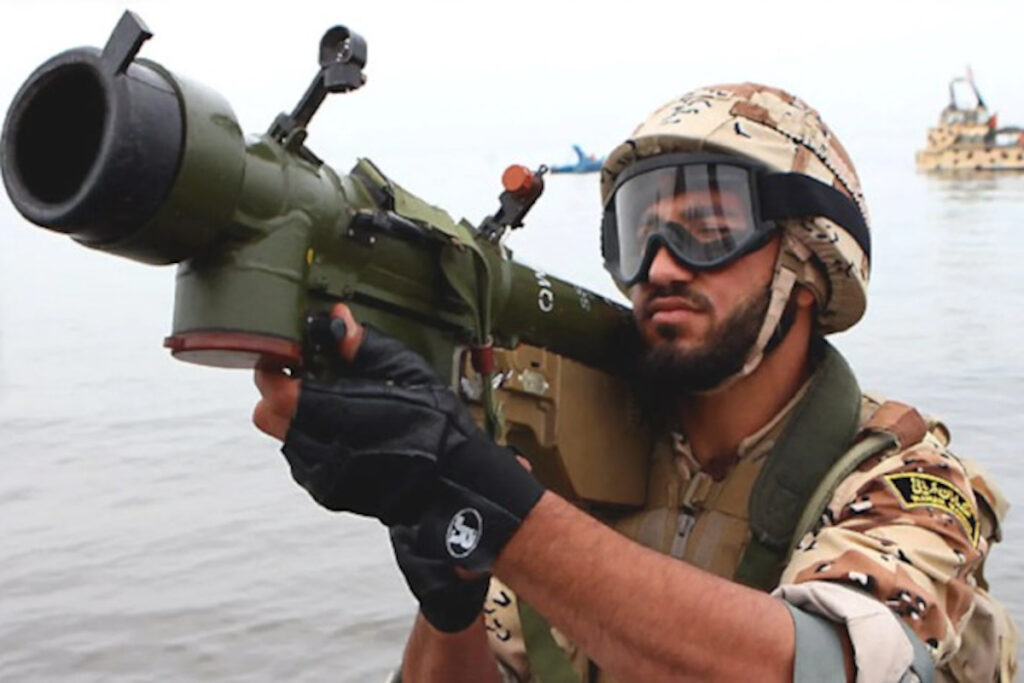

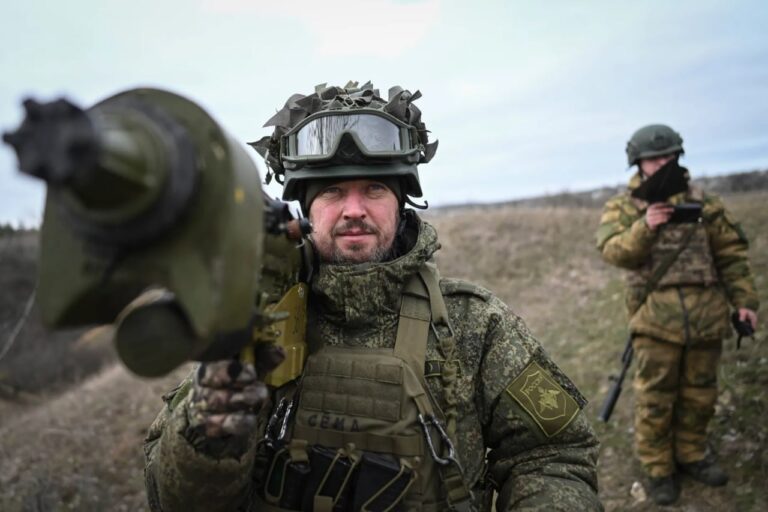
The appearance in a Russian state television report of an unidentified man-portable air-defense system (MANPADS) with an air-defense unit in Rostov Oblast deserves attention less because of the system’s characteristics than because of its possible origin. The system outwardly resembles the Chinese QW-18/QW-19 and is being used against Ukrainian UAVs; a Russian serviceman gives its range as approximately 4 km.
However, based on open-source information, it cannot yet be confirmed that China directly supplied Russia with complete QW-18/QW-19 systems. The War Zone also identifies a significant visual resemblance to China’s QW series, but allows for an Iranian origin, a Russian modification, or another transfer channel. Russian servicemen call the system ‘Iva.’
The origin of the system is therefore the key intelligence gap.
If it is established that the system or its missiles were supplied directly by the PRC, this would constitute a much more significant political signal: NATO has so far characterized Chinese assistance to Russia primarily as large-scale support for its defense-industrial base through dual-use goods and components.
If Russia has instead localized a Chinese design, the strategic significance could be even greater. This would imply not a one-off transfer of missiles, but the possibility of creating a cheap, mass-produced air-defense layer based on Chinese technology.
For the United States, the direct military threat posed by a single MANPADS of this type is limited. A much more serious potential threat is the emergence of a two-way mechanism — China technology → Russian combat adaptation → battlefield feedback → China — enabling both states to adapt weapons to modern warfare more rapidly.
What Has Actually Been Observed
Russian television showed a mobile air-defense group in Rostov Oblast. One serviceman was carrying a MANPADS that differs visibly from standard Russian Igla and Verba systems.
The systems display characteristic features of China’s QW series, although similar technological solutions are also found in Iran’s Misagh systems.
There are therefore at least four working hypotheses:
Why Russia Needs a Foreign MANPADS
The appearance of the ‘Verba’ in Rostov Oblast fits well with a structural problem facing Russian air defense.
Ukraine’s large-scale use of long-range UAVs forces Russia to protect a vast number of dispersed facilities — oil refineries, fuel depots, military airfields, warehouses, factories, logistics hubs, and command posts.
Using expensive missiles from larger air-defense systems against a significant share of these targets is economically inefficient.
Russia therefore needs a cheaper lower-tier layer: electronic warfare → mobile fire groups → machine guns/automatic cannon → MANPADS → more expensive air-defense systems.
This is precisely where Chinese technology could be useful.
There is also a more important indirect indicator. On October 1, Putin himself acknowledged that Ukrainian strikes on Russian oil refineries have an economic effect that he estimated at approximately 1% of GDP.
Moscow therefore has an obvious incentive to increase the density of inexpensive air defenses as rapidly as possible.
The Most Important Question Is Not the Missile, but the Technology
To assess the threat to the United States, it is necessary to establish exactly what China may have transferred to Russia.
There is a fundamental difference between: a complete missile → components → technical documentation → a license → a production line.
The first option is primarily tactical in significance.
The last two are strategic.
If Russia has acquired the ability to manufacture a QW-derived system independently, Moscow could scale production without requiring continuous deliveries of complete missiles from China.
This could also explain the absence of obvious Chinese factory markings noted by observers. Markings alone, however, do not prove localized production.
The MANPADS Appearance Coincides With Another, Far More Important Process
The incident should not be analyzed in isolation.
In 2026, additional evidence emerged of deepening Russian-Chinese military interaction.
In May, Reuters reported, citing three European intelligence services and documents, that around 200 Russian servicemen had undergone covert training in China. The training covered UAVs, electronic warfare, army aviation, armored infantry units, engineering, and counter-drone capabilities. Some Russian personnel subsequently returned to combat operations in Ukraine. China says it is neutral in the war.
At the same time, Chinese troops are currently participating in Russia’s Center-2026 exercises.
The exercises involve around 47,000 personnel, with a Chinese contingent among the participating foreign forces.
According to the Critical Threats Project, Chinese personnel have an opportunity to observe and practice Russian methods for employing FPV drones, ground robotics, electronic warfare, and small assault groups developed during the war in Ukraine.
This creates a potentially important cycle:
Chinese industrial base
↓
Russian battlefield requirements
↓
adaptation of Chinese technologies
↓
use in Ukraine
↓
battlefield feedback
↓
Russian-Chinese exercises
↓
the PLA gains experience from a type of war it has not itself fought for decades.
This cycle poses a much greater problem for the United States than the specific MANPADS itself.
Threat No. 1 to the United States: China Gains Russian Battlefield Experience
The People’s Liberation Army has no experience of a war on the scale of the Russia-Ukraine war.
Russia, by contrast, has accumulated extensive practical experience in:
drone warfare, electronic warfare, counter-UAS operations, air-defense adaptation, camouflage, logistics under constant UAV observation, and countering precision-guided weapons.
Reuters notes that Russian personnel have already trained in China, while Chinese personnel are traveling to Russia.
An increasingly complementary model is emerging.
China possesses large-scale industrial production and electronics capacity.
Russia possesses current battlefield experience.
The exchange of these respective advantages could reduce the time both states need to adapt to modern warfare.
Threat No. 2: Implications for a Potential Indo-Pacific Crisis
This is where the most direct long-term U.S. interest emerges.
In a future crisis over Taiwan, the United States and its allies could face not simply the Chinese military, but a PLA that has absorbed some Russian experience of fighting against Western weapons systems.
RUSI previously analyzed documents that, in the institute’s assessment, indicate Russian assistance to China in developing airborne capabilities, including equipment transfers, training, and potential technology localization. RUSI cautions that although much of the documentation appears authentic and some details have been verified, manipulation of parts of the material cannot be entirely ruled out.
Separately, in September ASPI highlighted the possibility that Russia’s Pacific Fleet could create additional problems for the United States and its allies in a potential conflict through submarines and threats to sea lines of communication, ports, and undersea infrastructure. This is an analytical scenario, not an established Moscow plan.
The strategic risk, therefore, lies in the mutual reinforcement of two military systems even without the creation of a formal Russian-Chinese military alliance.
Threat No. 3: Russia Could Acquire a Cheaper and Deeper Counter-Drone Shield
For the United States, this also has a European dimension.
If Chinese industry helps Russia scale inexpensive air-defense and counter-UAS capabilities, Russia could increase protection for military factories and oil refineries, free more expensive air-defense systems for strategic facilities, improve the resilience of rear-area infrastructure, and reduce the effectiveness of Ukraine’s long-range UAV campaign.
This indirectly affects U.S. strategy in Europe because it increases Russia’s capacity to sustain a prolonged war.
NATO has already officially described China as a decisive enabler of Russia’s war, primarily through components, equipment, raw materials, and other dual-use supplies for the Russian defense industry.
Confirmation of a MANPADS technology transfer would represent a qualitative expansion of this model.
Threat : Blurring the Line Between Dual-Use and Lethal Assistance
This is probably the most important political aspect.
China has long sought to maintain a formal boundary: support for Russian industry — yes; overt direct deliveries of finished lethal weapons — a far more sensitive issue.
Even in June 2026, NATO Secretary General Mark Rutte, discussing Chinese assistance to Russia, emphasized sanctions circumvention and dual-use goods in particular.
If the ‘Iva’ proves to be a serially produced Chinese MANPADS transferred directly to Russian forces, that boundary would become much less clear.
An even more important scenario, however, may be one in which China does not transfer finished weapons to Russia but instead provides technology, components, or manufacturing capabilities, after which Russia produces the weapon itself.
Such a model is more difficult to address through sanctions controls and political attribution.
What This Means Directly for U.S. Forces
The threat posed by the QW-like MANPADS itself should not be exaggerated.
A man-portable system with a range of several kilometers does not by itself alter the U.S.-Russian balance of forces.
However, mass proliferation could increase the threat to low-altitude aircraft, helicopters, and certain types of UAVs in a potential conflict.
For the United States, the more important issue is that China’s industrial base could potentially allow Russia to replenish and scale certain categories of weapons much faster than would be possible through Russia’s defense industry alone.
This is particularly relevant amid current tensions surrounding Kaliningrad. On October 1, Moscow again warned NATO that it could employ its entire available arsenal in the event of a direct attack on Russian territory.
At the same time, European officials interviewed by Reuters in September did not assess a direct Russian attack on NATO as imminent; they identified sabotage, cyberattacks, airspace violations, and other hybrid operations as more immediate threats.
Accordingly, the appearance of a single Chinese or Chinese-derived MANPADS is not an indicator that Russia is preparing for war with the United States or NATO.
It is an indicator of a different potential problem — accelerating Russian-Chinese military-technological integration.
Threat Assessment for the United States
The most defensible approach is to divide the assessment by time horizon.
| Threat | Horizon | Assessment |
| Direct threat to U.S. forces from the specific MANPADS | Short term | Limited |
| Strengthening Russian air defense with Chinese technology | Short/medium term | Noticeable if scaled |
| PRC shift from dual-use support to transfer of lethal military technology | Medium term | Potentially significant, but the system’s origin must be confirmed |
| Russian-Chinese exchange of battlefield experience ↔ technology | Medium term | Strategically important |
| Strengthening the PLA through Russian wartime experience | Medium/long term | Relevant to U.S. planning in the Indo-Pacific |
| Formation of a fully integrated Russia-China military alliance | At present | Available sources do not establish this |
Serial production will be an especially important indicator.
One or several systems could be experimental, captured, or obtained through a third country.
Dozens or hundreds of identical ‘Iva’ systems across different air-defense units would tell a very different story — the emergence of a new supply or production channel.
Key Judgment
The appearance of a QW-like MANPADS in the Russian military does not yet prove a direct transfer of lethal weapons from Beijing to Moscow. But it comes at a time when substantially deeper Russian-Chinese military interaction has already been documented: Chinese support for Russia’s defense industry, training of Russian personnel in the PRC, Chinese participation in Center-2026, and exchanges of experience in drones and counter-UAS operations.
For Washington, therefore, the central question is not ‘Has Russia received a Chinese MANPADS?’ but ‘Is a mechanism emerging for the systematic transfer of military technologies between China and Russia, followed by battlefield testing in Ukraine?’
If such a model is confirmed, its significance would extend far beyond Ukraine. The war could become a laboratory for mutual Russian-Chinese military adaptation: China’s industrial and technological base helps Russia solve specific battlefield problems, while China gains access to Russian experience in conducting high-technology warfare against forces equipped with Western systems.
It is this mechanism — rather than the characteristics of a single MANPADS — that represents the most relevant long-term risk for U.S. defense planning in Europe and the Indo-Pacific.