

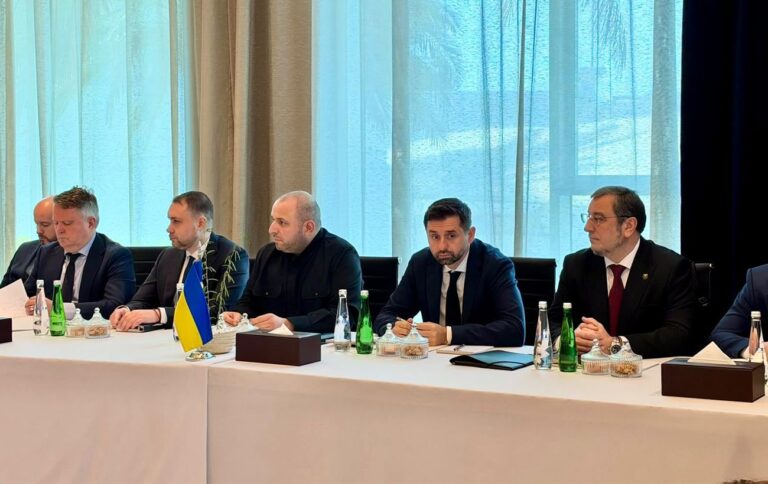
The negotiations between Ukraine, Russia, and the United States that began in Abu Dhabi on November 10, 2026, may become another diplomatic initiative that fails to alter the Kremlin’s strategic calculations. The central problem extends beyond territorial disputes: the parties attach fundamentally different meanings to ending the war.
For Ukraine, peace means ending Russian aggression and establishing conditions that prevent its recurrence. For Moscow, an acceptable agreement may mean consolidating territorial gains, restricting Ukrainian sovereignty, and revising the European security order. Washington, meanwhile, seeks a diplomatic result but risks prioritizing the speed of an agreement over its ability to deliver lasting peace.
Reuters reports that the first day was described as constructive, although no breakthrough occurred. Moscow continues to demand concessions over Donbas, while disagreements over security guarantees remain unresolved.
The conditions for diplomatic failure are rooted in incompatible strategic objectives. Russia seeks not only territorial concessions but also restrictions on Ukraine’s future military and political independence.
The main weakness of the American approach is the risk of negotiations without sufficient coercive leverage. Washington is attempting to narrow the differences between the parties, but unless the cost of continuing the war rises for Russia, diplomatic proposals may offer insufficient incentive.
The Kremlin may view negotiations as a continuation of war by other means. The diplomatic process allows Moscow to test the U.S. position, seek sanctions relief, and advance broader demands concerning European security.
Territorial concessions without credible guarantees do not eliminate the causes of the war. They could create the conditions for another offensive once Russia rebuilds its military capabilities.
The Kremlin can be compelled to reconsider its position only by changing its cost-benefit calculation. This requires coordinated military, economic, financial, and diplomatic measures by the United States, Ukraine, and European allies.
Europe must participate in shaping any security agreement. Negotiations over the continent’s future security architecture without full European participation create additional opportunities for Russian influence.
The Abu Dhabi Talks: Diplomacy Without Strategic Convergence
The American negotiating initiative is represented by Steve Witkoff and Jared Kushner. The agenda includes ending the war, security guarantees, humanitarian measures, and the future European security order.
Ahead of the talks, President Donald Trump expressed optimism about the prospect of an agreement. Kushner said the differences between the parties had narrowed. However, as early as November 9, U.S. officials did not expect an agreement to emerge directly from the meeting.
Abu Dhabi presents a deeper problem: Russia may have an interest in maintaining the negotiating process without reaching an agreement that would force it to abandon the war’s principal political objectives.
According to Reuters, the Russian delegation seeks to discuss elements of a new European security system. At the same time, Moscow has shown no willingness to abandon its demand for the entirety of Donbas.
Instead of defining the conditions for ending Russian aggression, the discussion could shift toward revising relations among Russia, the United States, and NATO.
For the Kremlin, such a shift would allow it to portray the war against Ukraine not as the consequence of Russia’s invasion but as the result of supposedly unresolved disputes between Russia and the West.
Even without a peace agreement, Moscow could potentially secure a diplomatic gain: recognition of its claims concerning the European security order as a separate subject of negotiation.
Why the Kremlin Is Unwilling to End the War on Terms Acceptable to Ukraine
War Remains an Instrument for Achieving Political Objectives
The most serious mistake American diplomacy could make would be to assume that substantial human and economic losses automatically make Russia interested in peace.
Authoritarian regimes do not always assess the costs of war by the same criteria as democratic governments. For Vladimir Putin, ending hostilities without a politically significant outcome could threaten his own legitimacy and Russia’s image as a great power.
Ending the war without subjugating Ukraine would mean acknowledging that Moscow had failed to achieve some of the fundamental objectives of its 2022 invasion.
The Kremlin likely views the war as a means of achieving three interconnected outcomes: consolidating Russian control over occupied territories and, if possible, securing further territorial concessions; limiting Ukraine’s ability to determine its foreign policy, develop its defense capabilities, and join alliances; and forcing the United States and European states to effectively recognize Russia’s special role in determining the security future of the post-Soviet region.
A territorial compromise may therefore prove insufficient. Even if Moscow obtains some of its desired territorial concessions, it may continue to insist on Ukrainian neutrality, limits on Ukraine’s military capabilities, and the rejection of meaningful Western guarantees.
The Kremlin Seeks to Revive Its 2021 Ultimatum
Particularly revealing is the position of Russian Foreign Minister Sergei Lavrov, who on November 10 proposed first defining the parameters of a future European security architecture and only then moving toward a settlement of the war.
The Institute for the Study of War (ISW) views this position as an attempt to revive the demands Moscow advanced in December 2021. At that time, Russia sought to restrict NATO’s military presence in states that joined the Alliance after 1997 and effectively gain influence over decisions on further NATO enlargement.
This indicates that the Kremlin is attempting to use negotiations over Ukraine to pursue much broader objectives.
In this context, even a cessation of hostilities would not necessarily mean the end of Russia’s confrontation with the West.
Moscow Is Counting on the Erosion of Western Political Will
Russia’s strategy may rest on the belief that the ability of the United States and European countries to support Ukraine will diminish over time.
The Kremlin may expect domestic political divisions in the United States, pressure on European budgets, other international conflicts, and public fatigue with the war gradually to create more favorable conditions for Russia.
That assumption may not reflect actual trends, but its existence could explain Moscow’s present unwillingness to compromise.
Russia’s continued strikes on Ukrainian energy infrastructure during the talks are an important signal.
Reuters
Weaknesses in American Negotiating Policy
Problem One: Seeking an Agreement Rather Than Changing the Aggressor’s Behavior
The Trump administration has demonstrated an interest in ending the war quickly. That is not inherently a weakness: diplomatic efforts can reduce human suffering and create opportunities for a settlement.
The problem arises when securing an agreement becomes more important than its substance.
Washington’s public optimism may create the impression that the U.S. administration is more politically invested in an outcome than the Russian side. Under such an asymmetry, Moscow has an incentive to prolong the talks in anticipation of additional American concessions.
Repeatedly declaring that peace is near without verified changes in the Kremlin’s position weakens negotiating discipline.
Asymmetric Pressure on Ukraine and Russia
Reuters reported on November 11 that Trump had intensified public pressure on Kyiv, urging Ukraine to reach an agreement and warning of adverse consequences if it failed to do so. Meanwhile, Russia had shown no willingness to relinquish its demand for all of Donbas.
This creates a fundamental contradiction in American diplomacy.
If Washington applies greater pressure to the side that needs military assistance than to the state continuing the aggression, Moscow may conclude that delaying negotiations works in its favor.
Ukraine depends on Western weapons, intelligence, and financial support. American pressure on Kyiv therefore has immediate consequences.
Russia, by contrast, may regard diplomatic warnings as less credible if they are not accompanied by concrete economic and military-political measures.
The result is a risk that American diplomacy will demand concessions from Ukraine that Moscow has been unable to obtain by military force.
Overestimating the Value of a Territorial Compromise
According to Reuters on November 9, American officials suggested that the parties might show some flexibility on territorial questions. A senior Ukrainian representative, however, denied Kyiv’s willingness to make such concessions and stressed that territorial matters could be addressed only at the leaders’ level and in conjunction with adequate security guarantees.
This illustrates the danger of treating the war as an ordinary territorial dispute.
For Ukraine, territory concerns not only internationally recognized borders but also defense infrastructure, civilian security, and the ability to deter future aggression.
It would be particularly dangerous to transfer to Russia territory it has been unable to occupy without guarantees capable of genuinely preventing another invasion.
Such a decision could reward military coercion and set a precedent for other revisionist states.
Uncertainty Over Security Guarantees
American officials have discussed the possibility of guarantees for Ukraine modeled on Article 5 of the North Atlantic Treaty. However, a political formula alone does not ensure automatic military assistance.
The effectiveness of guarantees depends on specific mechanisms: the obligations of guarantor states, response timelines, the availability of military assistance, funding for Ukraine’s defense, and the consequences of renewed Russian violations.
If the guarantees are merely declaratory, Moscow may regard them as a temporary political obstacle rather than a credible deterrent.
Europe’s Insufficient Role
European representatives are taking part in consultations, but Moscow opposes their full participation in negotiations involving Russia, Ukraine, and the United States.
On November 11, the Kremlin said it had no plans to engage with European representatives in Abu Dhabi. The European Commission, meanwhile, insists that broader discussions of European security should take place after a ceasefire.
For Russia, bilateral or narrowly trilateral diplomacy is more advantageous because it reduces the influence of states that will be directly responsible for Ukraine’s long-term security.
Without Europe’s participation, agreements on sanctions, defense assistance, reconstruction, and future guarantees may prove incomplete.
How to Compel the Kremlin to End the War: Coercive Strategy Instead of Diplomacy by Concession
The decisive question for Washington is not how to convince Putin of the benefits of peace, but how to make continuing the war less advantageous for the Kremlin than ending it.
This requires a shift from a negotiating model based primarily on seeking compromise to coercive diplomacy, in which diplomatic proposals are backed by credible threats of additional costs.
Such a strategy must combine pressure with a realistic diplomatic exit. Its purpose should not be Russia’s unconditional humiliation or uncontrolled escalation. The objective is to end the aggression on terms that do not create incentives for its recurrence.
Change the Kremlin’s Military Calculations
Russia will have fewer reasons to continue the war if it concludes that further offensive operations will not produce strategic gains.
To achieve this, the United States and European countries must provide Ukraine with predictable, multiyear supplies of air-defense systems, ammunition, counter-drone systems, and other defensive capabilities.
Support for Ukrainian defense production is especially important. Dependence on short-term political decisions in Washington encourages Moscow to expect that assistance may eventually stop.
Conversely, long-term supply programs and joint arms production could convince the Kremlin that a strategy of exhausting Ukraine will not deliver the expected result.
The central task is not necessarily to achieve Russia’s rapid military defeat, but to deprive Moscow of the belief that continuing the war will improve its negotiating position.
Increase Economic Pressure on Russia’s Ability to Finance the War
Sanctions policy should primarily target the resources that sustain Russia’s war economy.
Priorities include limiting energy-export revenues, countering the use of the shadow fleet, financial oversight of intermediaries facilitating sanctions evasion, and tightening restrictions on supplies of dual-use components.
Sanctions, however, should not be treated as an automatic mechanism for ending the war. Their impact depends on international coordination, Russia’s ability to find alternative trade channels, and third countries’ willingness to enforce restrictions.
Washington should therefore move from largely declaratory sanctions pressure to systematic monitoring of actual results.
Additional restrictions on financial institutions and companies knowingly supplying critical goods to Russia’s military-industrial complex could be an important tool, provided appropriate evidentiary procedures and avenues for appeal are maintained.
Prevent Moscow from Using Negotiations to Obtain Sanctions Relief
One of the gravest mistakes would be to grant Russia economic concessions merely for agreeing to continue negotiations.
Sanctions relief should follow verified actions, not serve as a reward for diplomatic promises.
Washington could propose a phased mechanism under which specific restrictions are reconsidered only after concrete conditions have been met: ending attacks, enabling international monitoring, fulfilling agreements on prisoners of war, and observing agreed security measures.
Any relief must be reversible. Violations should trigger the rapid reinstatement of restrictions.
This would transform sanctions from a bargaining chip into a means of enforcing an agreement.
Preserve Ukraine’s Sovereignty as a Nonnegotiable Condition
The United States should not accept a Russian veto over Ukraine’s foreign-policy choices.
Possible agreements on arms control, military transparency, or incident-prevention mechanisms may be discussed on a reciprocal basis. They must not, however, deprive Ukraine of its right to self-defense or to choose its own security partnerships.
At the same time, negotiations on European security must include the states whose rights and defense commitments are directly affected.
A model in which Russia effectively gains the right to determine NATO’s military presence in Central and Eastern Europe in exchange for ending its aggression against Ukraine would be unacceptable.
Establish Automatic Consequences for Violations of a Peace Agreement
Any future agreement must account for the risk of renewed Russian aggression.
Security guarantees must therefore include not only political declarations but also pre-agreed response mechanisms: reinstatement of sanctions, accelerated delivery of defensive equipment, intelligence sharing, international monitoring, and defined consultation procedures among guarantor states.
Such mechanisms could reduce the Kremlin’s ability to use a ceasefire to regroup militarily before resuming an offensive.
Which Instruments Could Actually Change the Kremlin’s Position?
The matrix below is an analytical assessment of potential impact, not the result of quantitative modeling.
Forecast: Three Scenarios for the Negotiations
Assessment horizon: the next 3–6 months. Probabilities are expert scenario assumptions, not a statistical forecast.
Scenario 1. Protracted Negotiations Without a Strategic Breakthrough
Russia continues to advance territorial and security demands, the United States seeks to preserve the negotiating process, and fighting continues. Limited humanitarian arrangements are possible, but no comprehensive peace agreement is reached.
Scenario 2. Partial Ceasefire or Limited Agreement
The parties agree on limited de-escalation measures, prisoner exchanges, or temporary arrangements concerning certain categories of attacks. Territorial questions and security guarantees remain unresolved.
Scenario 3. Progress Toward a Comprehensive Agreement with Credible Guarantees
The United States and Europe agree on a guarantee mechanism, Russia accepts a verifiable cessation of hostilities, and the talks move toward concrete arrangements for implementing the agreement.
The first scenario remains the most likely. Its realization would not mean a complete absence of diplomatic results, but it would indicate that the negotiations had failed to change the parties’ fundamental positions.
Recommendations for the United States and NATO
Washington must abandon the practice of treating the mere continuation of negotiations as evidence that peace is approaching. Success should be measured by Russia’s willingness to take verifiable steps that genuinely reduce the threat to Ukraine.
The U.S. administration should agree with European allies on a common set of conditions for a future settlement, specify the consequences of Moscow’s refusal to compromise, and ensure long-term support for Ukraine’s defense capabilities.
The sequence of implementation is especially important: first, a verifiable cessation of aggressive actions and the establishment of monitoring mechanisms; then, phased fulfillment of mutual obligations; and only afterward, possible reconsideration of some sanctions.
The United States must also avoid creating the impression that Russia could obtain broader concessions concerning NATO in exchange for ending a war it started.
At the same time, diplomatic channels, humanitarian negotiations, and mechanisms to prevent uncontrolled escalation must be maintained. Military and economic pressure should increase the likelihood of a political settlement, not replace one.
Conclusion: Peace Depends Not on the Number of Negotiations but on Changing the Kremlin’s Calculations
The Abu Dhabi talks reveal a fundamental problem in American policy toward Russia’s war against Ukraine: Washington is seeking a diplomatic compromise between parties, one of which may still consider continuing the war an effective instrument for achieving strategic objectives.The weakness of American negotiating policy becomes most apparent when pressure on Ukraine is more concrete than the consequences Washington is prepared to impose on Russia.