
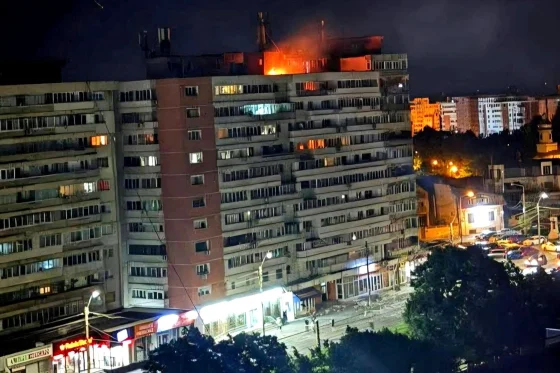
The reported impact of a Russian-origin Shahed-type drone on a residential building in the Romanian city of Galați, combined with the reported strike on a Turkish-operated vessel departing a Ukrainian port, represents a potentially significant evolution in Russia’s campaign against Ukraine and raises important intelligence, military, legal, and political questions for NATO.
Although incidents involving Russian missiles and drones entering NATO airspace have occurred previously in Poland, Romania, Latvia, and other allied states, a direct strike on an occupied residential building inside a NATO member state would constitute a qualitatively different event, particularly if investigations confirm that the drone remained operational at impact rather than merely crashing due to malfunction.
The most important intelligence question is not whether Russia intended to start a war with NATO. There is no evidence suggesting Moscow seeks direct military confrontation with the Alliance.
The more relevant question is whether Russia increasingly accepts the possibility of collateral strikes inside NATO territory as an acceptable cost of its campaign against Ukraine.
If confirmed, the Galați incident may indicate: growing Russian risk tolerance; decreasing concern regarding NATO reactions; use of ambiguity as a tool of coercion; testing of Alliance political cohesion; gradual normalization of kinetic incidents inside NATO territory.
From Moscow’s perspective, repeated incidents that fail to trigger serious consequences reinforce the belief that NATO will remain strategically restrained.
Was the Strike Deliberate?
Most Likely Scenario (60–70%)
The drone was intended for targets in Ukraine’s Danube port infrastructure and deviated from its planned route because of: electronic warfare; GPS spoofing; navigation failure; destruction of guidance systems.
This explanation fits previous incidents in: Poland Romania Latvia where Russian missiles or drones crossed into NATO territory unintentionally.
Alternative Scenario (20–30%)
Russian planners knowingly accepted a high probability that drones attacking the Izmail region could cross into Romanian territory.
In this scenario: the objective was not the Romanian apartment building itself; the risk to Romanian civilians was deemed acceptable; strategic intimidation was considered worthwhile.
This would be consistent with Russia’s broader pattern of coercive escalation.
Low-Probability Scenario (5–10%)
A deliberate strike against Romanian territory intended to send a political message.
Potential motives: intimidation of NATO’s eastern flank; punishment for Romanian support to Ukraine; testing Alliance reactions.
At present there is insufficient evidence for this assessment.
Why Galați Matters
The incident differs from previous NATO incursions because: missiles landed in fields; debris struck rural areas; no major civilian casualties occurred.
Galați Case
A drone reportedly entered: an inhabited residential district; a multi-story apartment building; a populated urban environment.
Had fatalities occurred, the political pressure on Bucharest would have been dramatically higher.
This creates an important precedent.
Did Russia Intentionally Strike a Turkish Vessel?
The reported strike on a Turkish-operated vessel is equally significant.
Intelligence Question: Did Russia know the vessel was Turkish? Most likely.
Modern maritime surveillance systems used by Russian forces can identify: vessel flags; ownership; AIS signals; route information.
If Russian forces launched an attack despite this knowledge, Moscow may have calculated that Ankara would protest; compensation mechanisms could be offered; Turkiye would avoid escalation.
This reflects a recurring Russian assumption regarding NATO states: economic and political interests will outweigh escalation risks.
The Danube corridor has become one of Ukraine’s most important export routes.
Key objectives to attack this corridor include: Destroying: grain exports; logistics infrastructure; storage facilities; port operations; Creating instability near NATO borders. Demonstrating that no export corridor is fully secure. Raising shipping costs and insurance premiums.
This strategy seeks to undermine Ukraine’s economic resilience without requiring major battlefield breakthroughs.
Could Romania Invoke Article 4?
Article 4 consultations are specifically designed for situations where a member believes: its security is threatened; territorial integrity is endangered; external aggression creates risks.
This is the most likely NATO response.
Historically, Article 4 has been invoked by:Turkiye, Poland, Lithuania,during periods of heightened security concern.
Could Article 5 Be Triggered?
Currently, no.
The threshold for Article 5 remains extremely high.
NATO would likely require evidence of: deliberate targeting; intentional attack; repeated hostile actions; demonstrable Russian intent.
A single drone incident—even one causing injuries—is unlikely to satisfy those requirements.
However, repeated strikes could gradually alter political calculations.
What Does Moscow Probably Expect?
Russian planners likely anticipate Diplomatic Response summoning ambassadors; official condemnations; NATO consultations;increased air defense deployments surveillance enhancements.
What Russia Does Not Expect: direct NATO military retaliation; enforcement of a no-fly zone; strikes against Russian launch sites.
This expectation may itself encourage future risk-taking.
Is Russia Testing NATO?
One of the most important intelligence questions is whether Moscow is conducting a long-term “threshold testing” campaign.
Evidence supporting this hypothesis includes: repeated airspace violations; GPS jamming operations in the Baltic region; interference with civilian aviation; maritime provocations; cyber operations against NATO states.
Each incident individually remains below the threshold of war.
Collectively, however, they form a pattern consistent with hybrid warfare doctrine.
The objective is not escalation but calibration—learning precisely where NATO’s red lines actually exist.
Strategic Implications for NATO
The Galați incident exposes a growing vulnerability.
Russia increasingly attacks targets located only a few kilometers from NATO territory: Danube ports; border infrastructure; logistics hubs; transportation corridors.
This creates a persistent risk that: future drones strike populated NATO areas; casualties occur; Alliance leaders face pressure to respond more forcefully.
The probability of a NATO-Russia crisis may therefore rise not because Moscow seeks war, but because repeated high-risk operations near Alliance borders increase the likelihood of miscalculation.
The most likely explanation remains a Russian Shahed attacking Ukrainian targets near the Romanian border that subsequently entered Romanian territory.
Even if unintended, the incident demonstrates Russia’s growing willingness to accept risks to NATO civilian populations.
The reported strike on a Turkish vessel suggests Moscow is increasingly prepared to endanger the interests of NATO members in pursuit of its campaign against Ukrainian export infrastructure.
Romania is likely to seek consultations under Article 4 rather than advocate Article 5 measures.
Moscow probably expects limited consequences and may interpret a restrained response as confirmation that similar incidents can continue without strategic costs.The most significant long-term risk is not immediate escalation but the gradual normalization of Russian kinetic incidents inside NATO territory, increasing the probability that a future strike causing mass casualties could trigger a major Alliance political crisis.