
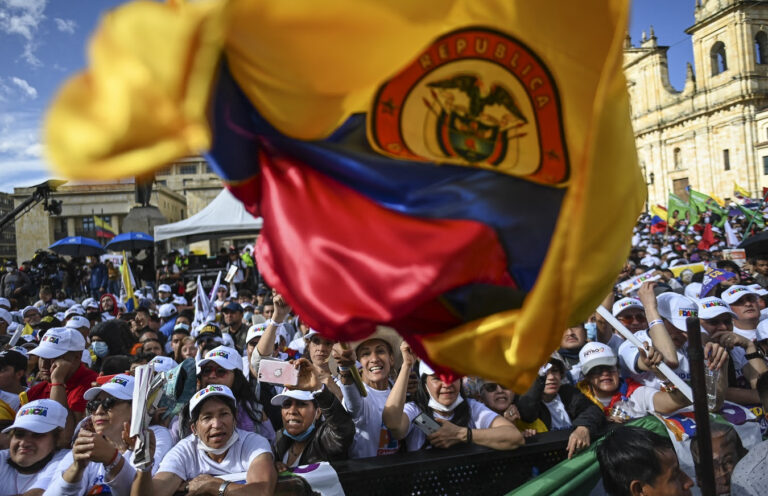
Colombia’s 2026 presidential election represents one of the most consequential political contests in Latin America. The vote is evolving into a referendum on the legacy of President Gustavo Petro — Colombia’s first left-wing president — and on the broader future orientation of the Colombian state. The election is unfolding amid worsening security conditions, economic uncertainty, deep institutional polarization, and mounting public frustration over the limited implementation of Petro’s ambitious reform agenda.
The political environment before the election is defined by four central dynamics: The partial collapse of Petro’s “Total Peace” strategy and the resurgence of armed violence. Growing polarization between progressive and conservative blocs. Fragmentation of the political center. Rising voter demand for security, anti-corruption policies, and economic stability.
The electoral field remains fluid, but several actors have emerged as dominant figures: left-wing candidates linked to Petro’s Historical Pact coalition, conservative and Uribista forces, and centrist technocratic alternatives.Opinion polls indicate an extremely fragmented electorate in which no candidate currently approaches majority support, making a second-round runoff almost certain.
The election’s outcome will have major consequences not only for Colombia’s domestic trajectory, but also for regional security, migration dynamics, U.S.-Latin America relations, anti-narcotics policy, relations with Venezuela, and China’s growing influence in South America.
The defining issue before the election is the deteriorating security environment. President Petro entered office promising a “Total Peace” strategy based on negotiations with guerrilla groups, criminal organizations, and narcotrafficking structures. However, by 2025–2026, many Colombians increasingly perceive the policy as ineffective or even counterproductive.
Armed groups including: the National Liberation Army, dissident factions of the Revolutionary Armed Forces of Colombia, narcotrafficking cartels; and regional criminal networks have expanded territorial control in several departments, especially in border and rural regions. Kidnappings, attacks on infrastructure, illegal mining, and internal displacement have all increased.
As a result, public demand for a harder security approach has intensified. This environment strongly benefits right-wing and conservative candidates advocating a return to aggressive counterinsurgency measures associated with former President Álvaro Uribe.
Petro’s government sought major reforms in: labor legislation, pensions, taxation, healthcare, land redistribution, and energy transition policy.
However, congressional resistance, bureaucratic inefficiency, fiscal constraints, and investor concerns limited implementation.
Key economic concerns before the election include: slowing investment, inflationary pressure, uncertainty regarding the oil and mining sectors, public debt concerns, and high inequality.
Although Petro maintains support among poorer and marginalized sectors, middle-class and business communities increasingly favor stability-oriented or conservative alternatives.
Colombia is experiencing one of its most polarized political periods since the post-FARC peace agreement era.
Petro’s opponents accuse him of: attempting institutional overreach, undermining checks and balances, and seeking constitutional transformation that could weaken traditional democratic safeguards.
Meanwhile, Petro’s supporters argue that entrenched elites, business groups, and conservative institutions obstruct structural reforms aimed at reducing inequality.
This polarization increasingly resembles broader hemispheric trends visible in: Brazil, Argentina, Mexico, and the United States.
Gustavo Bolívar has emerged as one of the strongest candidates associated with Petro’s ideological camp. Polls in 2025 showed him leading or tied for the lead in several early surveys.
Bolívar’s support comes primarily from: urban lower-income voters, younger progressive voters, Afro-Colombian and indigenous communities, left-wing activists, labor organizations, and sectors benefiting from Petro’s social policies.
His campaign positions itself as the defender of: social justice, state intervention, welfare expansion, and continuation of Petro’s reform project.
However, Bolívar faces several structural weaknesses: association with Petro’s unpopular policies, public dissatisfaction over security, concerns about fiscal stability, and fear of institutional radicalization.
His electoral ceiling may therefore remain limited outside Petro’s core ideological base.
Paloma Valencia represents the traditional conservative and Uribista wing. She advocates strong military operations,business-friendly policies, opposition to negotiations with insurgents, and restoration of state authority.
Her support derives from: conservative rural voters, security-oriented middle classes, agribusiness elites, traditional right-wing voters, anti-Petro coalitions, and segments fearful of “Venezuelanization.”
The Venezuelan factor remains highly influential, especially in border regions where anti-Chavista sentiment strongly shapes voting behavior.
Abelardo de la Espriella represents a newer populist-security model resembling aspects of: Nayib Bukele, Latin American anti-establishment strongmen, and anti-crime populism.
He proposes: mega-prisons, uncompromising anti-criminal operations, rejection of peace negotiations, and constitutional restructuring.
His support appears strongest among: frustrated urban voters, anti-establishment conservatives, security-focused youth, and citizens disillusioned with both traditional elites and Petroism.
If violence continues rising, de la Espriella could rapidly expand his support.
Sergio Fajardo remains the principal centrist candidate. Polls repeatedly place him among the leading contenders.
Fajardo promotes institutional moderation, anti-corruption policies, technocratic governance, gradual reform, and depolarization.
His support comes mainly from: educated urban professionals, moderate middle classes, students, centrists disillusioned with polarization, and parts of the business community.
Fajardo’s key challenge is Colombia’s increasingly polarized environment. Moderate candidates often struggle in high-intensity elections dominated by security fears and ideological confrontation.
Vicky Dávila emerged from journalism into politics and quickly became a major anti-Petro figure. Polls throughout 2024–2025 frequently placed her among leading candidates.
Her support derives from anti-establishment conservatives, media-oriented voters, urban middle classes, anti-corruption constituencies, and voters seeking a nontraditional outsider.
Dávila’s media background gives her unusually strong visibility and communication capacity.
The United States remains Colombia’s most important external partner.
Washington’s priorities include: anti-narcotics cooperation, migration management, regional stability, and limiting Chinese and Russian influence.
The U.S. establishment is carefully monitoring whether Colombia: continues Petro’s softer security approach, or returns to more aggressive counterinsurgency policies.
A conservative victory would likely strengthen: military cooperation, extradition cooperation, and intelligence coordination.
A continuation of Petroism could create periodic tensions with Washington over: coca eradication policy, environmental restrictions on energy projects, and relations with Venezuela.
Venezuela remains a major geopolitical factor in Colombian politics.
Relations between Petro and Nicolás Maduro normalized after years of hostility. However, many Colombians remain deeply suspicious of Chavismo.
Conservative candidates actively use Venezuela as: a warning example, a mobilization tool and a symbolic threat against left-wing governance.
Border security, migration, contraband, and armed group activity along the frontier remain central election issues.
China has significantly expanded its economic role in Colombia through: infrastructure, mining, telecommunications,renewable energy, and transportation projects.
A left-wing or nationalist government may deepen Chinese economic penetration, particularly if relations with U.S. investors deteriorate.
However, Colombia’s security establishment remains traditionally pro-American, limiting the possibility of a strategic geopolitical realignment.
Petro maintains political and ideological connections with broader Latin American progressive movements linked to: Brazil’s left, Mexico’s Morena movement, and parts of the regional “Pink Tide.”
Nevertheless, Colombia’s political culture remains more security-focused and institutionally conservative than many neighboring states, limiting the durability of radical transformations.
Polling throughout 2025 and early 2026 reveals an extremely fragmented electorate. No candidate consistently exceeds 15% support nationally.
The leading figures in most polls include: Gustavo Bolívar, Vicky Dávila, Sergio Fajardo, Paloma Valencia, and Abelardo de la Espriella.
Several trends are visible:
Despite Petro’s declining popularity in some sectors, the left still maintains a strong mobilized base, especially among poorer urban populations.
Escalating violence strongly favors right-wing candidates emphasizing: military strength, prison expansion, and anti-cartel operations.
Colombia’s two-round electoral system means coalition-building between the first and second rounds will likely determine the winner.
Scenario 1: Conservative Security Victory. A right-wing or conservative coalition candidate defeats the Petro-aligned left in the second round.
Consequences: return to hardline security doctrine, reduced emphasis on negotiations, stronger ties with Washington, more investor-friendly policies, possible rollback of Petro reforms.
This is currently the most probable outcome if violence continues worsening.
Moderate-Low Scenario 2: Centrist Technocratic Victory. A centrist figure such as Sergio Fajardo successfully unites anti-polarization voters.
Consequences: moderate economic stabilization, institutional compromise, selective continuation of social reforms, balanced security approach.
This scenario depends on voters rejecting both Petroism and hardline conservatism.
Scenario 3: Continuation of Petroism.
A Petro-backed candidate wins due to fragmentation of the opposition.
Consequences: continuation of social reform agenda, deeper institutional confrontation, expanded state intervention, prolonged polarization, continued uncertainty over security policy.
The election will shape: the future of the Colombian peace process, anti-narcotics strategy migration dynamics, U.S.-Colombia security cooperation, energy and mining policy, and regional ideological balance in Latin America.
A conservative victory would likely mark: the decline of the regional progressive wave, and the restoration of traditional security-oriented governance.
A Petroist continuation would strengthen: left-wing regional networks, and encourage broader debates about constitutional transformation in Latin America.
Most importantly, the election will determine whether Colombia prioritizes: security restoration, or continued structural social transformation.At present, growing insecurity appears to be the decisive factor shaping voter behavior. If violence escalates further before the election, Colombia may move sharply toward a more authoritarian and security-centered political model similar to trends visible elsewhere in Latin America.