
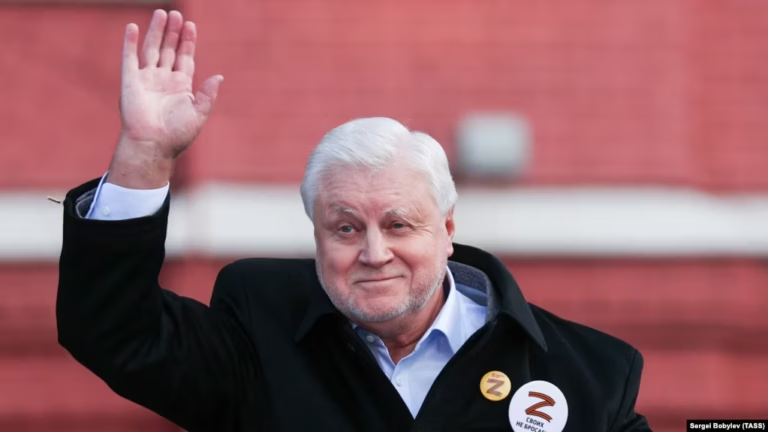
The leader of A Just Russia, Sergey Mironov, announced the creation of an international network called “Sovintern,” which, under the slogan of “Socialism 2.0,” aims to unite more than 100 left-wing parties and movements from 70 countries. The co-initiators include nine organizations: the Workers Party of Britain, the Union of Democratic Socialists (DRC), the Party of Progress and Socialism (Morocco), the Party of Socialists of the Republic of Moldova, the Sandinista National Liberation Front (Nicaragua), the Movement of Socialists of Serbia, the American Communist Party, the “Tunisia Forward” movement, and the Socialist Party A Just Russia.
The project is presented as a modern alternative to capitalism, allegedly based on the “achievements of Soviet civilization.” The first Sovintern forum is expected to take place in Moscow on April 25–29.
The party A Just Russia was established in 2006 through the merger of several organizations, including Rodina, the Russian Party of Life, and the Party of Pensioners. It positions itself as a center-left force of socialist orientation advocating social justice and patriotism. Its leaders are Sergey Mironov, former Speaker of the Federation Council, and Alexander Babakov, First Deputy Chairman of the State Duma. Mironov has repeatedly supported Vladimir Putin in elections, while Babakov is known as a businessman and politician with influential connections.
A Just Russia has traditionally demonstrated loyalty to the Kremlin, actively supporting Putin’s course and Russia’s war against Ukraine. The party is considered a “systemic opposition,” performing the role of a controlled left-wing flank that does not pose a real threat to the authorities but instead helps the Presidential Administration maintain its social electorate. This close relationship with the Kremlin allows the party to remain in parliament while limiting its independence.
In practice, A Just Russia operates in close coordination with the Russian Presidential Administration, effectively acting as an instrument of Kremlin policy. Under Russian political conditions, any large-scale international initiative—especially one that seeks to build a global network—cannot be implemented without direct approval from the Kremlin. This indicates that “Sovintern” is not an independent project, but part of Russia’s state strategy.
Despite being framed as an innovative “Socialism 2.0” initiative, the project should not be viewed as an ideological platform but rather as a political and informational tool of Russian foreign policy. It is integrated into a broader arsenal of Kremlin hybrid instruments aimed at influencing international audiences.
The initiative to create Sovintern reflects Moscow’s attempt to consolidate global left-wing forces under its political influence. Russia seeks to position itself as an alternative center for countries and parties dissatisfied with the policies of the United States and the European Union, exploiting anti-Western sentiment.
Sovintern functions as a tool of hybrid warfare through which the Kremlin attempts to legitimize its domestic and foreign policies. The formation of an international network allows Russia to create the illusion of broad support for its course among foreign political parties.
Despite its rhetoric of “renewed socialism,” the project effectively reproduces the Soviet model of ideological influence abroad, resembling structures such as the Comintern or the Cominform. The involvement of over 100 parties from 70 countries indicates an intention to create a large-scale platform for the systematic dissemination of Kremlin narratives across multiple regions, including Europe.
From a strategic perspective, the Sovintern project is aimed at undermining the unity of the European Union, spreading anti-Western narratives, and justifying aggression against Ukraine. This makes it part of a broader policy of destabilizing Europe.
The organization of the forum in Moscow and the arrangement of trips for foreign delegates to combat zones have a clear propaganda purpose. The Kremlin seeks to use these participants as “international witnesses” to legitimize its aggression against Ukraine and to discredit Ukraine’s position at the global level.
For A Just Russia, the Sovintern project also serves as a tool to enhance its domestic political weight. The party seeks to demonstrate its usefulness to the authorities by positioning itself as a conduit of Russian “soft power” and party diplomacy on the international stage.
Russia’s initiative to create the so-called “Sovintern” should be understood not as an isolated political project, but as a continuation—and adaptation—of a long-standing Soviet strategy of ideological expansion and covert influence, rooted in the historical experience of the Communist International. As highlighted in the Robert Lansing Institute analysis, senior Russian officials, including Sergei Naryshkin, have explicitly called for drawing on the legacy of the Comintern as a model for reshaping the global order, including through influence operations and subversive activity.
Within this context, the emergence of “Sovintern” reflects not merely an attempt to unite left-wing parties, but a broader strategic effort by the Kremlin to rebuild an international political infrastructure capable of projecting influence across ideological, informational, and potentially operational domains. Historically, the Comintern functioned as a centralized network of foreign political actors subordinated to Moscow, combining propaganda, political coordination, and in some cases direct Soviet-era structures were not limited to ideological outreach but included institutions dedicated to sabotage training, intelligence coordination, and support for uprisings, indicating a fusion of political and security functions.
The modern “Sovintern” initiative appears to replicate this logic in a contemporary form. While framed in terms of “Socialism 2.0,” its real function lies in creating a transnational network through which Moscow can amplify anti-Western narratives, shape political discourse, and cultivate influence within foreign political systems. Unlike the original Comintern, however, today’s Russia lacks a coherent global ideological project. As noted in the Lansing Institute analysis, Moscow’s current strategy is less about exporting a unified doctrine and more about leveraging anti-Western sentiment as a unifying denominator among diverse actors, ranging from left-wing movements to authoritarian regimes.
This shift is critical. The Soviet Comintern operated within a clearly defined ideological framework centered on global proletarian revolution. In contrast, the modern Russian approach is pragmatic and opportunistic, using ideological branding primarily as a tool to mobilize existing grievances against the United States and the European Union. The “Sovintern” thus functions less as a genuine ideological alliance and more as a platform for coordinated influence operations, where political parties serve as amplifiers of Kremlin-aligned narratives rather than independent actors.
At the same time, the project must be viewed as part of a broader hybrid strategy that integrates political, informational, and covert elements. The Lansing Institute analysis underscores that contemporary Russian thinking about the Comintern legacy includes not only propaganda functions but also the potential use of destabilization tactics, including support for disruptive activities in Western countries. This suggests that networks built under the “Sovintern” framework could, over time, evolve beyond political coordination into more active roles in shaping protest movements, influencing electoral processes, or even facilitating indirect destabilization efforts.
The inclusion of parties from Europe, Latin America, and Africa further indicates that Russia aims to construct a geographically diverse influence network capable of operating across multiple political environments. This mirrors the historical Comintern model, which relied on local actors embedded within national contexts to advance Moscow’s strategic objectives. However, unlike the Soviet period, where ideological discipline ensured a degree of cohesion, the modern network is likely to be more fragmented, relying on shared opposition to the West rather than a unified political program.
Another important dimension is the domestic function of the project. For A Just Russia, the promotion of “Sovintern” enhances its status within the Russian political system by demonstrating its utility as an instrument of external influence. In a system where political relevance is closely tied to alignment with Kremlin priorities, the ability to operate on the international stage as a vehicle of “soft power” strengthens the party’s position. At the same time, the project reinforces the broader narrative of Russia as a global ideological center, compensating for its relative isolation in the formal diplomatic sphere.
Strategically, the implications of “Sovintern” extend beyond party politics. The initiative contributes to the gradual construction of a parallel political ecosystem that challenges Western dominance in the informational and ideological domains. By cultivating networks of sympathetic actors, Russia seeks to erode consensus within the European Union, weaken transatlantic cohesion, and legitimize its foreign policy, including the war against Ukraine. The use of international forums and curated exposure of foreign delegates to conflict zones serves to create a perception of global support, even if such support is limited or symbolic.
Ultimately, the comparison with the Comintern is not rhetorical but structural. While the scale, coherence, and ideological depth differ, the underlying principle remains the same: the use of transnational political networks as instruments of state strategy. The key difference lies in the adaptation to contemporary conditions, where influence is exercised less through rigid ideological control and more through flexible, network-based approaches that combine political messaging, information operations, and selective engagement with foreign actors.
In this sense, “Sovintern” should be viewed not as a revival of Soviet ideology, but as a modernization of Soviet methods—repackaged for a fragmented and multipolar world, where influence is no longer imposed through a single doctrine, but constructed through the convergence of diverse anti-Western forces under Moscow’s coordination.
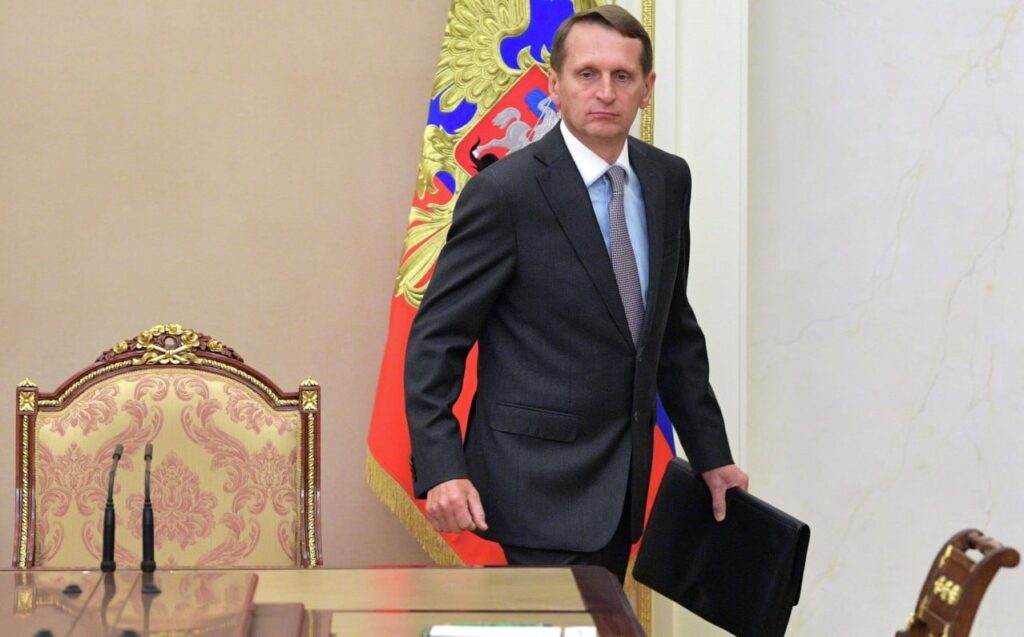
The alignment between Sergey Mironov and Sergey Naryshkin is best understood less as a matter of personal ideological conviction and more as a reflection of how the Russian political system functions. In that system, major “initiatives” of international scope—especially those touching on ideology, influence networks, or historical narratives like the Comintern—are rarely bottom-up. They are signals moving downward through the political hierarchy and then being operationalized by loyal actors. Mironov’s promotion of the “Sovintern” concept fits that pattern.
Naryshkin, as head of the SVR, has publicly revived interest in Soviet-era instruments of external influence, including the Comintern model, not as historical nostalgia but as a conceptual framework for modern hybrid operations. His messaging reflects a broader shift within the Russian state toward rebuilding transnational ideological networks that can support geopolitical objectives. When Mironov echoes and advances these ideas, he is effectively translating a strategic concept associated with the intelligence and security apparatus into a political vehicle that can operate in the international party space.
From this perspective, Mironov is not independently “supporting” Naryshkin so much as aligning himself with a policy line that already carries institutional backing. In Russia’s system of “managed pluralism,” parties like A Just Russia exist precisely to perform such roles. They occupy a controlled niche—in this case, the left flank—and can be tasked with initiatives that require ideological packaging, international outreach, or engagement with foreign political actors. The “Sovintern” project is particularly suited to that function because it blends political branding (“socialism 2.0”) with strategic messaging and network-building.
At the same time, there is a clear element of intra-elite positioning. Mironov has long been a loyal figure within the system, but his political weight has fluctuated. Launching a high-profile international initiative allows him to demonstrate relevance in an environment where proximity to the Kremlin’s strategic priorities determines status. By associating himself with a project that resonates with the thinking of the security establishment, he signals utility to the center of power. In practical terms, this is a way of moving from being a routine parliamentary actor to a figure involved in what could be framed as “strategic influence operations.”
This raises the question of whether Mironov is seeking an appointment within the executive branch. It is certainly plausible that such motivations exist, but they should be interpreted within the logic of the Russian staff system rather than as a straightforward bid for office. Advancement in Russia is less about formal applications and more about demonstrating that one can deliver results aligned with Kremlin priorities. By taking ownership of “Sovintern,” Mironov is effectively presenting himself as someone capable of managing a politically sensitive and internationally oriented project. That can translate into greater influence, access, or a redefined role, though not necessarily a classic ministerial appointment.
It is also important to consider that roles connected to foreign influence, ideology, or international networks do not always sit neatly within the formal executive hierarchy. They can exist at the intersection of party structures, presidential administration, and security agencies. In this sense, Mironov may be positioning himself not for a traditional cabinet role, but for a function that bridges political and quasi-operational domains—something closer to a coordinator of “soft power” or party diplomacy aligned with state strategy.
Ultimately, Mironov’s behavior reflects a broader pattern within the Russian system, where political actors compete for relevance by aligning with the strategic narratives and priorities emerging from the security elite. Supporting ideas associated with Naryshkin allows Mironov to anchor himself within that strategic direction. Whether this leads to a formal executive appointment is uncertain, but it clearly serves as a mechanism for maintaining and potentially enhancing his standing within the hierarchy of power.Mironov can be seen as a political executor of influence concepts associated with the SVR, rather than a participant in military or covert operations linked to the GRU.