

The 2026 presidential election in Benin reflects a decisive transformation from a once-celebrated democratic model into a system increasingly characterized by centralized power, restricted political competition, and managed electoral outcomes. While the election formally marks a transition after two terms of President Patrice Talon, in practice it represents continuity of the ruling system rather than a genuine contest for power.
The electoral process unfolded in a constrained political environment, with opposition forces weakened, institutional checks eroded, and foreign actors primarily focused on stability rather than democratic standards.The outcome—an overwhelming victory of the ruling coalition candidate—confirms the consolidation of executive dominance and raises long-term concerns about governance, legitimacy, and security.
Situation Before the Election
In the decades following the 1990 National Conference, Benin had been regarded as one of West Africa’s most stable democracies. However, this trajectory began to reverse after 2016, when Patrice Talon initiated a series of political and institutional reforms that gradually concentrated power in the executive branch.
Electoral reforms introduced during Talon’s presidency significantly narrowed political competition. New rules required presidential candidates to secure endorsements from a substantial share of mayors and legislators—positions largely controlled by pro-government forces—effectively filtering out independent or opposition candidates.
The 2019 parliamentary elections marked a turning point, as opposition parties were excluded entirely, leading to a legislature composed solely of pro-government factions. This pattern continued into subsequent electoral cycles, reinforcing a system in which formal multiparty competition existed, but meaningful political pluralism diminished.
By 2026, the political climate was further shaped by a failed coup attempt and growing concerns about democratic backsliding. Independent media faced pressure, opposition figures were arrested or disqualified, and civil liberties were increasingly restricted. The result was an electoral environment defined less by competition than by controlled succession.
Main Problems in Society
The electoral process in Benin unfolded against a backdrop of structural socioeconomic and political challenges. Despite notable improvements in infrastructure and public services under Talon’s administration, inequality and unemployment—particularly among youth—remain significant concerns.
At the same time, political tensions have intensified due to the shrinking space for dissent. The use of judicial mechanisms against opposition figures, restrictions on protests, and arrests of activists have contributed to widespread distrust in state institutions.
Another key issue is the erosion of democratic legitimacy. While formal institutions remain in place, their perceived independence has weakened, creating a gap between legal frameworks and political reality. This has led to declining voter engagement, as reflected in low turnout in previous elections and expectations of similar patterns in 2026.
Security concerns also play an increasing role, as Benin faces spillover threats from jihadist activity in the broader Sahel region. Although not yet central to electoral competition, this factor contributes to the broader context of state fragility and governance pressure.
Main Candidates and Their Electoral Bases
The 2026 election was dominated by the candidate of the ruling coalition, Romuald Wadagni, who served as finance minister under Talon. His candidacy represents continuity of the existing political and economic model.
Wadagni’s electoral base is rooted in several overlapping constituencies. First, he benefits from the full support of the ruling political apparatus, including administrative structures, local elites, and state institutions. Second, his technocratic profile and role in maintaining fiscal stability appeal to business circles, urban middle classes, and international partners. Third, his association with Talon’s development agenda ensures backing from segments of the population that have benefited from infrastructure and public service improvements.
In contrast, the opposition field was weak and fragmented. Paul Hounkpè, representing a residual opposition structure, functioned more as a symbolic challenger than a competitive candidate. His electoral base is limited to traditional opposition supporters and marginalized groups dissatisfied with the current system, but lacking the organizational capacity to translate discontent into electoral success.
The imbalance between candidates reflects not only differences in popularity, but structural inequalities embedded in the electoral system itself. The ruling coalition’s control over political resources and institutional mechanisms effectively precluded a competitive race.
Foreign Actors and Their Influence
Foreign actors played a significant but indirect role in the 2026 election. Their influence was less about direct intervention and more about shaping the broader strategic environment in which the election took place.
Western actors, including the United States and European Union, have historically supported democratic governance in Benin. However, in the current context, their priorities appear increasingly focused on stability, economic cooperation, and security, particularly given regional instability in West Africa. This pragmatic approach has limited external pressure on the Beninese government regarding democratic standards.
At the same time, international financial institutions and investors have maintained engagement with Benin due to its economic reforms and investment climate. This has reinforced the position of the ruling elite by providing external validation of its economic policies, even as political freedoms have declined.
Regional dynamics also matter. The broader trend of democratic backsliding and military coups in West Africa reduces incentives for strong external intervention, as Benin is still perceived as relatively stable compared to its neighbors. This comparative advantage allows the government to maintain international legitimacy despite internal concerns.
Election Results
The election outcome was overwhelmingly in favor of the ruling coalition candidate, Romuald Wadagni, who secured more than 90 percent of the vote according to provisional results. This result reflects not only his political dominance, but also the absence of meaningful competition.
The scale of the victory, combined with low voter engagement and restricted opposition participation, reinforces the perception that the election functioned more as a controlled transition than a competitive democratic process.
Consequences
The immediate consequence of the election is the consolidation of a political system centered on executive authority and limited pluralism. While this may ensure short-term stability, it raises significant long-term risks.
First, the lack of political competition undermines institutional resilience. Without credible opposition or independent checks, governance becomes increasingly dependent on the ruling elite’s internal cohesion. This creates vulnerabilities in the event of internal divisions or leadership transitions.
Second, the erosion of democratic legitimacy may deepen public disengagement and social tensions. Even if economic performance remains stable, the absence of political inclusiveness can generate latent instability.
Third, Benin’s international position may gradually shift. While it remains a partner for Western actors, continued democratic decline could reduce its reputation as a model of governance in the region and weaken its soft power.
Finally, the election reflects a broader regional trend toward hybrid regimes—systems that combine formal democratic structures with authoritarian practices. In this sense, Benin is not an exception, but part of a wider transformation in West African politics.
Conclusion
The 2026 presidential election in Benin marks a critical stage in the country’s political evolution. What was once a competitive democratic system has increasingly become a managed political order in which elections serve to legitimize continuity rather than enable change.
The dominance of the ruling coalition, the marginalization of opposition forces, and the limited role of foreign actors in defending democratic norms all point to a system that prioritizes stability over pluralism. While this model may deliver short-term governance efficiency, it carries long-term risks for legitimacy, resilience, and national cohesion.
Benin’s trajectory illustrates a broader shift in global politics, where democratic institutions persist in form but are gradually hollowed out in practice.
There is a real but limited risk of a coup in Benin after the 2026 elections, but it should be understood as contained rather than imminent. The situation is best described as a latent instability scenario, where structural risks exist, yet strong countervailing factors still favor regime stability.
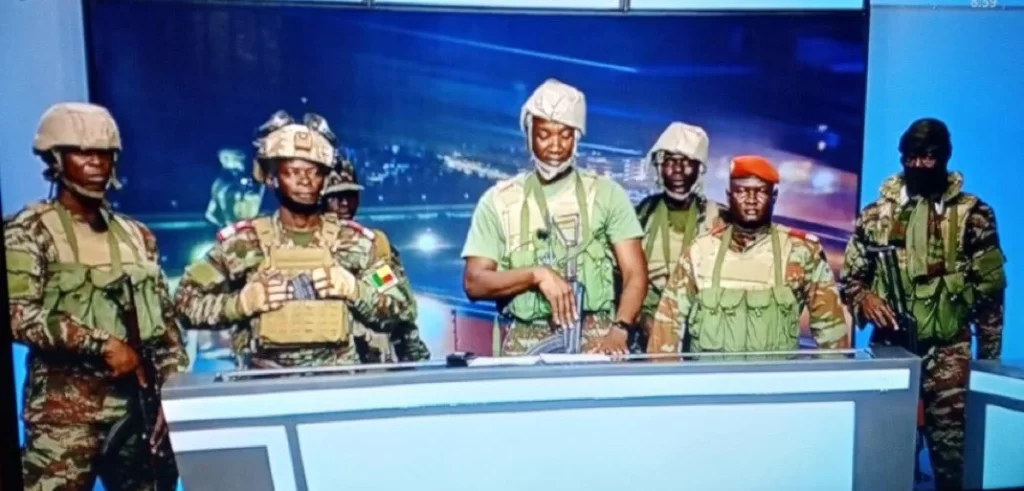
The most important factor is that Benin has already crossed a critical threshold: an attempted coup took place on 7 December 2025, just months before the elections. Mutinous soldiers attacked the presidential palace, seized parts of the state broadcaster, and declared the government removed before being suppressed by loyal forces.
This is significant because Benin had previously avoided coups since the 1990s, meaning the 2025 event signals a break in historical stability. The coup attempt itself was driven by grievances that remain unresolved, including dissatisfaction within the military, concerns over favoritism, deteriorating security in the north, and political restrictions.
At the same time, the 2026 election took place in a politically constrained environment where opposition forces were largely excluded and the ruling coalition dominated institutions. This creates a classic post-election risk dynamic: when political change becomes impossible through electoral means, pressure may shift toward extra-constitutional methods, including military intervention.
There is also a broader regional context. West Africa has experienced a wave of coups in recent years—in Mali, Burkina Faso, Niger, and Guinea—which lowers the normative barrier for military intervention. In fact, there are indications that regional actors linked to Sahel juntas may have had an interest in destabilizing Benin, particularly due to its strategic coastal position.
Despite these warning signs, several stabilizing factors significantly reduce the likelihood of a successful coup in the near term.
First, the 2025 coup attempt failed quickly, demonstrating that the core of the armed forces remains loyal to the state. Loyalist units were able to regain control within hours, suggesting that the military is not broadly fragmented or politicized at a systemic level.
Second, Benin benefits from strong regional and international backing. During the coup attempt, neighboring countries and regional organizations intervened rapidly, including military support from Nigeria and coordination through ECOWAS. This external deterrence is a critical factor, as it raises the cost of any future coup attempt and reduces its chances of success.
Third, although political space has narrowed, the country still maintains a degree of institutional continuity and economic stability compared to its neighbors. Stability in Benin is still seen as strategically important in a region experiencing widespread political volatility.
Post-Election Risk Dynamics
After the elections, the risk shifts from immediate military takeover to three more subtle scenarios.
The first is the possibility of renewed but fragmented coup attempts, especially from small factions within the military rather than a unified command. The 2025 case already showed that such attempts may emerge from limited groups rather than broad institutional consensus.
The second is low-intensity instability, where dissatisfaction within the army combines with external pressure from jihadist threats in northern Benin. Security stress is a key factor, as military frustration often increases when troops face casualties without sufficient support or recognition.
The third is long-term erosion of regime legitimacy, which does not immediately produce a coup but gradually increases the probability of one over time. When political competition is restricted and opposition channels are closed, military actors may begin to view themselves as alternative agents of change.
The risk of a coup in Benin after the elections is real but conditional. It is not driven by a single trigger, but by a combination of factors: restricted political competition, military grievances, regional contagion, and security pressures.
However, the state currently retains enough control, institutional coherence, and external support to prevent a near-term breakdown. What matters most is the trajectory, not the immediate moment. If the political system continues to exclude opposition and if military dissatisfaction deepens—especially under pressure from security challenges—the probability of another attempt will increase over time.
Benin is no longer the “coup-proof democracy” it once was, but it has not yet entered the cycle of repeated military takeovers seen elsewhere in West Africa. The failed 2025 coup marks a warning rather than a turning point.In the short term, the risk is contained. In the medium to long term, however, it is structural and growing, particularly if governance remains centralized and security pressures intensify.

More on this story: Nature Reserves Provide a Strategic Advantage for Insurgents in Benin