

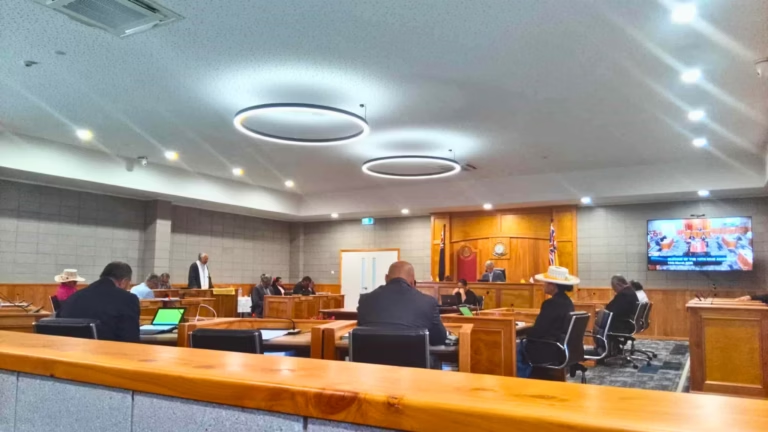
Niue’s parliamentary election on 2 May 2026 is less a contest between formal parties than a test of leadership, local legitimacy, and elite continuity in one of the world’s smallest self-governing polities. General elections are held every three years, and the 2026 vote follows the formal dissolution of the 18th Niue Assembly on 27 March 2026. In practical terms, the election will determine not only the composition of the Assembly, but also who can assemble a working majority to choose the next prime minister at the first sitting of the new parliament.
The structure of the political system is central to understanding the election. Niue has no formal political parties. Its 20-member Assembly is elected through a mixed system in which 14 members come from single-member village constituencies and 6 are elected from the common roll, a nationwide constituency. After the election, those 20 members choose the prime minister, who then appoints three other ministers from within the Assembly. That means the real struggle is not for a party majority in the conventional sense, but for a coalition of personalities and local representatives capable of controlling the post-election parliamentary arithmetic.
The situation before the election is defined by controlled continuity, but also by unmistakable signs of transition fatigue. Prime Minister Dalton Tagelagi entered the campaign as the incumbent and as the dominant figure of the outgoing government, having been re-elected prime minister in 2023 and continuing to lead a cabinet that included Crossley Tatui, Mona Ainu’u, and Sonya Talagi. At the same time, public reporting before the vote indicated that Tagelagi had signaled this could be his final term, while Speaker Hima Douglas was also departing, underscoring that Niue is entering a period in which generational and leadership change is becoming unavoidable.
Niue’s core political problems are not ideological in the usual left-right sense. They are structural and demographic. The island’s politics revolve around governance capacity, depopulation, economic sustainability, infrastructure resilience, and the persistent challenge of running a microstate with very limited human resources. The official record of recent Assembly business shows continued attention to infrastructure, communications, public safety, territorial-sea legislation, and youth-related measures, which suggests that the central public concerns remain practical rather than doctrinal. The 2024 constitutional referendum also reinforced this pattern: voters approved changing the title of the head of government from “Premier” to “Prime Minister,” but rejected expanding cabinet size and extending the parliamentary term from three to four years. That outcome suggested a public mood supportive of modest institutional adjustment, but not of enlarging the political class or reducing electoral accountability.
In that context, the main competitive forces in Niue are not parties but political camps organized around incumbency, personal reputation, village standing, and common-roll visibility. The first and most important force is the incumbent governing network around Tagelagi. Its electoral base lies in village-level trust, administrative continuity, and the argument that a small island state facing external and economic pressures needs experienced leadership. This camp benefits from incumbency, name recognition, and the ability to present itself as the custodian of stability. Its strength is most visible in the way a number of incumbents in both 2023 and 2026 either faced weak competition or were returned unopposed in some constituencies. In the current cycle, public reporting already indicated that some village seats were again effectively settled early, which is typical of a system where local standing often matters more than campaign spectacle.
The second force is the common-roll reformist and challenger space, which is less cohesive but politically significant. In Niue, the common roll often serves as the entry point for nationally known challengers, newer political figures, and candidates whose legitimacy is not tied to one village alone. The 2023 results are instructive here: they produced a sizeable turnover, with eight new MPs elected and several newcomers winning common-roll seats. Figures such as O’Love Jacobsen, Sonya Talagi, Emani Fakaotimanava-Lui, and Kahealani Hekau demonstrated that the common-roll electorate can reward broader name recognition, professional standing, or reformist appeal. This makes the common-roll contest the most volatile and nationally consequential part of the election.
The third force is the village-centered independent bloc, which is often decisive after the vote. These are not opposition or government parties in a formal sense, but MPs whose primary legitimacy comes from representing village interests rather than belonging to a national camp. In Niue’s system, such members can become kingmakers because prime ministerial power depends on post-election bargaining inside the Assembly. An MP elected on local prestige may support an incumbent government, demand concessions in exchange for support, or align with a challenger if that seems better for village interests or cabinet access. That is why Niue’s elections are often less about campaign rhetoric before polling day than about elite coalition-building afterward.
Who stands behind the leaders in Niue is also different from larger parliamentary systems. There is no evidence of party financiers, ideological machines, or mass donor networks in the conventional sense. What stands behind leaders instead are village structures, family networks, officeholders, senior civil servants, local reputations, and the political capital that comes from having delivered projects or maintained access to government. In Tagelagi’s case, the support base is clearly rooted in incumbency and ministerial control, reinforced by experienced colleagues in cabinet. Behind common-roll challengers, the support tends to come from wider social networks, cross-village recognition, and reputations built through public service or prior political involvement. The political elite in Niue is small enough that electoral competition is personal and relational rather than machine-driven. That makes individual credibility more important than ideology, but it also means leadership transitions can be abrupt when elite consensus shifts.
Foreign powers do matter, but mainly through the broader strategic environment rather than direct electioneering. Niue is self-governing in free association with New Zealand, and New Zealand remains the central external partner in institutional, economic, and constitutional terms. In late 2025, New Zealand publicly emphasized stronger economic and diplomatic ties with Niue, especially amid its tensions with the Cook Islands over transparency and China. That matters politically because it sharpens the contrast between Niue’s current external orientation and the more geopolitically contentious trajectories seen elsewhere in the Pacific. Niue’s election is therefore taking place in a regional environment where Pacific microstates are under growing pressure from strategic competition, but where Niue itself still appears closely anchored to Wellington.
China’s impact is indirect rather than dominant in this election. The broader Pacific context means all small island states are increasingly evaluated through the lens of Chinese influence, aid competition, and questions of transparency. But the publicly available evidence in this case points less to active Chinese intervention in the vote and more to a background strategic effect: Niue’s leadership will be judged partly on how it balances sovereignty, development needs, and its relationship with New Zealand. That makes the election geopolitically relevant even without overt foreign interference. The main external line of cleavage is not pro-China versus anti-China in an electoral sense, but continuity with Niue’s cautious, New Zealand-centered external orientation versus any future temptation to diversify partners more aggressively.
Polling in the conventional sense is almost absent. There is no robust public polling ecosystem for Niue comparable to larger democracies, and any claim of precise national vote forecasts should be treated with caution. The best available basis for forecasting is therefore structural rather than statistical. The incumbent camp starts with advantages in visibility and institutional continuity, but Niue’s recent electoral history also shows real volatility, especially in the common-roll seats. In 2023, several incumbents were unseated, eight new MPs entered the Assembly, and the common roll proved especially competitive. That pattern suggests 2026 is likely to produce a mix of continuity and selective turnover rather than a clean sweep by any one camp.
The most likely result is therefore a plural and mixed Assembly in which incumbents retain a meaningful bloc, village representatives remain highly autonomous, and the decisive question becomes whether Tagelagi or an alternative figure can secure the numbers for the prime ministership. A full anti-incumbent wave appears less likely than a negotiated post-election realignment. The strongest forecast is not that one “party” wins, since there are none, but that government formation will once again depend on post-election parliamentary bargaining, with the common-roll members and a handful of village independents holding disproportionate influence.
The consequences of the election will be important despite Niue’s small size. Domestically, the vote will determine whether Niue continues with experienced but aging leadership or begins a more visible transition to a newer political generation. Institutionally, it will test whether the political system can preserve continuity while adapting to demographic and governance pressures. If the incumbent camp retains control, the likely outcome is policy continuity, close alignment with New Zealand, and a continued emphasis on administrative stability. If a looser reformist coalition emerges, the immediate effect may be less a change in external orientation than a rebalancing of internal priorities, especially around governance style, cabinet composition, and elite renewal.
In strategic terms, Niue’s election matters because it illustrates how politics works in Pacific microstates where formal party competition is absent but geopolitical relevance is increasing. The election will not produce dramatic ideological change. But it will shape whether Niue remains a model of cautious continuity in the Pacific or begins to move toward a more fluid and competitive style of elite politics at a time when larger powers are paying much closer attention to the region.
At first glance, elections in Niue look marginal for U.S. interests. In reality, they matter because they sit inside a wider Pacific competition space where small states collectively shape access, alignment, and legitimacy.
The core issue is geography. Niue lies in a region the United States treats as part of its strategic rear area in the Indo-Pacific. While Niue itself hosts no major U.S. base, its political orientation contributes to the broader alignment pattern across Pacific island states. In an environment where China is expanding diplomatic, economic, and security engagement, even small shifts in governance or external partnerships can accumulate into a regional balance change. For Washington, the concern is not Niue alone, but whether the Pacific remains a network of states broadly aligned with U.S. partners.
A second layer is alliance architecture. Niue is in free association with New Zealand, one of the United States’ closest security partners. Stability and alignment in Niue reinforce New Zealand’s role as a reliable anchor in the South Pacific. If political change in Niue were to complicate that relationship or open space for alternative external actors, it would indirectly affect U.S. influence. In this sense, the election is relevant because it touches the integrity of allied networks, not because of direct bilateral ties.
Third, there is the issue of precedent and signaling. Pacific microstates are closely watched by one another. If a country like Niue were to diversify its external partnerships in ways that increase Chinese presence—through infrastructure, financing, or security cooperation—it could encourage similar moves elsewhere. The United States is particularly sensitive to this dynamic after cases like the Solomon Islands, where security agreements with China altered regional perceptions. Even a modest shift in Niue would therefore be read in Washington as part of a pattern, not an isolated event.
Another dimension is governance and strategic access. The United States prioritizes a Pacific environment where states remain transparent, stable, and resistant to external coercion. Elections in Niue test whether leadership remains anchored in this model or begins to explore more transactional foreign policy approaches. Given that small states often negotiate access, connectivity, and infrastructure with external partners, political leadership determines whether such arrangements remain within a Western-aligned framework or become more open to competing powers.
There is also a softer but still important factor: legitimacy. The U.S. strategy in the Pacific increasingly relies on partnerships framed around sovereignty, development, and democratic governance. Elections—even in very small states—reinforce or weaken that narrative. A stable, credible electoral process in Niue supports the broader U.S. argument that Western-aligned Pacific states offer a governance model distinct from authoritarian alternatives. Conversely, any perception of instability or elite capture creates openings for competing narratives.
Finally, the importance of the election lies in cumulative effect. One election in Niue will not shift the strategic balance. But taken together with elections across the Pacific, it contributes to the long-term alignment map of the region. For the United States, the risk is not a sudden loss of influence, but gradual erosion through a series of small adjustments by multiple states.In practical terms, Washington is not focused on who wins in Niue in a narrow political sense. What matters is whether the outcome preserves a trajectory of alignment with New Zealand, openness to Western partnerships, and caution toward deeper engagement with China. If those conditions hold, the election reinforces the existing regional order. If they begin to shift, even slightly, it becomes another data point in a broader strategic trend that the United States is actively trying to manage.