
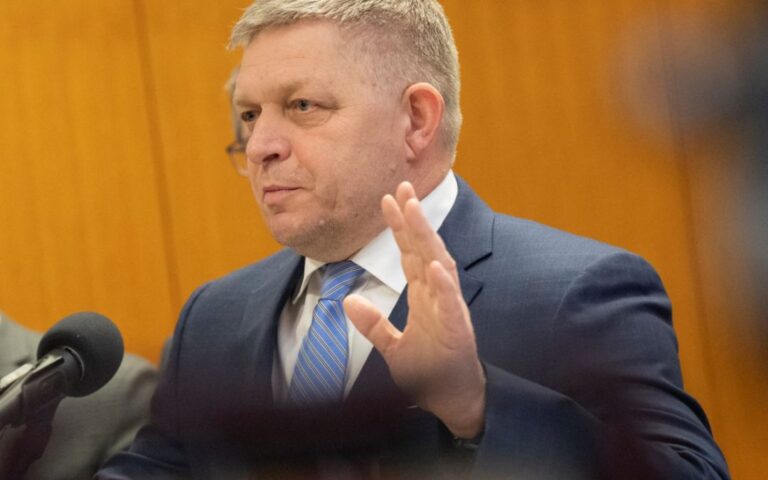
The European Parliament has adopted a resolution calling for the possible suspension of EU funding to Slovakia over violations of democratic principles. By a majority vote (418 in favor, 207 against), Members of the European Parliament urged the European Commission to consider freezing financial support due to breaches of the rule of law by the government of Robert Fico.
European lawmakers expressed concern over the dismantling of key anti-corruption institutions, including the National Criminal Agency (NAKA) and the Special Prosecutor’s Office, as well as the politicization of whistleblower protection mechanisms and allegations of fraud involving EU funds. They drew comparisons between Fico’s policies and the governance model associated with Viktor Orbán.
Although the resolution is political in nature and not legally binding, it significantly increases pressure on Bratislava.
The resolution serves as a warning signal to the Slovak government, as it raises the prospect of freezing funding and imposing sanctions in response to actions by the Fico administration that undermine fundamental rule-of-law principles and enable potential financial misconduct. The dismantling of key anti-corruption bodies such as NAKA and the Special Prosecutor’s Office indicates a deliberate erosion of the system of checks and balances—an essential pillar of democratic governance—and creates conditions conducive to abuse of power and corruption.
Fico and Orban use Brussels as a political counterweight—an external actor they can blame for economic hardship, migration pressures, or regulatory constraints.
- It reframes internal problems as externally imposed. It mobilizes voters around sovereignty and “national dignity”. This is especially effective in countries where EU policies are seen as distant or technocratic.
Criticism of the EU often accompanies institutional reshaping at home weakening anti-corruption bodies; politicizing judiciary or media; reducing independent oversight.
Orbán has institutionalized this model over a decade. Fico is moving in that direction, but hasn’t fully consolidated it.
Migration is the most powerful shared narrative tool framed as a security and identity threat; used to oppose EU relocation or asylum policies; tied to sovereignty arguments.
This links directly to hybrid pressures from Belarus and Russia, making the rhetoric appear grounded in real threats, even when politically amplified.
Both leaders maintain softer positions toward Moscow compared to mainstream EU governments opposing sanctions or slowing consensus; advocating “pragmatic dialogue”.
Anti-EU rhetoric helps justify this by portraying Brussels as ideological and detached from national interests.
Electoral logic: polarization works.
Their rhetoric creates a binary political space “national government vs Brussels elites”; “traditional values vs liberal agenda”. This polarization benefits incumbents by weakening fragmented opposition.
Despite similarities, there are structural differences:
Fico operates in a contested environment.
Could Fico repeat Orbán’s electoral success in 2027
Scenario 1: Orbán-style consolidation (moderate probability)
Fico could replicate Orbán’s trajectory if: he continues dismantling anti-corruption institutions; opposition remains divided; economic conditions do not sharply deteriorate. Anti-EU + migration narratives remain dominant. This would require institutional entrenchment before 2027.
Scenario 2: Electoral survival without full dominance (most likely)
Fico wins or remains competitive, but: institutions remain partially pluralistic. EU pressure constrains deeper authoritarian shift. opposition retains mobilization capacity. Slovakia becomes Hungary-lite.
Scenario 3: Political backlash (increasing risk)
Fico could lose if: EU funding is frozen or reduced (economic impact), corruption scandals escalate; opposition unifies; public perceives democratic rollback. Unlike Hungary, Slovakia still has higher volatility.
Key variables to watch before 2027
EU funding decisions and rule-of-law mechanisms. Cohesion or fragmentation of opposition parties. Economic performance (inflation, growth, energy prices). Degree of control over judiciary and media. External influence (Russia-related narratives, hybrid pressure).
Strategic assessment
Orbán’s model is exportable in rhetoric, but harder to replicate structurally.
Fico is adopting the playbook, but lacks Orbán’s time horizon; faces stronger institutional and EU constraints; operates in a more competitive political environment.
dAnti-EU rhetoric is a tool, not an ideology—used to consolidate power; justify institutional changes; mobilize voters.Fico can partially replicate Orbán’s trajectory, but a full transformation into a Hungarian-style system by 2027 would require accelerated institutional control and favorable political conditions.
The most realistic outcome is hybridization, not duplication.
Russian Influence Vectors: Slovakia vs Hungary
Energy Dependence (Primary Structural Vector)
| Dimension | Slovakia | Hungary |
| Oil dependence | ~75% Russian oil | ~90%+ Russian oil |
| Gas dependence | Majority via TurkStream | Dominant Russian supply |
| Nuclear fuel | 100% dependent | Strong Russian involvement |
Evidence: Both countries continue importing Russian energy despite EU diversification efforts
Assessment:
- Hungary = high structural dependency (strategic vulnerability)
- Slovakia = high but declining (transition phase)
Impact:
Energy is the strongest leverage tool Russia has in both states.
Political Alignment & Policy Obstruction
Hungary: Systematic blocking or delaying of EU sanctions; Long-term alignment with Moscow’s positions; Direct political communication channels with Russian leadership.
Slovakia: Increasing alignment under Robert Fico; Suspension of military aid to Ukraine; Opposition to sanctions framed as economic protection.
Evidence: Slovakia and Hungary have coordinated to resist sanctions and protect Russian-linked interests
Assessment: Hungary = institutionalized pro-Russian policy.
Slovakia = emerging alignment, less entrenched
Russian oligarch interests linked to political lobbying. Attempts to remove sanctioned individuals from EU lists.
Informal political coordination between Budapest, Bratislava, and Moscow.
Evidence: Leaked communications show Hungarian and Slovak officials coordinating with Russia on sanctions relief
Assessment:
This vector is high-impact but opaque, operating through elite-level influence rather than public policy.
Slovakia: Use of pro-Russian alternative media ecosystems. Political figures (including Fico allies) appear on platforms spreading Kremlin narratives. Evidence: Slovak political actors engage with outlets known for Russian-aligned disinformation.
Hungary
Stronger centralized media control. Government-aligned messaging often mirrors Kremlin narratives. Institutional amplification of anti-EU and anti-Ukraine discourse
Key Analytical Takeaways
Hungary = Russia’s “systemic ally” in the EU
Long-term institutional capture. Ideological convergence. Predictable obstruction behavior.
Slovakia = “swing state under influence”
- Not fully aligned;
- Still constrained by EU and domestic opposition
- Influence is growing but reversible
Different models of influence
- Hungary:
→ Top-down, institutional, ideological. - Slovakia:
→ Bottom-up + elite-driven, opportunistic.
Strategic Conclusion
Russia applies a multi-vector influence strategy, but:
This distinction is critical Hungary represents a stable node of Russian leverage inside the EU
Slovakia represents a contested battleground where influence is still being consolidated.