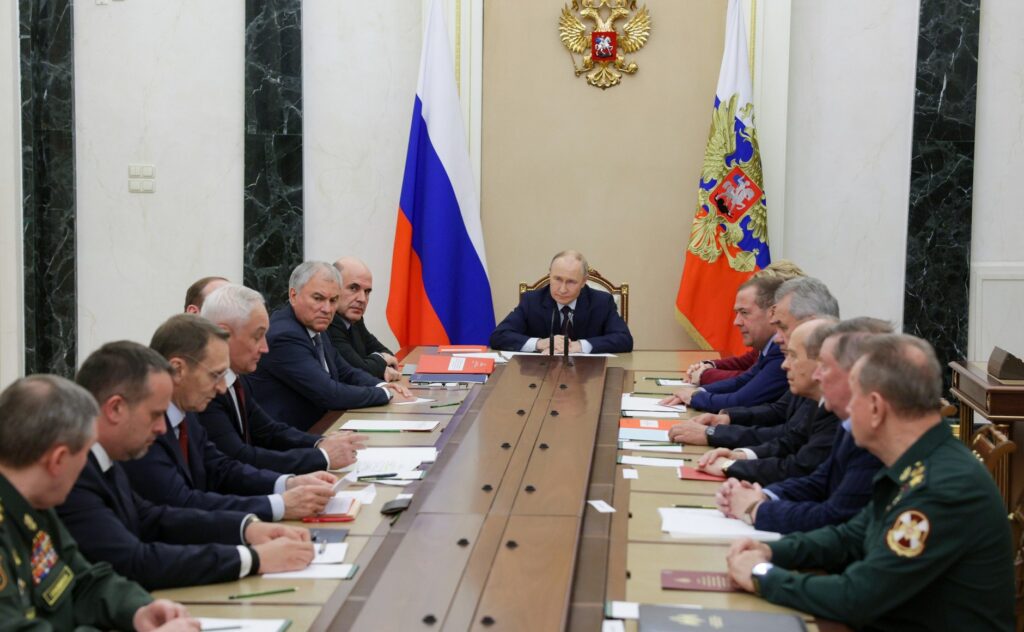

Gennady Gatilov, Russia’s permanent representative to the United Nations in Geneva, stated that Moscow has prepared “adequate response measures” in the event that France increases the scale of its nuclear arsenal or if other NATOmembers advance similar initiatives.
According to the diplomat, the Russian leadership is closely monitoring developments, including proposals by Emmanuel Macron to extend French nuclear deterrence to cover all of Europe, as well as the potential transfer of Dassault Rafaleaircraft equipped with nuclear warheads to Germany.
Gatilov emphasized that despite its official posture of “restraint,” Russia is prepared to act symmetrically to ensure its own security should Paris move toward concrete steps to expand its nuclear influence.
The statement by Russia’s UN representative regarding “adequate response measures” forms part of the Kremlin’s broader rhetoric of nuclear intimidation and coercion, aimed at obstructing the integration of European Union defense capabilities and undermining collective European security.
Russia is using French initiatives as an informational pretext to accuse NATO countries of escalating threats and to justify its own aggressive policies, despite the fact that Paris’s plans are defensive in nature.
The statement by Gennady Gatilov should be understood less as a concrete policy signal and more as part of a calibrated deterrence narrative designed to shape European decision-making. Moscow is not reacting to an immediate change in nuclear posture by France, but to the political trajectory implied by initiatives associated with Emmanuel Macron—namely, the gradual Europeanization of nuclear deterrence.
At its core, this rhetoric reflects Russian concern about a structural shift in Europe’s strategic architecture. For decades, nuclear deterrence in Europe has been anchored primarily in U.S. capabilities under NATO. French proposals to extend its nuclear umbrella—whether formally or informally—introduce the possibility of a more autonomous European deterrent layer. From Moscow’s perspective, this complicates escalation management by adding another nuclear decision center that is geographically closer, politically motivated by regional threats, and potentially less constrained by transatlantic consensus.
The reference to “symmetrical measures” is deliberately ambiguous. It does not necessarily imply a direct mirroring of French capabilities but signals Russia’s willingness to adjust its posture across multiple domains: forward deployment of nuclear-capable systems, doctrinal recalibration, or intensified signaling through exercises. This ambiguity is strategic. It maximizes psychological pressure while preserving operational flexibility.
The mention of potential transfers of nuclear-capable Dassault Rafale aircraft to Germany is particularly telling. Even if such plans remain speculative or politically constrained, Moscow is preemptively framing them as escalatory. This serves two purposes. First, it seeks to create friction within Europe by amplifying sensitivities around nuclear sharing, especially in countries with strong domestic opposition to nuclear weapons. Second, it attempts to delegitimize any movement toward deeper European defense integration by portraying it as inherently destabilizing.
More broadly, this messaging fits into Russia’s established playbook of nuclear signaling since the start of its confrontation with the West over Ukraine. Nuclear rhetoric is used not primarily to prepare for use, but to shape the strategic environment—to deter incremental policy shifts by raising their perceived risks. By labeling defensive European initiatives as escalation, Moscow aims to invert the narrative: positioning itself as reactive while casting Europe as the destabilizing actor.
However, the effectiveness of this strategy is diminishing. European states are increasingly interpreting such statements as routine coercive signaling rather than credible indicators of imminent escalation. This reduces their deterrent value while potentially encouraging further integration of European defense capabilities. In this sense, Russia faces a paradox: continued reliance on nuclear rhetoric may reinforce the very dynamics—greater European strategic autonomy and cohesion—that it seeks to prevent.
At the same time, the risks should not be understated. Even if primarily rhetorical, repeated references to nuclear “responses” lower the threshold of discourse and normalize escalation language. This increases the probability of miscalculation, particularly in crisis scenarios where signaling could be misinterpreted as intent.
In strategic terms, the statement signals that Russia views emerging European nuclear discussions not as marginal policy debates but as a potential inflection point. The contest is no longer only about military capabilities; it is about who defines the rules of deterrence in Europe.
When NATO decided to deploy U.S. Pershing II and cruise missiles in Europe in response to Soviet SS-20 deployments, Moscow launched a sustained campaign of nuclear intimidation. The USSR portrayed NATO’s move as aggressive escalation, despite the fact that it was a response to Soviet deployments. Soviet leaders threatened countermeasures, including additional missile deployments and targeting European capitals.
The objective was not purely military—it was political. Moscow sought to fracture Western unity by mobilizing anti-nuclear movements in countries like West Germany and the Netherlands. This mirrors today’s attempt to exploit divisions within Europe over French nuclear initiatives.
2. Soviet SS-20 Deployment and Forward Nuclear Posturing
RSD-10 Pioneer
The USSR deployed SS-20 intermediate-range nuclear missiles capable of striking Western Europe with little warning. When NATO reacted, Moscow framed its own deployments as defensive and accused the West of escalation. This inversion—presenting offensive capability as defensive necessity—is directly echoed in current Russian narratives.
3. Able Archer 83 Crisis
Able Archer 83
During this NATO exercise simulating nuclear escalation, the Soviet leadership interpreted Western signaling as potentially real. In response, it reportedly placed nuclear forces on heightened alert.
While different in context, the lesson is critical: persistent nuclear signaling and mistrust can create conditions where routine actions are misread as preparation for war. Today’s rhetoric carries a similar risk of misinterpretation, especially as multiple nuclear actors are involved.
4. French Nuclear Autonomy and Soviet Reactions
Charles de Gaulle
When France developed its independent nuclear force (“force de frappe”), the USSR viewed it as destabilizing because it introduced an additional nuclear decision center outside U.S. control. Soviet rhetoric warned that independent European nuclear capabilities could complicate deterrence and increase risks.
This is almost identical to current concerns about proposals linked to Emmanuel Macron—the fear is not just capability, but loss of predictability in nuclear decision-making.
The Soviet Union repeatedly used nuclear rhetoric as a political instrument, not just a military signal. The key elements then and now are label Western defensive measures as escalation; Threaten “symmetrical” or unspecified responses; Exploit divisions within Europe; Use ambiguity to amplify psychological pressure.
What is different today is the strategic environment. During the Cold War, deterrence was largely bipolar and structured. Now it is more fragmented, with additional actors and less stable communication channels. This makes similar rhetoric potentially more dangerous, even if its intent remains largely coercive rather than operational.
Today’s Russian messaging is not new—it is a continuation of a well-established Soviet playbook, adapted to a more complex and less predictable security landscape.
Russia’s objective is not singular; it operates on three simultaneous tracks—delay, divide, and, if possible, block—with priority shifting depending on feasibility.
At the strategic level, Moscow’s preferred outcome is to block the emergence of a European nuclear role led by France. A more autonomous European deterrent would reduce Russia’s ability to manage escalation through a primarily U.S.-centric framework within NATO. It would introduce an additional nuclear decision-making center closer to Russia’s borders, potentially more threat-sensitive and less constrained by transatlantic political balancing. From the Kremlin’s perspective, this would complicate deterrence stability and weaken its leverage over European security dynamics.
However, Moscow likely assesses that fully blocking this trajectory is difficult in the current geopolitical environment. As a result, its operational focus shifts to delay and division, which are more achievable in the near term.
Delay is pursued through nuclear signaling and escalation rhetoric. Statements such as those by Gennady Gatilov are designed to raise the perceived risks of European nuclear integration. By framing French initiatives as escalatory, Russia seeks to slow decision-making processes, increase political caution, and force European governments to weigh domestic and alliance-level costs more heavily. The goal is to stretch timelines, not necessarily to stop the process outright.
Division is the most effective and actively exploited line of effort. European states are not unified on nuclear issues. Some—particularly in Eastern Europe—favor stronger deterrence, while others remain politically and socially resistant to nuclear expansion. Russia amplifies these differences by targeting public opinion, political parties, and strategic narratives in key countries. The aim is to prevent consensus around any French-led initiative and keep Europe dependent on existing, fragmented deterrence structures.
In practice, these three objectives reinforce each other. By deepening divisions, Russia makes it harder for Europe to act collectively; by delaying decisions, it preserves its current strategic environment; and by sustaining both, it keeps open the possibility of effectively blocking the emergence of a coherent European nuclear role.
In short, Russia’s strategy is layered: block if possible, delay where necessary, and divide at all times.
Question: Under what conditions could rhetorical nuclear signaling transition into actual force posture changes?
What are the risks of misinterpretation of exercises or deployments similar to past crises like Able Archer 83?
if Moscow concludes that Europe is moving from debate to implementation: formal French consultations with allies, basing arrangements, nuclear-sharing mechanisms, or integration of French deterrence into European defense planning. Russia would likely respond first with exercises, publicized inspections, and forward movement of dual-capable systems rather than immediate warhead deployment.
Second, if Russia sees a direct military shift near its borders: new NATO nuclear-capable aircraft deployments, expanded infrastructure in Poland, the Baltics, Germany, or Romania, or deeper NATO nuclear planning. Russia has already used Belarus as a forward nuclear-signaling platform, and analysts describe Russian nonstrategic nuclear deployments there as a meaningful shift in posture.
Third, if battlefield pressure in Ukraine or a crisis on NATO’s eastern flank creates a perception in Moscow that conventional deterrence is weakening. In that case, nuclear signaling could become compensatory: raising readiness, conducting nuclear drills, moving delivery systems, or publicly rehearsing “de-escalation” options.
Fourth, if the Kremlin needs political coercion inside Europe. Even without intent to use nuclear weapons, posture changes can be used to frighten publics, strengthen anti-nuclear parties, and divide NATO.
The Able Archer 83 risk is relevant because misinterpretation does not require irrationality; it requires tension, poor communication, and ambiguous indicators. In 1983, NATO conducted a planned command-and-control nuclear exercise during a period of high U.S.-Soviet tension, shortly after the Soviet shootdown of KAL 007 and ahead of NATO INF deployments. Declassified analysis later emphasized the danger that Soviet reactions were initially underestimated and that intelligence assumptions became too rigid.
Today, the main risk is that routine exercises, such as NATO’s Steadfast Noon, which NATO describes as long-planned, transparent, and involving no live weapons, could still be framed by Russia as preparation for escalation. Conversely, Russian-Belarusian nuclear drills may be read by NATO states as more than signaling, especially if combined with cyberattacks, sabotage, airspace violations, or force movements.
The most dangerous scenario would be a compressed crisis: a major Russian setback in Ukraine, a NATO reinforcement exercise, Russian nuclear-capable systems moving in Belarus or Kaliningrad, and mutual information operations portraying the other side as preparing escalation. Under those conditions, each side could interpret precautionary moves as offensive preparation.
Thus, the probability of deliberate nuclear use remains low, but the risk of dangerous misreading rises sharply when rhetoric, exercises, forward deployments, and political crisis occur simultaneously.
European reactions to French nuclear initiatives are converging in direction but diverging in pace, scope, and political comfort. The common thread is growing openness to a stronger European deterrent layer—driven by Russia’s behavior—combined with different national constraints.
Germany
Germany treats French proposals as a useful complement, not a replacement for the U.S. nuclear umbrella within NATO. Berlin’s priority is continuity of U.S. extended deterrence and NATO nuclear sharing; anything French-led is framed as additive and politically sensitive.
Support is therefore cautious and incremental: deeper consultations with France, participation in dialogue on doctrine, and interest in interoperability (e.g., dual-capable aircraft, command-and-control coordination). Domestic constraints—historical anti-nuclear sentiment, coalition politics, and legal/constitutional sensitivities—limit overt steps such as hosting additional nuclear assets under a French framework.
Bottom line: Germany is quietly supportive of dialogue and capability integration, but avoids moves that could look like a parallel nuclear arrangement outside NATO.
Poland
Poland is the most forward-leaning. Warsaw views French initiatives as a way to thicken deterrence on NATO’s eastern flank and reduce reliance on a single guarantor. It is open to tangible measures—expanded nuclear consultations, greater visibility of deterrence, and potentially hosting or supporting additional capabilities (whether U.S.- or France-linked) if politically feasible.
Poland also pushes to embed any French role within NATO structures, ensuring alliance coherence and U.S. buy-in. The risk tolerance is higher given Poland’s threat perception, and domestic politics are more permissive of robust deterrence steps.
Bottom line: Poland is proactive and supportive, seeking practical enhancements while keeping NATO central.
Baltic States (Estonia, Latvia, Lithuania)
Estonia, Latvia, and Lithuania strongly favor any credible strengthening of deterrence, including a French contribution. Their assessment is threat-driven: proximity to Russia and limited strategic depth make additional nuclear signaling and assurance valuable.
In practice, they emphasize political endorsement and alliance integration rather than hosting nuclear assets, given geographic vulnerability and escalation risks. They advocate frequent consultations, visible exercises, and clearer messaging that Europe has multiple layers of deterrence.
Bottom line: the Baltics are politically supportive and strategically aligned, but focus on reassurance and integration rather than basing.
Cross-cutting dynamics
- NATO primacy: All actors insist French initiatives complement, not compete with, NATO’s nuclear framework.
- Consultations first, deployments later: Near-term support centers on doctrine, planning, and signaling; physical deployments are the most politically sensitive step.
- Division lines: Germany’s caution vs. Poland/Baltics’ urgency is the main fault line Moscow seeks to exploit.
- Trajectory: If French initiatives remain consultative and NATO-embedded, support will broaden. If they move toward autonomous European nuclear arrangements, resistance—especially in Germany—will rise.
Net assessment: Europe is edging toward a layered deterrence model—U.S. backbone, NATO.
Russia would not choose a single lane; it would sequence responses—hybrid first, conventional next, nuclear as a backstop—based on risk, visibility, and reversibility.
Primary: hybrid and information countermeasures.
Moscow’s default is to shape the environment before it moves forces. Expect intensified influence operations, cyber activity, and covert disruption aimed at fracturing consensus around any French-led initiative and raising political costs inside NATO states. These tools are deniable, scalable, and cheap, and they target the decision cycle directly (public opinion, parliaments, coalition politics).
Secondary: calibrated conventional signaling.
If political shaping is insufficient or Europe moves toward implementation, Russia is likely to escalate with visible but controlled military steps: snap exercises, higher readiness, and repositioning of dual-capable systems in areas like Kaliningrad Oblast and via cooperation with Belarus. The aim is deterrence by demonstration—credible enough to be noticed, Tertiary: nuclear signaling as coercive ceiling.
Nuclear tools are reserved for signaling, not use, unless Moscow perceives a severe deterioration in its deterrence position. This includes rhetorical warnings, doctrinal messaging, exercises involving nuclear-capable units, and possibly adjustments in readiness. Statements by officials such as Gennady Gatilov fit this layer—designed to amplify perceived risks and slow European decisions.
Russia is most likely to prioritize hybrid measures, use conventional deployments for credibility, and keep nuclear signaling as a coercive cap—escalating stepwise while preserving room to de-escalate.
The United States broadly accepts that Europe will assume more responsibility for its own defense, but it seeks to shape any move toward a more autonomous European nuclear posture so that it strengthens—rather than fragments—NATO deterrence.
At the strategic level, Washington’s core interest is preserving the credibility of U.S. extended deterrence in Europe. The U.S. nuclear umbrella remains the backbone of NATO, and American policymakers are wary of parallel structures that could dilute unified command, complicate escalation management, or create ambiguity in crisis decision-making. For this reason, U.S. officials tend to frame French-led initiatives not as alternatives, but as complements embedded within NATO frameworks.
In practice, the U.S. is shaping this evolution in three main ways.
First, through institutional anchoring. Washington encourages deeper consultations between France and other European allies, but insists that these discussions remain linked to NATO’s Nuclear Planning Group and broader alliance structures. The objective is to ensure that any expansion of France’s role enhances collective deterrence rather than creating a separate European nuclear pole.
Second, through capability integration and burden-sharing. The U.S. supports European efforts to modernize conventional forces and increase defense spending, seeing this as essential to a more balanced transatlantic partnership. In the nuclear domain, this translates into support for dual-capable aircraft, interoperability, and shared planning processes. Washington is comfortable with Europe becoming more capable, as long as those capabilities are interoperable with U.S. systems and reinforce alliance cohesion.
Third, through quiet boundary-setting. While publicly supportive of European defense initiatives, the U.S. signals—often privately—that it is cautious about steps that could lead to full strategic autonomy in the nuclear sphere. This includes concerns about independent European nuclear command structures or arrangements that might weaken U.S. political influence over escalation decisions.
At the same time, U.S. thinking is evolving. The war in Ukraine and shifting global priorities, particularly in the Indo-Pacific, have increased interest in greater European self-reliance. From Washington’s perspective, a stronger European pillar—potentially including a more prominent role for France—could enhance overall deterrence, provided it does not undermine transatlantic unity.
The U.S. therefore faces a balancing act. It wants Europe to do more, but not to act independently in ways that reduce coordination. It supports diversification of deterrence, but not fragmentation. And it recognizes that initiatives associated with Emmanuel Macron reflect a real strategic shift in Europe, even as it works to channel that shift into NATO-compatible forms.In essence, Washington’s approach is to enable, shape, and constrain simultaneously: enabling greater European capability, shaping it through NATO integration, and constraining it where it risks undermining alliance coherence.
More on this story:T he Global Consequences of a Nuclear Detonation in Low Earth Orbit