


Belarus has continued to systematically direct migrants toward the Latvian border. According to the Latvian Border Guard, following a relatively calm winter, a steady flow of irregular migrants resumed in April 2026, and officials expect the influx this year to remain broadly at the level observed in 2025. The conflict in the Middle East is likely to further increase the number of migrants from the region attempting to reach the borders of Latvia and other Baltic states.
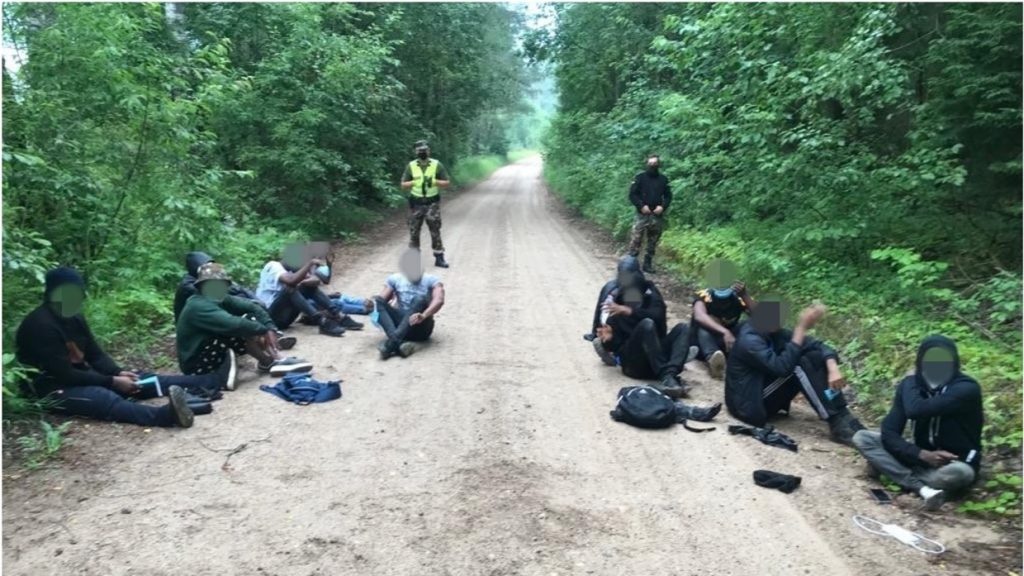
In recent years, Latvia has faced sustained migration pressure from Belarus, which Baltic governments interpret as a form of hybrid aggression. The Latvian Border Guard regularly reports dozens of attempted illegal crossings, forcing Riga to maintain heightened security measures and deploy additional military and police resources.
The situation is further complicated by the deliberate use of migration flows to destabilize the internal situation within the European Union and to exhaust the resources of the Baltic states. This activity is widely viewed as part of a coordinated strategy by Moscow and Minsk aimed at maintaining constant pressure along NATO’s eastern flank.
Russia and Belarus are using migrants from the Middle East as an instrument to provoke persistent tension along the borders of the European Union. The artificial creation of migration pressure is intended to overload and disperse the efforts of Baltic border services, while also testing NATO’s response to hybrid threats.
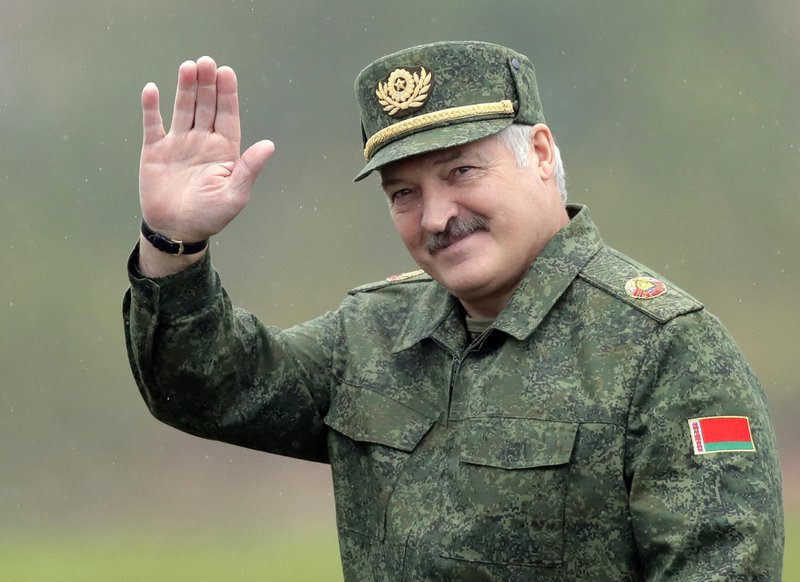
The escalation of tensions in the Middle East is generating new waves of refugees attempting to reach the EU via Russian and Belarusian territory. The Lukashenko regime is exploiting this dynamic to intensify migration pressure on the borders with the Baltic states.
In effect, the Belarusian and Russian regimes have turned themselves into logistical “operators,” organizing the transport of migrants to the borders of Latvia and other Baltic countries. There are documented cases of Belarusian authorities facilitating the movement of irregular migrants to border areas and providing them with the necessary means to attempt illegal crossings.
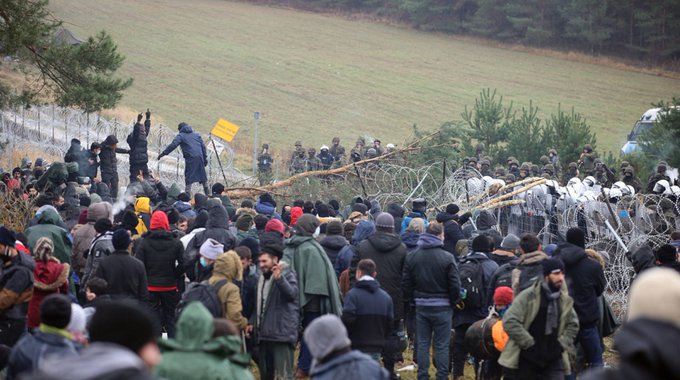
Repeated attempts by large groups of migrants to breach the border pose a direct threat to the national security of the Baltic states and the European Union. These incidents are often accompanied by aggressive behavior and provocations, forcing Riga and neighboring capitals to deploy additional army and police units.
Latvian intelligence services confirm the direct involvement of Belarusian officials and military personnel in organizing the transfer of migrants to the EU border. Security forces under the Lukashenko regime not only coordinate group movements but also guide migrants toward weak points along the border and actively facilitate illegal crossing attempts.
The use of migrants constitutes a component of hybrid warfare aimed at destabilizing internal security and provoking political divisions within the European Union. This is further amplified by the involvement of human rights organizations that defend these migration flows, collectively increasing psychological and administrative pressure on democratic Western institutions and potentially forcing them into concessions in dialogue with authoritarian regimes.
The renewed flow of irregular migrants toward Latvia in 2026 should not be viewed as a humanitarian spillover from the Middle East alone, but as a deliberately engineered instrument of hybrid warfare orchestrated by the regimes in Minsk and Moscow.
Following a temporary seasonal decline, the resurgence of migration pressure in April 2026 reflects intentional reactivation, not spontaneous dynamics. The synchronization of flows with geopolitical developments—particularly escalating instability in the Middle East—indicates that Belarus is exploiting external crises as a force multiplier, converting refugee movements into a controllable geopolitical tool.
At the operational level, the Belarusian state has evolved from passive facilitator to active logistics coordinator. Evidence provided by Latvian authorities points to organized transport of migrants to border zones, provision of equipment, and direct guidance by Belarusian security personnel toward vulnerable segments of the EU’s external border. This demonstrates a level of state involvement consistent with planned and sustained hybrid operations, rather than opportunistic border pressure.
Crucially, this activity is not autonomous. It aligns with broader Russian strategic objectives. Moscow’s interest lies in maintaining persistent, low-intensity pressure on NATO’s eastern flank, forcing the Alliance into a reactive posture. In this framework, Belarus functions as a forward-operating proxy, enabling Russia to exert pressure while preserving plausible deniability and avoiding direct escalation.
The strategic logic behind weaponized migration operates across several dimensions.
First, it aims at resource attrition. Continuous border incidents require Latvia and other Baltic states to maintain elevated readiness levels, diverting military, police, and financial resources away from other security priorities. Over time, this creates structural strain, particularly for smaller states with limited capacity.
Second, it seeks to fragment political cohesion within the European Union. Migration remains one of the most divisive issues in European politics. By artificially increasing pressure, Minsk and Moscow aim to amplify internal disagreements between member states, as well as between governments and civil society actors. This includes exploiting tensions between security imperatives and human rights obligations.
Third, it serves as a testing mechanism for NATO response thresholds. Unlike conventional military provocations, migration pressure operates in the grey zone—below the level of armed attack but above routine border management challenges. This allows Russia and Belarus to probe Alliance unity, decision-making speed, and willingness to escalate in response to non-kinetic threats.
Fourth, the tactic generates psychological pressure and normalization effects. Repeated incidents, even if limited in scale, contribute to a sense of permanent instability. Over time, this risks desensitizing both policymakers and publics, lowering the threshold for acceptance of hybrid coercion as a “new normal.”
The role of Middle Eastern instability is instrumental rather than causal. Conflicts in the region provide a supply of vulnerable populations, but it is the deliberate routing through Russian and Belarusian territory that transforms migration into a geopolitical weapon. This distinction is critical: the crisis is not merely external—it is actively manufactured at the EU’s borders.
Latvian intelligence assessments indicating direct involvement of Belarusian officials and security forces further reinforce the conclusion that this is a state-directed operation. The identification of weak points along the border and the coordination of group movements suggest premeditation and tactical planning.
From a broader strategic perspective, the use of migration as a tool of pressure reflects a consistent pattern in Russian hybrid warfare doctrine: the instrumentalization of non-military vectors—energy, information, and now human flows—to achieve strategic effects without crossing conventional red lines.
The implications are significant. Weaponized migration blurs the boundary between internal and external security, complicates legal and political responses, and creates persistent vulnerabilities in democratic systems. It also challenges existing deterrence frameworks, which remain primarily designed for military threats.
In conclusion, the situation on the Latvian border is not an isolated migration issue but part of a systemic hybrid campaign. Belarus, acting in alignment with Russian strategic interests, is leveraging human mobility as a tool of coercion. The objective is not territorial gain, but strategic disruption—eroding EU cohesion, exhausting frontline states, and testing NATO’s ability to respond to unconventional threats.
There is now substantial, multi-source evidence—from government data, intelligence findings, and independent reporting—that Belarus (with alignment from Russia) is not merely a transit route, but an active organizer of migrant pressure on EU borders. The evidence falls into several categories:
The strongest evidence comes from official Latvian military and border guard findings (2026):
- Belarusian law enforcement and military units are directly involved in directing migrants to the Latvian border; Migrants have been transported using Belarusian military vehicles; Officials have coordinated and organized illegal crossing attempts. This moves the phenomenon from smuggling to state-orchestrated operations.
2. Physical evidence linking military units
Latvian authorities reported concrete, traceable proof:
- Military documents and communication equipment belonging to a Belarusian soldier were found on detained migrants; The materials were linked to a reconnaissance battalion of the Belarusian army; Photos and equipment (radios, gear) suggest direct operational contact between migrants and military personnel.
This is critical: it indicates not just facilitation, but operational integration.
Evidence shows active physical guidance: Belarusian border guards have been recorded escorting migrants to crossing points. They identify weak points in border defenses and direct groups there (reported by Baltic intelligence and border services). In earlier phases of the crisis, migrants reported being given tools (e.g., cutters) and instructions for crossing. This indicates intentional penetration tactics, not spontaneous migration.
Investigations and EU reporting show a structured system .Belarus used state-controlled travel networks and flights from the Middle East to bring migrants in.
Migrants are then moved internally toward EU borders in organized groups. There are documented cases of accommodation coordination, transport to border zones, repeated attempts forced or encouraged by authorities. This resembles a state-managed logistics chain, not irregular migration.
Evidence suggests migrants are not acting freely: Belarusian forces have prevented migrants from returning inland.Reports of intimidation, coercion, and forced repeated crossing attempts. Migrants effectively become “trapped instruments” in the border zone.
This reinforces the assessment of weaponization of human flows.
Latvia recorded over 12,000 illegal crossing attempts in 2025. The pattern has been sustained since 2021, not episodic. Seasonal pauses followed by renewed flows (e.g., spring 2026) suggest controlled activation cycles and Indicates strategic continuity, not crisis spillover.
Latvian forces also reported Electronic warfare interference from Belarus affecting communications near the border. Use of migrants for possible reconnaissance purposes. This expands the operation into multi-domain hybrid activity.
While Belarus is the operational actor, multiple indicators point to Russian alignment. The crisis began after Belarus leadership threatened to “flood” the EU with migrants. EU and regional governments have repeatedly assessed the crisis as coordinated pressure by Belarus and Russia. The pattern matches established Russian hybrid tactics: use of non-military instruments, plausible deniability; pressure below Article 5 threshold.Belarus acts as a forward proxy within a broader Russian strategy.
The evidence base is unusually strong for a hybrid operation: State actors identified (military, border guards);Material evidence recovered (documents, equipment); Operational patterns observed (transport, escort, coordination); Strategic intent inferred (pressure, destabilization, testing NATO). This is not a migration crisis in the traditional sense. It is a state-engineered pressure mechanism, where human mobility is used as a tool of coercion, a method of resource exhaustion, a trigger for political division inside the EU.In intelligence terms, the situation meets the criteria of a coordinated hybrid operation with state sponsorship, rather than irregular or criminal migration flows.
The migrant flow from Belarus affects terrorism risk in Europe indirectly but meaningfully, primarily by creating security gaps, intelligence overload, and exploitable entry vectors rather than by acting as a direct pipeline for terrorists. The threat is therefore best understood as risk amplification, not automatic infiltration.
Pressure on border control = reduced screening capacity
Large, organized flows—especially when pushed in waves—force frontline states like Latvia, Lithuania, and Poland to shift from detailed screening to rapid response and containment. Border guards must prioritize stopping mass crossings over conducting deep background checks; Processing capacity becomes overwhelmed. Biometric and intelligence verification may be delayed or incomplete. This creates windows of opportunity for individuals seeking to enter Europe without detection.
Belarusian-directed flows are not random; they are often guided to remote forest areas; weakly monitored border sections; night-time crossings in groups. These conditions complicate identification and tracking.
In such environments, even a small number of hostile actors can blend into larger groups, making detection significantly harder.
Sustained migration pressure produces systemic strain on security services. Intelligence agencies must track larger volumes of unknown individuals. Police and counterterrorism units are diverted to border management tasks. Information-sharing systems across the EU become congested. This increases the risk that early warning signals are missed.
While there is no evidence that Belarusian flows are currently a primary terrorist pipeline, historical cases show how migration routes can be exploited:
Paris attack. At least two attackers entered Europe via the Balkan migration route using false Syrian passports. They exploited refugee flows to avoid scrutiny.This Demonstrates how large migration movements can mask operatives.
Ansbach and Würzburg attacks (Germany, 2016)
In 2016 Germany attacks Perpetrators were asylum seekers who became radicalized after arrival. This Shows risk of post-entry radicalization, not just infiltration.
ISIS external operations strategy
ISIS explicitly called for operatives to enter Europe through refugee flows during peak migration years. This Confirms that terrorist groups see migration as an exploitable vector.
The Belarus route adds unique elements compared to earlier crises. Migrants are guided and concentrated, not self-organized. Movement is coordinated by security forces. Raises concern about selective facilitation, even if not proven.
Flows also could be used for reconnaissance, probing border response, testing EU reaction times. Even without terrorists, this creates security vulnerabilities.
Unlike 2015, the Belarus route is sustained and repeatable. This creates long-term strain rather than a temporary crisis. Long-term strain increases cumulative risk.
There are high probability of Increased security gaps; Overloaded screening systems; Greater vulnerability to infiltration.
Moderate probability of Using routes by individual extremists or facilitators.
Low (but non-zero) probability of systematic use of Belarus corridor for organized terrorist infiltration.
The key risk is not that migrants themselves are terrorists, but that weaponized migration creates the conditions in which terrorism risk increases.
Thus, the Belarus-driven migrant flow functions as a threat multiplier. It does not directly generate terrorism, but it erodes the systems designed to prevent it. Historical precedents show that even small numbers of attackers can exploit such conditions, meaning the real danger lies in structural vulnerability rather than scale.
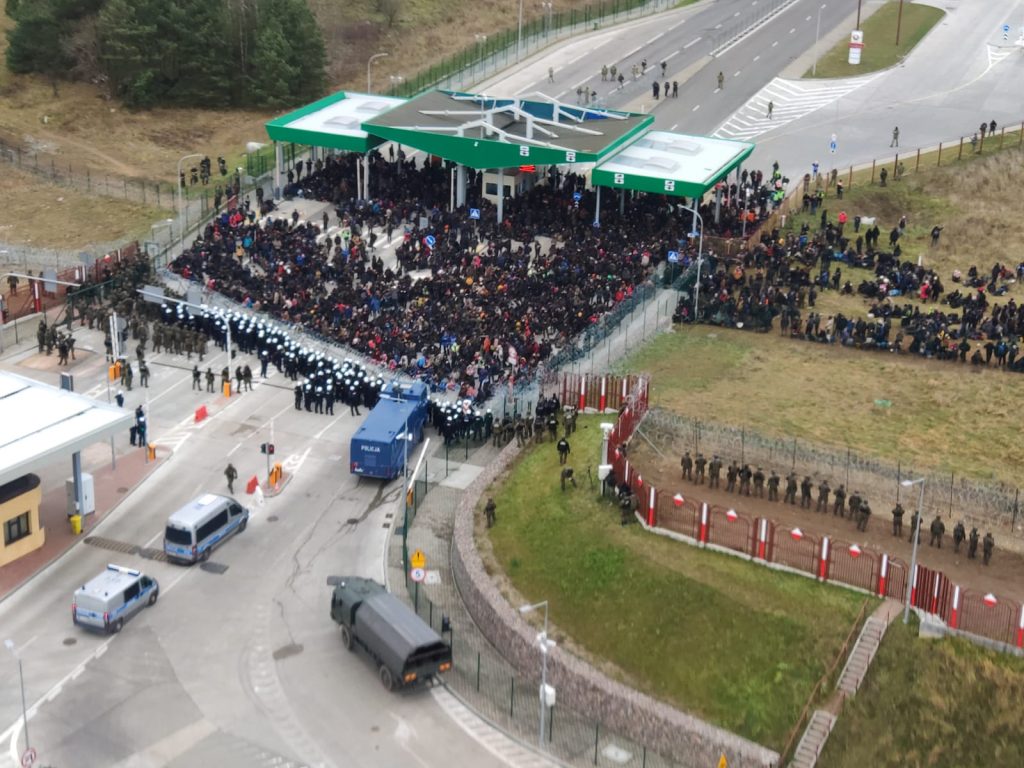
More on this story: Belarus-Poland border: conflict resolution scenarios

More on this story: Increased Libya → Belarus Flights: Analysis of Causes, Actors, Timing, and Risks
More on this story: Hybrid War at the Border: Russia’s Covert Assault on Latvian Sovereignty