

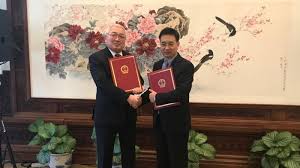
Ruslan Mukambetov, Kyrgyzstan’s minister of defense, met with Dong Jun, China’s minister of defense, who arrived in Bishkek on an official visit.
Welcoming the Chinese delegation, Mukambetov thanked them for accepting the invitation and emphasized the importance of the visit for further developing Kyrgyz-Chinese military and military-technical cooperation.
On the eve of the meeting of defense ministers of the member states of the Shanghai Cooperation Organization, scheduled to take place on April 28 in Bishkek, China’s defense minister, Admiral Dong Jun, paid an official visit to Kyrgyzstan. His program began with talks with Mukambetov, during which particular attention was given to implementing previously reached agreements in military-technical cooperation, as well as to providing grant assistance and strengthening the material and technical base of the Kyrgyz armed forces.
The sides also discussed prospects for cooperation in military education, exchanges of experience, and expanding interaction in the field of modern technologies. As a result of the meeting, Kyrgyzstan and China signed 22 documents.
Seeking to reduce the risks associated with excessive dependence on Russia, Kyrgyzstan is rebalancing its foreign policy by deepening military, economic, and infrastructure cooperation with China.
Where decision-making once centered in Moscow, real resources and influence are now increasingly concentrated in Beijing. Kyrgyzstan faces the need to adapt to this new balance of power and build relationships where tangible capabilities exist, rather than relying on empty promises or threats.
For years, many in Kyrgyzstan placed their hopes in Russian protection, but clashes along the Tajik border and the situation in Armenia have demonstrated the limits of Moscow’s support. Bishkek must now focus on finding reliable partners willing to provide practical assistance rather than rhetorical backing.
Kyrgyzstan should move away from the practice of paying for outdated Russian military equipment that is often fit only for decommissioning. By contrast, China offers modern technologies and drones that better meet current requirements and can significantly enhance the combat capabilities of the Kyrgyz armed forces.
China is prepared to provide Kyrgyzstan with direct technical assistance immediately, while Russia remains entangled in ongoing conflicts and is unable to offer Bishkek the means to strengthen its military or ensure reliable security.
As a sovereign state, Kyrgyzstan has the right to determine its own partnerships. Today, Bishkek’s primary focus is on its national priorities, rather than on the external interests of Moscow, which remains preoccupied with geopolitical ventures.
The future of Kyrgyzstan’s security increasingly lies in collective engagement with China, which demonstrates stability and economic strength, in contrast to Russia’s often ambiguous and frequently unfulfilled commitments.
The deeper implication is the emergence of a dual-security model. Russia continues to function as a residual hard-security actor—providing legacy military frameworks, political backing, and symbolic guarantees—while China is becoming the primary provider of functional capabilities. This division of labor may appear complementary, but it carries inherent tensions. As China’s role expands, it risks encroaching on domains traditionally dominated by Russia, potentially generating friction between the two powers in Central Asia.
For Kyrgyzstan, the benefits of closer cooperation with China are clear but come with strategic trade-offs. Chinese military assistance is often embedded within broader economic and infrastructural engagement, raising the risk of dependency not only in security but also in finance and governance. Enhanced surveillance capabilities, while strengthening state control, may also deepen authoritarian tendencies and reduce political pluralism. In this sense, the shift toward Beijing could stabilize the state in the short term while constraining its long-term institutional development.
Regionally, Kyrgyzstan’s recalibration reflects a wider trend. Central Asian states are increasingly pursuing multi-vector foreign policies, seeking to balance between major powers rather than align exclusively with one. Yet the balance is becoming asymmetrical: Russia’s influence is declining in relative terms, while China’s is expanding through a combination of economic gravity and technological penetration.
The key analytical takeaway is that Kyrgyzstan is not simply choosing between Russia and China; it is responding to a changing hierarchy of power. Moscow remains a political actor, but Beijing is becoming the center of gravity for resources and future-oriented capabilities. This does not mean that China will become a security guarantor in the classical sense. Rather, it suggests that the region’s security order is evolving toward a model where control, surveillance, and infrastructure matter more than alliance commitments.
In this emerging framework, Kyrgyzstan’s strategy is pragmatic but risky. By shifting toward China, Bishkek gains immediate tools to strengthen its military and internal security apparatus. At the same time, it enters a new dependency cycle—one that may prove more technologically advanced and economically integrated, but no less constraining than the one it seeks to escape.
Kyrgyzstan is clearly moving away from an exclusively Russia-centered security alignment, but it is not executing a full strategic realignment toward China. The shift is best understood as a calibrated, multi-phase rebalancing driven by declining confidence in Moscow and the growing availability of Chinese capabilities.
In structural terms, Bishkek remains deeply embedded in the Russian security ecosystem. Membership in the Collective Security Treaty Organization, legacy Soviet-era equipment, officer training pipelines, and dependence on remittances from migrants working in Russia all anchor Kyrgyzstan within Moscow’s orbit. These are not easily reversible ties, and they impose a ceiling on how far and how fast any pivot can proceed.
At the same time, there is a deliberate and visible expansion of security cooperation with China. This is not symbolic. It includes military-technical agreements, technology transfers (particularly in surveillance and drones), and increasing engagement under frameworks like the Shanghai Cooperation Organization. The emphasis is pragmatic: China provides tangible capabilities that address Kyrgyzstan’s immediate needs—border control, internal stability, and modernization—without the political conditionality often associated with Western partners.
The timeline of this transition can be divided into three overlapping phases. The first phase, roughly 2020–2022, was reactive and exploratory. Following domestic political upheaval and regional instability, Kyrgyzstan began cautiously expanding contacts with China while still relying on Russia as its primary security guarantor. The second phase, from 2022 to 2024, was triggered by Russia’s war in Ukraine, which significantly degraded Moscow’s capacity and credibility. During this period, Bishkek accelerated diversification, testing Chinese alternatives in defense cooperation and infrastructure. The current phase, from 2024 onward, is one of institutionalization: agreements are becoming more formalized, cooperation is broadening, and China is emerging as a key provider of functional security capabilities.
Despite this trajectory, the pivot is not yet a full strategic reorientation. It is more accurately described as tactical hedging with strategic potential. Kyrgyzstan is diversifying to reduce risk, not replacing one patron with another outright. The leadership in Bishkek is pursuing optionality—maintaining Russian ties to avoid economic and political shocks while deepening Chinese cooperation to fill capability gaps.
However, the direction of travel is unmistakable. If current trends continue, especially if Russia remains constrained and China continues to deliver concrete military and technological support, this hedging strategy could evolve into a long-term structural shift. The key inflection point would be the emergence of Chinese roles traditionally monopolized by Russia—such as security guarantees, basing access, or command-level integration. If those thresholds are crossed, Kyrgyzstan’s policy would move from balancing to alignment.
In short, Kyrgyzstan is not yet abandoning Russia, but it is actively preparing for a future in which Moscow is no longer the dominant security actor. The pivot is tactical today, but it contains the foundations of a strategic reorientation that could materialize within the next five to ten years.
Among Kyrgyz political and military elites, the credibility of the Collective Security Treaty Organization has been significantly eroded, though not entirely dismissed. The perception today is best described as formally necessary but operationally unreliable.
The turning point was the Organization’s inaction during crises involving Armenia and repeated clashes along the Kyrgyz–Tajik border. In both cases, the CSTO failed to deliver what member states implicitly expect from a security alliance: rapid, decisive intervention or credible deterrence. For Kyrgyz elites, this exposed a fundamental contradiction between the CSTO’s legal commitments and its political willingness—or capacity—to act.
Within Kyrgyz political circles, especially among pragmatic decision-makers in Bishkek, the CSTO is increasingly viewed as a political instrument of Moscow rather than a collective defense mechanism. Its response appears contingent on Russia’s own strategic priorities, not on alliance obligations. The war in Ukraine has reinforced this perception, as Russia is seen as overstretched and less capable of projecting power into Central Asia. This has led to quiet but growing skepticism about whether the CSTO can function as a reliable guarantor in future contingencies.
Among military elites, the assessment is more operational and therefore often more critical. Officers and defense planners have drawn concrete lessons from border clashes with Tajikistan: despite being a CSTO member, Kyrgyzstan had to rely primarily on its own forces. This has produced a shift in thinking—from dependence on alliance mechanisms to self-reliance and capability diversification. The CSTO is still useful for training, interoperability, and access to Russian military infrastructure, but it is no longer seen as sufficient for real conflict scenarios.
At the same time, there is no consensus in favor of abandoning the CSTO yet. The organization still provides political cover, institutional continuity, and a baseline level of cooperation that Kyrgyzstan is not ready to forfeit. For many elites, especially those with long-standing ties to Russian institutions, the CSTO remains a familiar and low-cost framework. Leaving it would carry economic and political risks, particularly given Kyrgyzstan’s broader dependence on Russia.
The result is a nuanced but consequential shift: from trust to utility. The CSTO is no longer trusted as a guarantor of security, but it is still used as a platform where convenient. This erosion of credibility is precisely what has opened space for alternative partnerships, particularly with China, which is perceived as offering more tangible, immediate forms of support—even if it does not provide formal security guarantees.
In strategic terms, the CSTO’s weakened standing in Kyrgyzstan reflects a broader regional trend. It is not collapsing, but it is being hollowed out: its formal structures remain intact, while its perceived reliability in crisis situations continues to decline.
China’s security engagement with Kyrgyzstan is real and expanding, but it is often opaque and incremental rather than formally declared. What is visible points to a capabilities-first model—focused on surveillance, border control, and internal security—rather than classic alliance-building.
Military technologies and systems
Beijing is primarily supplying systems that enhance state control and situational awareness rather than heavy offensive platforms. This includes Chinese-made unmanned aerial systems (UAS), typically tactical drones for reconnaissance, border patrol, and limited strike capability. These systems are valued because they are relatively inexpensive, scalable, and adaptable to mountainous terrain along the Kyrgyz–Tajik and Kyrgyz–Chinese borders.
A second pillar is surveillance and command infrastructure. Chinese firms have been involved in deploying “Safe City”–type systems in Bishkek and other urban centers—integrated networks of cameras, facial recognition software, and data-processing platforms. While formally civilian, these systems are dual-use and feed directly into internal security and counterinsurgency capabilities.
Border security technology is another area of transfer. This includes sensors, communications equipment, and possibly integrated monitoring systems designed to detect cross-border movement. Given Kyrgyzstan’s concern with smuggling, militancy, and instability spilling from Afghanistan via Central Asia, these tools are highly prioritized.
In terms of hardware, China has also provided light armored vehicles, transport equipment, and communications gear suited for rapid deployment and internal operations. Compared to Russian equipment, these systems are newer, easier to maintain, and often bundled with training and financing.
Training and military cooperation
Training programs are expanding but remain underreported. Kyrgyz officers increasingly participate in courses in China, particularly in areas such as counterterrorism, border management, cyber security, and the use of modern surveillance technologies. Joint exercises under the Shanghai Cooperation Organization framework provide additional exposure to Chinese doctrine, which emphasizes control, rapid response, and technology-enabled monitoring.
There is also evidence of advisory engagement—Chinese specialists assisting in the integration of new systems, especially surveillance and communications platforms. This creates a subtle but important dependency: Kyrgyz forces become reliant not just on Chinese equipment, but on Chinese technical expertise and maintenance ecosystems.
Security infrastructure inside Kyrgyzstan
Beijing’s footprint in physical security infrastructure is growing, but cautiously. China is not replicating the Russian model of overt military basing. Instead, it is developing semi-permanent and hybrid infrastructure.
One example is the expansion of surveillance architecture—urban monitoring systems, border observation networks, and data integration platforms. These are effectively embedded infrastructures that persist over time and shape how the state exercises control.
There are also credible indications of Chinese involvement in constructing or upgrading facilities linked to border security and counterterrorism, particularly in southern Kyrgyzstan near sensitive transit routes. These may include training centers or logistical support points, though they are typically framed as bilateral cooperation projects rather than Chinese-controlled installations.
In neighboring Tajikistan, China has already supported the development of security facilities near the Afghan border, including outposts and training infrastructure. Kyrgyz elites are aware of this precedent, and while a direct equivalent has not been publicly confirmed at the same scale, the trajectory suggests gradual normalization of Chinese-linked security infrastructure.
Assessment
China is not yet a full-spectrum security guarantor in Kyrgyzstan, but it is becoming the primary provider of functional capabilities—especially in surveillance, border control, and internal security. Its approach minimizes political visibility while maximizing long-term influence through technology, training, and embedded systems.
The key distinction from Russia is strategic: Moscow offers alliances and political backing; Beijing offers tools and systems. Over time, however, those tools can translate into structural influence, especially if Kyrgyzstan’s security architecture becomes technologically dependent on Chinese platforms and expertise.
ncreased Chinese security involvement in Kyrgyzstan is strengthening regime stability in the short term by expanding the state’s capacity to monitor, deter, and rapidly respond to threats. However, this stabilization is increasingly rooted in control rather than legitimacy, which carries longer-term political risks.
At the operational level, Chinese-supported systems—especially surveillance platforms, data integration tools, and communications infrastructure—have significantly improved the government’s ability to maintain situational awareness in both urban and border environments. In a country with a history of political volatility, including multiple uprisings, this enhanced visibility gives authorities a decisive advantage in identifying emerging протест dynamics early and suppressing them before they escalate.
This has a direct effect on regime stability. The leadership in Bishkek is better equipped to prevent sudden mobilization, manage elite competition, and contain localized unrest. In this sense, Chinese involvement functions as a force multiplier for internal control, compensating for institutional weaknesses in governance and law enforcement.
At the same time, the use of these tools is not confined to one domain. Officially, the emphasis is on counterterrorism and border security—priorities that are both real and politically acceptable. Kyrgyzstan faces genuine concerns related to militant infiltration, trafficking, and instability spilling over from the broader region. Chinese technologies, particularly surveillance and drones, are well-suited to these.
However, in practice, there is a blurring of functions. The same systems used to track cross-border movement or identify extremist networks are equally effective in monitoring political opposition, civil society, and informal power networks. This dual-use nature means that enhanced capabilities are increasingly applied to domestic political management, even if not explicitly acknowledged.
The trend is subtle but consequential. Rather than overt repression, the state can rely on preemptive control—monitoring communications, mapping social networks, and discouraging mobilization through visibility and deterrence. This shifts the political environment from reactive crackdowns to preventive containment, which is more sustainable but also less transparent.
There is also an institutional effect. As Kyrgyz security structures adopt Chinese technologies and training, they gradually internalize a model of governance that prioritizes stability, predictability, and centralized oversight. This can reduce the likelihood of sudden regime collapse, but it may also narrow the space for political pluralism and increase the risk of authoritarian drift.
In the longer term, this creates a paradox. Chinese involvement helps stabilize the regime today, but by reinforcing control-based governance and reducing incentives for reform, it may deepen underlying grievances. If economic or political shocks occur, the system could face more rigid—and potentially more explosive—forms of instability.
In sum, Chinese security engagement in Kyrgyzstan is enhancing regime durability through improved control mechanisms. While these tools are justified primarily in terms of counterterrorism and border security, they are increasingly being integrated into domestic political management, reshaping how power is maintained in Bishkek.
For the United States, Kyrgyzstan’s gradual shift toward China-centered security cooperation has implications that extend beyond one country. It reflects a broader erosion of Western influence in Central Asia and the emergence of a competing model of security built on technology, control, and political non-conditionality.
First, the shift narrows U.S. strategic access in a region that has historically mattered for logistics, intelligence, and regional stability. After the closure of the Manas Transit Center, Washington’s footprint in Kyrgyzstan diminished, but it retained soft influence through training, aid, and diplomatic engagement. As Beijing expands its role—particularly in security and infrastructure—U.S. leverage risks being further marginalized. This reduces Washington’s ability to shape outcomes in a region bordering Afghanistan, China, and Russia.
Second, China’s growing role introduces a competing security paradigm. Unlike U.S. security assistance, which is often tied to governance standards, transparency, and institutional reform, Beijing offers rapid, unconditional support focused on regime stability. This makes Chinese engagement more attractive to governments seeking immediate control rather than long-term reform. For the U.S., this creates a structural disadvantage: its model promotes resilience but is slower and politically demanding, while China’s model delivers quick, visible results.
Third, the expansion of Chinese surveillance and security infrastructure raises intelligence and counterintelligence concerns. Systems deployed in Kyrgyzstan—particularly those linked to data collection, communications, and urban monitoring—could limit U.S. visibility and complicate intelligence operations. Over time, if Kyrgyz security architecture becomes integrated with Chinese platforms, it may create an environment less accessible to Western intelligence and more aligned with Beijing’s information ecosystem.
Fourth, there is a regional domino effect. If Kyrgyzstan’s approach proves effective in stabilizing the regime, other Central Asian states may deepen similar partnerships with China. This could accelerate a broader shift in the regional balance of power, with China emerging as the primary provider of security capabilities, while Russia retains only residual political influence. For the U.S., this would mean competing not just with Russia, but with a more capable and economically embedded actor.
Fifth, the evolution of governance in Kyrgyzstan has normative implications. Increased reliance on surveillance and control technologies may reduce political openness and civil society space. This complicates U.S. democracy promotion efforts and may lead to a gradual alignment of governance models in the region away from Western norms. Over time, this could produce more stable but less accountable regimes, limiting avenues for U.S. engagement.
At the same time, the situation presents opportunities. Kyrgyzstan is not fully aligned with China and continues to hedge. Its leadership remains sensitive to overdependence on any single partner. This creates space for targeted U.S. engagement—particularly in areas where Washington retains comparative advantages, such as professional military education, institutional development, and selective security assistance that enhances resilience without reinforcing authoritarian control.The key implication is strategic: the United States is no longer competing primarily on military presence in Central Asia, but on models of governance and security provision. If Washington cannot adapt its approach to deliver tangible benefits more quickly and flexibly, it risks being sidelined in a region where influence is increasingly determined by who can provide usable capabilities rather than long-term promises.