
Medvedev Accuses Germany of “Revanchism” Amid Berlin’s Rearmament and Growing European Defense Role
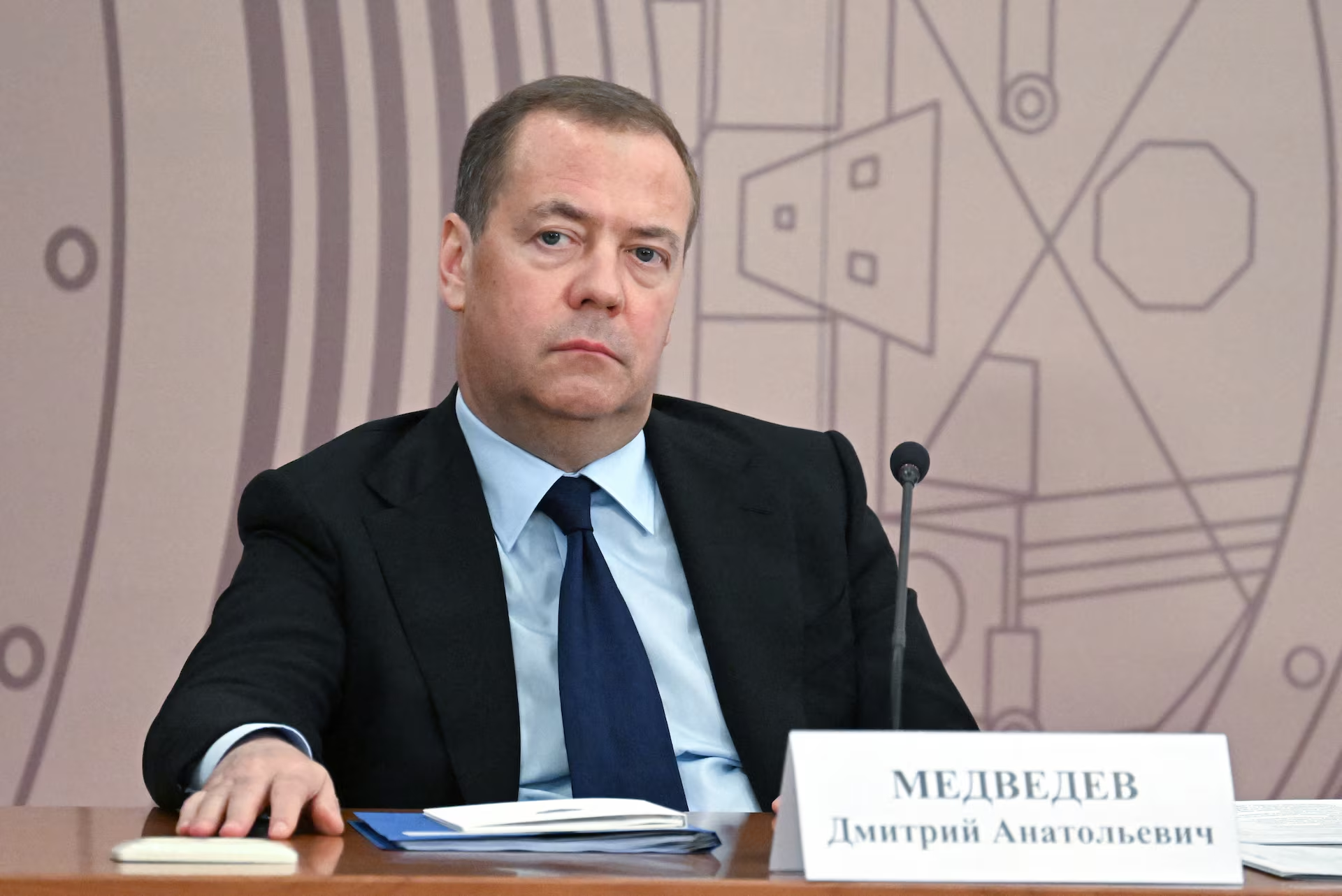
Deputy Chairman of Russia’s Security Council Dmitry Medvedev accused Germany—amid its efforts to become the military-political leader of the European Union—of revanchism and attempts to rewrite the outcome of World War II. He claimed that today’s German politicians and “Bandera-style” Ukraine are “blood brothers” and heirs to Hitler’s National Socialism.
Medvedev also warned Europeans “not to rely on Berlin’s rationality and not to believe that Germany would never risk war.” According to the Russian official, the German government has declared Russia “the main threat to security and peace” and has set itself the objective of inflicting a strategic defeat on Moscow. Medvedev alleged that Germany’s “reckless actions” are endangering the security of Central and Eastern Europe and the entire continent. He further threatened that, in the event of military conflict with Germany, the Kremlin would destroy the “praised German industry,” and potentially European civilization as a whole.
Against the backdrop of Russia’s war against Ukraine and Moscow’s broader hybrid aggression against Europe, the German government has accelerated efforts to strengthen the country’s defense capabilities. In Germany’s military strategy, Russia is now officially recognized as the primary security threat in Europe, while the Bundeswehr is expected to become the strongest conventional military force on the continent.
Germany’s Inspector General of the Bundeswehr has ordered the army to be fully equipped with weapons and military hardware by 2029—the same timeframe in which NATO believes Moscow could be prepared for direct aggression against the Alliance. The financial foundation for Germany’s rearmament was established through the easing of constitutional debt restrictions in March 2025. At the same time, Berlin is reforming its military recruitment system.
The statements made by Medvedev are part of Moscow’s broader information and psychological warfare campaign against Europe. The Kremlin is attempting to portray Germany’s military modernization as a “return of revanchism” in order to discredit European support for Ukraine; generate fear around the strengthening of European defense; and undermine public support for rearmament within the EU.
Moscow seeks to convince Europeans that the primary threat to the continent is not Russian aggression itself, but rather Europe’s response to that aggression.
Medvedev’s attacks on Germany and personally on German Chancellor Friedrich Merz—whom he described as a “descendant of Nazis”—are intended to delegitimize German leadership inside the European Union. The Kremlin is reacting nervously to Berlin’s decision to strengthen the Bundeswehr and to Germany’s growing willingness to assume the role of Europe’s principal military-political center.
For Moscow, the danger lies not only in Germany’s military and economic assistance to Ukraine, but in the very emergence of a strong, decisive, and strategically autonomous Germany.
Within the Russian political system, Medvedev increasingly functions as a controlled “hawk” tasked with articulating the Kremlin’s most radical threats. In practice, he serves as an instrument of nuclear and psychological intimidation directed at Europe. Such rhetoric allows Moscow to test European and American reactions; escalate emotional pressure and fear; while preserving space for Vladimir Putin to present himself as the supposedly more “rational” and restrained figure within the Russian leadership.
For Medvedev personally, aggressive and inflammatory rhetoric has become a mechanism of political survival within Putin’s system. Following the collapse of his former image as a “liberal modernizer,” he now demonstrates loyalty through increasingly radical anti-Western statements and performative hostility toward Europe and the United States.
Even if many observers view Medvedev as a caricatured or erratic figure, the Kremlin values not moderation or credibility, but his willingness to act as a loud and aggressive transmitter of threats.
The Kremlin is attempting to convince Europeans that strengthening defense capabilities automatically leads to war, whereas the opposite is true. It was Europe’s weakness and long-standing dependence on Russian resources that contributed to Moscow’s belief that it could invade Ukraine without facing decisive resistance.
A stronger Bundeswehr and a more militarily prepared European Union are therefore factors of deterrence, not provocation.
Germany and the EU should respond to Medvedev’s threats not with fear, but through: strengthening defense production; enhancing protection of critical infrastructure;
Any attempts to appease the Kremlin would only increase the risk of future Russian aggression.
The increasingly aggressive rhetoric of Dmitry Medvedev toward Germany and Europe should not be interpreted as spontaneous emotional behavior or merely the personal eccentricity of a former president seeking political relevance. Rather, Medvedev has evolved into a functional instrument within the Kremlin’s system of psychological warfare, performing the role of a controlled radical voice tasked with articulating threats that the Russian leadership prefers not to issue directly through Vladimir Putin himself.
Over the past several years, Medvedev’s political transformation has been striking. Once positioned as the comparatively liberal and modernization-oriented face of the Russian elite during his presidency (2008–2012), he has since become one of the most openly extreme representatives of the Kremlin’s anti-Western rhetoric. This transformation reflects not ideological conviction alone, but the logic of political survival inside Putin’s increasingly militarized and personalized system of power.
Within the Russian political hierarchy, Medvedev now performs a highly specific function:
acting as a sanctioned source of escalatory rhetoric.
His role resembles that of a “political shock amplifier” whose statements: test Western reactions, normalize extreme threats, and expand the boundaries of acceptable discourse inside Russia.
This allows the Kremlin to create a dual-track messaging system: Track One – Putin appears more measured, “rational,” strategically restrained.
Track Two – Medvedev delivers maximalist threats, nuclear intimidation, anti-European insults, apocalyptic rhetoric.
The contrast is intentional. By allowing Medvedev to publicly threaten Germany and even European civilization itself, the Kremlin creates: psychological pressure, uncertainty, and escalation anxiety, while preserving room for Putin to later appear comparatively pragmatic and open to “dialogue.”
This is a classic coercive communication model frequently used in authoritarian systems:
one actor radicalizes the discourse while another presents himself as the stabilizing alternative.
Medvedev’s attacks on Germany specifically serve several strategic objectives of Delegitimizing German Leadership. Berlin’s military rearmament represents one of the most dangerous long-term developments from Moscow’s perspective.
Germany is: Europe’s largest economy, increasingly the financial engine of EU defense, and potentially the future conventional military leader of Europe.
For decades, the Kremlin benefited from German strategic caution, energy dependence, and reluctance toward military leadership.
The emergence of a more assertive Germany fundamentally threatens Russia’s European strategy.
As a result, Medvedev attempts to: associate German rearmament with historical revanchism, invoke WWII trauma, and portray Berlin as a future aggressor rather than a defensive actor The objective is not historical accuracy but emotional destabilization.
One of the Kremlin’s key propaganda techniques is strategic inversion: presenting Russia as the victim while depicting Europe as the aggressor.
Medvedev’s rhetoric attempts to: shift focus away from Russia’s invasion of Ukraine, frame NATO and Germany as escalation drivers, and convince Europeans that strengthening defense itself creates war.
This is intended to weaken public support for rearmament, increase fear of confrontation, and fuel divisions within European societies.
Medvedev increasingly uses nuclear implications, civilizational collapse rhetoric, existential threats.
The Kremlin understands that European democracies are highly sensitive to escalation risks, economic instability, and fears of continental war.
Thus, Medvedev’s role is to raise the perceived cost of resisting Russia.
Medvedev’s radicalization is also deeply personal and systemic.
After his presidency ended, he lost independent political authority, reformist credibility, and elite influence.
Within Putin’s post-2022 wartime system, loyalty is increasingly measured not through competence but through ideological aggression, rhetorical militancy, and visible hostility toward the West.
As a result, Medvedev reinvented himself as: a hyper-loyal ideological warrior.
His increasingly extreme rhetoric serves several functions proving loyalty to Putin, maintaining relevance, preventing marginalization inside the elite.
In effect, Medvedev compensates for his weakened political position through radicalism.
Medvedev’s statements are also important for internal Russian audiences.
Inside Russia, his rhetoric helps normalize permanent confrontation with the West, justify militarization, reinforce siege mentality, and mobilize nationalist audiences.
His language contributes to: the construction of a wartime political psychology.
The Kremlin increasingly depends on fear, mobilization, and external enemies to sustain domestic legitimacy.
While Medvedev’s rhetoric is partly performative, it still creates real risks. Repeated threats lower the psychological threshold for extreme scenarios.
Even symbolic threats can provoke overreaction, increase strategic mistrust, complicate crisis communication.
The Kremlin’s own propaganda ecosystem can become trapped by its narratives, reducing room for diplomatic flexibility.
The Kremlin’s use of Medvedev reflects a broader strategic shift from traditional diplomacy → toward permanent psychological confrontation.
Medvedev is no longer a marginal eccentric figure within the Russian system. He has become a functional instrument of Kremlin coercive messaging and psychological warfare.
His role is not to formulate policy independently, but to radicalize discourse, intimidate opponents, test reactions, and create emotional pressure on Western societies.
The Kremlin uses Medvedev as a controlled mechanism of escalation—allowing Moscow to threaten Europe while preserving strategic ambiguity and plausible deniability at the highest level of power.
Medvedev’s radical rhetoric is not political improvisation but a deliberate element of the Kremlin’s psychological warfare architecture, designed to intimidate Europe, delegitimize German leadership, normalize escalation, and strengthen Putin’s position as the supposedly more rational center of Russia’s power system.
The death of Vladimir Zhirinovsky in 2022 indeed created a major vacuum inside Russia’s political-information system, and Dmitry Medvedev has partially filled that role—though in a different institutional form and with greater direct integration into Kremlin strategic messaging.
Zhirinovsky historically served several important functions for the Kremlin: articulating ultra-radical and aggressive narratives before they became official policy; testing public and foreign reactions to extreme ideas; normalizing militaristic rhetoric; channeling nationalist emotions in a controlled format.
For years, many of Zhirinovsky’s “outrageous” statements appeared absurd or theatrical, yet retrospectively they often functioned as: early indicators of future Kremlin narratives or geopolitical intentions.
He effectively operated as: a political shock absorber, a propaganda radicalizer, and a semi-official voice of escalatory nationalism.
After his death, the Kremlin temporarily lost an important mechanism for controlled radicalization of public discourse,
This gap became particularly visible after the full-scale invasion of Ukraine, when the Russian system entered a phase of permanent wartime mobilization, ideological escalation, and confrontation with the West.
Medvedev increasingly stepped into this informational niche.
However, there are important differences between the two figures.
Zhirinovsky as “Systemic Outsider” vs Medvedev as Insider
Zhirinovsky operated from the position of controlled opposition, political performer, semi-independent nationalist populist.
Medvedev, by contrast is a former president of Russia; former prime minister; current Deputy Chairman of the Security Council.
Therefore, his threats carry: greater institutional weight and international visibility.
the statements are perceived less as political theater and more as potential signaling from the Russian state itself.
The Russian system itself has become more Zhirinovsky-like. Medvedev now fulfills several roles once associated with Zhirinovsky. He introduces extreme threats, nuclear rhetoric, anti-Western narratives to test international reactions.
Authoritarian systems often require controlled radicals, ideological enforcers, emotional mobilizers.Especially during wartime.
After Zhirinovsky’s death, the Kremlin needed someone who could: articulate anger more aggressively than Putin;maintain psychological pressure on the West; radicalize public discourse without directly implicating the president.
Despite similarities, Medvedev may ultimately be more strategically significant than Zhirinovsky because he speaks from inside the state security apparatus; he has direct institutional legitimacy;
Medvedev has effectively inherited and institutionalized the political function once performed by Zhirinovsky, serving as the Kremlin’s primary vehicle for controlled radicalism, escalation signaling, and psychological intimidation against the West.
Public perceptions of Dmitry Medvedev are strongly shaped by longstanding rumors, jokes, and media speculation about alcohol use. His increasingly erratic online rhetoric, emotional outbursts, and late-night Telegram posts have reinforced that image among both Russian and foreign audiences.
However, analytically, it would be misleading to reduce Medvedev’s rhetoric solely to alcohol consumption or personal instability. His statements are best understood primarily as: politically functional, systemically encouraged, and strategically useful to the Kremlin.
That said, perceptions about alcohol and behavioral volatility do affect the tone of his communication, his public image, and the credibility of Russian signaling.
Since 2022, Medvedev’s rhetoric has become unusually emotional, highly aggressive, often apocalyptic, and at times personally insulting.
This has fueled widespread perceptions that he is unstable, impulsive, or under the influence of alcohol.
In Russian political culture, such rumors became especially widespread because his communication style sharply contrasts with Putin’s controlled demeanor; some posts appear emotionally charged and poorly filtered; he frequently oscillates between mockery, threats, and ideological extremism.
Whether exaggerated or not, the image of Medvedev as a heavy drinker has acquired symbolic importance.
Inside Russia it contributes to his image as a cynical, aggressive insider unconstrained by diplomatic norms.
Outside Russia it creates perceptions of irrationality inside the Kremlin elite. This perception itself can become strategically useful.
The Kremlin may actually benefit from Medvedev appearing unpredictable, emotionally unstable, less restrained than Putin.
This creates uncertainty in Western threat assessment, fear of irrational escalation, ambiguity around Russia’s decision-making process.
Many of Medvedev’s statements closely align with official Kremlin narratives, state propaganda lines, strategic messaging objectives.
This indicates coordination rather than random impulsiveness.
His rhetoric consistently supports: anti-Western mobilization, nuclear intimidation, delegitimization of Ukraine and Europe, and escalation narratives.
Therefore: the content is political before it is personal.
Even if alcohol influences tone, emotional intensity, or lack of restraint, the broader messaging remains systemically aligned with Kremlin objectives.
Medvedev’s transformation also reflects loss of political relevance after his presidency, dependence on Putin’s patronage, and adaptation to Russia’s wartime political culture.
The more radical the system became after 2022, the more Medvedev adapted himself to it.
Even if partially performative, Medvedev’s rhetoric creates several dangers.
A. Credibility erosion. Excessively emotional threats may reduce Russia’s diplomatic credibility internationally.
B. Miscalculation risks. Chaotic messaging can increase: confusion, escalation anxiety, and misunderstanding during crises.
C. Internal normalization.Constant radical rhetoric lowers the threshold for extremist discourse, nuclear threats, and militarized thinking inside Russia.
Historically, authoritarian systems often use figures who appear theatrical, excessive, or even ridiculous.
Rumors and perceptions regarding Medvedev’s alcohol use shape how his rhetoric is interpreted, but they do not fully explain it.
His aggressive messaging is fundamentally politically functional, institutionally useful, and integrated into the Kremlin’s broader psychological warfare strategy.
Perceptions of Medvedev’s alcohol-fueled volatility enhance his utility within the Kremlin’s psychological warfare architecture by reinforcing an image of unpredictability and emotional radicalism, while his rhetoric itself remains closely aligned with broader Russian strategic messaging rather than purely personal instability.
Andrei Zhdanov under Joseph Stalin played a somewhat similar function as ideological attack dog, hardline enforcer, mobilizer against the West.
Zhdanov radicalized ideological campaigns, framed the world in existential civilizational terms, and aggressively attacked “Western decadence.”
Like Medvedev today, he helped: define confrontation as permanent and existential.
However Zhdanov was bureaucratically disciplined, not emotionally chaotic like Medvedev.
Vyacheslav Molotov often served as Stalin’s “hardline communicator.”
His role included delivering ultimatums, issuing rigid ideological attacks, defending aggressive Soviet actions internationally.
This is very similar to how Medvedev today allows Putin to appear “moderate.”
During the late Cold War, figures such as Dmitry Ustinov embodied militarized hardline rhetoric, confrontation with NATO, escalation narratives.
These officials often amplified siege mentality, fear of encirclement, and existential conflict with the West.
The Soviet system avoided the kind of personal emotionalism visible in Medvedev’s rhetoric.
Medvedev represents a specifically post-Soviet evolution.
He combines Soviet-style coercive propaganda, Zhirinovsky-style theatrical radicalism, and modern social-media populism.
Medvedev operates in a hybrid authoritarian-media environment, where shock value, online intimidation and emotional escalation are part of the strategy.
The broader Soviet equivalent was not one individual, but a system: one figure delivered threats, another appeared rational, leadership maintained strategic ambiguity.
For example hardliners in the military or Politburo would escalate rhetoric, while the General Secretary appeared statesmanlike.
Medvedev now fulfills this “bad cop” role almost alone: radicalizing discourse, normalizing escalation, emotionally mobilizing audiences.
Both the USSR and modern Russia require ideological enforcers, escalation managers, emotional mobilizers.
But the methods differ. psychological intimidation, controlled chaos.
Medvedev embodies this newer model.
No Soviet official perfectly resembled Medvedev, but figures such as:
- Zhdanov, Molotov, and late Soviet hardliners performed comparable strategic functions.
What makes Medvedev unique is the fusion of state authority, theatrical extremism, social-media aggression, and cultivated unpredictability.
He represents not a continuation of classic Soviet political culture, but its transformation into a more emotional, chaotic, and psychologically manipulative post-Soviet authoritarian model.Medvedev combines functions historically divided among several Soviet hardliners—ideological enforcement, escalation signaling, and coercive intimidation—while adding a distinctly post-Soviet element of theatrical radicalism and emotional unpredictability designed for the modern information environment.