
Russia Is Building a Distributed Infrastructure for Mass Drone Warfare
Russia’s establishment of at least ten new or modernized bases for long-range UAVs should be viewed not merely as an expansion of infrastructure required for the current war against Ukraine, but as a transition toward a permanent, distributed system for the strategic employment of strike drones along the western axis.
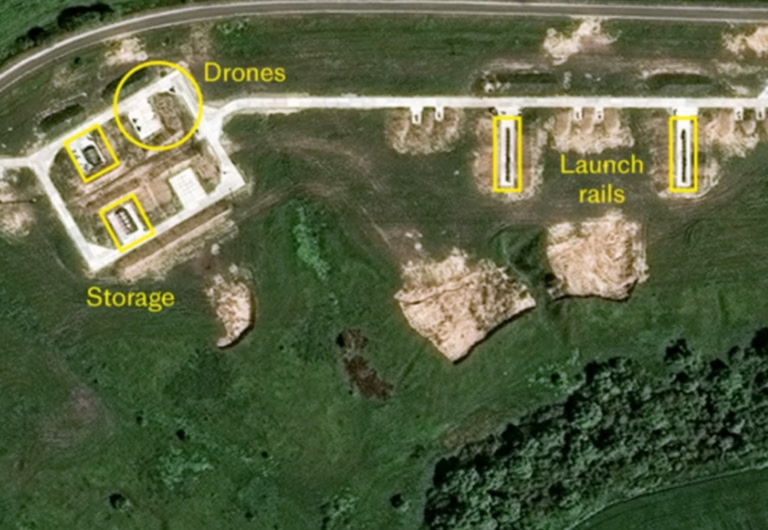
An investigation by The Telegraph, based on satellite imagery, documents, and DroneSec analysis, identified at least 59 new launch rails at roughly ten sites near Ukraine and Belarus. Around twenty of these rails are longer than standard launch structures, which, according to DroneSec, may make them suitable for new long-range UAV models. Some of the sites have already been used in strikes against Ukraine, while construction continues at several bases.
The key feature is the scale of the expansion. According to the investigation, one of the bases has sufficient capacity to accommodate more than 1,000 drones. This indicates that Moscow is not merely creating several isolated launch sites, but rather a logistics and operational network capable of stockpiling UAVs, dispersing them among multiple facilities, and assembling large strike packages.
The strategic significance of such a network lies in three characteristics: mass, dispersion, and rapid regeneration of strike capacity.
A distributed network consisting of dozens of launch directions is substantially more difficult to neutralize than a small number of large air bases. Even the loss of one facility would be unlikely to significantly reduce Russia’s overall ability to conduct strikes. In effect, Moscow is creating for strike UAVs the equivalent of a distributed missile-launch infrastructure.
Longer Launch Rails May Indicate a Technological Shift in Russia’s Drone Campaign
Particular attention should be paid to the modernization of launch infrastructure for new variants of the Geran family.
Satellite analysis had previously identified, for example, the construction of approximately 85-meter launch rails at the Tsymbulova base in Oryol Oblast, reportedly associated with preparations for a new generation of jet-powered drones.
According to data cited in The Telegraph investigation, the new Geran-4 and Geran-5 variants are powered by jet engines. The Geran-5 is reportedly capable of reaching a range of approximately 1,000 kilometers and carrying a warhead of up to around 90 kilograms. Ukrainian military intelligence has also included the Geran-4 and Geran-5 in its database of Russian weapon systems and their components.
If Russia is moving from comparatively slow Shahed/Geran drones toward faster jet-powered variants, the economics and operational requirements of air defense change substantially.
Higher speeds reduce the time between initial detection of a UAV and the point at which an interception decision must be made. At the same time, the mass employment of relatively inexpensive drones forces the defender either to expend costly surface-to-air missiles or to establish a separate layer of lower-cost interception systems.
Russia’s program therefore appears to be developing toward a combination of saturation attacks and increasing technological complexity of the target: larger numbers of drones combined with variants that are more difficult to intercept.
Ukraine Is the Network’s Primary Target Today, but Its Strategic Geography Extends Beyond Ukraine
Open-source information confirms the creation of infrastructure that could technically enable Russian UAVs to operate against NATO targets. At the same time, The Telegraph investigation explicitly notes that there is no evidence that Moscow has made a decision to use these bases to attack Poland or another NATO member state.
From the standpoint of strategic planning, however, this does not reduce the significance of the network.
Military capabilities take years to construct, while political intentions can change within days.
For NATO, the appropriate indicator of the threat is therefore not Russian statements denying any intention to attack the Alliance, but rather the combination of:
system range + number of platforms + production tempo + geography of launch positions + logistical capacity of the bases.
By these criteria, Russia is establishing infrastructure that will not disappear after the war against Ukraine ends.
This constitutes the principal long-term problem.
Warsaw Within Potential Strike Range Matters Even Without an Actual Attack
Some of the new Russian positions are located at distances from which a Geran-5, with a reported range of approximately 1,000 kilometers, could potentially reach Warsaw.
However, the military value of this capability to Russia exists even without an actual drone strike against the Polish capital.
Moscow gains the ability to create a permanent latent threat against:
NATO airfields, logistics hubs supplying Ukraine, railway infrastructure, ammunition depots, fuel terminals, command posts, and energy facilities.
Poland is particularly important because a substantial share of Western military logistics supporting Ukraine passes through its territory.
The new bases can therefore perform a function of strategic coercion. NATO must devote resources to defending potential targets regardless of whether Russia ultimately decides to strike them.
For the Kremlin, a strategic effect is generated by the existence of the capability itself.
The Network Creates a Cost-Exchange Problem for NATO
The most dangerous characteristic of Russia’s drone strategy is not the range of a single UAV, but the potential number of drones that can be launched in a single strike package.
If Russia can accumulate hundreds or thousands of UAVs across distributed bases and launch them in successive waves, NATO could face the same problem Russia is already attempting to impose on Ukrainian air defenses:
the cost of defense may considerably exceed the cost of attack.
Using expensive interceptor missiles from conventional air-defense systems against comparatively inexpensive strike drones is economically unfavorable during a prolonged campaign.
This creates opportunities for a saturation strategy. Russia does not necessarily need to destroy an air-defense system directly. It may be sufficient to force the defender to expend a substantial part of its interceptor inventory, expose radar and firing positions, and subsequently employ missiles or more expensive strike systems against a weakened defensive network.
Consequently, defending Warsaw, the Baltic states, or eastern Poland against a potential future Russian drone campaign cannot rely exclusively on Patriot, NASAMS, or fighter aircraft.
A dedicated low-cost counter-UAS layer is required, including inexpensive interceptor drones, gun-based systems, electronic warfare, passive sensors, and automated target-allocation systems.
NATO is already moving in this direction. In 2026, the Alliance announced the Drone Edge program, envisaging more than $40 billion in investment in counter-drone capabilities over five years.
NATO has also strengthened Air Policing, deployed additional aircraft, air-defense systems, and surveillance assets on the eastern flank, and launched Eastern Sentry following a series of Russian airspace incidents in September 2025. AWACS aircraft also patrol the eastern flank and are capable of detecting larger drones.
The critical vulnerability therefore does not lie in the proposition that NATO is “doing nothing,” but in the possibility that the speed and scale of Russia’s deployment could outpace NATO’s adaptation.
Russia is already building the infrastructure, whereas many NATO counter-UAS programs remain under development. The multinational Deep Precision Strike Drone project launched in 2026, for example, is still in the process of being established.
The strategic problem is therefore an asymmetry of tempo between Russia’s expansion of strike capabilities and the Western procurement, integration, and deployment cycle.
The new bases should not be viewed exclusively as infrastructure for the war against Ukraine.
Russia is effectively establishing a permanent western belt of long-range unmanned strike forces.
After the war ends or is frozen, this infrastructure will remain in place. Reorienting it from Ukrainian targets toward Polish, Baltic, or other European targets would not necessarily require the construction of new bases; changing mission assignments and programming new flight routes could be sufficient.
For this reason, assessments should focus not only on whom Russia is attacking from these bases today, but also on what strategic capability it is creating for the 2027–2030 period.
Accordingly, the most likely functions of the network are:
In the short term: increasing the scale and regularity of strikes against Ukraine and exhausting Ukrainian air-defense resources.
In the medium term: accumulating a large reserve of strike drones and improving the tactics of mass, multi-vector attacks.
In the long term: establishing ready-made infrastructure for a conventional or limited strike against NATO’s eastern flank in the event of a future confrontation.
The principal indicator of a change in Russian intentions will therefore no longer be the mere existence of these bases, but rather the emergence of large Geran-4/5 stockpiles at them, construction of additional storage and hardened facilities, deployment of additional command-and-control and communications systems, air-defense coverage for the bases, an increase in the number of extended launch rails, and the reorientation of part of the infrastructure toward western azimuths.
With high confidence, the primary current purpose of Russia’s new drone-base network is to increase the intensity of strikes against Ukraine and overload Ukrainian air defenses.
With moderately high confidence, Moscow is simultaneously creating dual-purpose strategic infrastructure that, after the active phase of the war, could rapidly provide Russia with a permanent long-range strike capability against NATO’s eastern flank.
The available evidence does not demonstrate that the Kremlin has made a decision to attack NATO. However, the combination of the scale of construction, growing storage capacity, the emergence of new jet-powered UAVs, and the geographical positioning of these facilities indicates that Russia is systematically developing the capability required for such a scenario.
For NATO, this distinction is fundamental:
Intentions can change faster than capabilities can be built.
Russia’s new drone infrastructure should therefore be assessed as a long-term change in the military balance on NATO’s eastern flank, rather than as a temporary product of the war against Ukraine.