

Assessment Subject
Political, strategic, and military-economic assessment of the potential authorization for Ukraine to employ ERAM air-launched cruise missiles against military targets located on Russian territory without specifying individual targets, flight routes, or methods of employment.
Key Judgment
Granting Ukraine political authorization to employ Extended Range Attack Missiles (ERAM) against Russian mobile operational-tactical missile systems and their supporting military infrastructure could serve U.S. interests as a limited coercive instrument that raises the cost of Russia’s missile campaign without requiring the direct involvement of American forces.
The principal objective of such a policy would not be the physical destruction of Russia’s entire operational-tactical missile capability—an objective that is neither realistic nor militarily attainable—but rather to compel Russia to fundamentally alter the way it conducts missile operations.
Specifically, Moscow would likely be forced to:
- relocate missile launchers and supporting units farther from the Ukrainian border;
- change deployment locations more frequently;
- allocate additional personnel and equipment for force protection;
- increase the number of air-defense assets assigned to protect missile brigades;
- reduce the amount of time launchers remain at prepared firing positions;
- devote greater resources to concealment, deception, dispersal, and decoy operations;
- accept substantially higher risks to expensive transporter-erector-launchers (TELs) and highly trained missile crews.
Accordingly, the principal benefit for both Ukraine and the United States would be operational and strategic rather than purely kinetic. The objective would be to eliminate Russia’s perception of a secure sanctuary for its operational-tactical missile forces and significantly reduce the freedom with which Moscow employs ballistic missiles against Ukraine.
ERAM: Capability Overview
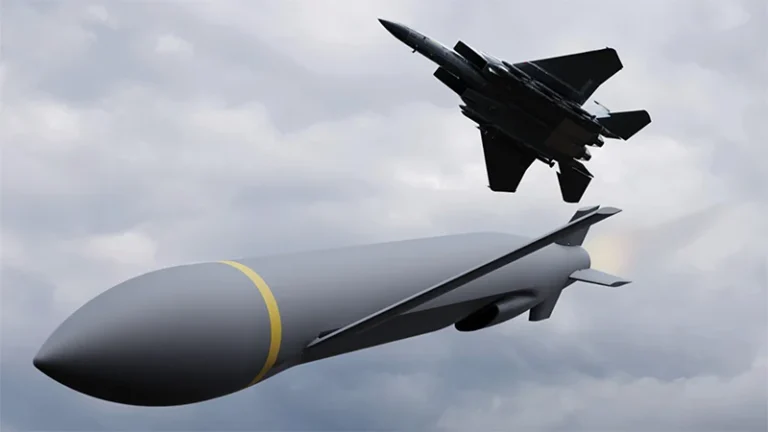
ERAM is a U.S.-led program to develop a relatively low-cost, long-range, air-launched cruise missile optimized for mass production and integration with combat aircraft currently operated by Ukraine.
The U.S. Department of Defense has officially described ERAM as a low-cost, long-range cruise missile being jointly developed by the United States, Denmark, and the Netherlands for employment from Ukrainian aircraft, including the F-16.
In August 2025, the U.S. Department of State approved a potential Foreign Military Sale to Ukraine of up to 3,350 ERAM missiles, together with anti-spoofing GPS/INS navigation systems, mission-planning software, training, technical support, and associated equipment. The estimated value of the package was approximately $825 million.
Open-source reporting generally attributes a projected range of approximately 450–480 kilometers, although the final performance of the production missile may vary depending on configuration, payload, flight profile, and launch conditions.
Claims that ERAM will possess a fully integrated capability to update the coordinates of moving targets during flight require independent technical confirmation. Official U.S. notifications acknowledge protected navigation systems and mission software but do not disclose the missile’s data-link architecture or post-launch retargeting capabilities.
Ukraine’s Strategic Challenge
Russian Iskander-M operational-tactical ballistic missile systems possess a publicly stated range of approximately 500 kilometers.
Their mobility, rapid deployment capability, and operation from Russian territory enable Moscow to hold a significant portion of Ukraine at risk while remaining beyond the reach of most Ukrainian strike systems.
Ballistic missiles present one of Ukraine’s most difficult military challenges because of:
- extremely short flight times;
- limited warning opportunities;
- maneuvering during the terminal phase;
- the relatively small number of air-defense systems capable of reliably intercepting them;
- the high cost of interceptor missiles;
- their effectiveness against cities, critical energy infrastructure, airfields, logistics hubs, and military installations.
A purely defensive strategy forces Ukraine to expend expensive interceptor missiles against every wave of ballistic attacks.
Even successful missile interception leaves intact:
- the launcher;
- its trained crew;
- missile stockpiles;
- command-and-control infrastructure;
- logistical support elements.
Consequently, a U.S. political decision permitting Ukraine to strike the launch platforms and supporting military infrastructure responsible for ballistic attacks should be viewed as a complement to missile defense rather than a substitute for it.
How a 480-km Strike Capability Could Alter the Strategic Geometry
A strike capability approaching 480 kilometers could fundamentally alter Russia’s operational geography by eliminating what has effectively become a cross-border sanctuary for Russian missile forces.
Under current political restrictions, Russian missile brigades can operate from positions inside Russian territory with a high degree of confidence that Western-supplied weapons will not be authorized for employment against them.
An ERAM missile with a range of approximately 480 kilometers would transform much of that previously secure rear area into a zone of potential operational risk.
This does not imply that every military objective within that radius could be reliably destroyed. Actual target accessibility would continue to depend on numerous operational variables, including:
- aircraft launch position;
- air superiority conditions;
- terrain;
- electronic warfare;
- intelligence quality;
- and political restrictions governing target selection.
Nevertheless, the strategic consequence would be significant.
Russia would no longer be able to assume that positioning missile launchers only several dozen—or even several hundred—kilometers from Ukraine’s border automatically guarantees their safety.
Should Moscow choose to relocate missile brigades deeper into Russian territory, the effective strike envelope of Iskander-M systems would shift correspondingly eastward or northward.
In simplified operational terms:
- each additional 100 kilometers that launchers are withdrawn from the border reduces their reach into Ukraine by approximately the same distance;
- relocation by 200–300 kilometers would not eliminate the ballistic missile threat entirely but could place portions of western and central Ukraine beyond the effective range of specific missile groupings;
- increased launch distances would also enhance the effectiveness of systems such as Patriot, allowing them to exploit their full operational capabilities against a reduced and more geographically constrained threat.
Operational and Strategic Effectiveness of Strikes Against Russian Missile Forces
The effectiveness of potential strikes against Russian operational-tactical missile launchers should be assessed across multiple levels rather than solely by the number of launchers destroyed.
Operational Effectiveness
Even a limited number of successful strikes could compel Russia to significantly modify the deployment and employment of its missile forces.
Potential operational effects include:
- relocation of missile brigades away from their standard deployment areas;
- reduced launch readiness and increased preparation times;
- greater dispersion of missile brigades across wider operational areas;
- increased separation between transporter-erector-launchers (TELs), command vehicles, and transporter-loader vehicles;
- allocation of additional surface-to-air missile systems to protect missile formations;
- expanded use of camouflage, deception measures, and decoy launchers;
- a reduction in the overall tempo of ballistic missile launches.
Consequently, the effectiveness of the policy should not be measured solely by the number of launchers destroyed.
Equally important indicators include:
- a decline in the frequency of Russian ballistic missile launches;
- longer intervals between deployment and missile launch;
- relocation of missile units farther from Ukraine;
- increased Russian expenditures on force protection and air defense;
- a reduction in the number of immediately available launch positions;
- diversion of Russian air-defense assets from other operational theaters to protect missile brigades.
In this context, forcing the adversary to alter its behavior constitutes an operational success even without the large-scale destruction of missile systems.
Strategic Effectiveness
The ability to strike Russian missile forces would confront Moscow with a fundamentally new operational dilemma.
Russian military planners would have to choose between two undesirable alternatives:
- maintaining the current intensity of missile strikes while exposing expensive launchers and highly trained missile crews to increased risk; or
- reducing the operational tempo of the missile campaign by relocating forces deeper into Russian territory.
Either option imposes strategic costs on Russia.
From the perspective of the United States, such pressure could contribute to creating conditions more favorable for ending the war on terms acceptable to democratic nations.
If Russia is compelled to alter its missile posture, it risks losing many of the strategic advantages that its ballistic missile campaign currently provides, including:
- the sustained terrorization of the Ukrainian civilian population;
- repeated attacks against critical infrastructure;
- strikes against Ukrainian air bases;
- attacks on logistics hubs and military command infrastructure;
- the psychological effect of maintaining continuous pressure on Ukraine’s rear areas.
The objective is therefore not merely to destroy missile launchers, but to reduce the operational effectiveness of Russia’s entire ballistic missile campaign.
Benefits for the United States and the Principle of “Peace Through Strength”
For Washington, this approach offers an inherently asymmetric advantage.
Ukraine would conduct the strikes using its own personnel and aircraft, while Russia would be forced to devote substantially greater resources to:
- relocating missile brigades;
- expanding force protection;
- reinforcing air-defense coverage;
- increasing electronic warfare activities;
- replacing damaged or destroyed launchers;
- training replacement missile crews.
Importantly, the United States would incur no direct combat losses and would not need to deploy American strike forces near Russian territory.
This approach is broadly consistent with the Trump Administration’s stated strategic concept of “Peace Through Strength,” which emphasizes deterrence, burden-sharing, and a narrowly defined U.S. national interest.
Authorization for limited strikes against the military assets directly responsible for Russia’s ballistic missile attacks could therefore be presented not as an expansion of the war, but rather as a calibrated instrument designed to compel Moscow toward negotiations while simultaneously strengthening Washington’s position as a potential mediator.
An additional military benefit would be the reduced consumption of expensive Patriot interceptor missiles.
Every Russian ballistic missile launcher destroyed—or forced to relocate—reduces the number of missiles that Ukraine must intercept.
Consequently, the United States could preserve larger stocks of Patriot interceptors for its own armed forces and for other strategic theaters.
ERAM as Negotiating Leverage
The potential political value of ERAM extends beyond its military utility.
President Donald Trump has consistently portrayed the United States as the only actor capable of facilitating negotiations between Russia and Ukraine.
Secretary of State Marco Rubio stated in February 2026 that the Administration intended both to continue supplying military assistance to Ukraine and to preserve Washington’s ability to negotiate with both parties.
Within this framework, authorization to employ ERAM could become a controlled instrument of political leverage.
Rather than representing an unconditional or permanent policy, authorization could be:
- expanded;
- restricted;
- temporarily suspended;
- geographically limited; or
- directly linked to Russian behavior.
For example, authorization could depend upon:
- the continuation or cessation of Russian strikes against Ukrainian cities;
- attacks on critical energy infrastructure;
- deliberate targeting of civilian facilities;
- Russia’s willingness to engage in negotiations.
In this sense, ERAM becomes more than a military capability—it becomes a flexible coercive mechanism that can be adjusted according to developments on the battlefield and at the negotiating table.
As reflected in discussions within segments of the U.S. political, intelligence, and defense communities, influential policymakers argue that permitting Ukraine to strike legitimate military targets inside Russia constitutes a logical means of strengthening deterrence while avoiding direct U.S. participation in the conflict.
From their perspective, such authorization would provide the Trump Administration with a scalable pressure instrument that can be increased or reduced without crossing the threshold into direct war with Russia.
Implications for the U.S. Defense Industrial Base
From the perspective of the U.S. military and defense establishment, the potential transfer and operational employment of ERAM offers benefits that extend beyond the battlefield in Ukraine.
The proposed sale of up to 3,350 ERAM missiles, valued at approximately $825 million, would:
- sustain production across multiple segments of the U.S. defense industrial base;
- accelerate the development of high-volume manufacturing capacity for low-cost long-range cruise missiles;
- provide an opportunity to validate an emerging precision-strike concept under modern combat conditions;
- establish a potentially attractive export capability for allied nations; and
- expand demand for U.S.-produced navigation systems, mission-planning software, technical support, and lifecycle sustainment services.
Ukraine therefore represents not only an operational user of ERAM but also the first large-scale test environment for a new generation of affordable precision-guided munitions.
Combat experience in Ukraine would generate valuable operational data that could inform future missile development, production improvements, and export strategies.
ERAM as a New Category of Precision Weapon
Recent military operations in the Middle East have highlighted the increasing demand for relatively inexpensive precision-guided weapons capable of striking targets at long range without relying on scarce, high-end cruise missiles.
ERAM has the potential to become precisely such a capability.
Rather than replacing strategic cruise missiles, ERAM could occupy the operational niche between:
- precision-guided aerial bombs;
- tactical stand-off weapons; and
- significantly more expensive long-range cruise missiles.
If validated under combat conditions, ERAM could become an attractive solution for U.S. allies seeking affordable long-range strike capabilities while reducing dependence on high-cost precision weapons.
More importantly, successful employment of ERAM against Russian missile infrastructure could reduce reliance on expensive missile-defense interceptors.
Every operational disruption imposed on Russian missile brigades decreases the number of ballistic missiles that ultimately require interception.
Consequently, successful implementation of this concept could produce several long-term advantages for the United States:
- reduced demand for emergency deliveries of Patriot interceptor missiles;
- preservation of U.S. strategic missile inventories;
- lower long-term costs associated with supporting Ukraine;
- greater flexibility to allocate air-defense interceptors to other priority theaters, particularly in the Indo-Pacific and Middle East.
From an industrial perspective, ERAM therefore serves both as a combat capability and as a catalyst for strengthening America’s long-term defense manufacturing base.
Why This Represents the Most Advantageous Option for Washington
Among the available policy options, this scenario arguably offers the most favorable balance between military effectiveness and escalation management.
It occupies the middle ground between two less desirable alternatives:
Passive Defense
- continuing to rely primarily on expensive missile-defense systems;
- allowing Russia to retain secure launch sanctuaries;
- imposing a growing financial burden on the United States and its allies.
Direct Military Intervention
- employing U.S. forces directly against Russian military targets;
- significantly increasing the risk of military confrontation between NATO and Russia.
The ERAM option avoids both extremes.
Ukraine would remain solely responsible for conducting combat operations, while target selection could remain limited to military objectives directly involved in Russia’s ballistic missile campaign.
The United States would retain political authority over the conditions governing employment while simultaneously communicating to Moscow that further escalation will carry increasing military costs.
A Readily Implementable Option
An additional advantage of this approach lies in its practicality.
The United States and its allies have already invested substantial resources in establishing Ukraine’s F-16 capability, including:
- pilot training;
- maintenance infrastructure;
- logistics;
- weapons integration;
- operational planning.
ERAM expands the operational utility of the existing F-16 fleet without requiring the development of an entirely new strike platform.
Consequently, implementation could occur more rapidly and at considerably lower cost than introducing an entirely new weapons system.
Maintaining Political Control Over Escalation
Unlike the transfer of strategic long-range missiles, authorization for ERAM employment could remain subject to continuous political control.
The United States could choose to:
- restrict strikes to specific categories of military targets;
- modify authorization as negotiations evolve;
- suspend employment in response to agreed conditions;
- directly link authorization to the scale or character of Russian missile attacks.
This approach aligns closely with the transactional philosophy often associated with the Trump Administration, under which military assistance functions primarily as an instrument of leverage rather than an unconditional strategic commitment.
By retaining authority over the geographic scope, target categories, and political conditions governing ERAM employment, Washington would preserve escalation control while simultaneously increasing pressure on Moscow.
Final Assessment
Potential authorization by the Trump Administration permitting Ukraine to employ ERAM missiles against Russian military systems directly involved in ballistic missile strikes could represent a strategically advantageous policy for the United States, provided that strict political oversight and legal control remain in place.
The principal value of such authorization lies not in the expectation of destroying large numbers of mobile missile launchers.
Rather, its greatest strategic benefit would be compelling Russia to alter its operational behavior.
Even a limited and credible threat of precision strikes could deprive Russian missile brigades of their current operational freedom by forcing them to:
- relocate farther from Ukraine;
- lengthen strike preparation cycles;
- disperse launch assets over wider areas;
- reduce the number of immediately available launch positions.
For Washington, this approach offers multiple strategic advantages simultaneously:
- increasing the military and economic costs of Russia’s war;
- minimizing the need for direct U.S. military involvement;
- strengthening the American defense industrial base;
- enhancing President Trump’s negotiating leverage;
- preserving political control over escalation;
- reducing long-term demand for expensive missile-defense interceptors.
Ultimately, this model achieves maximum coercive effect while maintaining a comparatively manageable level of escalation risk. It represents a calibrated strategy that combines military pressure, political flexibility, industrial benefits, and diplomatic leverage into a single, scalable instrument of U.S. policy.