

At least 21 of the 117 employees serving at Russian diplomatic missions in Austria have been identified as having confirmed or possible links to Russia’s Foreign Intelligence Service (SVR), military intelligence (GRU/GU), or Federal Security Service (FSB). The count covers only personnel officially listed by the Russian Embassy and Russia’s missions to international organizations in Vienna; administrative and technical staff are not included.
Some of these suspected intelligence links have been established through previous employment or service records, while others are based on registration addresses, family connections, and other indirect indicators. Of the 48 employees of the Russian Embassy itself, at least eight have displayed indicators of possible intelligence affiliations. Two of them had previously appeared in media investigations into Russian intelligence activities in Austria.
For years, Austria’s counterintelligence posture was constrained by a significant legal loophole: espionage was punishable when it was conducted directly to the detriment of the Austrian state. This helped make Vienna an attractive operating environment for foreign intelligence services, including Russia’s.
Austria is now moving to close that gap. Alongside the expulsion of Russian diplomats suspected of operating under intelligence cover, Vienna is preparing a broader reform of its criminal law. The proposed changes are intended to criminalize espionage directed against the European Union and international organizations based in Vienna—including the IAEA, OSCE, and United Nations—as well as recruitment and cooperation on behalf of foreign intelligence services.
Vienna is of exceptional strategic value to Russian intelligence because of the concentration of international organizations, diplomatic missions, and foreign officials in the city. This environment provides extensive opportunities for intelligence collection, cultivation of sources, and agent recruitment.
Its importance increased further after Russia’s full-scale invasion of Ukraine in February 2022. European governments expelled large numbers of suspected Russian intelligence officers operating under diplomatic cover, significantly constraining Moscow’s intelligence presence across the continent. Against this backdrop, Vienna emerged as one of the locations from which Russian services could rebuild, sustain, and coordinate parts of their European intelligence activity.
Russia has continued to exploit its extensive diplomatic presence in Vienna as a potential platform for intelligence operations. The finding that at least 21 of 117 personnel may have links to the SVR, GRU/GU, or FSB illustrates the scale of the potential intelligence footprint embedded within Russia’s diplomatic infrastructure in Austria.
The combination of legitimate diplomatic activity and covert intelligence operations gives Russian services opportunities to acquire sensitive information, cultivate contacts within political and business circles, and gain insight into European decision-making.
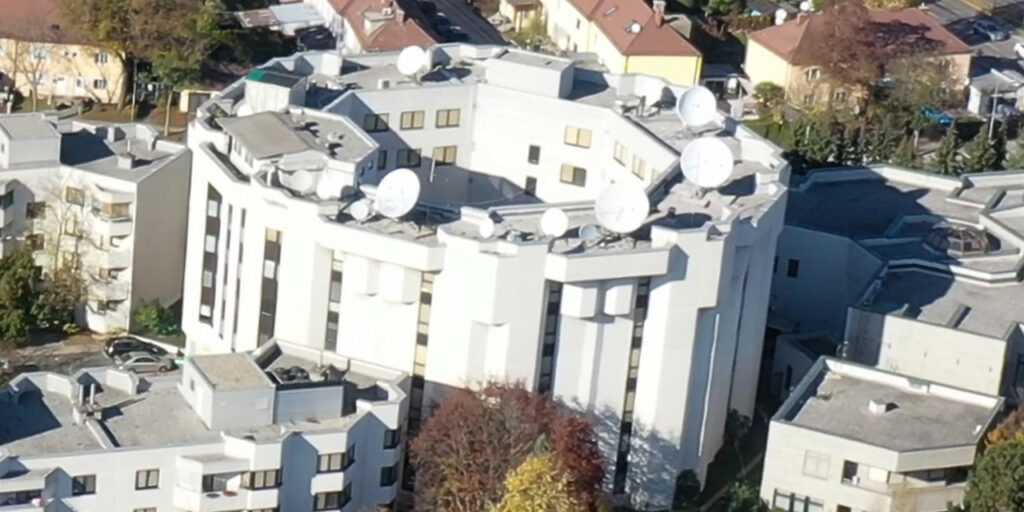
Vienna has also increasingly attracted attention as a potential hub for Russian signals intelligence. In 2026, Austrian authorities and local media reported specialized antennas installed on the roofs and façades of Russian diplomatic properties in the capital. Such equipment could potentially be used to intercept satellite and radio communications and monitor the activities of international organizations, including the United Nations, IAEA, and OSCE.
Russia’s extensive intelligence presence creates risks extending well beyond Austria itself. Information collected in Vienna concerning European governments’ positions, international negotiations, and decision-making processes could help the Kremlin anticipate Western policy, identify vulnerabilities among European partners, and adjust its political, military, and hybrid operations accordingly.
The problem also carries reputational consequences for Austria. Vienna has traditionally presented itself as a neutral venue for international diplomacy and global dialogue. The use of diplomatic facilities for intelligence collection or communications interception risks reinforcing the perception that Russian intelligence services have been able to exploit the Austrian capital as a comparatively permissive operating environment.
Austria’s response therefore represents more than a technical amendment to its criminal law. The expulsion of suspected intelligence officers, stronger counterintelligence measures, and proposed expansion of criminal liability for espionage against international organizations and foreign partners indicate a gradual shift in Vienna’s security posture.
If implemented effectively, these measures should make it more difficult for Moscow to use Austrian territory as a platform for intelligence collection and operations directed against European states and international institutions.
Austria Reconsiders Its Espionage Laws: Russian Operations as a Catalyst for Reform
The central weakness in Austria’s legal framework has been the narrow wording of Section 256 of the Criminal Code. The provision criminalized the operation or support of a clandestine intelligence service when the activity was conducted “to the detriment of the Republic of Austria.” In practice, this created a significant loophole when Vienna was used as an operational base for intelligence activities targeting third countries, international organizations, dissidents, or journalists.
The problem was therefore not that espionage was legal in Austria. Rather, the law was primarily designed to protect the Austrian state itself. If a foreign intelligence service used Austrian territory to monitor a diplomat, opposition figure, journalist, or citizen of another country, prosecutors faced the additional challenge of demonstrating that the operation was also detrimental to Austria.
This distinction became increasingly difficult to sustain given Vienna’s unique international role. The city hosts numerous international organizations, diplomatic missions, and UN institutions. Austria’s neutrality, its exceptionally large diplomatic community, and its historically cautious approach to counterintelligence disputes helped create an environment in which foreign intelligence services could operate with comparatively low levels of legal risk.
The Egisto Ott Case: A Turning Point
The scandal surrounding former Austrian intelligence officer Egisto Ott became the principal catalyst for a reassessment of this system.
Ott was arrested in March 2024. Austrian prosecutors suspected him of providing sensitive information to Jan Marsalek, the former chief operating officer of Wirecard who fled following the company’s collapse and was subsequently linked by European investigations to Russian intelligence structures.
Investigators examined whether Ott had exploited his access to Austrian police and international databases to obtain information on individuals of interest to Moscow. Potential targets included Russian opposition figures and other people whom Russian authorities sought to locate or monitor.
The significance of the case went considerably beyond the unauthorized disclosure of documents. Investigators also examined allegations involving data extracted from the mobile phones of senior Austrian officials, access to European law-enforcement information systems, the transfer of protected government equipment, and assistance to other operations associated with the Marsalek network.
The case therefore exposed a particularly serious vulnerability: Russian-linked structures potentially had access not merely to recruited sources in Austria but to an individual who had operated inside Austria’s own counterintelligence system and could potentially reach information circulating through wider European security networks.
Jan Marsalek and the Shift to Non-Official Cover
The second central figure in the case is Jan Marsalek.
After fleeing in 2020, Marsalek eventually surfaced in Russia. European investigations subsequently portrayed him as an important intermediary between Russian intelligence and clandestine networks operating across Europe.
Austria was particularly important because of Marsalek’s longstanding connections in Vienna. The Ott investigation illustrated the effectiveness of a model in which Russian intelligence could operate through several layers:
Russian intelligence service → private or non-official intermediary → former or serving national-security insider.
This structure provides Moscow with greater deniability than traditional operations conducted directly through an intelligence officer posted to an embassy. It also complicates the task of establishing a legally demonstrable connection between an individual operative and the Russian state.
Marsalek therefore represents an important evolution in the Russian intelligence model. Diplomatic cover remains valuable, but it is no longer indispensable. Businesspeople, former officials, private intermediaries, and citizens of third countries can provide additional layers between Russian intelligence headquarters and an operational target.
The Christo Grozev Case Exposed the Legal Gap
The case involving investigative journalist Christo Grozev is particularly important for understanding why reform of Section 256 became necessary.
Grozev, who had lived in Vienna and investigated Russian intelligence operations, became the target of a Bulgarian surveillance network linked to Marsalek. A British investigation established that members of the group conducted extensive surveillance against Grozev and considered different forms of action against him. The network also collected information on other targets.
In 2023, Grozev said security concerns prevented him from returning to Austria.
The implications for Vienna were uncomfortable. A foreign intelligence network could potentially use Austrian territory to conduct an operation against a person living under Austrian jurisdiction, yet traditional espionage legislation could be difficult to apply if prosecutors could not demonstrate that the operation itself was directly detrimental to the Austrian state.
This exposed the fundamental weakness of the existing model.
The question was no longer simply whether Russia was spying on Austria. The more important question was whether Russia and other foreign powers could use Austria as an operational platform for intelligence activities against third countries, international organizations, journalists, dissidents, and other individuals.
Cases such as the operation against Grozev transformed the Section 256 loophole from an abstract legal problem into a tangible national-security vulnerability.
Who Initiated the Legislative Shift?
The Ott–Marsalek scandal significantly changed the political debate in Vienna.
Following Ott’s arrest, then-Chancellor Karl Nehammer (ÖVP) publicly called for Austria’s espionage laws to be strengthened. The issue was no longer treated primarily as a technical matter of criminal law; it increasingly became a question of national security and Austria’s credibility as a host country for international institutions.
Then-Justice Minister Alma Zadić also advocated reforming the legal framework. The debate included both widening the scope of criminal liability and reconsidering the severity of existing penalties.
The political momentum behind the reform therefore emerged directly from the realization that Austria’s existing legislation had not kept pace with the transformation of foreign intelligence operations.
Why Did Austria Retain This System for So Long?
The explanation is partly historical.
Following the Second World War, and particularly after the declaration of permanent neutrality in 1955, Austria sought to position itself as a bridge between East and West. Vienna became a major diplomatic center in which Western, Soviet, and subsequently Russian intelligence services operated alongside one another.
Austria’s criminal-law approach traditionally concentrated on protecting its own sovereignty and state interests. When foreign intelligence services conducted operations against one another from Austrian territory without causing clearly demonstrable harm to Austria itself, the issue was often treated primarily as a counterintelligence or diplomatic problem rather than one requiring criminal prosecution.
For decades, that approach was compatible with Vienna’s role as a neutral diplomatic crossroads.
The security environment after 2022 made it increasingly difficult to sustain.
Russian intelligence activity in Europe expanded beyond conventional collection of classified information to include surveillance of dissidents, influence operations, cyber activity, suspected sabotage-related activity, and the use of criminal, commercial, and private intermediaries.
As a result, the distinction between “espionage against Austria” and “espionage conducted from Austria against somebody else” became increasingly artificial from a national-security perspective.
Strategic Significance of the Reform
The most important purpose of the legislative changes is therefore not simply to impose longer prison sentences. The strategic objective is to reduce the ability of foreign intelligence services to use Austria as a comparatively safe operational base against other states and international organizations.
This is particularly relevant to Russian intelligence.
Vienna has historically offered Moscow considerable operational value because of its concentration of embassies, international organizations, Russian diplomatic personnel, and potential intelligence targets from Central and Eastern Europe.
Expanding criminal liability beyond espionage directly targeting Austria would increase the legal and operational risks faced by Russian intelligence officers, intermediaries, recruited Austrian nationals, and other individuals supporting foreign intelligence activity.
The reform is unlikely to eliminate Russian intelligence operations in Austria. Moscow is more likely to adapt.
One probable consequence will be greater reliance on intermediaries whose connection to the Russian state is more difficult to establish: businesspeople, consultants, citizens of third countries, former security officials, and agents operating without diplomatic status.
The Marsalek network already illustrates how such a system can function.
The principal effect of reform will therefore be to raise the operational cost and legal risk of conducting intelligence activity from Austrian territory.
For Vienna, this represents a gradual transition away from the historical model of a tolerated intelligence crossroads toward a more restrictive counterintelligence posture closer to that adopted by other European states.
The ultimate measure of the reform’s effectiveness will not simply be the number of prosecutions it produces. The more important test will be whether Austrian authorities can investigate and prosecute foreign intelligence operations directed against Austria’s partners, international organizations, and individuals on Austrian territory without first having to prove direct harm to the Republic of Austria.
The Ott–Marsalek affair demonstrated why this matters. It showed how a legal framework originally intended to protect Austrian sovereignty could, under contemporary conditions, turn one of Austria’s traditional diplomatic advantages—its neutrality and openness—into a counterintelligence vulnerability.
Absolutely — here is the next section, continuing with the chronology of documented Russian intelligence operations in Austria since 2014.
Documented Russian Intelligence Operations in Austria Since 2014
The Austrian Colonel and Igor Zaitsev: A Classic GRU Recruitment Operation
One of the clearest examples of traditional Russian human intelligence activity in Austria involved a retired Austrian Armed Forces colonel whose name was not publicly disclosed.
The case came to light in 2018, although investigators established that the officer had supplied information to Moscow for more than 25 years. In 2020, an Austrian court convicted him of spying for Russian military intelligence and sentenced him to three years in prison.
Of particular significance was Austria’s identification of his alleged Russian handler, Igor Yegorovich Zaitsev, whom Austrian authorities identified as a GRU officer. Vienna subsequently issued European and international arrest warrants for him.
The operation demonstrated a fundamental vulnerability in Austria’s security environment: Russian military intelligence had been capable of maintaining long-term agent access to the Austrian defense establishment.
The case, however, did not expose the principal weakness of Section 256. Because the colonel had provided information concerning Austria’s own armed forces, the activity clearly affected Austrian national interests and could therefore be prosecuted under the existing legislation.
Its importance lies elsewhere. It demonstrated that Austria was not merely a neutral meeting ground for foreign intelligence services; Austrian institutions themselves could become targets of sustained Russian penetration.
Industrial Espionage Under Diplomatic Cover, 2020
In August 2020, Austria declared a Russian diplomat persona non grata over suspected espionage—the first such expulsion in the history of bilateral relations between Austria and Russia.
The case reportedly concerned industrial espionage and the diplomat’s relationship with an Austrian citizen employed by a technology company. The Russian official’s identity was not publicly disclosed.
The case suggested that Russian intelligence collection in Austria extended beyond conventional political and military targets to include commercially and technologically valuable information.
It also illustrated the continuing importance of diplomatic cover. An intelligence officer operating from an embassy enjoys access to potential sources, freedom to establish professional contacts and, crucially, diplomatic immunity that can make criminal prosecution extremely difficult.
Public information does not provide a sufficiently reliable basis for attributing the diplomat to the SVR or GRU specifically. The appropriate assessment is therefore that he was suspected of working on behalf of a Russian intelligence service whose precise affiliation was not publicly disclosed.
Jan Marsalek: The Emergence of a Non-Official-Cover Network
The case of Jan Marsalek represents a qualitatively different form of Russian intelligence activity.
The former Wirecard chief operating officer fled Germany in 2020 following the collapse of the company and subsequently surfaced in Russia. European investigations later linked him to Russian intelligence operations and identified him as an organizer or intermediary in clandestine activities conducted across Europe.
Austria was particularly important because Marsalek had developed extensive connections in Vienna before his disappearance.
His operational significance lies in the model he represents:
Russian intelligence service → non-official or private coordinator → citizens of third countries → local sources and operatives → target.
This architecture provides several advantages over traditional embassy-based intelligence activity.
It distances the Russian state from the operational act, complicates attribution, reduces dependence on personnel vulnerable to diplomatic expulsion, and allows Moscow to recruit individuals whose movements attract less counterintelligence attention than those of accredited Russian diplomats.
Marsalek therefore illustrates why diplomatic expulsions alone cannot substantially neutralize modern Russian intelligence networks. Even when suspected intelligence officers are removed from an embassy, operations can continue through private intermediaries and non-official-cover personnel.
Egisto Ott: Penetration of Austria’s Counterintelligence Environment
The Egisto Ott case represents one of the most serious Russian-linked counterintelligence scandals in modern Austria.
Ott had served in the Federal Office for the Protection of the Constitution and Counterterrorism (BVT), the predecessor of today’s Directorate for State Security and Intelligence (DSN). His professional background gave him access to sensitive information and contacts within Austria’s security system.
The investigation examined allegations that Ott had provided sensitive information to Marsalek and assisted in obtaining information on individuals of interest to Russia.
The potential intelligence value was considerable. The allegations involved access to police databases, information concerning Russian opposition figures and journalists, protected state equipment, and potentially sensitive material circulating through Austrian and European security channels.
From a counterintelligence perspective, this represented a far more serious problem than conventional diplomatic espionage.
The Russian-linked network was potentially exploiting an individual who had worked inside the very institution responsible for detecting foreign intelligence operations.
The case therefore exposed not only an agent-recruitment vulnerability but a potential counterintelligence penetration problem.
It also demonstrated the strategic value of intermediaries such as Marsalek. Instead of a Russian intelligence officer directly tasking an Austrian source, an intermediary could create an additional layer between the intelligence service and the individual providing information.
This complicates attribution, prosecution and damage assessment.
Christo Grozev and the Bulgarian Network
The operation against investigative journalist Christo Grozev is arguably the case that most clearly demonstrates the structural weakness of Austria’s existing espionage legislation.
Grozev had lived in Vienna and was internationally known for investigations into Russian intelligence operations, including activities associated with the GRU and FSB.
A Bulgarian network linked to Marsalek conducted surveillance against Grozev. British proceedings subsequently established extensive intelligence-gathering activities against him and other targets.
The group reportedly monitored movements, collected information and considered different operational options against its targets. Its intelligence interests extended beyond Grozev and included other individuals relevant to Russian security interests.
The implications for Austria were significant.
The target was not the Austrian state. The operation concerned an individual residing in Austria who was of interest to Russian intelligence.
Under the traditional logic of Section 256, this distinction mattered because prosecution for espionage required demonstrating that the intelligence activity was conducted to Austria’s detriment.
The Grozev case therefore exposed the fundamental contradiction in Austria’s legal framework: an intelligence service could potentially use Austrian territory to target a person living in Austria while remaining more difficult to prosecute under the principal espionage provision because the immediate intelligence target was not the Austrian Republic itself.
This is precisely the type of operational scenario that the proposed reform is intended to address.
Russian Diplomatic Expulsions in 2023
In February 2023, Austria expelled four Russian diplomats.
Two were employees of the Russian Embassy, while two worked at Russia’s Permanent Mission to international organizations in Vienna. Austrian authorities stated that their activities were incompatible with their diplomatic status or with the relevant international agreements.
The individuals’ names and precise intelligence-service affiliations were not publicly disclosed.
The involvement of personnel accredited to international organizations is particularly significant because Vienna hosts an unusually dense concentration of institutions of intelligence interest, including the:
- International Atomic Energy Agency (IAEA);
- United Nations Office at Vienna (UNOV);
- United Nations Office on Drugs and Crime (UNODC);
- Organization for Security and Co-operation in Europe (OSCE);
- Comprehensive Nuclear-Test-Ban Treaty Organization (CTBTO);
- Organization of the Petroleum Exporting Countries (OPEC).
For Russian intelligence, these organizations offer access to information concerning nuclear policy, sanctions, international security, energy, arms control, organized crime, diplomatic negotiations and the positions of numerous governments.
The case therefore reinforced the argument that protecting only Austrian state secrets was no longer sufficient. Vienna’s responsibilities as a host to international institutions required a broader counterintelligence framework.
Further Diplomatic Expulsions in 2024
Austria expelled another two employees of the Russian Embassy in March 2024 after determining that they had engaged in activities incompatible with their diplomatic status.
Again, their identities and affiliations with specific Russian intelligence services were not publicly disclosed.
The recurrence of such expulsions illustrates another weakness in the traditional Austrian response to espionage.
When a suspected intelligence officer operates under diplomatic immunity, the state may be able to identify and expel the individual but remain unable to prosecute him. Moscow can subsequently replace the expelled officer with another accredited employee.
Diplomatic expulsions therefore disrupt individual operations but do not necessarily dismantle the underlying intelligence infrastructure.
This problem becomes even more pronounced when intelligence services shift activities to non-diplomatic intermediaries such as Marsalek.
OMV: Intelligence Interest in Austria’s Strategic Energy Sector
A further suspected espionage case emerged in 2025 involving OMV, one of Austria’s most strategically important energy companies.
According to the source material, an OMV employee was suspected of providing confidential information to an employee of the Russian Embassy. Austria subsequently declared the Russian diplomat persona non grata after Moscow refused to waive his diplomatic immunity to allow investigative measures.
The diplomat’s identity and precise intelligence affiliation were not publicly disclosed.
The significance of OMV extends well beyond ordinary corporate espionage.
For Moscow, intelligence concerning the company could potentially provide insight into:
- gas-supply negotiations;
- diversification away from Russian energy;
- Austrian energy-security planning;
- negotiations with alternative suppliers;
- contractual disputes;
- corporate decision-making;
- government thinking on future energy relations with Russia.
Energy has historically been one of the most important components of the Austrian-Russian relationship. Intelligence access to a company such as OMV could therefore offer both commercial and strategic advantages.
The case also demonstrates the expansion of the counterintelligence problem from government institutions into critical infrastructure and strategically important private companies.
The “Antenna Forest”: Suspected Russian SIGINT Activity in Vienna
The most technologically significant recent case concerns the extensive antenna and communications equipment installed on Russian diplomatic properties in Vienna.
In 2026, Austria expelled three Russian diplomats amid concerns about suspected signals-intelligence activity. Austrian counterintelligence had reportedly been monitoring the proliferation of specialized antennas and satellite equipment associated with Russian diplomatic facilities.
Such systems could potentially be used to intercept satellite or radio communications.
The location is particularly sensitive because potential collection targets in Vienna include not only Austrian institutions but also:
- the United Nations;
- the IAEA;
- the OSCE;
- OPEC;
- foreign embassies;
- other international organizations and diplomatic missions.
This case encapsulates the central problem confronting Austrian lawmakers.
If signals-intelligence equipment located on Russian diplomatic premises is used primarily to collect communications belonging to international organizations or third countries, establishing that the activity was conducted directly “to the detriment of the Republic of Austria” may be considerably more complicated than demonstrating that intelligence collection occurred.
The suspected SIGINT infrastructure therefore provides perhaps the clearest contemporary illustration of why the traditional wording of Section 256 has become inadequate.
Which Russian Intelligence Services Are Most Active in Austria?
Publicly available cases support different levels of confidence regarding the presence of Russia’s principal intelligence agencies.
GRU/GU — High Confidence
Russian military intelligence has the strongest publicly documented operational footprint.
The Austrian colonel case and the identification of Igor Zaitsev provide direct evidence of GRU activity. The broader Marsalek network has also been repeatedly associated in European investigations with Russian military-intelligence interests.
Likely GRU priorities in Austria include:
- military information;
- NATO-related intelligence;
- defense policy;
- military personnel;
- Ukrainian and Western security activities;
- operational support to clandestine networks.
SVR — High Probability, Lower Case-Specific Public Attribution
The SVR almost certainly has a substantial interest in Vienna because the city offers exceptional opportunities for political, diplomatic, economic and international-organizational intelligence collection.
Its likely targets include:
- Austrian political elites;
- foreign diplomats;
- international organizations;
- business networks;
- energy policy;
- European decision-making.
However, Austrian authorities generally do not publicly identify the specific Russian service involved when expelling diplomats. It would therefore be analytically unsound to label every suspected embassy intelligence officer as SVR without supporting evidence.
The assessment should distinguish between high confidence that the SVR operates in Austria and lower confidence regarding the attribution of individual publicly reported cases.
FSB — Probable Role in Transnational Repression
The FSB’s potential role is particularly relevant where Russian intelligence operations target Russian citizens, opposition figures, defectors, journalists or other individuals regarded by Moscow as security threats.
Such operations overlap with the FSB’s counterintelligence and internal-security responsibilities.
The Grozev case and other activities involving Russian dissidents illustrate the type of target set that could attract FSB interest. Nevertheless, the Marsalek network also demonstrates that Russian services may cooperate, share intermediaries or operate across institutional boundaries.
Consequently, precise attribution to the FSB should be made only where supported by specific evidence.
Overall Assessment
Austria’s espionage-law reform is not the product of a single scandal. It reflects the gradual recognition that the Russian intelligence model operating in and through Austria has evolved substantially.
Traditional recruitment of military personnel and intelligence officers operating under diplomatic cover have been supplemented by:
- penetration of security institutions;
- private and commercial intermediaries;
- citizens of third countries;
- corporate insiders;
- surveillance of journalists and Russian government opponents;
- signals-intelligence capabilities located on diplomatic premises;
- intelligence collection against international organizations.
The traditional Section 256 framework was primarily designed for a relatively straightforward threat model:
A foreign state conducts espionage against Austria.
The contemporary Russian model is considerably broader:
A foreign state uses Austria as an operational platform for intelligence activity directed across Europe and against international institutions.
This distinction explains why the Marsalek–Ott network, the operation against Christo Grozev, and suspected SIGINT activity from Russian diplomatic facilities are particularly important to the legislative debate.
These cases suggest that Austria’s counterintelligence challenge is no longer limited to protecting Austrian state secrets. It increasingly concerns preventing Vienna from being used as a comparatively permissive base for intelligence operations against third countries, international organizations and individuals residing under Austrian jurisdiction.
The strategic purpose of reforming Section 256 is therefore to remove that advantage.
If effectively implemented, the changes will not end Russian intelligence activity in Austria. They will, however, make such operations more expensive, more legally hazardous and more dependent on complex clandestine networks.
Moscow is likely to respond by placing greater emphasis on non-official cover, private intermediaries, citizens of third countries and compartmentalized agent networks.
The Marsalek model may therefore be less an exception than an indication of how Russian intelligence activity in Austria is likely to evolve as Vienna strengthens its counterintelligence legislation.
This completes the substantive translation of the chronology and concluding intelligence assessment from the source document.

More on this story: Russia’s SVR Turns Vienna into a Hub for Signals Intelligence Operations

More on this story: Kneissl case to show how deeply Russian intelligence penetrated EU
More on this story: Moscow sets the stage for intelligence infiltration into OSCE PA

More on this story: Moscow plotting to remove German Chancellor