
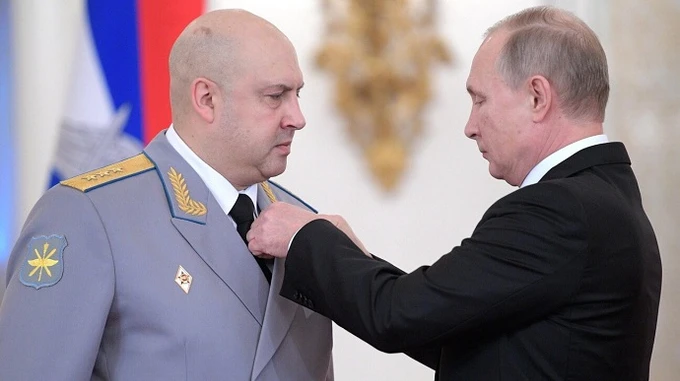
Army General Sergei Surovikin acquired the nicknames “the Syrian butcher” and “General Armageddon” during Russia’s military operation in Syria under President Bashar al-Assad, where he commanded the Russian force grouping from April to December 2017 and again from January to April 2019. Human rights organizations, including Human Rights Watch, documented large-scale strikes by the Russian Aerospace Forces on opposition-controlled areas of Aleppo, including residential neighborhoods and medical facilities. The Human Rights Watch report published in October 2020, Targeting Life in Idlib: Syrian and Russian Strikes on Civilian Infrastructure, identifies Surovikin as one of the commanders whose possible responsibility for war crimes should be examined, including attacks on homes, schools, hospitals and public markets carried out by Russian forces during the 2019–2020 Idlib offensive;
On November 13, 2017, according to the findings of the UN Independent International Commission of Inquiry on Syria, Russian aircraft carried out a series of strikes on the central market in the town of Atarib in Aleppo province, killing 84 people, including five children and six women, and injuring approximately 150 others. The strikes destroyed a significant portion of the market premises, residential buildings and surrounding civilian infrastructure. The UN Commission found indications that unguided aerial munitions had been used by a Russian aircraft. Throughout 2017, Russian and Syrian government forces repeatedly carried out airstrikes on hospitals and medical facilities in Idlib province. During the offensive that began in September 2017, six hospitals and five civil-defense centers were destroyed or damaged. More than 150 civilians were killed during the campaign, while the strikes also significantly reduced the local population’s access to medical care;
During military operations in Syria in 2017, the use of cluster and incendiary munitions by the Russian Armed Forces was repeatedly documented. Human Rights Watch recorded at least 238 instances of cluster-munition use between August 2016 and July 2017 and reported 22 attacks involving incendiary weapons during 2017. In April 2017, human rights monitors documented the use of ZAB incendiary submunitions in the area of Saraqib in Idlib province, causing indiscriminate harm to civilians, fires and destruction of residential buildings;
On April 4, 2017, Syrian government forces carried out a chemical attack using sarin on the town of Khan Sheikhoun in Idlib province. According to Human Rights Watch, at least 90 people, including children, were killed. The joint investigative mechanism of the United Nations and the Organisation for the Prohibition of Chemical Weapons established the responsibility of Syrian government forces for the use of chemical weapons. The attack occurred during Surovikin’s first deployment to Syria, when he commanded the Russian military contingent supporting Bashar al-Assad’s government;
On October 15, 2020, Human Rights Watch published its extensive investigation Targeting Life in Idlib: Syrian and Russian Strikes on Civilian Infrastructure, documenting 46 attacks by Syrian and Russian forces on civilian objects between March 2019 and March 2020. At least 224 civilians were killed and another 561 were injured. Twelve medical facilities and ten schools were damaged, while the large-scale military campaign displaced approximately 1.4 million people. Human rights researchers analyzed satellite imagery, more than 550 photographs and videos, and testimony from more than 100 witnesses. In many cases, the researchers found no evidence of lawful military targets near the strike sites. Human Rights Watch explicitly included Sergei Surovikin among the senior Russian commanders whose possible command responsibility for war crimes should be investigated;
Surovikin’s experience in Syria became an important factor in shaping his reputation as a commander prepared to accept large-scale destruction and civilian casualties. After his appointment as commander of Russian forces in Ukraine in October 2022, a large-scale campaign of strikes against Ukraine’s energy infrastructure began on October 10, 2022. Analysts at the Carnegie Endowment assessed the attacks on the energy system as part of a strategy intended to weaken Ukraine’s ability to wage war and increase pressure on Ukrainian society. The U.S.-based Institute for the Study of War (ISW), meanwhile, stated that “Surovikin’s air campaign” against Ukrainian civilian infrastructure failed, bringing only suffering to Ukrainian civilians;
Sergei Surovikin commanded Russia’s Southern Grouping of Forces in 2022 and, from October 8, 2022, to January 11, 2023, served as commander of the Joint Grouping of Russian Forces in Ukraine. During his command, the Russian military conducted a large-scale campaign of missile strikes against Ukraine’s energy system, residential buildings, hospitals and other civilian objects. On October 10, 2022, two days after Surovikin was appointed commander of Russian forces in Ukraine, Russia launched a massive missile attack on Kyiv, Dnipro, Zaporizhzhia, Zhytomyr and other cities. Strikes hit residential areas as well as energy, transport and civilian infrastructure. In Kyiv, university buildings, cultural institutions, Shevchenko Park and a pedestrian bridge were damaged; 11 people were killed and another 89 were injured. Beginning in October 2022, the Russian military launched large-scale missile and drone strikes on Ukrainian power plants, substations, heating facilities and energy networks, leaving millions of Ukrainians without electricity, water and heating as temperatures fell. On November 15, 2022, Russian forces fired approximately 90 missiles at Ukraine, attacking energy facilities across multiple regions. Residential buildings in Kyiv were damaged and civilians were killed. By early December 2022, at least 77 civilians had been killed and another 272 injured during attacks on energy facilities and related strikes. The UN Commission of Inquiry found that these attacks could constitute war crimes and that their systematic character also required assessment in the context of crimes against humanity;
On November 23, 2022, during a massive missile attack, a Russian munition struck a residential area in Vyshhorod, Kyiv region. Several apartment buildings were damaged, apartments and parked vehicles were destroyed, seven people were killed and another 35 were injured, including six children. During the night of November 23, 2022, a Russian missile struck the maternity ward of a hospital in Vilniansk, Zaporizhzhia region, destroying part of the medical building and killing a newborn boy who was only two days old. On December 16, 2022, during another large-scale Russian attack, a missile struck a three-story residential building in Kryvyi Rih. One section of the building was destroyed, trapping civilians under the rubble. Four people, including a child, were killed and 13 others were injured;
Russia’s campaign against Ukraine’s energy infrastructure has already received a procedural assessment from the International Criminal Court (ICC), which found reasonable grounds to suspect war crimes connected with the Russian campaign of strikes against Ukrainian energy infrastructure. In March 2024, the ICC issued arrest warrants for Lieutenant General Sergei Kobylash and Admiral Viktor Sokolov, and in June of the same year for former Russian Defense Minister Sergei Shoigu and Chief of the General Staff of the Russian Armed Forces Valery Gerasimov. The judges pointed, among other matters, to possible responsibility for directing attacks against civilian objects and for excessive incidental harm to civilians;
The report by the British newspaper The Telegraph that Russian President Vladimir Putin ordered General Surovikin to destroy bridges in Kyiv should be viewed as an indication of the Kremlin’s intent to use tactics of terror against the civilian population aimed at undermining the humanitarian and economic viability of the Ukrainian capital. Bridges across the Dnipro in Kyiv have not only transport but also humanitarian significance, as they enable civilian movement, the operation of emergency services, access to hospitals, the delivery of goods and the functioning of the city’s economy. Their destruction, according to the argument presented in this paper, would be intended to break the morale of Ukrainian society and could fall within the category of war crimes if attacks were intentionally directed against protected civilian infrastructure in violation of the Geneva Conventions and applicable provisions of the Rome Statute. Putin’s decision to involve General Surovikin in active command of combat operations in Ukraine should be viewed as a signal of a new phase of Kremlin escalation against Ukraine. His reputation as “General Armageddon” and his experience of campaigns involving large-scale strikes on civilian infrastructure in Syria and Ukraine indicate a reliance on harsh methods of warfare involving extensive destruction and pressure on the civilian population;
Despite his long involvement in Russian military operations and allegations by international human rights organizations concerning war crimes, Surovikin is not currently among the Russian generals for whom the International Criminal Court has publicly announced an arrest warrant. At the same time, the European Union placed him on its sanctions list in 2022, noting that during his command of Russian forces in Ukraine, Russian troops carried out large-scale air attacks against civilian objects, including Ukraine’s energy infrastructure. In addition to the EU, Surovikin has been sanctioned by the United Kingdom, Switzerland, Australia, New Zealand, Ukraine and Japan. In light of the documented record of large-scale attacks on civilian objects in Syria and Ukraine during periods of Surovikin’s command, as well as reports that he received an order to destroy bridges in Kyiv, the paper argues that there are sufficient grounds for the ICC to consider an arrest warrant for him. Such a step would be consistent with the ICC’s existing scrutiny of alleged war crimes in Russia’s campaign against Ukrainian energy infrastructure and its issuance of warrants for other senior Russian military and political figures. Including Surovikin among those subject to judicial scrutiny would, in the paper’s assessment, support accountability and efforts to prevent impunity for systematic attacks on civilians and critical infrastructure.
More on this story: Moscow appoints Surovikin: an echo of chaos in Russian military rule
More on this story: Alleged Coup Planning Within Russia’s General Staff