
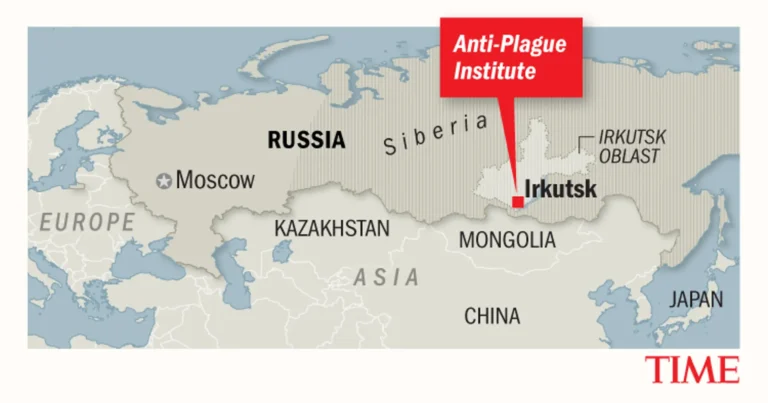
Twenty-eight-year-old Daria Shipilova, an employee of the Irkutsk Anti-Plague Research Institute, died after developing severe pneumonia. About 200 contacts were placed under medical observation, some were hospitalized or isolated, and strict restrictions were introduced at the Shelekhov District Hospital. Russian authorities, however, say that no microorganisms associated with her professional activity were detected in samples from the deceased and that a commission found no evidence of a laboratory accident. The report that she broke a test tube remains unconfirmed.
More importantly, the WHO reported today that there are no signs of new infections among the contacts being monitored, while the Russian side continues to investigate the cause of Shipilova’s death, including the possibility of pneumonic plague. The WHO is awaiting additional information from Moscow.
“an incident involving a suspected particularly dangerous infection that, because the deceased worked at an anti-plague institute, has raised legitimate questions about a possible laboratory origin of the illness.”
Why the Authorities’ Response Still Deserves Attention
There is an obvious asymmetry between the public account and the scale of the initial measures.
If this is merely an ordinary case of “pneumonia of unknown etiology,” the medical monitoring of roughly 200 contacts, the isolation of employees of a specialized anti-plague institute, the emergency involvement of Rospotrebnadzor leadership, and special anti-epidemic measures require explanation. This is why the situation has attracted the attention of the United States and the WHO. Reuters reports that Washington is monitoring the incident and that the WHO has requested additional information.
Available documentation from the Irkutsk Anti-Plague Research Institute confirms authorization to work with pathogens in Russian pathogenicity groups I–II, including plague. However, Russia’s pathogen classification and the U.S. BSL system are different frameworks, and it is incorrect to automatically equate “pathogenicity group I” with “BSL-4.”
Moreover, Yersinia pestis does not in itself require BSL-4 containment.
The CDC defines BSL-3 as the level used for agents capable of aerosol transmission and of causing serious or potentially lethal infections. BSL-4 is reserved primarily for highly dangerous agents for which no treatment is available, such as Ebola or Marburg. Plague, by contrast, can be treated with antibiotics if detected early.
But Is Infection Possible Even in a High-Containment Laboratory?
No level of biosafety reduces risk to mathematical zero.
High-level containment creates several successive barriers:
engineering controls + airflow control + biological safety cabinets + PPE + decontamination + protocols + medical surveillance.
A single failure therefore should not normally result in infection. A serious incident often requires either a specific exposure or a combination of technical and human factors.
In 2009, a researcher in Chicago died from laboratory-acquired Yersinia pestis even though he had been working with an attenuated strain. The CDC determined that the infection was occupationally acquired, although the precise route by which the bacterium entered his body could not be established. The investigation identified problems with compliance with biosafety procedures.
Conceptually, therefore: “high-level biosafety” ≠ “infection is impossible.”
But this does not mean that such an event occurred in Irkutsk.
Laboratory-acquired infection is a plausible but currently unconfirmed hypothesis. Mass laboratory-linked transmission is unlikely on the evidence currently available because, after a substantial part of the incubation window has passed, no corresponding secondary cases have yet been identified among roughly 200 contacts. The WHO states that the typical incubation period for plague is approximately 1–7 days.
If all contacts remain negative over the coming days, the hypothesis that a transmission chain of pneumonic plague has already formed will become still weaker.
But There Were Natural Cases in the Soviet Union as Well
Plague never disappeared completely.
The vast Soviet anti-plague system — more than 100 institutions — existed precisely because natural foci of Y. pestis persisted across the Soviet Union, particularly in Central Asia and other steppe regions.
Another point is especially revealing: for decades, the Soviet authorities did not report human plague cases to the international community.
A scientific publication on “plague and glasnost” notes that only in October 1989 did the Soviet Union report a human death from plague to the WHO for the first time in many decades. Specialists nevertheless knew that natural foci persisted and that sporadic human cases occurred.
The incident surrounding the death of Daria Shipilova, an employee of the Irkutsk Anti-Plague Research Institute, does not yet provide sufficient grounds to speak of a plague outbreak in Irkutsk Oblast. As of October 6, Russian authorities describe the cause of death as pneumonia of unknown etiology, while the WHO reports no signs of illness among the contacts being monitored. The widely circulated media claim that Shipilova broke a test tube containing Yersinia pestis also remains unconfirmed.
Secretary of State Marco Rubio’s reaction to the Irkutsk incident suggests above all that Washington views it not as a confirmed plague epidemic but as a potential international biosafety incident for which the United States considers the information provided by Russia insufficient.
On October 6, Rubio effectively hardened his initial position. Whereas the previous day he said the situation required attention but not panic, he now stated directly that Russia should provide the world with more information and that the United States was monitoring developments “very closely, hour by hour.” He also said Washington had the means to assist Russia if the situation proved more serious than Moscow currently acknowledges.
This supports several important conclusions.
Washington Is Dissatisfied With the Level of Russian Transparency
This is probably the most important signal.
On October 5, the State Department said it was monitoring the situation together with the CDC and other U.S. agencies, stressing that many details remained unconfirmed and calling on Russian authorities to provide accurate information quickly and transparently.
Rubio has now personally repeated the demand for transparency.
For Washington, therefore, the issue is not limited to the question: “Did Shipilova die of plague?” There is a broader question: “Does the international community have enough information to independently assess the risk?”
Particularly revealing are the contradictions between early regional reports about anti-epidemic measures and the later federal account from Rospotrebnadzor, which denied a laboratory accident and said that no microorganisms associated with Shipilova’s professional activity had been detected in her samples.
The United States Appears to Be Considering a Scenario in Which Moscow Is Underestimating the Scale of the Event
Rubio’s statement that U.S. assistance could be available if the situation proves more serious than has so far been acknowledged is particularly important.
The diplomatic formulation indicates that the U.S. side does not rule out a discrepancy between the actual situation and Russia’s public account.
The U.S. position therefore effectively looks like this: do not panic → do not accept the Russian account without verification → collect information → demand transparency → remain prepared to respond.
The Incident Has Already Been Elevated From a Regional Medical Issue to a U.S. National Security Concern
The incident is not being monitored by the CDC alone. The State Department has reported interagency monitoring, while the White House earlier said the administration was “monitoring the outbreak, and assessing options.”
The reason is clear: Shipilova did not work at an ordinary hospital but at a specialized anti-plague research institute that works with dangerous pathogens.
Washington therefore has to assess at least three different scenarios: natural infection → occupational/laboratory-acquired infection → a broader laboratory incident.
The available evidence does not yet establish the second or third scenario.
But Rubio Is Deliberately Avoiding Alarmism
This is no less important than his tougher demand for transparency.
On October 5, Rubio said he saw no reason for panic, although the situation required close attention.
The WHO’s current data also support a cautious approach.
The WHO assesses the risk as moderate-to-low for Irkutsk, low for Russia as a whole, and very low for the WHO European Region. None of Shipilova’s identified contacts currently shows symptoms of plague.
Washington, therefore, is not currently behaving as though it possesses information indicating an uncontrolled epidemic.
The Offer of Assistance to Russia Also Has Diplomatic Significance
Trump has already said that the United States is prepared to help Russia. Rubio repeated that Washington has the relevant capabilities but first needs more information.
This creates a kind of diplomatic trap for Moscow.
If the situation is genuinely under control, Russia can provide the data and reduce international concern.
If Moscow refuses greater transparency, the United States can argue that it is the absence of Russian information — rather than U.S. policy — that is obstructing an international response.
The U.S. offer of medical assistance effectively allows Washington to separate two issues: humanitarian assistance to Russia — yes; sanctions relief — an entirely different matter.
In other words, Moscow cannot easily construct the argument that “sanctions prevent the West from helping us fight the epidemic” when Washington itself is publicly offering assistance.
Key Analytical Judgment
Secretary of State Marco Rubio’s reaction indicates that Washington now views the Irkutsk incident not only as a domestic Russian epidemiological issue but as a potential international biosafety incident. At the same time, the U.S. side has so far shown no indication that it possesses independently confirmed evidence of a pneumonic-plague outbreak or a major laboratory accident.
The central element of Washington’s position is its demand for transparency. Rubio’s statement that Russia must provide additional information, together with reports that the United States is monitoring the situation “hour by hour,” indicates that Washington does not regard the information currently provided by Russia as sufficient for an independent risk assessment. Particularly significant is the secretary of state’s suggestion that the situation could potentially prove more serious than the Russian side currently acknowledges.
At the same time, Washington is deliberately avoiding alarmism. Rubio stresses that there is currently no reason to panic, consistent with the WHO’s present assessment: the risk to Russia is considered low and the risk to the European Region very low. The U.S. position is therefore not based on an assumption that a large-scale epidemic is already under way, but on the need to rule out a concealed or underestimated laboratory incident.
The U.S. offer to assist Russia also carries political significance. It allows Washington to separate a humanitarian response from broader U.S.-Russian disputes and the sanctions regime. If Moscow continues to restrict access to information, it will become more difficult for the Kremlin to explain the absence of international assistance by pointing to Western sanctions, because Washington has already publicly stated its readiness to help address a potential epidemiological threat.
The most important indicator of how the situation develops will therefore not be Washington’s rhetoric itself but Moscow’s response to the demand for transparency: whether Russia provides the WHO with sufficient epidemiological and laboratory data, whether it permits an independent assessment of the origin of Daria Shipilova’s illness, and whether it can convincingly explain the discrepancy between the scale of the initial anti-epidemic measures and the official account of “pneumonia of unknown etiology.”
Moscow’s behavior following Rubio’s demand today — rather than the statement itself — may now become one of the most valuable indicators for assessing the Irkutsk incident.
Particularly revealing are the contradictions between early regional reports about anti-epidemic measures and the later federal account from Rospotrebnadzor, which denied a laboratory accident and said that no microorganisms associated with Shipilova’s professional activity had been detected in her samples.
The United States Appears to Be Considering a Scenario in Which Moscow Is Underestimating the Scale of the Event
The Incident Has Already Been Elevated From a Regional Medical Issue to a U.S. National Security Concern
The key intelligence gap is not the wording of the diagnosis “pneumonia of unknown etiology” itself, but the absence in the public domain of sufficient information about molecular diagnostic results, the specific nature of Shipilova’s work before she became ill, and any possible contact with Y. pestis cultures. Without these data, it is impossible to definitively confirm or rule out a laboratory origin of the infection.Historical experience shows that occupational infection with plague in specialized laboratories is possible in principle. The most relevant Soviet precedent is the infection of microbiologist Abram Berlin in 1939 while conducting experiments with Y. pestis. After becoming infected, he traveled to Moscow and had contact with civilians before a diagnosis was established. Thus, the principal risk of a laboratory accident lies not only in infection of the employee, but in delayed recognition of occupational exposure and the infected person leaving the controlled environment.
More on this story: The Next Black Swan? Assessing the Pandemic Potential of Marburg Virus”
More on this story: The Shadow of Biowarfare: Investigating Russia’s Pathogen Development
More in this story: Warning: growing risks of virus spread in Europe
More on this story: Russia uses African continent as a base for its biolabs

More on this story: Russia’s 10-year monkeypox virus work outbreaks in 2022