
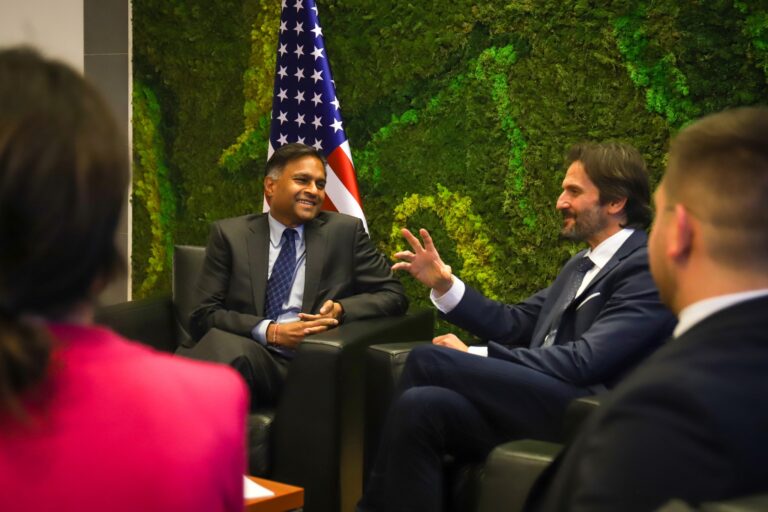
Slovak Deputy Prime Minister and Defense Minister Robert Kaliňák, one of the most influential figures in Prime Minister Robert Fico’s ruling Smer-SD party, has said that Bratislava does not regard Russia as a direct threat to Slovakia.
During an October 6 discussion, Kaliňák rejected the assessment of German Foreign Minister Johann Wadephul, who has described Moscow as the principal threat to freedom on the European continent. According to the Slovak defense minister, the government seeks to maintain dialogue with Russia and avoid steps that could lead to further escalation.
At the same time, Kaliňák stressed the need to distinguish between a provocation, a security incident and an armed attack. He argued that NATO should not automatically treat every drone incursion into allied airspace as grounds for invoking Article 5 of the North Atlantic Treaty. In his interpretation, Article 5 applies specifically to an armed attack, while Article 4 provides the mechanism for consultations when a member state perceives a threat.
Legally, that distinction does not in itself contradict the North Atlantic Treaty. The more consequential issue is the broader political context in which Slovakia’s leadership is making the argument.
Kaliňák’s statement is not an isolated remark but part of a consistent policy by the Fico government to downgrade Russia’s status as a direct military threat while gradually restoring bilateral channels of communication with Moscow.
As early as September, Kaliňák said that the threat to Slovakia was the war itself rather than Russia or Ukraine, calling for each incident involving Russian or Ukrainian drones to be assessed individually. At the same time, he has stressed that Slovakia is not abandoning its alliance commitments and would assist its allies in the event of an actual armed attack.
Bratislava is therefore sending a dual message: it formally reaffirms Article 5 and Slovakia’s place in NATO’s collective-defense system, while declining to endorse the view that Russia constitutes the Alliance’s principal military threat.
The Return of the Russian Military Attaché Moves the Policy from Rhetoric to Practice
The most important indicator of the shift in Slovak policy is the restoration of military-diplomatic relations with Russia.
In May 2026, during a meeting with Vladimir Putin in Moscow, Robert Fico publicly raised the prospect of restoring the exchange of military attachés. Kaliňák later said that the initiative had in fact originated with the Slovak side and had been under discussion for roughly six months before Fico’s meeting with Putin.
By October, the process had moved into practical implementation.
Slovakia has already sent its military representative to Moscow, while the Slovak Defense Ministry has confirmed the accreditation of a Russian military attaché who is expected to arrive in Bratislava.
This is therefore more than a diplomatic gesture. It restores a channel of direct military-diplomatic communication between the two countries that had effectively been suspended following Russia’s full-scale invasion of Ukraine in 2022.
For the Fico government, such a channel may have practical value: a military attaché in Moscow gives Slovakia direct access to Russia’s defense establishment, military-political information and official contacts.
At the same time, the principle of reciprocity gives Russia comparable opportunities in Bratislava.
Counterintelligence Dimension
This is precisely what makes the decision politically and security-sensitive.
Russia’s previous military-diplomatic presence in Slovakia was already associated with a counterintelligence scandal. In 2022, Slovak security services released material showing Sergei Solomasov, then deputy Russian military attaché, handing money to a Slovak citizen and discussing the recruitment of people willing to collect political information for Moscow, including information concerning NATO and the European Union.
After the start of the full-scale war, the government of Eduard Heger expelled the Russian military attaché along with other Russian diplomats. Slovakia’s military representation in Moscow was suspended at the same time.
The return of a Russian military attaché in 2026 therefore restores an institutional channel that was closed not only because of the war against Ukraine but also against the backdrop of Russian intelligence activity identified by Slovak security services.
A Gap Is Emerging Between Slovak and Allied Threat Assessments
Strategically, the most important issue is not Kaliňák’s interpretation of Article 5 itself, but the divergence between the Slovak government’s threat assessment and those of a number of other NATO members.
While Germany, the Baltic states and other allies increasingly view Russian sabotage, cyberattacks, information operations and airspace violations as elements of a broader hybrid campaign, the Slovak government insists that such incidents should be assessed individually and warns against automatically interpreting them as acts of Russian aggression.
This divergence does not automatically mean that Slovakia is violating its alliance obligations. On the contrary, Kaliňák has explicitly said that Bratislava would assist its allies in the event of an armed attack.
The more difficult issue is that allies may define differently the point at which an accumulation of hybrid actions becomes a threat requiring a collective response.
Moscow can exploit precisely this gray zone, conducting operations below the obvious threshold of armed attack while calculating that allies will differ in their assessments of the incidents’ origin, scale and the response they require.
The key question, therefore, is not whether Slovakia recognizes Article 5, but which Russian actions Bratislava would consider serious enough to justify moving from bilateral dialogue and Article 4 consultations toward collective-defense mechanisms.
Bratislava Is Pursuing a Policy of Selective Normalization
Taken together, the Fico government’s actions point to a gradual policy of selective normalization with Russia.
The model does not involve Slovakia leaving NATO or renouncing allied guarantees. Rather, Bratislava is attempting to combine membership in Western security structures with the restoration of selected political, economic and military-diplomatic channels with Moscow.
The return of military attachés is both symbolically and practically important in this respect.
Bratislava is effectively signaling that it does not regard the current level of confrontation between Russia and NATO as sufficient reason to keep military-diplomatic relations frozen.
At the same time, Russia regains the ability to maintain a legal military-diplomatic presence in a NATO country on the Alliance’s eastern flank that is directly connected to logistics, defense production and support for Ukraine.
This does not mean that a Russian military attaché will automatically engage in intelligence activity. Slovakia’s previous experience with Russian military-diplomatic personnel does, however, mean that the counterintelligence dimension of the decision cannot be treated as purely theoretical.
Kaliňák’s statement that Slovakia does not view Russia as a threat is significant primarily because it coincides with practical steps by the Fico government to normalize relations with Moscow.
Restoring the exchange of military attachés moves this policy from the level of political rhetoric into the sphere of security interaction.
At the same time, Bratislava is not abandoning NATO: Kaliňák has reaffirmed Slovakia’s readiness to assist allies in the event of an armed attack, the country maintains a military presence on the Alliance’s eastern flank, and its own military attaché is returning to Moscow.
A different model is emerging: Slovakia remains inside NATO’s collective-defense system while seeking to restore its own channel of military-political communication with Russia and to differentiate its assessment of the Russian threat from the more severe assessments held by some allies.
For NATO, the principal risk posed by this policy is not a formal Slovak rejection of Article 5, but a possible divergence over where the boundary lies between a Russian provocation, a hybrid operation and an armed attack.
The ambiguity surrounding that boundary is itself one of the key elements of Russia’s strategy of operating below the threshold of open conflict.
The factual basis for the new section is substantial. In May, Kaliňák said explicitly that the Slovak Defense Ministry itself had proposed restoring the exchange of military representatives and that talks had already been underway for roughly six months. On October 8, Slovak media reported that the Slovak attaché had already been sent to Moscow, while the Russian officer had been accredited and was expected to arrive in Bratislava.
There is also an important counterintelligence context: the former deputy Russian military attaché, Sergei Solomasov, was recorded handing money to a Slovak source and assigning tasks related to the collection of political information about NATO and the European Union.

More on this story: From Tiso to Fico: Slovakia’s Dangerous Drift Toward the Aggressor
More on this story: One Against 26: How Fico Uses EU Unanimity in Moscow’s Interests