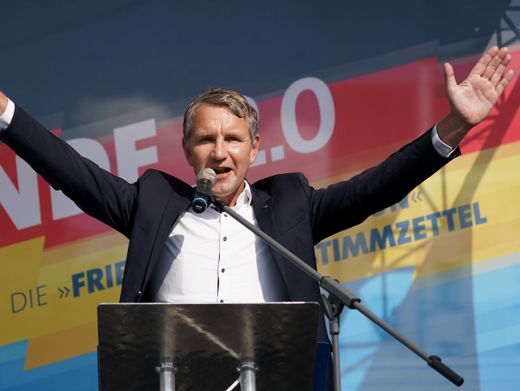

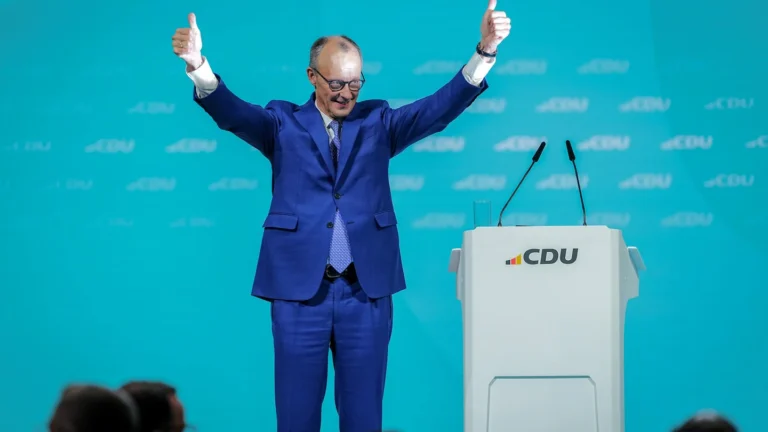
German Chancellor Friedrich Merz (CDU) warned that the Alternative for Germany (AfD) coming to power in Saxony-Anhalt could cause the state “significant damage,” primarily by reducing international investment. In his assessment, foreign companies are unlikely to be willing to open new facilities in a region whose state government is headed by an AfD representative.
Merz’s statement has an obvious election-campaign dimension, but the risk of a deterioration in the investment climate under an AfD-led government goes beyond political rhetoric. The party’s economic program contains a number of provisions that could potentially alter how international investors view Saxony-Anhalt—especially large industrial corporations, for which access to skilled international labor, regulatory predictability, and stable relations between the regional government, Berlin, and the EU are important.
At the same time, the AfD’s economic program is not unequivocally anti-business. However, the potential benefits of deregulation could be outweighed by substantially greater political and structural risks.
The first risk is a de facto shift in economic policy away from attracting global capital and toward prioritizing support for the local Mittelstand. The AfD’s program for Saxony-Anhalt explicitly contrasts support for small and medium-sized businesses with “subsidizing globalist large corporations.” As a negative example, the party points to Intel’s planned project near Magdeburg and criticizes the government’s willingness to provide multibillion-euro support to a major foreign investor.
This could signal to international corporations that the regional government would no longer regard attracting large foreign manufacturing projects as a strategic priority. This is particularly relevant to capital-intensive projects in the semiconductor, automotive, chemical, battery, and energy sectors, where location decisions often depend on public incentives, infrastructure, and long-term partnerships with local authorities.
The second—and probably most serious—risk concerns the labor market. Saxony-Anhalt is among the German states most affected by population aging and the contraction of the working-age population. Under these conditions, economic growth increasingly depends on the region’s ability to attract workers from abroad.
The AfD’s hard-line anti-immigration policy could affect this process even without a radical change in federal immigration law. For a foreign engineer, programmer, doctor, or manager, what matters is not only the legal possibility of working in Germany but also the social and political environment in which they and their family would live.
Consequently, the emergence of a lasting image of Saxony-Anhalt as an unwelcoming region for foreigners could reduce not only migrant inflows but also the internal mobility of highly skilled workers: foreign specialists already living in Germany may prefer Berlin, Hamburg, Bavaria, Hesse, or North Rhine-Westphalia.
For investors, this translates into a concrete economic metric—the cost of recruiting and retaining personnel. If companies have to pay more to persuade engineers and managers to relocate to Magdeburg or Halle, part of Saxony-Anhalt’s investment advantage from cheaper real estate and lower operating costs disappears.
The Leibniz Institute for Economic Research Halle (IWH) has already warned that creating a political environment hostile to foreigners could sharply exacerbate labor shortages. According to the institute’s estimate, over the next legislative term the state could lose thousands of workers and as much as €3.2 billion in value added as a result.
The third channel is reputational risk for corporations themselves. For major American, Japanese, South Korean, and Western European companies, decisions about where to locate a facility are determined by more than taxes or land prices. They also pass through internal compliance, ESG, human resources, and corporate-risk procedures.
Opening a major facility in a region whose government is associated with radical anti-immigration policies or conflict with democratic institutions could raise additional concerns among shareholders, employees, trade unions, and customers. This is particularly important for multinational companies competing for international talent.
As a result, an investor may not abandon Germany at all—it may simply choose another federal state. This is one of the main risks for Saxony-Anhalt: it competes for the same capital with dozens of other European regions, meaning that even a relatively small increase in political risk can influence the final decision on where to locate a new facility.
The fourth risk is conflict between an AfD state government and the federal government and the EU. The Saxony-Anhalt AfD supports lifting sanctions on Russia, Belarus, and Iran and takes a fundamentally different approach to climate, energy, and migration policy from the federal government. However, many of the relevant powers belong not to the state but to Berlin or the EU.
An AfD government could therefore find itself in a state of persistent political conflict with federal and European institutions while lacking the authority to implement a significant share of its own promises. For businesses, the problem lies less in AfD ideology itself than in growing regulatory uncertainty: companies would find it harder to predict how closely state-level policy will remain aligned with federal and European rules over the next five to ten years.
A fifth factor could be the weakening of the innovation ecosystem. For a modern industrial investor, what matters is not only the plant itself but the entire cluster around it—universities, research centers, international students, start-ups, engineers, suppliers, and the ability to attract specialists from other countries. Policies that make the region less attractive to foreign students, researchers, and skilled workers would gradually erode precisely the talent base required for high-technology investment.
A potential negative economic cycle could emerge: radicalization of the political environment → declining attractiveness to foreign specialists → deeper labor shortages → higher business costs → fewer new investments → weaker economic growth → further outflow of young and skilled workers.
The principal economic risk of an AfD victory is not that a state government would be able to radically change the rules for doing business overnight. A large share of tax, migration, foreign-trade, and sanctions policy is determined at the federal or European level.
The danger lies elsewhere: the AfD could alter Saxony-Anhalt’s relative competitiveness as a location for international capital. An investor does not need to conclude that the region has become “dangerous.” It is enough for an alternative location—in western Germany, Poland, the Czech Republic, or another EU country—to appear more politically predictable and to offer better access to international labor.
For this reason, the most vulnerable element would not be existing companies, which are unlikely to leave the state en masse immediately after a change of government, but future investment decisions. The economic effect may be almost invisible in the first months: factories would continue operating, employment would not fall sharply, and the AfD could argue that its opponents’ warnings had failed to materialize.
Yet over a two-to-five-year horizon, the consequences could become visible in the form of factories that were never built, R&D centers opened in other regions, international specialists who did not move to Saxony-Anhalt, and supply chains that developed elsewhere in Europe.
Friedrich Merz’s warning about a possible decline in international investment is therefore politically motivated but describes a real economic mechanism. The greatest threat to Saxony-Anhalt is not an immediate “flight of capital,” but the gradual emergence of a political-risk premium on investment that would make the state less competitive in the contest for the next generation of industrial and technology projects.
This risk is amplified by the fact that the AfD simultaneously proposes fairly conventional pro-business measures—deregulation, tax relief, and support for the Mittelstand. (IHK) The AfD’s tax and deregulation policies could improve some indicators of the investment environment, but its migration, foreign-policy, and institutional agenda could create a substantially larger risk premium for international capital.
This is particularly relevant now: ahead of the September 6 election, the AfD is polling at around 42%, compared with roughly 22% for the CDU, while Merz has explicitly linked a possible AfD government to the risk that international investors will abandon new projects in the state. (Reuters)Central question: “Could an AfD government set in motion a self-reinforcing cycle in Saxony-Anhalt—shortage of foreign workers → declining investment → weaker growth → population outflow → further radicalization of the electorate?” This makes it possible to examine not only the investment impact but also a potential long-term political-economic trap for eastern Germany.