

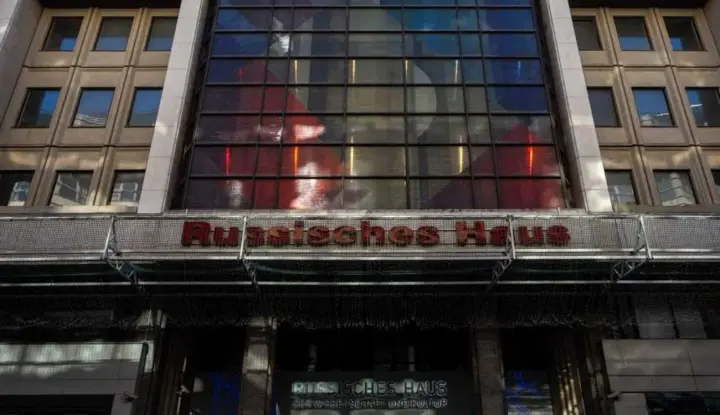
After Berlin officially held Russia responsible on September 1, 2026, for an attempted explosive-drone attack on Leipzig/Halle Airport, the government announced a package of measures: the closure of the Russian Consulate General in Bonn from September 18, termination of the agreement governing the Russian House in Berlin, tighter controls on the entry of Russian citizens, pressure on Russia’s “shadow fleet,” new EU sanctions proposals, and undisclosed measures in the intelligence sphere.
The most noteworthy element of the response is the Russian House itself. Its closure indicates that Berlin is beginning to treat Russia’s cultural and humanitarian infrastructure not only as an instrument of soft power, but as a potential component of a broader ecosystem of hybrid operations.
Berlin’s Response to the Leipzig Sabotage Plot: Why Germany Is Closing the Russian House
Germany’s decision to close the Russian House in Berlin and the Russian Consulate General in Bonn in response to a sabotage operation at Leipzig/Halle Airport prepared by Russian intelligence services signals a change in the federal government’s approach to countering Russian hybrid operations. Berlin is effectively moving from a largely reactive model—investigating individual acts of sabotage, cyberattacks, and influence operations-to gradually reducing the Russian state infrastructure that could potentially be used to support such operations.
On September 1, the federal government officially stated that the combined findings of the police investigation, the modus operandi, and intelligence information made it possible to attribute the attempted Leipzig attack to Russian state structures. Berlin assessed that the Russian side had provided the necessary expertise and resources, while lower-level agents were recruited to carry out the operation directly.
Russian hybrid operations increasingly do not require large numbers of career intelligence officers to be physically present in the target country. Moscow can use remotely recruited operatives, criminal networks, pro-Russian activists, and other intermediaries. Under these conditions, the traditional response of expelling several diplomats no longer necessarily produces a significant reduction in the operational capabilities of Russian services.
This is why Berlin chose a different target: the infrastructure of the Russian state presence.
The Russian House — More Than a Symbolic Target
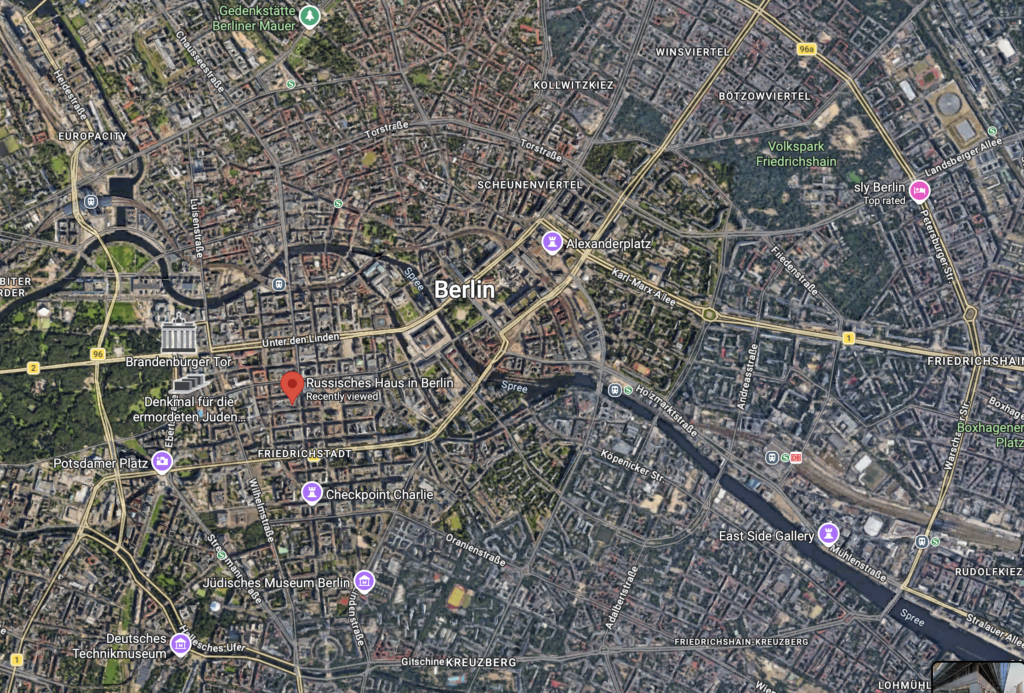
Formally, the Russian House of Science and Culture on Friedrichstraße is a cultural institution that offers language courses, exhibitions, film screenings, and other events. Its operator, however, is Rossotrudnichestvo—a Russian state agency under EU sanctions since 2022.
The EU has described Rossotrudnichestvo as one of the key state structures of Russian influence abroad, linked to networks of compatriots and agents of influence and to the financing of propaganda projects. In August 2026, German media also reported an assessment by the French Interior Ministry that the Russian House in Berlin had been used as cover for Russian intelligence activity.
Its closure therefore has more than diplomatic or symbolic significance. From a counterintelligence perspective, it potentially deprives Moscow of a legal platform that can be used to maintain contacts, build networks of loyal activists, conduct influence activities, and establish ties with communities of interest to Russian state structures.
It is particularly important that the Russian House operated outside the classic diplomatic infrastructure. This potentially made it more valuable after Germany had already substantially reduced Russia’s diplomatic presence since 2022.
Why the Russian House Was Not Closed Earlier
This is precisely what makes the current decision especially significant.
Berlin had known for several years about the institution’s problematic status. Rossotrudnichestvo has been under EU sanctions since July 2022, and German politicians repeatedly called for the Russian House to be closed. The federal government nevertheless refrained from doing so.
The reason was primarily legal and diplomatic.
The Russian House operates within a framework of bilateral German-Russian agreements concerning real estate and cultural institutions. Berlin and Moscow had, in practice, linked the status of the Russian House in Germany to that of the Goethe-Institut in Russia. As recently as August 10, the German Foreign Office explained that measures against the Russian House could have direct consequences for the Goethe-Institut in Moscow.
For a long time, therefore, a form of mutual deterrence existed:
Russian House in Berlin ↔ Goethe-Institut in Moscow.
The decision by Merz and Foreign Minister Johann Wadephul to terminate the agreement means that, after Leipzig, the German government considers the security risks of retaining the Russian institution more important than the risk of losing Germany’s cultural presence in Russia.
This is one of the most politically significant aspects of the decision.
Berlin Is Effectively Reassessing the Russian House: From Soft Power to Hybrid Infrastructure
Previously, the Russian House was viewed primarily through a diplomatic and cultural lens: even if it was used for propaganda, closing it created legal problems and risked a reciprocal response from Moscow.
After Leipzig, that logic is changing.
If Russia uses sabotage, low-level agents, information operations, and other instruments below the threshold of open military conflict against Germany, state structures capable of sustaining Russian networks inside Germany cease to be perceived as a neutral cultural presence.
The closure of the Russian House can therefore be interpreted as a counter-enabling measure—an action aimed not necessarily at the organizers of the specific Leipzig operation, but at the environment and infrastructure Moscow could potentially use for future operations.
This also explains the choice of the second target-the Russian Consulate General in Bonn.
Why Close a Consulate Rather Than Simply Expel Diplomats?
Germany has already made extensive use of expulsions of Russian diplomats. Since 2022, dozens of employees of Russian missions have been forced to leave the country.
Closing an entire institution has a different effect.
Moscow can potentially replace an expelled intelligence officer operating under diplomatic cover with another employee. Closing a consulate eliminates the organizational platform itself: the premises, staff, diplomatic cover, opportunities for contacts, and logistical infrastructure.
After the Bonn Consulate General closes, the Russian Embassy in Berlin will remain the principal Russian diplomatic structure in Germany. This makes it easier for German counterintelligence to monitor Russia’s official presence because it becomes more centralized.
The combination of the two measures therefore has an internal logic: Consulate General → reduction of diplomatic-intelligence infrastructure; Russian House → reduction of cultural-information and potential network infrastructure.
Berlin is targeting two different layers of the Russian presence simultaneously.
Why the Response Remains Asymmetric
At the same time, Germany deliberately did not respond to Russia with an analogous covert operation and did not use the most escalatory diplomatic instruments available.
Berlin, in particular, did not initiate NATO Article 4 consultations or announce another large-scale wave of expulsions of Russian diplomats.
This suggests that the Merz government was trying to accomplish three objectives at once: punish Moscow, materially reduce its operational capabilities, and avoid turning the response into uncontrolled escalation.
This is why the Russian House is an almost optimal target.
Its closure carries a high political and symbolic cost for Moscow but has a much lower escalation potential than mass diplomatic expulsions, closure of the embassy, or raising the issue under NATO Article 4.
At the same time, Berlin can present the measure not as punishment of Russian culture or Germany’s Russian-speaking population, but as the dismantling of the infrastructure of a specific Russian state institution—Rossotrudnichestvo.
Moscow Will Probably Respond in Kind, but Berlin Is Now Prepared to Accept That Risk
The most obvious Russian response could be further restrictions on, or the complete termination of, the Goethe-Institut’s work in Moscow, along with other measures against German structures in Russia.
However, the practical value of this Russian lever for deterring Berlin has declined significantly.
Before 2022, Germany had an interest in preserving a broad system of political, economic, and cultural contacts with Russia. By 2026, those relations had deteriorated to such an extent that the threat of losing the Goethe-Institut carries less strategic weight for Berlin than the potential threat posed by maintaining Russian state infrastructure inside Germany.
Moscow is therefore gradually losing another instrument of asymmetric leverage over Germany.
Closing the Russian House Could Set a Precedent for Europe
The German decision also matters beyond bilateral relations.
Russian Houses are part of Rossotrudnichestvo’s international network. If Berlin officially links the reduction of this infrastructure to its response to a Russian hybrid operation, it strengthens the case of EU states that view Russian cultural centers not as ordinary public-diplomacy institutions but as part of Russia’s influence infrastructure.
Moldova, the United Kingdom, Denmark, Poland, and Azerbaijan have already taken measures against Russian Houses or terminated their activities. Germany carries much greater political weight within the EU, so its decision could accelerate a reassessment of similar structures in other European countries.
Germany’s response to Leipzig looks less like classic diplomatic “retaliation” than an operation to reduce Russia’s hybrid-influence infrastructure.
This explains why Berlin selected the Russian House and the Consulate General.
Both structures have clear links to the Russian state; closing them imposes a tangible political and potentially operational cost on Moscow, while the measures remain below the threshold of serious interstate escalation.
The Russian House is particularly revealing. For four years Berlin effectively tolerated a paradox: the institution’s operator was under EU sanctions and there were suspicions that the center was used for propaganda and intelligence activity, yet the government did not want to dismantle a bilateral legal arrangement that also protected the Goethe-Institut in Moscow.
Leipzig changed the balance of risks.
Berlin appears to have concluded that preserving Russian state infrastructure inside Germany poses a greater risk than a possible Russian response against the remnants of Germany’s cultural presence in Russia.
The main significance of the decision therefore lies not in closing a single cultural center. It may signal the emergence of a new principle in Germany’s counter-hybrid policy:
once Moscow’s responsibility for a sabotage operation has been established, the response is directed not only against the specific perpetrators but also against legal Russian state infrastructure capable of enabling future influence, intelligence, or recruitment operations.
If this principle becomes systematic, the next phase could involve scrutiny of other structures linked to the Russian state, Rossotrudnichestvo, “compatriot” networks, information platforms, and organizations formally operating in the cultural, humanitarian, or civic sphere.
In that case, Leipzig would become more than another episode in Russian-German confrontation: it would mark Berlin’s transition from pursuing individual Russian hybrid operations to systematically dismantling the infrastructure that makes such operations possible.
Rossotrudnichestvo as an Element of Russia’s Influence and Intelligence Infrastructure in Germany
Rossotrudnichestvo’s activities in Germany should be assessed as part of a multilayered Russian influence system in which cultural diplomacy, diaspora engagement, information operations, and the potential facilitation of intelligence activity—including identifying pro-Russian or Russia-loyal individuals who may themselves initiate contact with Moscow’s representatives—can operate in parallel and partly use the same organizational infrastructure.
The key asset in this system is the Russian House in Berlin. Its value to Moscow was not defined by cultural events alone. The large complex in the center of the German capital provided a permanent physical presence for a Russian state institution, premises for events and meetings, residential infrastructure, and the ability to maintain contacts with a broad range of German and Russian-speaking communities.
It is precisely this combination of functions that makes the structure potentially valuable to Russia’s influence system.
Creating a Legal Environment for Russian Influence
Rossotrudnichestvo’s core function is to create long-term social and organizational infrastructure through which Moscow can maintain a presence in other countries’ societies.
Unlike RT, Sputnik, or openly political pro-Russian organizations, the Russian House presented itself as a cultural institution. Language courses, exhibitions, concerts, film screenings, historical events, and cultural-exchange programs provided access to a much broader audience than a purely political organization could reach.
This is an important advantage for influence operations.
A cultural platform can build a network around itself whose members are not necessarily pro-Russian activists: students, academics, businesspeople, journalists, diaspora representatives, civil-society organizations, and cultural figures.
From the Russian state’s perspective, the value of such a network lies primarily in the ability to maintain long-term contacts with different segments of German society.
Consolidating the “Compatriot” Environment
The second area is engagement with the Russian-speaking diaspora.
The concept of “compatriots abroad” has long been an important component of Moscow’s foreign policy. Through cultural, educational, historical, and commemorative projects, the Russian state seeks to maintain political and cultural identification with Russia among parts of the diaspora.
For Germany, this area is particularly important because of the size of its Russian-speaking population.
Within this system, Rossotrudnichestvo can function as an institutional hub: it does not need to directly control every pro-Russian organization in order to create an environment in which activists, cultural associations, media structures, and representatives of the Russian state can establish and maintain contacts.
The EU explicitly points to this function, describing Rossotrudnichestvo as an umbrella organization for networks of Russian compatriots and agents of influence.
The Russian House as a Platform for Information Influence
After 2014, the political component of its activities became more visible.
A CORRECTIV investigation identified a number of cases in which the Russian House was used as a platform for disseminating anti-Ukrainian, anti-Western, or Kremlin-friendly narratives.
Events involving Jürgen Elsässer, head of Compact magazine, were held on its premises; some events were broadcast by Russia Today. Organizations linked to Russian state media, as well as German groups disseminating pro-Russian narratives, also rented space in the complex.
The Russian House could therefore function as a kind of physical influence hub—a place where Russian state structures, media actors, and certain German political and civic milieus intersected.
This is more important than the simple dissemination of propaganda. Influence operations require not only information but networks through which that information can be further distributed.
The Most Sensitive Level — Potential Intelligence Use
In August 2026, it became known that the French Interior Ministry, in an official document, assessed the Russian House in Berlin as a structure used by Russian intelligence services as cover.
The German government publicly framed its position more cautiously. On August 10, the Federal Interior Ministry confirmed that possible influence operations and disinformation activity linked to the Russian House were being monitored by German security authorities.
According to CORRECTIV, German counterintelligence had monitored the complex for years, and employees of the Russian Embassy had previously lived on the premises. A source within the Verfassungsschutz system told the outlet that several Russian intelligence officers had at one point been housed in the building.
This does not prove that Rossotrudnichestvo is itself an intelligence service. It does, however, demonstrate another potentially important function: providing Russian intelligence services with favorable infrastructure outside the traditional embassy environment.
Why Such Infrastructure Is Useful to Intelligence Services
Russia’s classic intelligence footprint in Germany is associated with the embassy and consulates. The problem for Moscow is that these facilities are subject to the most intensive counterintelligence surveillance.
A cultural center creates a different operational environment.
Hundreds or thousands of people pass through it for entirely legitimate reasons. Cultural and civic events are held there, various organizations operate there, and the complex includes office and residential premises.
This creates what can be described as operational ambiguity.
A person’s contact with the Russian House is much harder to interpret as an indicator of intelligence activity than regular visits to the Russian Embassy.
Such structures are therefore potentially suitable for establishing initial contacts, assessing promising individuals, maintaining relationships, and building social networks from which other Russian structures can identify people of operational interest.
The Berlin Structure Is Not the Only One That Matters
Of particular interest is Rossotrudnichestvo’s presence in Dresden identified by CORRECTIV.
The agency manages separate property there that for years was provided free of charge to the Deutsch-Russisches Kulturinstitut (DRKI). Its activities partly mirror those of the Russian House—language courses, a library, and cultural events.
At the same time, DRKI operates a service office that helps Russian citizens prepare consular documents. This became particularly important after the closure of the Russian Consulate General in Leipzig.
Russian state infrastructure has therefore demonstrated an ability to adapt partially to the reduction of the official diplomatic presence by transferring certain functions to structures that are not formally diplomatic institutions.
This aspect has the greatest counterintelligence significance.
Rossotrudnichestvo Can Fill the Space Left by a Reduced Diplomatic Network
Following mass expulsions of Russian diplomats across Europe, Moscow faced a reduction in its traditional intelligence footprint.
This increases the potential value of alternative infrastructure: cultural centers → compatriot organizations → friendly civic structures → business and media contacts → informal activist networks.
In this model, Rossotrudnichestvo does not necessarily need to direct an intelligence operation.
Its strategic value may lie precisely in creating and sustaining an environment in which other Russian state structures can operate more effectively.
Rossotrudnichestvo is enabling infrastructure.
Connection to the Low-Level Agent Model
This aspect becomes especially important as Russia increasingly uses so-called expendable or low-level agents for sabotage operations in Europe.
Such operations differ from classic espionage. An operative does not necessarily need a years-long relationship with a career SVR or GRU officer. Recruitment can take place remotely, through Telegram, criminal milieus, or intermediaries.
As a result, the central counterintelligence question is no longer only the presence of career intelligence officers, but the entire ecosystem of Russian access to the local population.
This is where influence operations and intelligence operations can potentially intersect.
An individual may initially enter a Russian network through cultural, political, media, or civic activity and only later become the subject of assessment or recruitment by another Russian structure.
9. Why Closing the Russian House Makes Operational Sense
In this context, Berlin’s decision appears more logical.
Germany is not merely punishing an institution for propaganda. It is eliminating a physical node that can potentially provide several functions at once: Russian House → cultural access → diaspora networks → influence actors → Russian state contacts → potential intelligence access.
Closing such a center will not destroy Russian networks. A significant share of activity can move to other organizations, private premises, or online.
But it imposes an additional operational cost on Moscow.
What could previously be done through a large, permanent state complex in central Berlin will have to be distributed among less convenient and potentially more visible channels.
Most likely, Rossotrudnichestvo’s principal value to Russia’s influence system in Germany lay not in directly conducting espionage or sabotage operations, but in providing permanent, legal infrastructure for access to German society.
In this sense, the Russian House was a particularly useful asset: a Russian state structure had a large physical platform in the center of the capital, the ability to hold events, maintain contacts with the diaspora and German organizations, host affiliated structures, and build a network of social ties around itself.
For Russian intelligence services, the value of such a system may have lain primarily in network access, rather than in the building necessarily serving as a headquarters for specific operations.
The functional model can therefore be described as follows:
Rossotrudnichestvo
↓
Russian House / affiliated property
↓
cultural and civic events
↓
Russian-speaking diaspora + German political, media, and civic contacts
↓
dissemination of narratives / formation of influence networks
↓
potential access by other Russian state structures to promising contacts.
This is why the closure of the Russian House after Leipzig may have significance far beyond a symbolic reprisal.
Berlin is effectively striking at the intermediate layer between open diplomacy and covert operations—infrastructure that may not itself conduct sabotage, but that gives the Russian state social, informational, and organizational opportunities for sustained activity inside Germany.The most important next indicator will therefore not be the closure of the building on Friedrichstraße itself, but whether the BfV begins systematically mapping and dismantling the networks that existed around it. If the Dresden node, “compatriot” organizations, affiliated cultural associations, media structures, and their contacts with Russian diplomats come under scrutiny, this will indicate that Berlin views the problem not as the activity of a single Russian House, but as a distributed Russian influence-and-intelligence ecosystem.


More on this story: From Skyeton to Rheinmetall: A New Stage in Russia’s Sabotage War in Europe